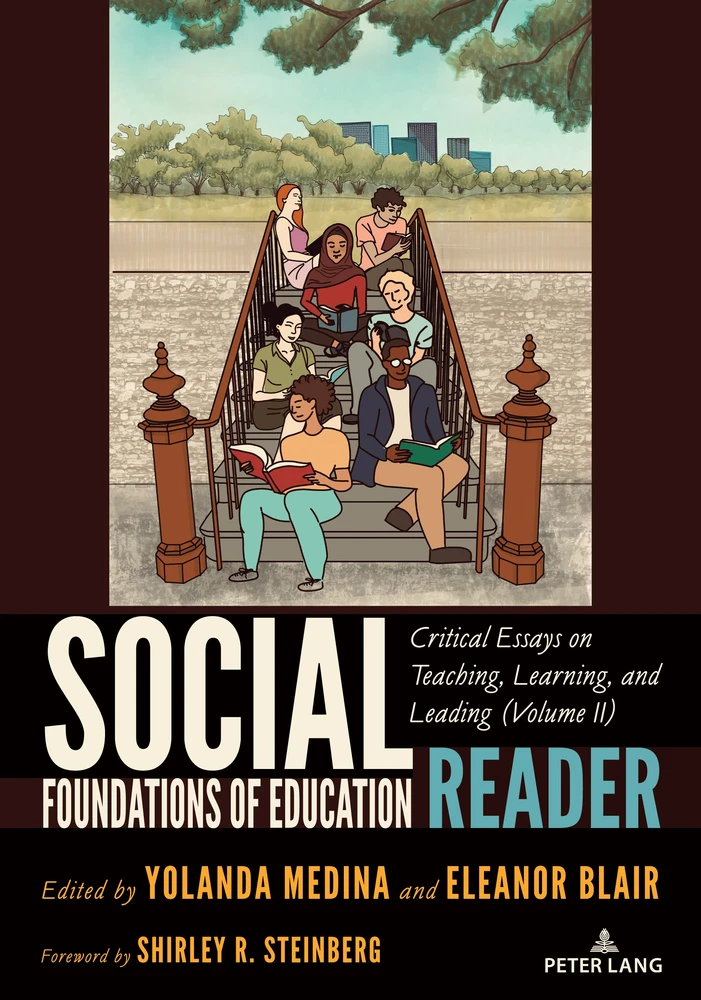
Social Foundations of Education Reader
Critical Essays on Teaching, Learning, and Leading (Volume II)
Summary
Excerpt
Table Of Contents
- Cover
- Title
- Copyright
- About the editors
- About the book
- This eBook can be cited
- Dedication
- Contents
- Foreword (Shirley R. Steinberg)
- Acknowledgments
- Introduction
- SECTION I POST-COVID PEDAGOGIES
- 1. Creating Spaces of Critical Hope: Testimonios from the Frontlines of Resistance and Resilience (Kevan A. Kiser-Chuc)
- 2. Without a Lifeline: The Impact of District and School-Level Leadership on Teacher Well-Being During COVID-19 (Emily Germain and Danielle Sutherland)
- 3. A New Framework to Dismantle Public Schools: How Legislators and Right-Wing Groups Used the Pandemic as a Wedge Issue to Control School Curriculum and Policy (Brianne Kramer and Denisha Jones)
- 4. Pandemic Pivoting Within Academia and Activism: An Exploration of New Forms of Classroom Pedagogies and Latinx/Chicanx Scholarship (Margaret Cantú-Sánchez)
- SECTION II TEACHERS AS ACTIVISTS
- 5. Open Your Door and Organize: Educators Advancing Justice Through Social Movements (Lauren Stark)
- 6. Teaching as Activism: The Role of Critical Pedagogy and Culturally Sustaining Pedagogies in Working Towards a Relational Vision of Education (Shadi Seyedyousef)
- 7. Teaching, Learning, and Leading While Other: The Fight for Educational Justice (Leslie Morrow)
- 8. Fattening Frogs for Snakes: Spirit Murder, Black Fightback, and Epistemic Justice (Lasana Kazembe)
- 9. Beyond the Death of the Teacher: Reimagining Life in Classrooms (Laura Rychly)
- SECTION III CONTEXTUALIZING EDUCATIONAL CHANGE EFFORTS
- 10. The Civilizing Project of Education: Indian Schools and Indigenous Education in the Building of the U.S. Empire (Madhu Narayanan)
- 11. ESL Teachers’ Culturally Connected Moments and the Incompleteness of Praxis: A Puerto Rican Migration Perspective in the Rural Midwest (Lisa Ortiz-Guzmán)
- 12. Towards Critical Race Histories of Education: Exploring Chicana and Chicano Education in Los Angeles, 1940–49 (Lluliana Alonso)
- 13. The Wealth of “Poor” Schools: Riquezas en las raíces (Riches in the Roots) (Marisol Diaz)
- 14. Voices from the Ground Level: Sustainable Education Practices for Bahamian Students with Disabilities (Anica Bowe)
- 15. The Politics of Undoing Rape Culture in Schools (Gillian Robinson)
- 16. Pride Before Prejudice: What a SAGA! (Mark Vicars and Sarah Tartakover)
- SECTION IV TRANSFORMATIVE/EQUITABLE PEDAGOGIES
- 17. Plática Pedagogy: A Chicana/Latina Feminist Approach (Rosemary Hendriks)
- 18. The Transformative and Reproductive Power of Storytelling in the Classroom (Bethany Parker)
- 19. Socially and Culturally Responsive Language Teaching for the Global Context (Francisco Javier Palacios-Hidalgo and Cristina A. Huertas-Abril)
- 20. De-Heteroing Education: Queer Futurity, Healing, and Liberation (Brandon Cockburn)
- 21. A Narrative Inquiry on an Equity in STEM Doctoral Course and Its Influence on Equity-Based Teacher Knowledge, Attitudes, and Practices (Elizabeth R. Goldberg, Taylor Darwin, Weventon Ataide Pinheiro, Samanthia Noble, Kassidy Wagner, Miranda Mullins Allen, and Jesus S. Esquivel)
- 22. Demanding More Than Equity and Inclusion: Historical and Emerging Understandings of dis/Ability Justice (Sandra Vanderbilt)
- SECTION V TEACHING AND LEARNING IN 21st CENTURY SCHOOLS
- 23. Cultivating Collaboration and Communication with Parents (Adrienne C. Goss)
- 24. Manufacturing and Leveraging Fear: An Exploration of Right-Wing Efforts to Undermine Trust in Public Schools (T. Jameson Brewer and Kerry Kretchmar)
- 25. Yo Quiero Ser Una Maestra Bilingüe: Latinx Pre-service Teachers’ Language Nepantla Stories (Sandra L. Osorio and Sanjuana Rodriguez)
- 26. Sisters of the Boogie: An Exploration of the Hip-Hop Feminist Epistemology of a Project Girl Turned Professor (Dawn N. Hicks Tafari)
- 27. Busqueda de esperanzas y aspiraciones. Pursuit of Hope and Aspirations Bienvenido a America (Catherine D. Rogers-Cesarez and Sandra L. Guzman Foster)
- 28. Students and Educators Learning from the Lived Experiences of Queer and Nonbinary of Color Student Activists (Pau Abustan)
- 29. Navigating Inequitable Legislation: Cultivating Inclusive Class Communities (Chloe Morris and Larisa Callaway-Cole)
- Afterword: Educational Foundations in a Post-Pandemic World: Re-Imagining Hope and Possibility in an Age of Despair (Eleanor J. Blair)
- Contributors
Social Foundations of Education Reader
Critical Essays on Teaching, Learning, and Leading (Volume II)
Edited by
Yolanda Medina and Eleanor Blair
Foreword by
Shirley R. Steinberg

PETER LANG
New York - Berlin - Bruxelles - Chennai - Lausanne - Oxford
Library of Congress Cataloging-in-Publication Control Number: 2024944694
Bibliographic information published by the Deutsche Nationalbibliothek.
The German National Library lists this publication in the German National Bibliography; detailed bibliographic data is available on the Internet at http://dnb.d-nb.de.
Cover design by Peter Lang Group AG
ISBN 9781636671697 (paperback)
ISBN 9781636670713 (ebook)
ISBN 9781636670720 (epub)
DOI 10.3726/b22271
© 2025 Peter Lang Group AG, Lausanne
Published by Peter Lang Publishing Inc., New York, USA
info@peterlang.com - www.peterlang.com
All rights reserved.
All parts of this publication are protected by copyright.
Any utilization outside the strict limits of the copyright law, without the permission of the publisher, is forbidden and liable to prosecution.
This applies in particular to reproductions, translations, microfilming, and storage and processing in electronic retrieval systems.
This publication has been peer reviewed.
About the editors
YOLANDA MEDINA is Professor and Chair of the Teacher Education Department at the Borough of Manhattan Community College, City University of New York. Dr. Medina has authored and co-authored several publications and is a co-editor of the Critical Studies of Latinx in the Americas book series published by Peter Lang.
ELEANOR J. BLAIR is a professor at Western Carolina University, where she teaches foundations of education courses. She is a frequent presenter at regional, national, and international conferences and has several publications that explore teaching, learning, and leadership in contemporary schools.
About the book
The Social Foundations Reader is intended for undergraduate and graduate students in introductory foundations of education classes. Unlike other readers, which often provide a generic and conservative perspective, this book offers a broad yet critical view of issues in education. It encourages students to consider the roles of critical theory and social justice in creating school environments that address equity and diversity. This book presents a different lens on twenty-first-century schools, considering the perspectives of parents, teachers, students and communities. The reader is exposed to a wide range of scholarship. Contested topics in teaching, learning and leading in contemporary public schools are examined within a context where addressing fundamental questions guiding meaningful school reform is essential for educators.
This eBook can be cited
This edition of the eBook can be cited. To enable this we have marked the start and end of a page. In cases where a word straddles a page break, the marker is placed inside the word at exactly the same position as in the physical book. This means that occasionally a word might be bifurcated by this marker.
DEDICATION
This book is a labor of love dedicated to my Borough of Manhattan Community College teacher education students. It is for them that I continue the battle so that they, in turn, can pick up the fight for a just world.
YM
This book is dedicated to 21st-century teachers across the globe. Your job is difficult, but more important than ever during these challenging and tumultuous times. Never forget that your courage and activism change lives and, as such, have the potential to change the world!
I continue to be inspired to do more to change the world by my loves, Charlotte, Hadleigh, and Hudson.
EJB
Foreword
Shirley R. Steinberg
Necessity Demands Foundations
Society exists through a process of transmission quite as much as biological life. This transmission occurs by means of communication of habits of doing, thinking, and feeling from the older to the younger. Without this communication of ideals, hopes, expectations, standards, opinions, from those members of society who are passing out of the group life to those who are coming into it, social life could not survive. If the members who compose a society lived on continuously, they might educate the new-born members, but it would be a task directed by personal interest rather than social need. Now it is a work of necessity.
John Dewey, 1916
Dewey’s tome, Democracy and Education (1916, 1944) enhances his notion of society and its existence … ironically, insisting that democracy exists … unfortunately, I query that notion. As Americans we blindly call ourselves a democracy, eschewing evidence. Avoiding the desire to spend too much time on the obvious, I do share Dewey’s notion that communication is essential in order to create some sort of order. However, the assumption that there is a democracy should be replaced with the assumption that we must fight to have a democracy. … therein lies the need for the foundations of education. Dewey associated the classroom with democracy, articulating that students should do, and by doing, often of their own accord, democratic schooling existed. Like society, however, democracy is much more difficult to achieve. Structure cannot be sustained without a foundation, and for the past three decades, the foundations, the bedrock of education, have been eradicated. The majority of those who pick up this book will pause to ruminate on those good old days of the philosophy, sociology, and history of education. I figure if a reader of this foreword graduated from high school before 1983, that person’s education was influenced by the foundations of education. Ironically, Dewey didn’t set out to create the foundations in education; that’s the downside of being the birth father of a concept. Dewey didn’t anticipate that he would become the father of educational philosophy.
He set the stage for the theorists who followed him to create those foundations, many assumed they would continue to do so.
For those who graduated after 1983, teacher education was reinvented into a different way of being. Irony runs through my retelling of the question: what happened to the foundations of education? In 1983, Ronald Reagan (former movie cowboy, president of the USA) decided, without evidence, that American children were not learning, they did not have enough math and science, and the USA would become subject to an “unfriendly foreign power” and be victims due to the “squandering of gains” (A Nation at Risk 1982–83) in student achievement caused by American “bad” schooling. The president, armed with a bachelor’s degree from Eureka College, declared that America’s children were not succeeding. In 1982, he created a National Commission on Excellence to study the quality of American education. Out of the 18 members of the committee there was one teacher (National Teacher of the Year: Foreign Languages), two principals, and 15 college and government administrators. The point, according to the Commission was to ascertain the quality of education in the United States and within 18 months to create a report. Delivered on time, the report was titled: A Nation at Risk (National Commission on Excellence in Education, April 1983). The entire report was structured around fear, educational historians now refer to the document as a gaslighting exercise enabling the presidency to take over the education of American children. The implication: bad education was caused by American teachers. Point of interest:

Imagine how difficult it is to write a foreword to a book that is a second edition of a concept that doesn’t exist. And that, dear readers, is our challenge: to create relevance for a book of 34 chapters espousing a field of education that does not exist in Wikipedia, and in most faculties of education.
Following the release of A Nation at Risk, Reagan began to ensure that his legacy would continue as the president who identified the lack of rigor and importance in the American curriculum. He succeeded beyond all expectation, and the results of the following 50+ years attest to what Donaldo Macedo refers to as the stupidification of American schools, American teachers, and American educational policymakers (Macedo, 1994). By the 1990s, most faculties had ceased their departments of social foundations; gone were courses in the Philosophy, Sociology, History of Education, and the arts. According to the United States Bureau of the Census, illiteracy rates in 1950 were below 3 %–10 %, in the 1960s–1970s the national rate was 2.4 %. Several decades were not measured, but in 1998, a U.S. government report, The State of Literacy in America noted there was a “significant growth in illiteracy in America.” Over 90 million U.S. adults, nearly one out of two are functionally illiterate or near illiterate, without the minimum skills required in a modern society (WSWS.ORG, 1998). As of 2021, the U.S. rate of literacy was 79 % compared to the same time in 2021 with Cuba, a country that maintains a literacy rate of 99.67 %.
It’s not hard to pinpoint colleagues who teach undergraduate courses bemoaning horrendous writing turned in by students. Indeed, it is difficult to truthfully award an “A” to many students in public institutions. An offshoot discovered by the low scores and literacy of students is the incredible arrogance that accompanies lower grades, accompanied by angry parents who “paid for this education,” and expect their children to receive A’s. Without the influence of sociology, many American parents do not understand the issues involved in the failure of American schools.
I rarely find young colleagues who are aware of A Nation at Risk and the literacy rates throughout the USA. Without courses in the history and sociology of education, it would appear to be non-curricular if taught in classes. Referring back to Dewey, well, there is no need to refer back to Dewey, because he is seldom taught in most college courses. I play a quick game with myself when I begin teaching a course: I ask graduate students who Dewey is and what he contributed to education; few, if any, respond. There are the brave professors who deviate from departmental curricula and discuss illiteracy rates and sociological reasons for the greatest country in the world to have some of the worst students in the world. However, without the sociology of education, students and teachers are unable to access support from schools that have buried these courses. Philosophy of education is a relic, and history of schooling … seriously? Who cares? By the 1990s, we saw education courses being immersed in curriculum, and educational foundations professors either retiring or learning the new lingo: which included a definite phaseout of foundations. I was caught in that unpleasant web, graduating in the late 90s in Foundations of Education. I began professoring by expecting to teach courses in what I studied: I was streamed into Curriculum and Instruction.
Whatever texts are still being written for the Social Foundations of Education often omit the historical, social, and philosophical underpinnings of education itself. A quick survey of most “foundations” texts seems to miss the inherent importance of foundations: how humans and institutions move throughout the world, understanding political and social nuance, and discussing the histories and philosophies that explain who and why we are. Chapters like: Why Teach? Stir and Serve Recipes for Teaching, Maintaining Discipline in Class … same ole, same ole. Occasionally, we receive a diamond in the rough of our not-so-foundational foundations texts. Not this text … it is smooth and smart and exactly what is missing in education. Hitting what we need to read is this out-of-the-park foundations text edited by Ellie Blair and Yolanda Medina, who have managed to give us a pertinent, timely, criticalized, historicized, and societally relevant second edition of The Social Foundations Reader. This text brings us important articles by new, not-so-new, and seminal scholars of the Social Foundations of Education.
The Social Foundations Reader second edition is a gift to those who understand that without foundations of education, we have no grounding. Contextually essential, the volume begins with pedagogy and reflections on Post-COVID Pedagogies. Many of us, maybe most of us, are still traumatized and decentered by the virus that came upon our globe: an unannounced plague to an unprepared world. Section Two reminds us that teachers can be, and should be activists, and we are prompted to encourage our students to speak truth to power and to carry socially just ways of being. The third section discusses the importance of contextualizing educational change. Indeed, the importance of contextualization itself should be infused within the entire notion of pedagogy. Completing the volume is Section Four, which reminds us that pedagogy should always be transformative and equitable for all and embody inclusion. What a book. Among the new voices reaching out to us from the pages is a scattering of a few of our GOATs of foundations: Lisa Delpit, Gloria Ladson-Billings, Joe L. Kincheloe, and Henry Giroux. Thanks to the editors for reminding us that scholars and students of education must contextualize our work through the channels of history, society, and philosophical ways of knowing and living.
References
- Macedo, D. (1994). Literacies of power: What Americans are not allowed to know. Westview Press.
- National Commission on Excellence. (1983). A Nation at risk.
- Roberts, L. (1998). “Illiteracy on the rise in America.” In WSWS.ORG. 14 October, 1998.
Acknowledgments
We want to acknowledge the work of the 43 authors who contributed to the creation of this book. These authors took the time to write, reflect on feedback, rewrite, and resubmit their work. Many of them volunteered to be involved in our peer review process as well. Their biographies appear in a separate section of this book. Thank you to Shirley Steinberg for so gracefully writing the foreword to this edition.
We also want to highlight the 58 peer reviewers who contributed to the creation of this academically rigorous manuscript who volunteered their time and completed their reviews with elegance and integrity. Here is the list of their names and affiliations:
- Pau Abustan, California State University, Los Angeles
- Remi Alapo, Borough of Manhattan Community College, City University of New York
- Miranda Allen, Texas Tech University
- Aleshia Allert, University of the West Indies, Global Campus
- Lluliana Alonso, California State University, Long Beach
- Charmaine Bissessar, University of Guyana
- Anica Bowe, Rutgers University
- Brandy S. Bryson, Appalachian State University
- Larisa Callaway-Cole, Cal Poly Humboldt
- Margaret E. Cantu-Sanchez, St. Mary’s University
- Roberto Castaneda, Universidad Autónoma de Quintana Roo (UQROO), Cancún, Mexico
- Brandon Cockburn, Washington State University
- Taylor Darwin, University of Southern California
- Eric Ferris, Eastern Michigan University
- Rebecca Garte, Borough of Manhattan Community College, City University of New York
- Emily Germain, Learning Policy Institute
- Jennifer Gilken, Borough of Manhattan Community College, City University of New York
- Elizabeth Goldberg, Texas Tech University
- Adrienne Goss, Clark Atlanta University
- Leslee Grey, Queens College, City University of New York
- Ruth Guirguis, Borough of Manhattan Community College, City University of New York
- Sandra Guzman Foster, University of the Incarnate Word
- James Hollar, Marist College
- Jesslyn Hollar, Marist College
- Casey Jakubowski, State University of New York, Oneonta
- Denisha Jones, Sarah Lawrence College
- Robert Karaba, New Mexico Highlands University
- Lasana Kazembe, Indiana University, Indianapolis
- Brianne Kramer, Southern Utah University
- Cara Kronen, Borough of Manhattan Community College, City University of New York
- Marina Lambrinou, Loyola University Maryland
- Jennifer Longley, Borough of Manhattan Community College, City University of New York
- Keitha-Gail Martin Kerr, University of Minnesota
- Timothy Monreal, University at Buffalo, The State University of New York
- Chloe Morris, Oklahoma State University
- Leslie K. Morrow, Ohio State University
- Madhu Narayanan, Portland State University
- Lisa Ortiz, University of Pittsburgh
- Sandra Lucia Osorio, Erikson Institute
- Bethany Parker, The University of Tennessee, Knoxville
- Amira Proweller, DePaul University
- Gary W. J. Pluim, Lakehead University, Canada
- Gillian Robinson, University of Alberta, Canada
- Catherine D. Rogers-Casarez, University of the Incarnate Word
- Carmel Roofe, The University of the West Indies, Mona
- Laura Rychly, Augusta University
- Lauren Ware Stark, Université de Sherbrooke
- Shadi Seyedyousef, Alder Graduate School of Education
- Theila Smith, Brooklyn College, City University of New York
- Vianela Tapia, Borough of Manhattan Community College, City University of New York
- Bingwan Tian, University at Buffalo, The State University of New York
- Shawgi Tell, Nazareth College
- Sandra Vanderbilt, George Washington University
- Juan Rios Vega, Bradley University
- Mark Vicars, Victoria University, Melbourne, Australia
- Shu Wan, University of Buffalo
Last but not least, thank you to Alison Jefferson from Peter Lang for her kindness, patience, and attentiveness. We are very proud of our final product. We hope our readers can appreciate our labor of love and our commitment to the field of Social Foundations of Education.
Yolanda Medina and Eleanor J. Blair
Introduction
An Urgent Call for Social Foundations of Education
The relevance of Social Foundations of Education courses in the preparation of teachers is more important than ever in these post-pandemic times. Right-wing politicians have taken advantage of the public’s fear of mask mandates, the hasty switch to online learning in PK-12 schools, and the high number of COVID-related deaths in poor communities of color to inject even more terror into the American people—this time about what our children are learning in schools today. Now, more than ever, we need our future teachers to be involved in critical discussions of what it truly means to be an educator, the purpose of schooling, and the power of politics in educational reform. There is no such thing as an apolitical education. Education has always been driven by political and social agendas.
The learning that happens in Social Foundations of Education courses encourages teachers to question assumptions that are taken for granted and accepted as legitimate practices. These conversations also promote educational reforms and pedagogies that support democratic ideals so that teachers can, in turn, deepen their understandings of the issues they will face inside and outside of their classrooms and be ready to make choices that will benefit all of their students’ growth.
Another important goal of a Social Foundations of Education course is to support the preparation of teachers as they develop critical pedagogical practices that organically infuse cultural competence, equity, and inclusion in their curricula and provide a more culturally sustaining and welcoming environment for all students. Social Foundations of Education courses are also dedicated to preparing teachers to understand the benefits of working with students’ caregivers and their communities; to see the diversity in their classrooms through an asset-based lens, and to recognize that the multiple perspectives and experiences that children from diverse backgrounds bring to their classrooms are a valuable example of democracy in action.
However, while Social Foundations of Education scholars and educators strive to accomplish these goals, our right-wing counterparts are wreaking havoc attempting to delegitimize courses that discuss principles and ideals such as Critical Race Theory, LGBTQ+ themes, as well as banning any books that can provoke the questioning of their righteous ideals.
So far, 44 states have imposed bans and restrictions either through legislation or other venues, to restrict teaching critical race theory or limit how teachers can discuss race and sexism. (Schwartz, 2024)
Times such as these are when teacher education programs need to place their Social Foundations of Education courses at the forefront of the preparation of their teachers. These courses shed light on the belief that
the system of schooling should be based on principles of equitable access and that every individual has a right to educational opportunities which are just, fair, and democratic. Social Foundations faculty believe that we must work against narrow conceptions of education and schooling which marginalize or otherwise minimalize the knowledge, culture, and experiences of some populations within our society while privileging others. (Tutwiler et al., 2013, p. 108)
The chapters in this book offer the above-mentioned perspectives and combat unquestioning assumptions of society and its role in the education of all children and what it means to be an educator dedicated to critical and democratic ideals.
What Is the Social Foundations of Education Reader
Education is a “mirror” of American society, one that reflects the larger culture in which we teach and live. Education and schooling are deeply intertwined within the fabric of society. The purpose of this Social Foundations of Education Reader is to compile essays that will critically examine the relationships that shape and are shaped by education, shedding light on how societal factors influence educational systems, policies, and practices. The chapters in this book explore the complex relationship between education and the broader social, cultural, economic, and political contexts in which it operates.
Understanding these intricate relationships is essential for teachers as they directly impact their pedagogies, the dynamics of their classrooms, their interactions with students, their caregivers, and their overall teaching effectiveness. These chapters will illustrate many of those complex relationships. Some will explore how educational practices have been influenced by historical events and social movements. Other chapters will examine how factors such as socioeconomic status, race, gender, and ability impact educational opportunities and outcomes. Additional chapters will discuss the role of culture in shaping curricula and pedagogy. They will also address issues related to cultural competence, inclusivity, and the challenges of navigating cultural differences in education. Today’s teachers must be culturally competent to effectively engage with their diverse student population. Knowledge of this will help teachers understand the cultural backgrounds of their students, allowing them to create inclusive and culturally responsive learning environments.
Details
- Pages
- XVIII, 462
- Publication Year
- 2025
- ISBN (PDF)
- 9781636670713
- ISBN (ePUB)
- 9781636670720
- ISBN (Softcover)
- 9781636671697
- DOI
- 10.3726/b22271
- Language
- English
- Publication date
- 2025 (January)
- Keywords
- Education K-12 Teaching Educational Foundations Diversity Equity and Inclusion Multicultural Perspectives Social Foundations of Education Reader Critical Essays on Teaching, Learning, and Leading (Volume II) Eleanor J. Blair Yolanda Medina
- Published
- New York, Berlin, Bruxelles, Chennai, Lausanne, Oxford, 2025. XVIII, 480 pp., 52 b/w ill., 9 b/w tables.
- Product Safety
- Peter Lang Group AG
