
 en
en  de
de 

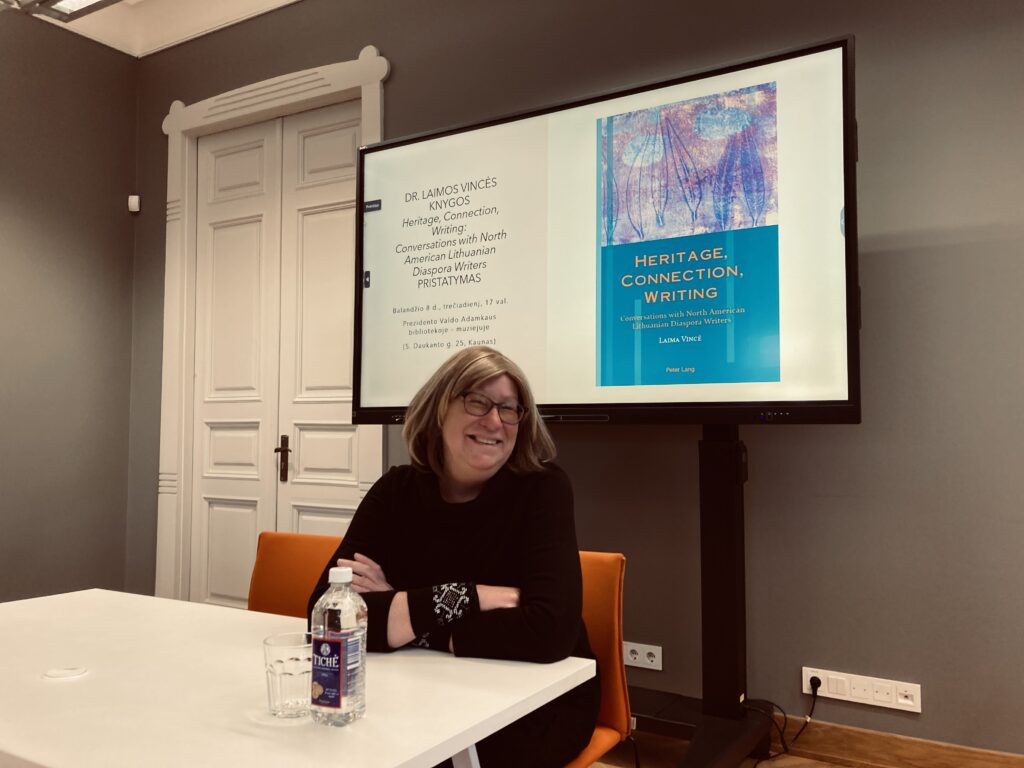
by Laima Vincė, author of Vanished Lands: Memory and Postmemory in North American Lithuanian Diaspora Literature, and volume editor of Heritage, Connection, Writing: Conversations with North American Lithuanian Diaspora Writers
I live in a vanished land that reappeared on the world’s map only thirty-six years ago, when Lithuania reinstated its independence—an independence that was painfully lost in 1944, when Soviet Russia illegally occupied Lithuania and incorporated its borders into the Soviet Union, erasing its interwar history of independence and social and cultural progress, rendering its language secondary to Russian, which became the State language, and erasing its cultural memory. Voices that remembered the wounds of World War II, the Holocaust, the Siberian deportations, were silenced. The stories of those whose lives changed forever, and those who were vanished, went underground.
“How does one hold onto so much loss?”
The second Russian occupation came on the heels of a brutal four-year Nazi occupation that caused the murder of ninety-five percent of Lithuania’s prewar Jewish population. Before the Nazis arrived in June 1940 the Red Army and Soviet Russia quickly took control of the country and initiated the deportation of Lithuania’s intellectual and educated class—both Lithuanians and Litvaks (Lithuanian Jews who spoke a dialect of Yiddish called Litvish)—to work camps in Siberia.
Today, here in Lithuania, constantly, every day, we are reminded by the news, by social media, through threats, that Russia intends to vanish Lithuania yet again. These are not empty threats. Every day we hear about Russia’s nightly bombings of Ukraine, of Russian attacks on Ukrainian infrastructure and civilians. Russia is actively destroying and vanishing Ukraine through the ongoing war that Russia initiated in 2014 and which became a full-scale invasion in 2022. The politics of Russia are, and have been for centuries, to vanish the cultures of its neighbors. This is both our cultural memory inheritance and our daily reality.
How does one hold onto so much loss? How does one live with multiple layers of intergenerational historical and cultural and historical trauma? And how can one heal those old wounds when they are constantly torn open and exposed by the events of the present?
These are not strictly academic questions per se, but when writing about the bloodlands (Tymothy Snyder’s term and the title of his book about the Holocaust in this region) these are questions that constantly hover behind the research, the numbers, the history, the archives. For these reasons, my academic monographs, Vanished Lands: Memory and Postmemory in North American Lithuanian Diaspora Literature and Heritage, Connection, Writing: Conversations with North American Lithuanian Diaspora Writers are books about the past and the present all at once. They are books about the shadows, about what lives on in the unconscious behind the glimmer of the present. They are also books that try to make sense of what the future holds for the Baltics and Eastern Europe.
It is the exile, the émigré, the individual pushed out of their own historical, cultural, social, and familial context who must carry their inheritance with them and then make use of it to build a diaspora abroad, in exile. Or else, the exile must relinquish their cultural memory and consciously vanish into a new cultural context. Descendents then come back to pick up the shards and attempt to understand what they have lost through this erasure.
This is perhaps the reason why Baltic people cling to their cultural and linguistic identities with such tenacity. We encounter in Heritage, Connection, Writing, North American writers who write in English and continue to write about Lithuania or at the very least to weave Lithuanian fairy tales, names, and symbols into their work, even when their ancestors emigrated over a century ago. The question the books poses is: Why?
We live in an era of shifting borders, migration, uprootedness caused by on-going wars, climate change, political unrest, hunger and the hoarding of wealth and resources by a very small percentage of this planet’s population. That is why the story of what happened in one small country and how its diaspora carried that story forwards matters. We may apply this story to other nations’ stories. Their cultural inheritance in exile may just show us how the microcosm is contained within the macrocosm.
“It is the exile, […] pushed out of their own historical, cultural, social, and familial context who must carry their inheritance with them and then make use of it to build a diaspora abroad”
Since Lithuania’s period of national rebirth in the late 1980s and early 1990s, over a hundred works of literature in the genres of fiction, memoir, literary nonfiction, essays, poetry, and drama have been written in English by North American writers of Lithuanian heritage. They have been published by commercial and university presses in the United States and Canada, and yet thematically these literary works are preoccupied with collective trauma that has affected Lithuania. Topics range from the nineteenth-century efforts of Tsarist Russia to Russify the Lithuanian population, the Soviet Russian occupation (1940-1941, 1944-1991), the Nazi occupation and Holocaust in Lithuania (1941-1944), the postwar armed resistance in Lithuania, and the plight of the World War II displaced persons.
A life lived within two or more cultures and languages becomes second nature to those born into an ethnic diaspora. Children and grandchildren of refugees learn to hold two or three cultural perspectives in balance. They become the keepers of their parents’ lost nations, collective trauma, historical memory. They carry the burden of explaining what the elder generation has endured. They also inherit their parents and grandparents’ survivors’ guilt. They know the toll it takes on the psyche to balance two or more cultural identities.
I explore these themes in my book, Vanished Lands. My second book published with Peter Lang International Academic Publishers, Heritage, Connection, Writing, continues this conversation with writers who were born into or inherited the emotional space of exile. This book presents different perspectives on what it means to retain a Lithuanian or Litvak heritage while living in North America and writing in English. The oldest participant in this book is age 91 and the youngest 40. Within those 51 years lies a vast expanse of history and cultural identity, sometimes lost and later regained. With birth years spanning from 1933 to 1985, the voices presented in this book represent a cross-section of three generations. Memory and postmemory writing are important features in the work of many of these writers. The rite of return journey is key to many of the conversations in this book and is one of the major themes in literature produced by these writers.
Heritage, Connection, Writing is organized into three sections. Part I consists of conversations with writers whose ethnic Lithuanian ancestors immigrated to the United States and Canada during the first wave of migration from Lithuania that took place from 1868 to 1918. This migration was mostly economically motivated, although conscription into the Russian army was a major catalyst for emigration for both Litvak and Lithuanian men. Litvak emigration tended to be permanent, while Christian Lithuanian emigration tended to be cyclical, with family members returning with savings from their earnings to re-establish themselves in Lithuania.
The second section consists of conversations with the descendants of political refugees who fled Lithuania during the first and second Soviet Russian occupations (1940–1 and 1944–91) and is divided into two subsections. The first section features interviews with writers who were displaced out of Lithuania as children and those born in the displaced persons camps in the Allied territories of Germany after World War II. The second subsection focuses on second and third generation American and Canadian born writers who grew up for the most part within the cultural, social, and educative space of the Lithuanian diaspora community created by the displaced persons (D.P.s) after emigrating to the United States and Canada in the late 1940s and early 1950s.
Part III is comprised of conversations with three generations of American writers of Litvak heritage, all of whom have chosen to maintain cultural and social ties with the contemporary Republic of Lithuania.
“A life lived within two or more cultures and languages becomes second nature to those born into an ethnic diaspora”
Vanished Lands is about the past. I analyze memoirs that reflect on the historical trauma of the Holocaust in Lithuania during the Nazi occupation. I write about postmemory works of literary nonfiction by descendants of Lithuanian Nazi collaborators who reflect on inherited guilt and intergenerational trauma, about the collective trauma experienced by Lithuanians during the Soviet Russian occupation of Lithuania and the deportations to Siberia. I discuss literary works that reference the Lithuanian Anti-Soviet armed resistance, forced migration, and immigration to North America. Finally, I write about how post-traumatic growth expressed through the communal activities of society, education, and culture enabled Lithuanian displaced persons to construct a cultural memory diaspora.
Heritage, Connection, Writing is about the future. This is a book about the ways that contemporary transnational diaspora writers have integrated their experiences and research into their own unique visions of Lithuania that is expressed in their literary work. In its essence, it is a book of conversations between descendants and ancestors. The Lithuanian word for ancestors is protėviai—elders who came before. The word for homeland is tėvynė—the land where the elders reside. Etymologically, the concepts of homeland and ancestors are linked through language. This connection is deeply embedded in the Lithuanian psyche and continues even in the diaspora. Ultimately, both books are about hope for a shared future that holds the lessons of the past in balance.