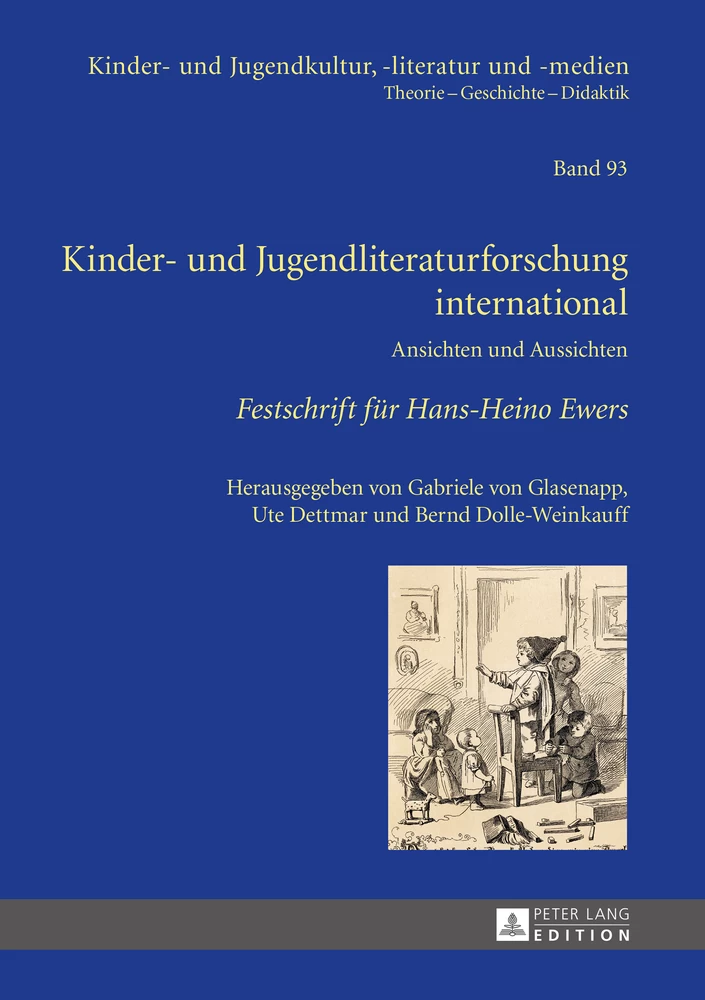
Kinder- und Jugendliteraturforschung international
Ansichten und Aussichten- Festschrift für Hans-Heino Ewers
 Ute Dettmar (Volume editor)
Bernd Dolle-Weinkauff (Volume editor)
Summary
Excerpt
Table Of Contents
- Cover
- Titel
- Copyright
- Autorenangaben
- Über das Buch
- Zitierfähigkeit des eBooks
- Inhalt
- Vorwort
- Teil I: Beiträge zur Theorie
- The Royal Canon: Maria Nikolajeva
- Bibliography
- The Unruly Playground: The Curious Progress of English-Language Children’s Literature Theory: Peter Hunt
- Then Was Then: the Tale of Two Endnotes
- Rival Gangs in the Playground
- Doing What the Grown-Ups Do
- Back in the Playground Again: Post-Theory
- Full circle
- Bibliography
- Cultural Translation: Ideological and Model Adjustments in Translation of Children’s Literature: Zohar Shavit
- Test cases
- Systemic constraints: ideological adjustment
- Test case 1: Joachim Heinrich Campe
- Test case 2: Madame de Genlis
- Test case 3: Swift’s Gulliver’s Travels – the model adjustment
- A short reminder of the history of Gulliver’s Travels
- Conclusion
- Bibliography
- Translations of Joachim Heinrich Campe into Hebrew
- Robinson der Jüngere
- Die Entdeckung von Amerika
- Merwürdige Reisebeschreibungen
- Theophron
- Sittenbücher für Kinder aus gesitteten Ständen
- Primary Sources
- Secondary Sources
- Ewers’ Category of “Action System” applied to the Investigation of Social Influences on the Translation in Brazil: Adriana Maximino dos Santos
- Translation of children’s literature
- Action system of the translation of children’s literature: theory and methodological apparatus
- Ewers’ action system applied to the investigation of social influences on the translation in Brazil
- An overview of the analysis and results
- Final Remarks
- Bibliography
- Primary sources
- Secondary sources
- Teil II: Übersetzung und Rezeption in einzelnen Ländern
- Imported Enlightenment. The Influence of German 18th-Century Children’s Literature in Denmark: Nina Christensen
- Concepts of literature and Danish children’s literature in the 18th century
- The market for children’s literature in Denmark in the second half of the 18th century
- 18th-century German writers in the Danish market for children’s literature
- The letter in 18th-century children’s literature
- Examples of letters in Danish publications for children
- Conclusion
- Bibliography
- La Littérature Allemande pour la Jeunesse en France. Quelques Pistes de Réflexion pour une «Grande Question»: Mathilde Lévêque
- Imitation, traduction, inspiration
- Malentendus et désintérêt
- Entre les deux guerres, une relative mais courte embellie
- Vers une littérature élitaire et élitiste ?
- Bibliographie
- Bilderwelten – Weltbilder. Intermediale Repräsentation fremder und eigener Nationen in ABC- und Bilderbüchern: Emer O’Sullivan
- Zweimal rund um die Welt
- Die Ursprünge: Fremde Nationen in der enzyklopädischen und ethnographischen Kinderliteratur des 18. und 19. Jahrhunderts
- Das Kontrastprinzip um 1900
- Gesamtschau der Nationen in der neueren Kinderliteratur: neue Formen, veränderte Perspektiven
- Eine als Quest gestaltete fantastische Weltreise
- Performatisierung des ABC-Buchs
- Klangähnlichkeit als Auswahlkriterium für Zuordnungen
- Noch zweimal rund um die Welt
- Literaturverzeichnis
- Primärliteratur
- Sekundärliteratur
- Deutsche und ägyptisch-arabische Kinderlieder im interkulturellen Vergleich. Eine linguistische Studie.: Hoda Lotfy
- Gegenstand der Untersuchung
- Zielsetzung und methodisches Vorgehen
- Die Auswertung des Materials
- Kategorie Farbe
- Kategorie Zeit
- Kategorie Raum
- Kategorie Tiere
- Fazit
- Literaturverzeichnis
- Arabische Literatur
- Internetquellen
- Kinder- und Jugendliteratur in Spanien: Veljka Ruzicka-Kenfel
- Literaturverzeichnis
- Autoren, Werke und Tendenzen der ungarischen Kinder- und Jugendliteratur: Sarolta Lipóczi
- Historische Kinderbücher
- Klassiker der ungarischen Kinder- und Jugendliteratur
- Zur Situation der ungarischen Kinder- und Jugendliteratur nach 1945
- Kinderlyrik als „Versteck” und literarische Ausdrucksform
- Der Kinder- und Jugendroman nach 1945
- Sozialistisches Menschenbild im Mädchenbuch
- Historische und zeitgeschichtliche Jugendbücher
- Kindertagebücher aus der ungarischen Revolution – 50 Jahre danach
- Märchen zwischen Tradition und Innovation
- Literaturverzeichnis
- Literaturgeschichte als Generationengeschichte. Ein Rückblick auf die kinderliterarische Wende um 1970: Andrea Weinmann
- Zum Problem der Generationen nach Karl Mannheim
- Zum Problem der literarischen Generationen nach Ralf Klausnitzer
- Historische Dynamik und Generationswechsel nach Karl Mannheim
- Die 68er und die Generation der Kriegs- und Nachkriegskinder
- Die Generation der Kriegs- und Nachkriegskinder als Trägerin der Kinderliteraturreform und der Generationswechsel um 1970
- Der Generationswechsel um 1970 auf dem Feld der Kinder- und Jugendliteratur
- Ausblick
- Literaturverzeichnis
- Primärliteratur
- Sekundärliteratur
- Politisierung von Jugendlichen in vormodernen und postmodernen Gesellschaften am Beispiel von Rafik Schamis Eine Hand voller Sterne und Mira Lobes Räuberbraut: Nermine El-Sharkawy
- Politisierung von Jugendlichen in Rafik Schamis Eine Hand voller Sterne
- Sich frei schreiben
- Politisierung von Jugendlichen in Mira Lobes Räuberbraut
- Politisches Engagement schlägt in soziales um
- Vergleichende Schlussbetrachtungen
- Literaturverzeichnis
- Primärliteratur
- Sekundärliteratur
- Jenseits des Ästhetischen. Der kulturelle Status der modernen afrikanischen Kinder- und Jugendliteratur: Kodjo Attikpoé
- Die Entstehung der afrikanischen Kinder- und Jugendliteratur: eine identitätsrelevante Frage
- Die Stellung der Kinder- und Jugendliteratur im afrikanischen literarischen Polysystem
- Die Kinder- und Jugendliteratur in Afrika, eine engagierte Literatur?
- Schlussbetrachtung
- Literaturverzeichnis
- From Sepoy Mutiny to Terrorism in Kashmir: Perspectives on War in Indian English Children’s Literature: Anto Thomas Chakramakkil
- Bibliography
- Primary Sources
- Secondary Sources
- Der Blick der fremden Einheimischen in der globalen Gesellschaft: Multikulturalität in der deutschsprachigen und südkoreanischen Kinder- und Jugendliteratur der Gegenwart: Young Eun Chang
- Der Multikulturalitätsdiskurs in Deutschland und Süd-Korea
- Ranka Kesers Jugendbuch Ich bin eine deutsche Türkin
- Aktuelle Kinder- und Jugendliteratur aus Süd-Korea zum Thema Multikulturalität
- Schlussbemerkung
- Literaturverzeichnis
- Primärliteratur
- Sekundärliteratur
- Flaschenpost für Gazaman: Von der Bedeutung der Mediatisierung als Thema und Kontext aktueller Jugendliteratur: Gudrun Marci-Boehncke
- Was meint hier „mediatisierte Gesellschaft“?
- Das Konzept der Mediatisierung bei Friedrich Krotz
- Analyse des Romans im Handlungssystem der Kinder- und Jugendliteratur
- Die Mediatisierung im Handlungs- und Symbolsystem des Romans
- Die Inszenierung der Peritexte
- Mediale Historizität der Rahmung
- Mediale Rahmung der soziopolitischen Gegenwart
- Fazit
- Literaturverzeichnis
- Primärliteratur
- Sekundärliteratur
- Internetquellen
- Teil III: Einzelstudien
- Volkspoesie als Kindheits- und Kinderliteratur. Von Herder zu den Brüdern Grimm: Isamitsu Murayama
- Volkspoesie bei Johann Gottfried Herder
- Der Begriff der Volkspoesie bei den Brüdern Grimm
- Ausblick
- Literaturverzeichnis
- Zwischen Trauma und Spiel: Kinderfiguren, Kinderszenen und Kindheit im Werk Annettes von Droste-Hülshoff: Rüdiger Steinlein
- 1.
- 2.
- 3.
- 4.
- 5.
- 6.
- 7.
- 8.
- Literaturverzeichnis
- Primärliteratur
- Sekundärliteratur
- Unverstanden: Death of a Child and Life of Children’s Literature: Jean Perrot
- European Destiny of Misunderstood: From Christmas Gift to Feminist Manifesto
- Exceptional Distribution
- Titles and Illustrations of Translations and Adaptations: Keys to an Ideology
- Adaptations for German Children
- Conclusion: International Legacy?
- Bibliography
- Primary sources
- Secondary sources
- Nominating a Children’s National Poet: The Belated Canonization of Chaim Nachman Bialik in Hebrew Hegemonic Children’s Culture: Yael Darr
- A canon with no history
- Historical background
- A belated recruitment of a classicist from the adult literary field
- Bialik’s ideological dissonance
- Bialik’s diamond jubilee: An entry ticket to the Labor bookshelf
- Adoration from afar: Everyone’s Bialik
- The eulogy issue: Part of the Labor family
- A new perspective on Bialik’s thank-you note to the children
- The appropriation of Bialik by the Tel Aviv Labor children’s school
- Grieving for the family patriarch
- From separation to unification of two literary fields
- Bibliography
- Primary sources
- Secondary sources
- Faszination des Grauens. Die Ambivalenz der Kriegserfahrung in den Kindheitserinnerungen Thomas Bernhards: Heinrich Kaulen
- Literaturverzeichnis
- Karl Bruckners Frühwerk Die Wildspur als ätiologische Basis seines jugendliterarischen Schaffens: Ernst Seibert
- Poetologische Konturen
- Von Salten zu Bruckner – ein poetologisches Transfer-Phänomen
- Bruckners Wildspur als Rezeption von Saltens Bambi
- Nach dem Krieg
- Translation des „homo homini lupus“
- Periphere Präsenz des Menschen
- Kindheitsschicksal als eigentliches Thema
- Bruckners Wildspur als Neubeginn
- Kleiner Epilog
- Literaturverzeichnis
- Primärliteratur
- Sekundärliteratur
- „Ganz hinten sollte Hoffnung sein“. Die Suche junger Menschen nach Heimat, Glückserfüllung und Wirkungsmöglichkeiten in der Gemeinschaft im Werk von Benno Pludra: Karin Richter
- Die ‚bescheidenen Anfänge‘: In Wiepershagen krähn die Hähne und Popp muss sich entscheiden
- Der Kinderroman Die Reise nach Sundevit
- Der Kinderroman Die Insel der Schwäne und seine besondere Stellung in der Kinder- und Jugendliteratur der DDR
- Das Herz des Piraten – eine ungewöhnliche Form phantastischen Erzählens
- Der Nachwende-Roman Jakob heimatlos
- Literaturverzeichnis
- Primärliteratur
- Sekundärliteratur
- Medien
- Cooking up a Good Story in Cookery Books for Children: Jean Webb
- Bibliography
- Primary Sources
- Secondary Sources
- Bildung als ultimatives Glück? Bildungsoptimismus und Sozialkritik in Andrea Hiratas Roman Die Regenbogentruppe: N. Rinaju Purnomowulan
- Vorbemerkungen – Indonesien im Wandel
- Andrea Hirata – Ausreißer und Heimkehrer
- „Sie wollen es wissen“ – Die Kinder der Regenbogentruppe
- Indonesischer Alltag – Bildung als Befreiung von der Armut
- Die Regenbogentruppe – eine indonesische Bildungsgeschichte?
- Literaturverzeichnis
- Internetseiten
- Between Reality and Literature. Der Gelukvinder by Edward van de Vendel and Anoush Elman as Life Writing for Adolescents: Helma van Lierop-Debrauwer
- Authenticity
- Identities
- Politics
- Conclusion
- Bibliography
- Primary sources
- Secondary sources
- Websites
- The Troyan War Reloaded. Motiv- und Mythenkomprimationen in Josephine Angelinis Starcrossed-Trilogie (2011-2013): Oxane Leingang
- Hämozentrismus – Wiederbelebung eines altgriechischen Motivs
- Hades Revisited
- Herkunftsbedingter Liebeskonflikt, Inzesttabu, Dreiecksbeziehung – die Spielarten des Eros
- Der Zweite Trojanische Krieg
- Literaturverzeichnis
- Primärliteratur
- Sekundärliteratur
- Teil IV: Medien
- „Es ist eine Freude an der Sache dabei, ein Mit- und Selbstgenuß“. Das Jesuitendrama als jugendliterarische Gattung (am Beispiel des Prodigusstücks): Otto Brunken
- Der filius prodigus als Allegorie der reumütigen Seele
- Richtige und falsche electio
- Konversion und Buße
- Literaturverzeichnis
- Quellen
- Sekundärliteratur
- Movable Books: Transnational Publication and Cultural Translations: Margaret R. Higonnet
- Bibliography
- Primary Sources
- Secondary Sources
- „Ich hab‘ das Spiel mit viel Bedacht in eine neue Form gebracht“. Das Purimspiel als deutschsprachiges Kinderschauspiel: Annegret Völpel
- Jüdische Kinderschauspiele deutscher Sprache
- Umformung des Purimspiels zum Kinderschauspiel
- Moderne Kinder-Purimspiele der 1920er und 30er Jahre
- Literaturverzeichnis
- Primärliteratur
- Sekundärliteratur
- Realismus und Poesie im Kindertheater der DDR. Zum Kindheitsbild bei Albert Wendt: Gerd Taube
- Kindheitsdichter und Kindheitskünstler – Realistisches Schreiben für Kinder
- Der Sauwetterwind von Albert Wendt – eine Interpretation
- Kunstfiguren in atmosphärischen Räumen – Eine andere Wahrheit
- Die Reise und der Kampf des Helden – Märchenmotive
- Die Reise in das Fühlen des Helden – Introspektion
- Kritischer Kindheitsdiskurs – Gesellschaftliche Partizipation im Kindertheater der DDR
- Erlösung und Heilung des Helden – Das Ende eines exemplarischen Kampfes
- Das Kindheitsbild als Perspektive der Interpretation – Parabel und Realismus
- Literaturverzeichnis
- Rotkäppchens Coming of Age. Über Mädchen, Werwölfe und populärkulturelle Grenzgänge im Film Red Riding Hood (2011): Ute Dettmar
- Zur (Entwicklungs-)Geschichte des Märchens
- Auftakt: Das Ende der kindlichen Unschuld – Rotkäppchen trifft Lolita
- Im Beziehungsdreieck der verbotenen Liebe – Rotkäppchen, Peter und der Wolf
- Rotkäppchen im Zwielicht – Red Riding Hood meets Bella Swan
- Literaturverzeichnis
- Primärliteratur
- Filmographie
- Sekundärliteratur
Kinder- und Jugendliteraturforschung international
Herausgegeben von Gabriele von Glasenapp, Ute Dettmar und Bernd Dolle-Weinkauff

Bibliografische Information der Deutschen Nationalbibliothek
Die Deutsche Nationalbibliothek verzeichnet diese Publikation in der Deutschen Nationalbibliografie; detaillierte bibliografische Daten sind im Internet über http://dnb.d-nb.de abrufbar.
Layout: Anke Harms
Umschlagabbildung:
August Corrodi: Deutsche Reime und Räthsel. Glogau: Carl Memming [1861], unpag..
Mit freundlicher Genehmigung der Bibliothek für Jugendbuchforschung, Frankfurt am Main
ISSN 1435-4721
ISBN 978-3-631-64614-4 (Print)
E-ISBN 978-3-653-03936-8 (E-Book)
DOI 10.3726/ 978-3-653-03936-8
© Peter Lang GmbH
Internationaler Verlag der Wissenschaften
Frankfurt am Main 2014
Alle Rechte vorbehalten.
Peter Lang Edition ist ein Imprint der Peter Lang GmbH.
Peter Lang – Frankfurt am Main · Bern · Bruxelles · New York · Oxford · Warszawa · Wien
Das Werk einschließlich aller seiner Teile ist urheberrechtlich geschützt. Jede Verwertung außerhalb der engen Grenzen des Urheberrechtsgesetzes ist ohne Zustimmung des Verlages unzulässig und strafbar. Das gilt insbesondere für Vervielfältigungen, Übersetzungen, Mikroverfilmungen und die Einspeicherung und Verarbeitung in elektronischen Systemen.
Diese Publikation wurde begutachtet.
Autorenangaben
Hans-Heino Ewers, Dr. phil., ist Professor für Germanistik/Literaturwissenschaft mit dem Schwerpunkt Kinder- und Jugendliteratur an der Universität Frankfurt am Main. Er ist Direktor des Frankfurter Instituts für Jugendbuchforschung.
Über das Buch
32 Autorinnen und Autoren reflektieren die internationale Verankerung, die theoretisch-methodische Ausdifferenzierung und das Forschungsinteresse an Geschichte und Gegenwart der Kinder- und Jugendliteratur. Sie beschäftigen sich in vier Schwerpunkten mit der Theorie, der Übersetzungs- und Rezeptionsgeschichte, mit kinder- und jugendliterarischen Medien sowie in zahlreichen Einzelstudien mit Gattungen, Formen und Themen historischer wie aktueller Kinder- und Jugendliteratur und -medien. Der Band ist Hans-Heino Ewers gewidmet, der in seiner über 25-jährigen Lehr- und Forschungstätigkeit maßgeblich zur theoretisch-systematischen Fundierung dieser vergleichsweise jungen Fachdisziplin beigetragen und wesentliche Impulse für die weitere Forschung gegeben hat.
Zitierfähigkeit des eBooks
Diese Ausgabe des eBooks ist zitierfähig. Dazu wurden der Beginn und das Ende einer Seite gekennzeichnet. Sollte eine neue Seite genau in einem Wort beginnen, erfolgt diese Kennzeichnung auch exakt an dieser Stelle, so dass ein Wort durch diese Darstellung getrennt sein kann.
Nina Christensen (Aarhus/Dänemark)
Imported Enlightenment. The Influence of German 18th-Century Children’s Literature in Denmark1
The mutual influence of Danish and German children’s literature reflects the geographical proximity of the two countries. On the German market, works by Hans Christian Andersen, Karin Michaëlis, and Bjarne Reuter are examples of books that travelled from North to South. Among others, works by E.T.A. Hoffmann, Karl May, Erich Kästner, Lisa Tetzner, and Wolf Erlbruch are familiar to various generations of Danish children. This article focuses on a very influential, but less-known interaction between Germany and Denmark at an early stage of the history of children’s literature.
German writers and German thought on education and childhood were fundamental to the establishment of a Danish market for children’s literature in the second half of the 18th century. A remarkable number of works were translated, and the influence of works by German authors and educators was extensive. I will indicate some of the most significant examples of the intersection of German and Danish children’s literature in this period, and pay special attention to the influence of Christian Fürchtegott Gellert’s works on letter writing. Since there has been limited scholarly interest in 18th-century children’s literature in Denmark, this article will also exemplify the extent to which Danish children’s literature research depends on, and interacts with German research on this period.
It would be inaccurate to speak of a specific ‚Danish‘ or ‚German‘ children’s literature during this period. In general, the limited number of authors and an explosively growing market made room for translations, often without mentioning of the source. For instance, it was commonplace to simply write the non-specific sentence: ‚From the German …‘ on the title page of Danish publications of this period. At the same time, the establishment of a German market for children’s literature was influenced by French and English children’s literature (Ewers 2010, 19). To a certain extent, there was a common, international, Northern European corpus of children’s literature in this period. Texts were circulated, translated, and in some cases rewritten in ways incompatible with later notions of authorship, copyright, and originality. ← 63 | 64 →
Concepts of literature and Danish children’s literature in the 18th century
Early histories of Danish children’s literature have described 18th-century texts for children as a relatively limited number of dull, moralizing, and didactic texts directed at a child who is supposed to behave like a little adult (Simonsen 1942; Stybe 1970; Winge 1986). In an English-languagecontext, such a pejorative view may be linked to an attempt in earlier eras to divide texts into two categories, according to whether they were intended to educate or to entertain (Immel and Whitmore 2010, 8). In Denmark, histories of children’s literature have adapted the point of view taken by F.J. Harvey Darton, that children’s books written, published, and used as part of children’s education could be excluded from the corpus (Darton 1932). A consequence of this has been that 18th-century children’s literature has been described as a didactic genre, in contrast to children’s literature written on the basis of a romantic definition. From this perspective, the publication of H.C. Andersensen’s Eventyr fortalte for Børn (‚Fairy Tales told for children‘, 1835) marks the beginning of Danish children’s literature in the romantic sense of the word: inventive, artistic, original creation.
American scholar Mitsy Myers clarified the need for a revision of the education/amusement divide, also in relation to English-language children’s literature of the 18th century (Myers 1995). More recently, Matthew O. Grenby rewrote the history of 18th-century British children’s literature, with a focus on children as relatively independent beings with the desire and the opportunity to influence their own reading and education, rather than as victims of education (Grenby 2009, 2011). Much earlier, German descriptions of 18th-century children’s literature stated that „Eine feste Grenze zwischen Kinder- und Schulbuch ist im 18. Jahrhundert nicht existent“ (Brüggemann and Ewers 1982, 9). A concept of literature that includes texts used for a variety of intersecting purposes is also relevant in relation to Danish children’s literature of this period, and could lead to this question: What does one see, when one analyses 18thcentury Danish children’s literature, with a focus on views on children’s literature and childhoodof this period?
The market for children’s literature in Denmark in the second half of the 18th century
Before drawing attention to specific German texts on the Danish market, a few remarks regarding the situation in the Danish market for children’s literature around 1750 might be useful. One important characteristic was that texts for children were most often produced as small, weekly publications, typically consisting of 8 pages, rather than in the codex format. Children were supposed to collect the weekly publications and make a book of them afterwards, and one ← 64 | 65 → issue would then become a chapter in the book. What is considered to be the first Danish book for children, Den danske Skoelemester (‚The Danish Schoolmaster‘ 1766-67) was published in this way, and so were the anonymously published journals, Ungdommens Ven (‚The Friend of Youth‘ 1770) and Avis for Børn (‚Newspaper for Children‘ 1779-82). The editors of these publications explicitly recognized children’s need for education and amusement, but also as things children themselves wanted. Child characters, especially girls, express a strong desire to have access to both entertainment and knowledge. For instance, in a letter to the editor, a girl states that she regards her brother ‚with envious eyes‘, because he knows how to write, and thus he can write to the editor for her (Ungdommens Ven 1770, 154). Since the editors of such publications wanted to stimulate both children’s ‚lust for reading‘ and their ‚thirst for knowledge‘ (Preface Avis for Børn 1779, no pagination), collections of texts include poetry, drama, and prose, and also all kinds of informative and philosophical texts. Children’s literature at this pioneering stage seems to be characterized by heterogeneity.
The term ‚children’s literature‘ (børnelitteratur) was not used when secularfiction for children was promoted around the middle of the 18th century. On the title page of certain books it is sometimes stated that the books are ‚for children and friends of children‘, and in prefaces, editors and authors address potential child readers explicitly, using invocations such as „Beautiful and hopeful youth! My young friends“ (Den danske Skoelemester 1766, no pagination). Prefaces often consist of arguments for the value of reading and education, and may be read as an effort to convince parents and educators to prioritize the purchase of books explicitly aimed at children. Authors and publishers were aware that adult buyers had to learn that children were potential owners and readers of books. In order to accomplish this, editors also include lists of subscribers in their publications. In Avis for Børn, such lists were published under the heading: „Alphabetical list of the young subscribers to the Newspaper for Children, who have been added during this year“ (Christensen 2012, 194). Another way to create and expand the market was to advertise other children’s books. In Newspaper for Children, the editor mentions eight different titles, including translations of Jeanne-Marie Leprince de Beaumont’s Magasin des enfants (1756, Danish translation, 1763-64) and a drama by Christian Felix Weiße (Christensen 2012, 197). Such recommendations reveal that children and their parents did not have a vast variety of books to choose from.
The authors of children’s literature in Denmark during the second part of the 18th century were a mixed group. Often, these publications were printed anonymously, which may be viewed as a sign that writing for children was considered a humble endeavour. One group of authors and publishers consisted of what could be termed ‚upstarts‘. They wrote extensively, within a variety of genres, andfor adults and children alike. They were not numbered among the ← 65 | 66 → literary elite, and were often self-made men of limited education, who tried to make a living and move up in society by setting up small businesses. For these writers and publishers, for instance, the editors and authors of Avis for Børn, Hans Holck, Emanuel Balling, and Niels Prahl, the publication of texts for children was, on the one hand, an idealistic way to help children to gain access to texts, and thereby to education and amusement. On the other hand, children’s literature was one commodity among others. Hans Holck co-owned an office from which he could distribute publications, and also a variety of other goods and services, such as the rental of sedan chairs, the bleaching of canvas, and the purchase of mouse and ratpoison! In this context, the sale of texts for children was just another possible source of revenue. Some clergymen were also active as translators and publishers in the emerging market for texts for children. They had an immediate interest in the character of texts for children, since the church supervised state schools.
As in Germany, a huge interest in questions related to education played a very important part in the development of a market for children’s literature. A recently published history of the Danish school system dedicates a number of pages to the ways in which progressive Danish educators were inspired by German philantropists. In particular, the ideas and publications of Johann Bernhard Basedow and Friedrich Eberhard von Rochow are foregrounded. Their works and ideas are seen as important to discussions that eventually led to the establishment of a national school committee in 1789, and in 1814, to the law on state education (Larsen, Nøhr, and Sonne 2013). Also, a previous school historian, and pioneer of Danish school history, Joakim Larsen, stresses the German influence:
All the leading ideas […] were imported from Germany and efforts were made to implement them by German-educated persons and German books. Translation upon translation meets us in the flood of educational literature that now floods Denmark, not only in the form of handbooks, but also textbooks and children’s books. (Larsen 1984, 29)
In Denmark in the second part of the 18th century, there was an intense interest in education, and therefore, also in providing suitable texts for children. But there was no well-established system of production and distribution consisting of specialized authors, editors, publishers, or bookshops. Against this background, it is not surprising that editors and printers saw a potential market for translations of works by what were considered the best German authors and educators. ← 66 | 67 →
18th-century German writers in the Danish market for children’s literature
Translations of German children’s literature did not suddenly appear in the second half of the 18th century. An earlier example is the illustrated version of biblical proverbs by Melchior Mattsperger, Geistliche Herzens-Einbildungen inn zweihundert und fünfzig biblischen Figur-Sprüchen angedeutet (1685), which was translated and published in 1710, and reprinted three times during the century. The production of children’s books expanded in Germany in the second half part of the 18th century, a fact that is also linked to the growing interest in childhood and education in a German context (Ewers 2010, 18). Subsequently, the number of Danish translations increased, and the translations were published shortly after the original versions.
A few significant examples will suffice: Friedrich Eberhard von Rochow’s Der Kinderfreund (1776) was translated and published in Denmark in 1777 as Børnevennen. En læsebog til Brug i Landsbyskolen (‚The Friend of Youth. A reader for use at village schools‘1777). More than 11 editions followed, up to 1817 (Larsen, Nørr, and Sonne 2013, 57). Rochow’s book was published together with some of Christian Felix Weiße’s Kleine Lieder für Kinder (1766), which was published separately, and with sheet music as Sange for Børn (1776). Weiße’s songs were the first secular poems for children to be published in Denmark. Joachim Heinrich Campe’s Robinson der Jüngere (1779-1780) was published as Robinson den Yngre in Denmark, in 1784-85. Finally, Christian Gothilff Salzmann’s works are also considered to have been very influential in a Danish context (Weinreich 2006, 93; Larsen, Nørr, and Sonne 2013, 61).
It would be fair to say that avast number of texts available to Danish children during the second half of the 18th century were of German origin. In some cases, these were translations of specific texts, in other cases, names and geographical settings suggest that a text was translated, although not stated explicitly, and in yet other cases, a text was rewritten and adapted to the local context. For instance, this is the case in the Danish version of Johan Conrad Dassel’s Merkwürdige Reisen der Gutmannschen Familie (1797), in which the family, in contrast to that in the original, also pays a visit to Copenhagen, in the Danish translation of 1802.
In the followingpages I do not focus on these authors, which are well described in a German context, but will introduce the influence on Danish children’s literature from another and perhaps more surprising source. My interest concerns the letter as a genre, as it appears in Danish publications for children, and the explicit reference to Christian Fürchtegott Gellert’s writings on letters in that connection. ← 67 | 68 →
The letter in 18th-century children’s literature
Prior to the 18th century, the letter was mainly a formal genre used in official communication. It was a form with certain conventions that one had to learn, especially as letters were primarily used for contracts and agreements. During the 18th century, the letter developed into a private, personal, and emotional genre. In an article on letters and epistolary novels of the 18th century, Danish scholar Ole Birk Andersen writes:
The sensitive style is characterized by the idea that subjectivity, perceived as the truly human, may only be expressed through a natural, simple, and artless style. First and foremost, the letter must be nature, not art, not rhetoric. This paves the way for a new ‚rhetoric of sensitivity‘, […] with a high frequency of the so-called ‚affective figures‘: exclamations, ellipses, aposiopesis, etc. (Birk Andersen 84-85)
Boys and girls, and men and women had to learn to write the new ‚natural‘ letter, and in a Danish context Christian Fürchegott Gellert’s Briefe, nebst einer praktischen Abhandlung von dem guten Geschmacke in Briefen (1751), translated into Danish in 1762, became the standard reference for this. A precursor to this book is Gellert’s thoughts on letters, published in the form of a letter as „Gedanken von einem guten deutschen Briefe“ (1742).
In his 1774 biography of Gellert, Johan Andreas Cramer writes that, even as a child, Gellert earned money by copying letters. These were official letters with traditional functions such as complaints, purchases, documents, and processes (Cramer 1776, 9). Gellert became familiar with the conventions of the formal letter to such a degree that when he later wrote his father from boarding school, they were written in civil service style. Allegedly, he would ask his father for new clothes in the same language and style as those employed by aprosecutorin court (Cramer 1776, 9). Gellert wrote a number of philosophical works and an epistolary novel, but probably reached the broadest audience through his Fabeln und Erzählungen (1746-48, Danish translation 1779). I wish to draw the attention to central elements of Gellert’s writing on letters, which may be related to Danish publications for children in the 18th century: the idea that a letter should be ‚natural‘, that it should imitate speech, and that it should be cheerful or humorous.
In Gedanken von einem guten deutschen Briefe, Gellert states that he does not think there are many rules concerning the writing of a good letter. He formulates this idea thus: „Ich will einmal setzen, ein guter Brief muß natürlich, deutlich, lebhaft, und nach der Absicht der Sache überzeugend geschrieben seyn“ (Ebrecht 1992, 24). That a letter must be ‚natural‘ is linked to the idea that a letter should be like a conversation: „So viel ist gewiß, daß wir in einem Briefe mit einem andern reden, und daß dasjenige, was ich einem auf ein Blatt schreibe, nichts anders ist, als was ich ihm mündlich sagen würde, wenn ich könnte oder wollte“ (Ebrecht 1992, 22). In other words, the letter must reflect ← 68 | 69 → the writer’s individual way of speaking, not acommonly accepted formal style and pattern. The reader of a personal letter wants to be surprised and amused by the style and content: „Wir lieben ja die Abwechselung, das Unverhoffte, das Ungezwungne“ (Ebrecht 1992, 23). The advantage of the letter is that one has the opportunity to think a little more about the form and the choice of words than when one speaks. To write ‚naturally‘ is not to write with a modern ideal of the stream of consciousness, rather, it is kind of reflective naturalness. Gellert encourages the author of a letter to think while writing: „Wer gut schreiben will, der muß gut von einer Sache denken können“ (Erbrecht 1992, 23). Though in this case, Gellert offers quite specific advice concerning letter writing, and states that among other things, expression must be „deutlich, fließend und angenehm“ (Erbecht 1992, 26), he concludes with a quote allegedly from Boileau, according to whom a beautiful ode could be praised because „Chez elle un beau desordre est un effet de l’art“ (Erbrecht 1992, 26): A person who wants to prove that he can write a proper personal letter must learn the difference between a charming and beautiful disorder, and disorder that reflects a lack of knowledge of the rhetoric of a ‚natural‘ letter.
Gellert’s 1751 book on letters repeats many of the points of view expressed in 1742, but interestingly in this context, he also provides specific advice for young people:
wenn junge Leute bedenken wollten, daß Briefe wider unsern Willen Verräther unsers Verstandes, und oft unsers ganzen Charakters sind, andern eine gute oder schlechte Meynung von unsrer Geschicklichkeit beyzubringen; daß sie Beweise sind, ob es dunkel oder helle, ordentlich oder unordentlich, gesund oder krank in unserm Geiste aussieht, ob wir zu leben wissen oder nicht; daß sie also sehr oft Mittel sind, uns Hochachtung und Liebe zu erwerben, unser Glück zu befördern oder zu hindern: so sollten sie sich mehr Mühe um die Schreibartder Briefe […] geben. (Gellert 1751, 121)
The way we write discloses who we are. Whether intentional or otherwise, a letter is a self-portrait. Therefore, being able to write is not only crucial to the way in which others regard us, but may also determine our destinies. Against this background, it is not surprising that editors and authors of children’s literature drew children’s attention to the letter as genre.
Examples of letters in Danish publications for children
In 1770, an explicit reference to Gellert’s writing on letters appeared in a publication for children. The editor writes: „Concerning letter-writing, the letters of Gellert must be carefully read. Fortunately, we have them in Danish, so I can even more strongly recommend them“ (Ungdommens Ven, 55). In this weekly publication for children there is a very strong focus on the importance of being able to read and write. The editor discusses boththe form and content of letters, and publishes a number of letters, allegedly written by actual children. In Avis ← 69 | 70 → for Børn, the letter is also a frequently used genre, often under the heading „Correspondence“. The correspondence may consist of only one letter and one reply, or they may continue over a number of issues. Some of the letters are between friends, some between siblings, some between a teacher and a student. In one of the first issues, the editor prints a short letter, by a little girl who has evidently not read Gellert’s writings on letters. The editor writes that it is written by a 14-year-old girl to her friend in the country. Unfortunately, the letter reveals that the author lacks a basic knowledge of orthography and style. In a free-associative, almost incomprehensible style, the girl writes that she hopes her friend is well, that a mutual friend sends her greetings, that the boy Matthias hopes she has not forgotten him, and that a sun hat she has ordered has been finished. The editor writes that he would like his readers to comment on the letter, and he is not disappointed. Two weeks later, he writes that he has received a reaction to the letter from one of his readers, who complains about the incompetence of the author of previously printed letter. In order to rectify the girl’s mistakes, this reader has composed a better written version with the exact same content, but written with no mistakes, correct punctuation, and in the accepted simple, intimate, yet careful style:
Dearest friend!
If this letter finds my dear Miss in good health and of cheerful mind I would be most pleased. […] Please allow me the pleasure of a letter. That would prove that she has not forgotten me […] Little Mathias sends his kindest regards, and prays that his little maid will not forget her promise […] Miss Ficke has asked me to let my friend know that her sunhat is now ready for her. Wishing her all happiness, I remain my best friend’s humble servant Elisabeth Cathrine. (Avis for Børn, 1779, 195)
Details
- Pages
- XIII, 474
- Publication Year
- 2014
- ISBN (Hardcover)
- 9783631646144
- ISBN (PDF)
- 9783653039368
- ISBN (MOBI)
- 9783653994049
- ISBN (ePUB)
- 9783653994056
- DOI
- 10.3726/978-3-653-03936-8
- Language
- German
- Publication date
- 2014 (December)
- Keywords
- Übersetzungstheorie Kinder- und Jugendliteratur Märchen kinder- und jugendliterarische Medien Kinder- und Jugendtheater
- Published
- Frankfurt am Main, Berlin, Bern, Bruxelles, New York, Oxford, Wien, 2014. XIV, 474 S., 26 s/w Abb., 3 Tab.
- Product Safety
- Peter Lang Group AG
Biographical notes
Gabriele von Glasenapp (Volume editor)
Ute Dettmar (Volume editor)
Bernd Dolle-Weinkauff (Volume editor)
Hans-Heino Ewers, Dr. phil., ist Professor für Germanistik/Literaturwissenschaft mit dem Schwerpunkt Kinder- und Jugendliteratur an der Universität Frankfurt am Main. Er ist Direktor des Frankfurter Instituts für Jugendbuchforschung.
