

 en
en  de
de 
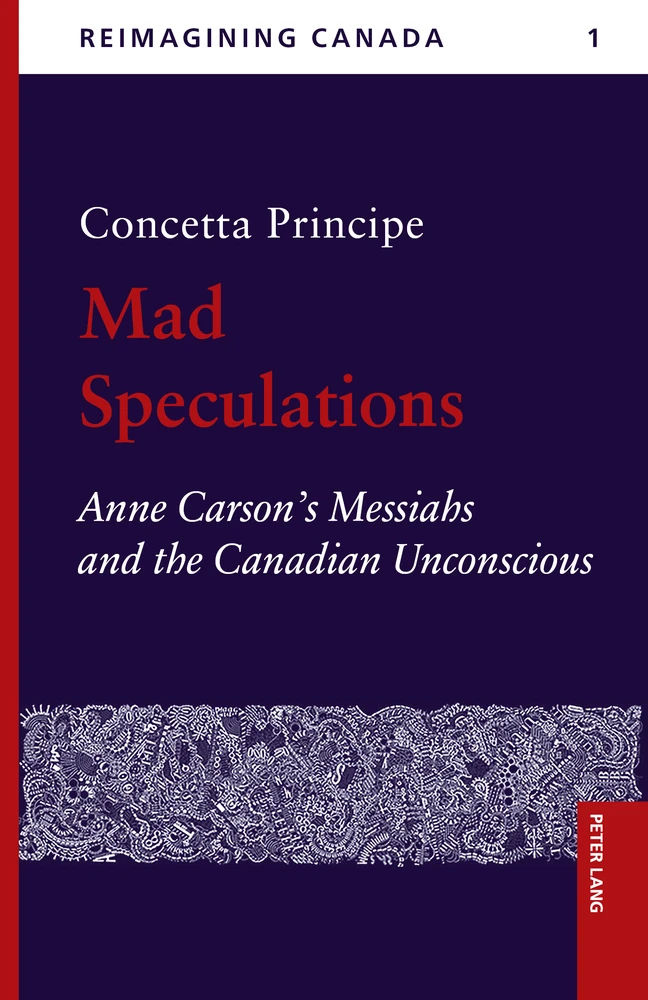
Mad Speculations: Anne Carson’s Messiahs and the Canadian Unconscious started out as a project exploring the phenomenon of the messiah in secular culture. As the research took shape, the work came to embody themes central to the Peter Lang series, Reimagining Canada. In this monograph that inaugurates the series, we rp
ead how Carson’s postmodern interpretation of the emancipator signifies the erosion of Canada’s foundational myths; allegiance to Canadian identity is both contested and reinforced by the “nowhere” of the stories driven by the “everyman” protagonists, and points us to envision some imagined future. Does Carson’s work exemplify a Canadian inferiority complex, or does it go beyond it? Do we find in these works an unconscious that speaks of the fragmented nation state? Do we take up Carson’s poetry as a roadmap to saving Canada? In considering these questions and listening to the mad messiahs, Mad Speculations makes some bold claims about the Canadian unconscious.
The Psychotic
In contrast to the neurotypical anxieties of autism that we find in Rainman (1988), Anne Carson’s Autobiography of Red (1998) reinvents the autistic story as a queer creative project. Stesichorus’ story about a beast named Geryon murdered by Herakles becomes in Carson’s hands the story of an autistic subject who falls in love with Herakles and then takes authority, literally authorship, over his life through photographs. The narrative ends with Geryon being a saviour figure for his friends. In the context of Carson’s oeuvre, certain texts explore a critical engagement with neurotypical anxieties about psychosis through the messiah. In short, Carson’s postmodernism reimagines the myths of madness and salvation.
The Messiah
Whether consciously or not, I argue, Carson reinvents Frederic Jameson’s “schizophrenic” as a mad messiah which speaks volumes to the Canadian desire for redemption. In the poem, “The Book of Isaiah” (1995), Carson’s prophet-who-becomes-messiah receives the violence of God’s word. It is a text that undermines the grand narratives of psychosis and divine revelation together. Geryon, in Autobiography of Red, is the on-the-psychotic-spectrum protagonist who queers the narrative of salvation. In Red Doc (2013), the saviour is a mosaic of characters struggling with various disorders who escape the dim, ineffective efforts of psychiatric treatment after failing in their messianic mission to heal. Each of these saviour narratives exemplifies how Carson undermines able-minded thinking by embracing fragmented identities that mark a path to a more equitable future.
Secularism
Why would there be a messiah in a secular project? What function would this religious anomaly have in discourse designed to replace religion? As Carson suggests in the interview with Mary Di Michele, worship needs to be accounted for, even in a secular world. But the world of these figures is not just secular. It is, in fact, emblematic of the generic “nowhere” which has been considered a mark of Canadian culture. The nationalism that appears in Carson’s saviours is complicated, a complication that explains the relationship between interpretation and speculation.
Speculation
Interpretation relies on patterns for proposing ways of reading. This project is about proposing ways of reading that are speculative, driven by considering unconscious messages using Freudian/Lacanian methods of interpretation. At the conscious level, Geryon is an autistic queer messianic figure troubling heteronormative hegemony. But Geryon is also personified as this ‘everyman’; buried in his generic features is the white Anglo-Saxon settler so central to Canadian culture. If Geryon’s character is shaped by unconscious Canadian ideology, his messianism is similarly shaped and equally unconscious. The fact is, as my analysis suggests, seeing a connection between Geryon’s representation and two historical figures, namely the first diagnosed schizophrenic, Daniel Paul Schreber as well as the Canadian self-proclaimed messiah, Louis Riél, may be bold but it is worth considering. That is, although these ways of seeing unconscious messaging cannot be substantiated by evidence other than in associative patterns of the text, these ways of seeing push us to look beyond what we think we know about Canada, what we assume is our cultural heritage, what we imagine the messiah is and may come to be.
The Unconscious
Lacan’s way of thinking about the unconscious invites us to imagine a Canadian future deeply buried in Carson’s work. In understanding how the unconscious works, Lacan quotes Freud in this German phrase: Wo Es war, soll Ich werden (where I was, so there shall I be). This is to say that the analysand will find the truth for herself after taking the path her unconscious has laid for her: the unconscious knows before the conscious self can know. In that sense, we can say that at the time of her writing, Carson’s work anticipated our contemporary scholarship that problematizes the neurotypical grand narratives about insanity and divine interventions. Her future is our present. In very provisional ways, then, we might speculate that this analysis of her messiahs, which interrogates the Canadian cultural landscape we know, points us beyond the disability politics Carson grapples with to consider a future in which the Canadian messiah is reinvented for a decolonized tomorrow.