
 en
en  de
de 
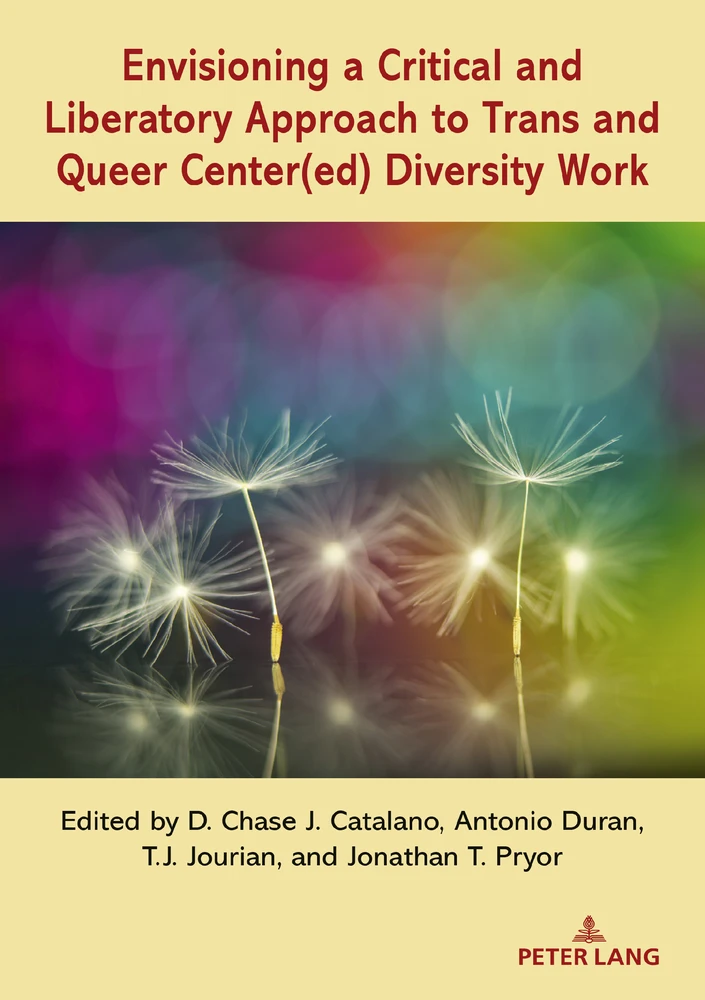
As part of the Peter Lang Pride Month celebrations, volume editors T.J. Jourian and Chase Catalano continue the conversation.
It wasn’t that long ago that we, along with two of our colleagues, decided we would co-edit Envisioning a Critical and Liberatory Approach to Trans and Queer Center(ed) Diversity Work (published in 2025). Yet many of the chapter authors’ professional and personal lives, including our own, feel worlds apart from ‘back then.’ US higher education had just begun sustaining the impacts of a swelling and multi-pronged ‘anti-DEI’ assault. The figurative ink had not yet set on senior administrators’ statements of commitment to justice and equity in response to nationwide protests against police brutality following George Floyd’s murder in May 2020, when the hollowness of those publicly promoted statements led to their quietly private annulment. Call it higher education’s remake of Britney Spears’ 55-hour marriage to Jason Alexander.
These highly bureaucratic institutions often require countless unrelenting advocates and years of taskforces, reports, benchmarking, and assessments to permit basic adjustments to policies and processes that enable marginalized students, staff, and/or faculty to breathe a touch easier. Yet, at the mere whisper of toothless executive orders and funding-cut threats, entire structures and organizational charts were upended. Commitments be damned and endowments untouched. Since then, several chapter authors have lost jobs and titles, left institutions and States for comparatively safer (i.e., less volatile) environments, and ditched careers they sought to or had dedicated their professional lives to. The festering anti-queer and anti-trans rhetoric coupled with institutional moves of capitulation—which are very much present and addressed in the book—have since taken hold more robustly, impacting trans staff and faculty—especially those of color—most significantly.
“Today, students, staff, and faculty are fighting to salvage what (little) resources and initiatives have become institutionalized or at least more available since then, while our visibility is weaponized against us and our young people in every aspect of social and public life.”
The two of us are ‘old enough’ to recall navigating the invisibility of transness in higher education as students and practitioners. A lot of our efforts were focused on alleviating ignorance and misinformation rather than addressing outright malice. To be clear, there was plenty of malice to go around; but it didn’t dominate where we deployed our energy and time. By the time either of us were working on our dissertations (both variably focused on trans men and masculine college students’ understandings of their manhood /masculinity), there were but a few research-driven publications about trans college students (none on staff or faculty), most by cisgender scholars writing with cisgender readership in mind (LOTS of defining terms and cislation of our illegible complexities), and flattening trans students into a one-dimensional aggregate.
Then, trans erasure on most campuses was less active. We were invisible mainly because most people didn’t know about us, not because we were being intentionally eliminated, as we are today. We hadn’t yet been written into the institution, so we created trans-inclusive housing and healthcare policies, replaced binary gender(ed) language with more expansive vocabulary, provided campus colleagues with the tools and skills to support all students, and were visible enough for trans students to find trans adults existing close by. Today, students, staff, and faculty are fighting to salvage what (little) resources and initiatives have become institutionalized or at least more available since then, while our visibility is weaponized against us and our young people in every aspect of social and public life.
That colleges and universities are not bulwarks for liberation and marginalized populations is not new or news to most of us who have engaged in queer center(ed) work for even a moment. What is renewed is the level of fear, anxiety, unsafety, and instability trans people are grappling with today and the open mass coordination of that renewal across social institutions (government, media, religion, education, and the economy) and the populace at large, including within the ‘LGB-without-the-T’ spaces we helped create.
In the book’s concluding chapter, we built on Barbara Love’s (2018) conception of liberatory consciousness and Charlene Carruthers’ (2018) questions for those seeking clarity about their place in resistance work, to offer four questions of our own:
- What do I/we need to know and understand?
- How will we think together?
- What actions and risks am I/we willing to take and able to take?
- How will I/we hold myself and each other in community in support and accountability?
“This Pride Month, […] we call on ourselves, each other, and all who want a future we can all thrive in”
At the time, “we” referred primarily to those undertaking TQ center(ed) diversity work. Today’s realities—plural, because, as always, the permeability of oppression has many fighting multiple, different, and often overlapping but siloed battles—require us to have a more expansive and poignant understanding of who “we” are. So, we (T.J. and Chase) reframe those questions1 to enable inquiry from any vantage point, regardless of identity, professional role, or organizing experience:
- What do we as individuals and as a collective need to illuminate for each other? How do we make room to hear each other’s stories as often as they need to be told in a variety of permutations?
- How can we fortify our analysis to enable us to have a kaleidoscopic and collective lens that leaves no-one out of the picture?
- How do we create a human-centered parable of the choir (an analogy by Celeste Bembry) to sustainably distribute the weight of action and risk taken up by a few, to allow for rest and reflection?
This Pride Month, whatever our individual interpretations and experiences of “Pride” might be, rather than lamenting or railing against the loss of corporate sponsorships that were always contingent on our palatability and profitability, we call on ourselves, each other, and all who want a future we can all thrive in, “to abandon notions of institutional saviorism in favor of saving ourselves” (Hobson & Jourian, 2025, p. 221). It’s what queer and trans people have done throughout history—our ancestors can show us the way!
T.J. Jourian is a freelance writer, independent scholar, and “DEI” consultant and coach. Formerly, he was an assistant professor in higher education leadership at Oakland University and worked in LGBTQ life and campus housing as a student affairs practitioner. Dr. Jourian’s writing, research, and practice center trans and queer people of color’s experiences and worldviews.
Find more information about Envisioning a Critical and Liberatory Approach to Trans and Queer Center(ed) Diversity Work, and purchase the book, here.