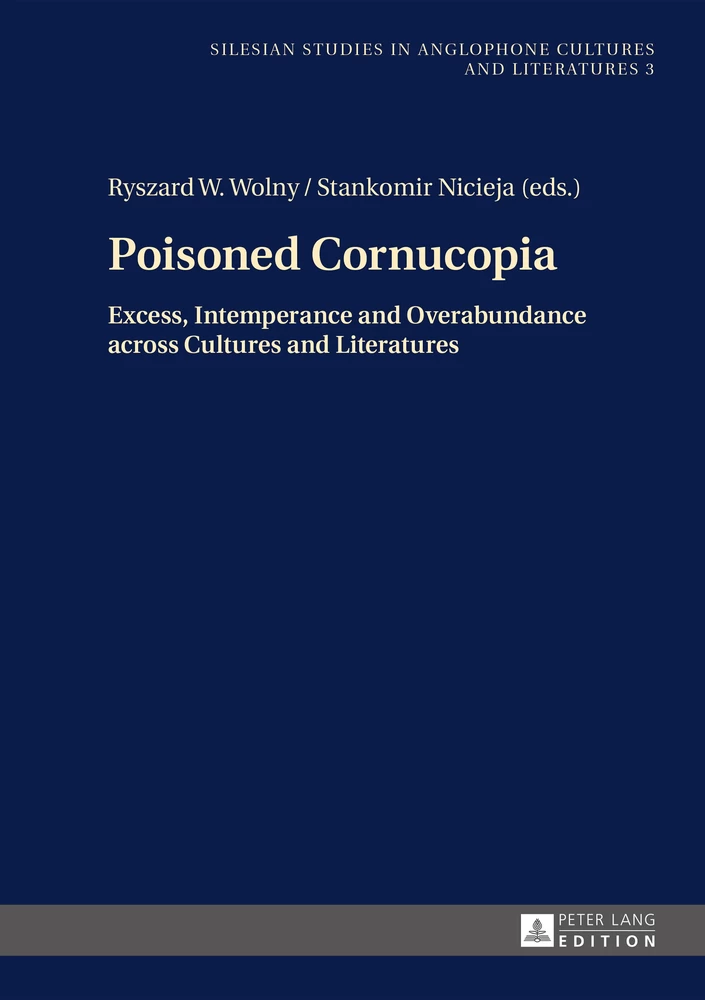
Poisoned Cornucopia
Excess, Intemperance and Overabundance across Cultures and Literatures
Summary
Excerpt
Table Of Contents
- Cover
- Title
- Copyright
- About the editors
- About the book
- This eBook can be cited
- Contents
- Notes on the Authors
- Introduction
- Part One: Literatures of Excess/es
- “If Music Be the Food of Love, Play on”: The Ambivalences and Necessity of Excess
- The End(s) of Excess
- Cornucopia Reversed: Overabundance and Poverty as Dehumanizing Factors in Suzanne Collins’s The Hunger Games Trilogy
- Abjection, Masochism and Haunting: Traumatic Excess in Jen Sookfong Lee’s The End of East
- “[F]or me it is an enviable lot to be unhappy with you”; Or, The Surfeit of Emotions in the Abbé Prévost’s Manon Lescaut in the Context of the Major Philosophical-Religious Controversies at the Turn of the 18th Century
- Dead or Alive; Or, When Excess Is Excess: The Composition of Herman Melville’s Mardi, and a Voyage Thither in the Context of the Romantic Debate on the Nature of Literary Creation
- Romantic Love and Its Images as Temporal Objects in Tswen-show Song’s Outside the Window
- Longing for the Forbidden: On an Excess of Restraints in the Works of David Lodge
- Space in Australian Literature
- “A Liquor as Burning as Life” in Guillaume Apollinaire’s Literary Output
- Part Two: Cultures of Excess/es
- Eroticism: Its Excesses and Deadly Masks in Contemporary Consumer Societies
- From Godfrey’s Cordial to Opium Dens and Pipe Dreams: Opiate Use in Victorian England
- Mass Culture as Excess in José Ortega y Gasset’s The Revolt of the Masses and Hermann Hesse’s Steppenwolf
- Joel Osteen, the Prosperity Gospel, and the Wages of Christian Conspicuous Consumption
- It’s Just Not Cricket: The Bullingdon Boys at Play
- The Excess of Tolerance: American White Nationalist Fiction and the Backlash against Political Correctness
- Sláinte! Excessive Drinking as a Central Part of Irish Culture
- Politics as “Expansion of Life”: The Order without Boundaries and Osugi Sakae’s Anarchism
- Part Three: Excess/es in Film and Mass Media
- The Excess of Affect: The Technologies of History in Seediq Bale
- Exchanging the Unexchangeable: The Profanation of Capitalism in Taiwan’s Betel-Nut Beauties and Li Ang’s “The Ghost at Dingfanpo”
- Scenes of Perverse Nature: Excess and Transgression as Art of Existence
- Heavy on Firepower: American Media Complicity in Unrestrained Consumption
- Too Much Trivia in the News? A Critical Discourse Analysis of Sensationalist Headlines in Online Newscasting
- The East-Asian Megacity as a Trope in Ridley Scott’s Blade Runner and Sophia Coppola’s Lost in Translation
- Index of Names
← 8 | 9 → Notes on the Authors
MAREK BŁASZAK completed English studies at the University of Wrocław, and his MA thesis was devoted to D. H. Lawrence. He then attended postgraduate courses at Oxford University (Exeter College) and the University of East Anglia (School of English and American Studies) in Norwich. He received a doctorate from Łódź University for a dissertation on Ann Radcliffe’s Gothic romances. He habilitated at Opole University and his recent monograph presented Captain Frederick Marryat as the proper father of the fully-fledged sea novel.
ANNA BRANACH-KALLAS is Associate Professor in the Department of English at Nicolaus Copernicus University, Toruń, Poland. She is the author of Corporeal Itineraries: Body, Nation, Diaspora in Selected Canadian Fiction (2010) and In the Whirlpool of the Past: Memory, Intertextuality and History in the Fiction of Jane Urquhart (2003). She has also published over fifty essays, which express a range of interests from corporeality, intertextuality and historiography to nationalism and postcolonialism. She is the co-editor of, among others, the first two volumes of the Polish Journal of Canadian Studies TransCanadiana. Since 2009 she has also directed the Canadian Studies Resource Center at Nicolaus Copernicus University.
DANIEL BROUDY is Professor and Chair of the Graduate School of Intercultural Communication at Okinawa Christian University. He has taught in the United States, Korea, and Japan. His research focuses on analysis of the sociocultural significance of signs and symbols as tools of mass persuasion. Among the puzzling questions he explores are, in what novel ways across cultures do humans use signs and symbols to express thought, deceive, and recover from past psychological traumas? He is co-author of Rhetorical Rape: The Verbal Violations of the Punditocracy (2010), co-editor of Under Occupation: Resistance and Struggle in a Militarised Asia-Pacific (2013), and managing co-editor of the communications journal, Synaesthesia: Communication across cultures.
STEPHEN DEWSBURY is Senior Lecturer at University of Opole and Speaker for Cambridge English. He has published on a variety of cultural, literary and ← 9 | 10 → linguistic themes which include an analysis of ugliness in the post-colonial discourse of the Ghanaian author, Ayi Kwei Armah, entitled, “A festering rotten stench: “The Man’s” experience of post-colonial rule in Ayi Kwei Armah’s The Beautyful Ones Are Not Yet Born” in Faces and Masks of Ugliness in Literary Narratives (Frankfurt 2013) and an analysis of capital punishment by hanging in eighteenth and nineteenth century London, entitled, “Tyburn to Newgate: Public Hanging and the Mass Spectacle” in From Queen Anne to Queen Victoria: Readings in 18th and 19th century British literature and culture (Warsaw 2012). He has also published an analysis on the processes involved in the vanishing and perseverance of local dialect words in the lexis of the Cheshire dialect, in “Vanishing Cheshire dialect words,” Languages In Contact (Wrocław 2011).
ILONA DOBOSIEWICZ is Professor of English Literature at University of Opole, Poland. She is the author of books: Female Relationships in Jane Austen’s Novels (1997) and Ambivalent Feminism: Marriage and Women’s Social Roles in George Eliot’s Works (2003) as well as articles on nineteenth-century British literature. She co-edits the series Readings in English and American Literature and Culture, published by Opole University, and is the managing editor (literature section) of Explorations: A Journal of Language and Literature (www.explorations.uni.opole.pl).
TOMASZ GADZINA is an assistant in the Institute of East-Slavonic Studies at University of Opole, where he teaches Business English. He also worked at the Holy Cross University in Kielce. As a member of the European Association for Studies on Australia, his academic interests include postcolonial studies and Australian literature and culture. He has currently been working on his Ph.D. dissertation in Australian literature and Tim Winton’s fiction.
ZBIGNIEW GŁOWALA is a Ph.D. student in the English Department of Maria Curie-Skłodowska University in Lublin. His academic interests include the campus novel, transgressive fiction and horror fiction.
MASAYA HIYAZAKI holds a Ph.D. and is a part-time lecturer at the Faculty of Political Science and Economics at Meiji University, Japan. His main fields of research are modern Japanese intellectual history, social thought, and political history in Japan. His publications include: Ōsugi Sakae no sisōkeisei to “kojinshugi” (The Formation of Ōsugi Sakae’s Thought and His Individualism). Tokyo: Tōshindō, 2005; Gendai ni Yomigaeru Ōsugi Sakae: Jiyū no Kakusei kara Sei no ← 10 | 11 →Kakujū e (Sakae Ōsugi Coming to Life in the Modern Age: From the Awakening of Freedom to the Expansion of Life). Tokyo, Japan: Tōshindō, 2013; “A Dark Sign on the Satō Eisaku Government: A Political Situation in 1971,” in Politics in the High-growth Period. Tokyo, Japan: Tsunansyuppan, 2011, and “A Study of the Attributes in Japanese Anarchism: Considering a Notion of Mutual Aid of Ōsugi Sakae,” in Catholic University of Lublin Studies in Literature and Culture 6, 2012.
KRZYSZTOF KOSECKI is Professor and Chair of English and General Linguistics, University of Łódź. His research interests include cognitive semantics, theory of the conceptual metaphor and metonymy, translation studies, the poetry and thought of W. B. Yeats, and cognitive poetics.
YU-LIN LEE is Associate Professor of the Graduate Institute of Taiwan Literature and Transnational Cultural Studies at National Chung Hsing University, Taiwan. His research interests include literary theory, modern Taiwan literature and cinema, translation studies, and Deleuze studies. His recent publications include: Writing Taiwan: A Study of Taiwan’s Nativist Literature (2008), Liminality of Translation: Subjectivity, Ethics, and Aesthetics (in Chinese, 2009). He is also the Chinese translator of Ronald Bogue’s Deleuze on Literature.
TADEUSZ LEWANDOWSKI, Ph.D., teaches in the Department of Anglophone Cultures ← 11 | 12 →at University of Opole, Poland. He has authored books on Dwight Macdonald and Polish/English interlingual errors.
HUNG-CHIUNG LI is currently Associate Professor in the Department of Foreign Languages and Literatures at National Taiwan University, Taiwan. His research interests include contemporary literary and cultural theories, and comparative literature. In the field of theory he has published papers on Lacanian psychoanalysis, Walter Benjamin, biopolitics, Giorgio Agamben, Alain Badiou, Gilles Deleuze, globalization, cyberculture. In the field of comparative literature, he endeavors to create dialogues between theory and Taiwan and has published papers on Taiwan’s literature, cinema, art, and socio-cultural phenomena. His recent research is directed toward East Asian thought and cultures, with the aim to derive potential theoretical modes for East Asia in the contemporary age of globalization.
ALEKSANDRA LUBCZYŃSKA graduated from Nicolaus Copernicus University in Toruń in 2010. Her MA thesis was devoted to the representation of queers in contemporary mainstream American cinema. Currently, she is a PhD student at University of Opole. She is working on a thesis concerning the relationship between camp and postmodern thought as presented in American cinema.
MAGDALENA MĄCZYŃSKA graduated from University of Opole in 2008. Having completed her studies in the English language and literature, she submitted Master’s thesis on J. R. R. Tolkien’s mythopoeia and the writer’s creative use of mythical themes present in Norse, Finnish and Celtic mythologies. She has attended several international conferences and has published articles on British and American fantasy literature, which is her major area of research. At present she is a doctoral student at University of Opole, and her Ph.D. thesis focuses on the works of Tolkien, Marion Zimmer Bradley and Philip Pullman.
KATARZYNA MOLEK-KOZAKOWSKA, Ph.D., is Assistant Professor at School of English, University of Opole, Poland. Trained as a linguist, she now specializes in discourse analysis and media studies. She has published on various aspects of mass-mediated political discourse, rhetorical and stylistic properties of contemporary journalism, methodology of critical discourse analysis and critical literacy. She co-edited a two-volume book Exploring Space: Spatial Notions in Cultural, Literary and Language Studies (Cambridge 2010), and authored a monograph Discursive Exponents of the Ideology of Counterculture (Opole 2011).
STANKOMIR NICIEJA works at the Department of Culture, School of English and American Studies, University of Opole. In 2011, his book, In the Shadow of the Iron Lady: Thatcherism as a Cultural Phenomenon and Its Representation in the Contemporary British Novel, was published by the University of Opole Press. His academic interests include contemporary British fiction, utopia and dystopia in Anglo-American literature as well as representations of politics and nationality in cinema. He is currently working on a book project about the images of China and the Far East in contemporary English-language films and novels.
TOMASZ PILCH teaches American literature at the Teachers’ College at Regionalne Centrum Kształcenia Języków Obcych in Opole. His primary academic interests are nineteenth-century American writers, particularly Herman Melville and Nathaniel Hawthorne, studied in the context of Romantic debates on vitalism and organicism, and the twentieth-century critique of hegemonic discourses.
TADEUSZ RACHWAŁ is Professor of English at Warsaw School of Social Sciences and Humanities. He published books and articles on British culture and literature, literary theory, and cultural studies. His academic interests concentrate ← 12 | 13 → on the cultural and ideological aspects of labour and the metamorphoses of its ethos in different discursive formations. His book devoted to work and creativity in Western culture (Labours of the Mind. Labour in the Culture of Production) was published by Peter Lang in 2006. Recently, he has been engaged in an international project targeting the problems of precarity and insecurity in the context of the future(s) of the European Union.
KATARZYNA RYBIŃSKA currently teaches at the Institute of Slavonic Philology at Wroclaw University. She holds a Master of Arts in Russian, a Master of Arts in English, doctorate in literary studies. Her scholarly interests focus on an extended examination of intoxication in European modernism, literary analysis of Virginia Woolf and James Joyce, comparative studies in English and Russian literature at the turn of the 20th century.
JOHN ERIC STARNES holds a B.A. and M.A. in history from Appalachian State University, as well as several TEFL certifications. His academic interests include research into fringe political and social movements in the United States, while he also specializes in expressions of nationalism and cultural trauma. Currently, he is working on a major research project examining the novels produced by the American white nationalist movement from the early 1800s to the present, with the paper presented in this volume growing out of that research project. Furthermore, he also researches southern historical memory (mainly the so-called Neo-Confederate movement and associated controversies surrounding the place of the memory of the Confederacy and Reconstruction in the contemporary South), American rural rebellions and rebel groups, the various myths surrounding the mythical land of Thule – also known as the “White Atlantis” and finally, the various conspiracy theories surrounding the involvement of the Nazis with the occult.
ANDREW TAYLOR is Emeritus Professor at Edith Cowan University, and is a Member of the Order of Australia. He taught for many years at the University of Adelaide. From 2006 until 2009 he was the poetry editor for the Australian literary journal Westerly. He has been a frequent visitor to Cornell University and Churchill College Cambridge, and has also taught at the University of Tübingen in Germany and at the University of Shanghai for Science and Technology. He was the regional winner of the British Airways Commonwealth Poetry Prize for his 1986 book, Travelling. His 1995 book of poetry, Sandstone, won the Western Australian Premier’s Book Awards for poetry for that year, and Götterdämerung Café. He was shortlisted in 2002. In 2005, Salt Publishing published Andrew Taylor’s Collected Poems, bringing together his entire body of poetry, including new ← 13 | 14 → poems written between 2000 and 2003. A further collection, The Unhaunting, appeared from the same publisher in 2009.
RYSZARD W. WOLNY is Professor and Director, School of English and American Studies, University of Opole, Poland. His interests focus largely on British and Australian literature and culture. He is an author of about eighty scholarly publications which include, among others, The Ruinous Anatomy: The Philosophy of Death in John Donne and the Earlier Seventeenth-century English Poetry and Prose (Perth, Western Australia, 1999), A Cry over the Abyss: The Discourse of Power in the Poetry of Robert Browning and Algernon Charles Swinburne (Opole 2004), Australia: Identity, Memory, Destiny (with S. Nicieja, Opole 2008), Crosscurrents: Culture, Literature and Language (Kielce 2008), On Time: Reflections on Time in Culture, Literature and Language (Opole 2009), Culture and Postcolonial Studies (Kielce 2012), Evil Ugliness Disgrace in the Cultures of the West and East (with S. Nicieja, Opole 2013), and The Masks of Ugliness in Literary Narratives (with Z. Wąsik, Frankfurt 2013). Recently, he also published a monograph entitled Patrick White: Australia’s Poet of Mythical Landscapes of the Soul (Wrocław 2013).
NAINU YANG is Associate Professor in the Department of English at National Kaohsiung Normal University, Taiwan. Her research interests include literary theories, utopian literature, science fiction, and Taiwanese documentary films. She has published articles in Kaohsiung Normal University Journal, Review of English and American Literature, Chung Wai Literary Quarterly, Concentric, and Fiction and Drama.
MARZENA ZIELONKA obtained her Master’s degree in English from University of Opole in 2010 for her thesis on “The Stereotype of the Irish in British Popular Culture.” After graduating, she moved to Ireland where she spent nearly three years actively participating in Irish cultural and educational life. While there she completed a course in Creative Writing and Journalism in the O’Fiaich Institute of Further Education and by accomplishing supervised teaching in the Ardee Secondary School in County Louth, she gained the Teaching Council’s recognition to teach English as a native language in the Republic of Ireland. Her primary interests lie in the fields of Cultural Studies, Postcolonial Theory and Food Studies. She is particularly interested in the issues concerning nation, gender and class in Irish writing, the representations of the Irish Troubles in popular culture, the Irish drama read in the light of Ireland’s self-definition, and the relation between food and identity in the twentieth-century Irish culture. Furthermore, over the past three years, she has developed her interest in Hiberno-English and the teaching of modern and contemporary Irish literature in the EFL context.
← 14 | 15 → Introduction
The notions of excess, intemperance and overabundance belong not only to one of the most important categories in the realm of Western civilization, but also constitute an important reference point in all possible discussions revolving around the theme of human nature – its vices and limits. Moreover, intemperance and excess are a focal subject of deliberation and critique in all major religions.
Just like many other similar categories, the notions of excess, intemperance and overabundance became subject to radical overvaluation during the 20th century, and this process is still ongoing in the first decades of the new millennium. Restraining mankind’s inclination towards intemperance and excess stopped being only the ambition of religious movements and became an important subject of political and ideological disputes. Thus, one of the greatest ambitions of the leftist movements in the 1920s was to suppress the excess and immoderation naturally generated by the rapidly developing capitalism. Both communism and socialism were to provide resistance to the flagrant (and ultimately self-destructive) greed of the ruling classes. However, in the heat of revolutionary zeal, the radical left itself became victim of intemperance and greed. In the name of spreading emancipation, gulags and concentration camps were established, mass executions were organized, and the liberties of travel and personal expression were drastically reduced.
Details
- Pages
- 341
- Publication Year
- 2015
- ISBN (Hardcover)
- 9783631646205
- ISBN (PDF)
- 9783653039825
- ISBN (MOBI)
- 9783653993929
- ISBN (ePUB)
- 9783653993936
- DOI
- 10.3726/978-3-653-03982-5
- Language
- English
- Publication date
- 2014 (December)
- Keywords
- westliche Kultur Postmoderne Massenmedien Kapitalismus
- Published
- Frankfurt am Main, Berlin, Bern, Bruxelles, New York, Oxford, Wien, 2014. 341 pp.
- Product Safety
- Peter Lang Group AG
