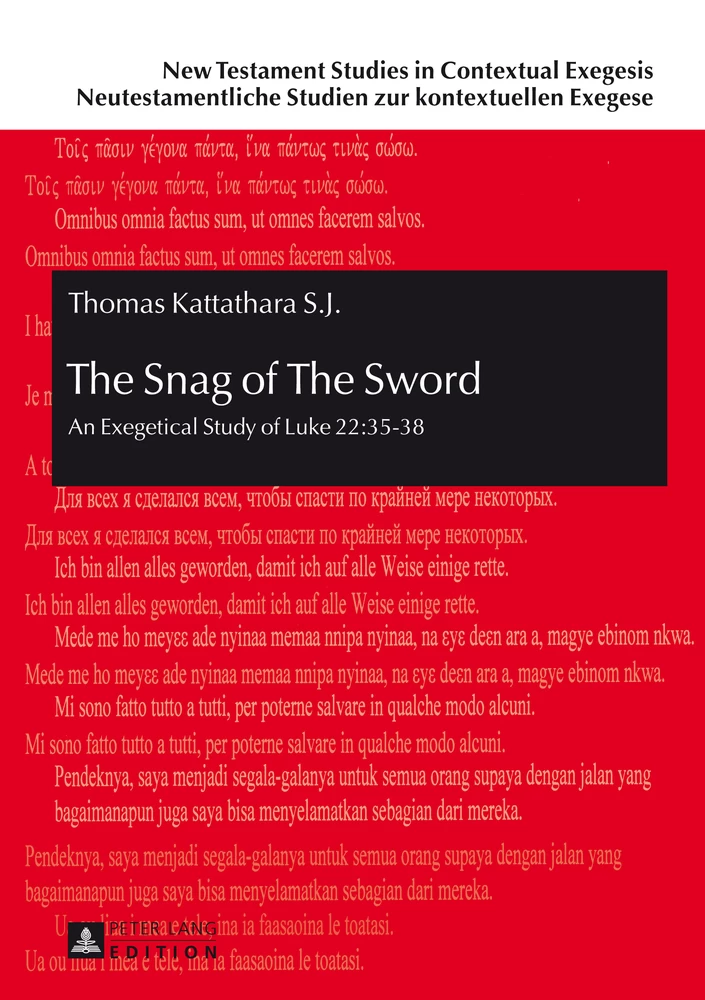
The Snag of The Sword
An Exegetical Study of Luke 22:35-38
Summary
Excerpt
Table Of Contents
- Cover
- Title
- Copyright
- About the author
- About the book
- This eBook can be cited
- Table of Contents
- General Introduction
- Chapter One. Sword in the Bible: General Terminology of Weapons in the Bible
- Introduction
- 1.1 Weapons in the Old Testament
- 1.2 Weapons in the New Testament
- 1.3 Sword (ma,caira)
- Conclusion
- Chapter Two. Comparative Study of Some Texts in the NT: Mt 10:34; Lk 2:34–35; Eph 6:17; Heb 4:12; Rev 1:16, 2:12, 2:16
- Introduction
- 2.1 Matthew 10:34
- 2.2 Luke 2:34–35
- 2.3 Ephesians 6:16–20
- 2.4 Hebrews 4:12
- 2.5 Revelation 1:16
- 2.6 Revelation 2:12
- 2.7 Revelation 2:16
- Conclusion
- Chapter Three. Conundrum and Snag of the Sword in the Scene of Jesus’ Arrest (Mt 26:51–54; Mk 14: 45–47; Lk 22:49–51; Jn 18:10–11)
- Introduction
- 3.1 The Gethsemane Scene in Matthew
- 3.2 The Gethsemane Scene in Mark
- 3.3 The Mount of Olive Scene in Luke
- 3.4 The Garden Scene in John
- Conclusion
- Chapter Four. The Zealots and the Sicarii
- Introduction
- 4.1 The Zealots
- 4.2 The Sicarii
- 4.3 The Robbers
- 4.4 The Socio-Political Concept of Jesus
- Conclusion
- Chapter Five. Exegetical Study of Lk 22:35–38
- Introduction
- 5.1 The Context of Luke
- 5.2 The Source of the Discourse
- 5.3 Exegetical Study of Lk 22:35–38
- 5.4 New Rules for a Time of Crisis (22:35–38)
- 5.5 The Exegesis
- 5.6 Luke and the Use of Scripture
- 5.7 Discipleship and Martyrdom
- 5.8 Delayed Parousia in Luke
- 5.9 Literary Form
- 5.10 The Source
- 5.11 The Newness of the Teaching
- 5.12 Some Theological Concerns of Luke
- 5.13 Jesus’ Vision of a New Society
- Conclusion
- Hermeneutical Reflections and the General Conclusion
- Introduction
- 6.1 The Existential Reality of the Church Today
- 6.2 Trust in Providence
- 6.3 Fight or Flight?
- 6.4 Self or Communal-defence?
- 6.5 Marga of Ahimsa and Satyagraha
- 6.6 Symbolic Relevance
- 6.7 Psychological Relevance
- 6.8 The Strategic Relevance
- Bibliography
The twentieth century has given many martyrs to the Church. The spread of the message of the Gospel to those parts of the world far from the milieu of Jesus opened the Gospel message to a wide range of witnessing possibilities. The message of the Gospel was confronted with both an affirmative and annihilating impact leading to response in faith and martyrdom. One need not look for glorified imprints of those martyrs; rather, understand how the Crucified is glorified in them. One shall recognize not just the heroism of their witness but the centrality of the message left by their blood stains. It is not just martyrdom by blood that we need to acclaim; rather, there is the development of a new history of the on-going and living martyrdom many are subjected to in several parts of the world, especially where the community of believers is in remnant form or is the little flock (Lk 12:32), which is the rudimental nature of the community of believers – called to be the leaven in society.
As this research was about to begin, we were confronted with the violent persecution in Kandamahal, Orissa, India. The gruesome atrocities on the hapless little flock have shocked the conscience of many beyond creed lineages. Although Kandamahal shook the conscience of many, it still needs to be justly dealt with or constructive steps have to be taken to prevent further such brutal attacks on a vulnerable people. Such individual and collective attacks wound our hearts forcing us to constructive responses that the Church needs to seek and actively engage in.
Short lives write long-lasting history. Unfortunately, subaltern history is seldom written. Hence, pathos of the poor and the marginalized dissolves into the thin air of forgetfulness. The popular history is seldom recorded by the victims. The unaffected agents of the powerful choreograph history. The subaltern historical perspective, even when written, vanishes into oblivion. A few years after any carnage and its aftermath, the perpetrators are held high by ← 1 | 2 → the sectarian beneficiaries, rather than liable and accountable. Every history is knowledge and not a belief. Every sectarian history creates false belief.
Good questions are easier than convincing answers. But the enquirer is charged with history to infer answers to questions. Thus historical knowledge becomes inferential knowledge. Historical knowledge is inferred because of the fact that unmediated knowledge is generally unavailable and in most cases irrelevant. When historical knowledge is inferential what guarantees the veracity of that which is historically known? The trustworthiness of the inferred knowledge depends on the value of conditional syllogism.
For the historians the questions are simply his/her own. The questions that one raises and the answers others provide become the potential date from which one must choose what one needs. Until a historian poses his or her own questions the available data remains unfocused. Unfocused availability of data cannot provide knowledge. They remain at the level of hypothesis. Therefore, these hypotheses need verification. Every hypothesis tends to intelligence and verification to reflection.
For one who is involved in the process an analysis would be certainly different. There is hardly room for hypothetical questions here. For him/her the history is always present; hence there is only the actuality of happening combined with its memories of pathos.
The Church in India, like anywhere else in such situations, has to take a stand. The Church cannot merely engage in subsequent relief activities of charity but evolve concerted pro-active and preventive strategies. It has to evolve strategies and engage in activities to preserve and protect the lives of the people. Here, we the Church in India remain vague. Channelizing her human and material resources for charity, here, seems marginally soothing but seldom curative.
For the Church to engage in constructive actions would mean strengthening the viable victims, primarily within its preview and through them embracing all victims beyond barriers, owing to the fact that the Church is entrusted with the Good News of peace and joy to all the nations (Lk 2:10–14) through the Marian Hymnal experience of God’s preferential option for the poor (Lk 1:46ff) and God’s engagement in human history (cf. Lk 4:18–21; 7:22–23) ← 2 | 3 → culminating in the resurrection experience. But the eschatological hope is also lived in the strategic present. Hence, it is the task of the Church to understand the teaching of Jesus with regard to mission strategy.
Has Jesus a clear teaching on mission strategy? I believe that the answer is in the affirmative; then how are we to understand the mission strategy of Jesus? In relation to the practical mission strategy, the reference is often made to Luke 9 and 10 where the disciples are sent on a mission, with the instruction not to carry bag, nor purse, or any other provisions for their way. If we accept it as the norm for mission pedagogy, there remains an inherent contradiction within the Church between its principles and practice. Lk 9:2–3 and 10:3–4 belongs to the mission of Jesus’ training of his disciples towards deeply trusting in the providence of God. But, the mission strategy of Jesus for the Church has to be found certainly in Luke 22:35–38.
The Focus of the Study
Lk 22:35–38 teaches us to prepare pedagogically women and men of Christ to the world. We try to understand Jesus’ mission strategy for us as his disciples today. Lk 9:2–3, 10:3–4 and 22:35–38 refer to the mission Sendings. While the first two agree on many aspects, 22:35–38 stands seemingly opposed to the previous instructions. We need to be reconciled to this hard saying of Jesus, “But now, let him who has a purse take it, and likewise a bag. And let him who has no sword sell his mantle and buy one” (Lk 22:36). In the light of the rampant violence against the Christians, there is the danger of misinterpreting these words of Jesus.
Therefore, Lk 22:35–38, the final instruction of Jesus to his Apostles, before his passion and death, shall be seen as the basic instruction towards evolving a sustainable mission strategy, without in anyway contradicting the overall teaching of Jesus in the Gospel.
35 Kai. ei=pen auvtoi/j\ o[te avpe,steila u`ma/j a;ter ballanti,ou kai. ph,raj kai. u`podhma,twn( mh, tinoj u`sterh,sateÈ oi` de. ei=pan\ ouvqeno,jÅ
36 ei=pen de. auvtoi/j\ avlla. nu/n o` e;cwn balla,ntion avra,tw( o`moi,wj kai. ph,ran( kai. o` mh. e;cwn pwlhsa,tw to. i`ma,tion auvtou/ kai. avgorasa,tw ma,cairanÅ ← 3 | 4 →
37 le,gw ga.r u`mi/n o[ti tou/to to. gegramme,non dei/ telesqh/nai evn evmoi,( to,\ kai. meta. avno,mwn evlogi,sqh\ kai. ga.r to. peri. evmou/ te,loj e;ceiÅ
38 oi` de. ei=pan\ ku,rie( ivdou. ma,cairai w-de du,oÅ o` de. ei=pen auvtoi/j\ i`kano,n evstinÅ
The instruction starts with the recalling of the experience of the sending, followed by the new instruction in v. 36. The new instruction is confirmed with a Christological fulfilment of Isaiah in (v. 37), finally the disciples stand bewildered and at cross purposes, bringing Jesus to an abrupt end of the instructive dialogue! The bewilderment is felt even today. We undertake to unravel the dilemma of the sword.
The mission of Jesus – you shall be my witnesses in Jerusalem and in all Judea and Samaria and to the end of the earth (Acts 1:8), – must be strategically executed, without ever shifting from the centrality of the Gospel. The strategy refers to the sum total of human efforts. Hence, the message, the primary task and the means to achieve it must cohere.
The Methodology
In our study, we move from the general to the particular. In the First Chapter we undertake a general survey of the use of weapons in the Bible. Certainly, it would give us a glimpse, not exclusively, on the wide range of weapons that are used in the Bible. In this chapter we undertake the study of the sword in detail. The Second Chapter deals with those passages in the New Testament, where “sword” is used metaphorically. In the Third Chapter we engage in understanding the literal use of the sword in the New Testament. The Fourth Chapter deals with the Zealots, the Sicarii and other aggressive groups in Israel, and places us in the socio-political situation of Jesus and his disciples. Thus having prepared the ground, the Fifth Chapter makes the study of Lk 22:35–38. This is the central part of our study. The pericope is narratively studied. We find it right to study the Gospel of Luke as a narrative. Finally, the work is concluded with hermeneutical conclusions.
We do not engage in the survey of the study of Lk 22:35–38. One of the well-known propositions is the theory of ‘double-sword.’ The eleventh century tension between the Church and the Caesar of Rome is the reason for the ← 4 | 5 → development of such an interpretation of the pericope. As the title suggests, the pericope is not easy to explain convincingly and without stumbling on the puzzle of the sword in the Gospel according to Luke. This is our task.
A Brief History of Ancient Weapons
However, before entering into the study of the weapons in the Bible, we have a bird’s eye-view of the history and classification of weapons.
Human existential and developmental concerns necessitate the use of different tools and implements made of various materials like stone, wood, copper, iron and the like. They help to extend the human body in space and time. The concept of tools and weapons sprung from the human need of existential extension.
Up to the latter part of the fifth millennium B.C. all tools and weapons were made of stone as a result of which we have the terms like Paleolithic, Mesolithic, and Neolithic. During this period, tools and weapons were not distinguishable in their use. The later part of the fifth millennium was followed by the chalcolithic period when copper tools and weapons were introduced replacing the stone weapons, although the stone weapons remained in use as late as the Iron Age. The earliest metal tools were made of native copper even before smelting was understood. Copper was hardened later and bronze came into use. Then came the Iron Age as having greater advantage over bronze. The iron weapons were almost unbreakable and pierced even the strongest of armours.1
While the early people had used stones, clubs, axes and spears, the modern people employ complex weapons to kill.2 The Sumerians by 3,500 B.C. were already a civilized society who fought with chariots pulled by donkeys and used bows and arrows. They too used spears, axes and clubs. The Egyptian ← 5 | 6 → was equally advanced in the use of weapons. The Assyrians who lived between 900 and 612 B.C. in the Middle East created a strong empire. They were the first to use iron weapons which were superior to bronze weapons. They used a combination of chariots, cavalry, and infantry. Each chariot carried three men, a driver, an archer and a shield bearer. The cavalry fought with bows, arrows and spears. Besides these weapons, the infantry fought with swords and slings. They used battering rams inside a wooden vehicle. It was swung to smash walls and city gates. The soldiers wore sturdy boots helping them on long marches.
The Greeks had developed a very strong infantry. They also used horses in battle. The Athenians had also a large navy. The catapult was a later invention by the Macedonians. It was powered by a twisted rope which was then released firing a stone at the enemy. Catapults were later on rampantly used by the Romans. The Roman military regime was one of the strongest military powers in the ancient world because of their superior weapons and war tactics. Swords and spears were the main weapons of Roman soldiers. The Roman army had both infantry and cavalry. By the 3rd century B.C. the sword was a long-pointed double-edged weapon. They also carried a dagger with an elaborately decorated sheath.
The weapons among the Hebrews can be better discussed in the light of what is known of weapons in the Near East in general. The innovative development of weapons continued during the centuries using innovative technologies, introduction of stronger and harder materials and designs.
It is the context that determines and distinguishes a tool from a weapon. From the view point of the purpose it can be divided roughly into: (a) Weapons of Domestic Use (a tool or an implement), (b) Weapons of War and Destruction3 and (c) weapons of defence. There can be different categories under which weapons can be classified, such as by user, by function, by their destructive capacity, and by target.4 A knife in the hand of one who engages ← 6 | 7 → in cooking food is a tool. The same knife in the hand of a brigand can be a weapon. We classify them in three categories: 1. Short-range weapons; 2. Long-range weapons and 3. Weapons of self-defence. This classification is based on the use of weapons in the warfront. Here, we have the setting for the first Chapter. Lk 22:35–38 is the task ahead for our research. We set out on our journey in good faith. ← 7 | 8 →
← 8 | 9 →
Details
- Pages
- X, 244
- Publication Year
- 2014
- ISBN (Hardcover)
- 9783631653531
- ISBN (PDF)
- 9783653045475
- ISBN (MOBI)
- 9783653982978
- ISBN (ePUB)
- 9783653982985
- DOI
- 10.3726/978-3-653-04547-5
- Language
- English
- Publication date
- 2014 (July)
- Keywords
- Verfolgung Mission Sikarier Zeloten
- Published
- Frankfurt am Main, Berlin, Bern, Bruxelles, New York, Oxford, Wien, 2014. X, 244 pp.
- Product Safety
- Peter Lang Group AG
