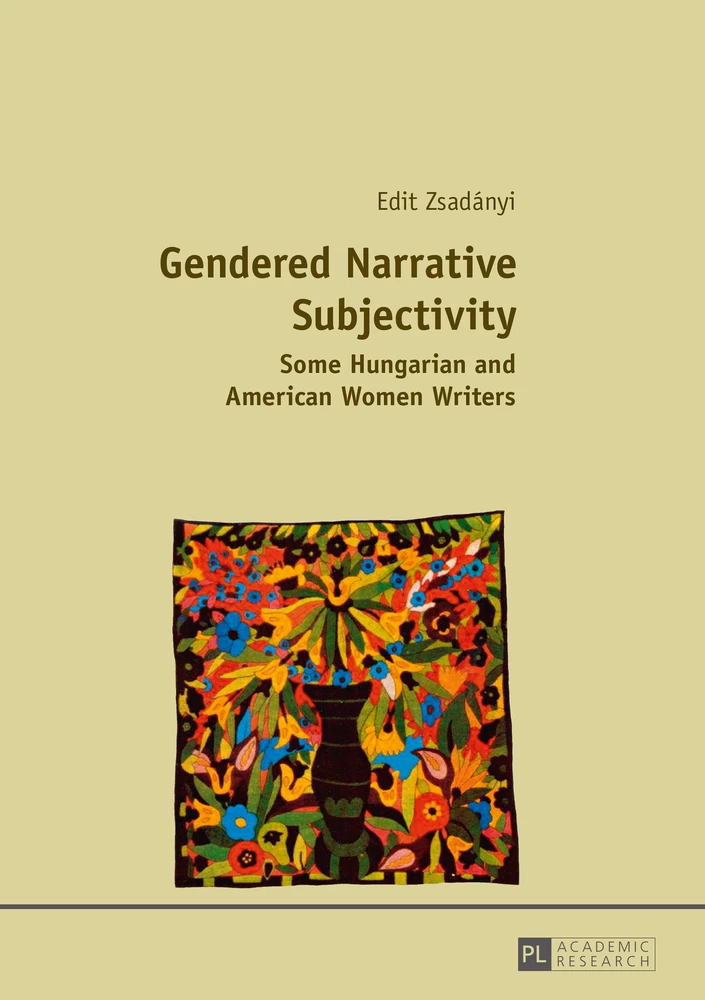
Gendered Narrative Subjectivity
Some Hungarian and American Women Writers
Summary
Excerpt
Table Of Contents
- Cover
- Title
- Copyright
- About the author
- About the book
- This eBook can be cited
- Table of Contents
- Acknowledgements
- Introduction
- Chapter 1: Subjectivity, Narrativity and Gender Identity
- Chapter 2: Figures of Narrative Subjectivity in the Works of Margit Kaffka, Emma Ritoók, Jolán Földes and Anna Lesznai
- Chapter 3: Narrative Conceptions of Identity and Otherness in the Works of Contemporary Hungarian Female Writers
- Chapter 4: Decentered Subjectivity in Gertrude Stein’s Three Lives and Kathy Acker’s Don Quixote
- Chapter 5: Speaking from the Margin: Gertrude Stein’s Tender Buttons and Agáta Gordon’s Goat Rouge [Kecskerúzs]
- Chapter 6: Detailed Description as Subjectivity Formation: Jhumpa Lahiri’s The Namesake and Jolán Földes’ The Street of the Fishing Cat [A halászó macska uccája]
- Conclusion
- Works Cited
- Illustrations
- Index
I wish to acknowledge the contribution of several colleagues and friends at Eötvös Loránd University, Budapest and The University of Groningen who gave valuable advice to make this book better. For critical response, helpful dialogue and friendly support let me single out Mónika Baár, Ronit Nikolsky and Zsuzsanna Szíjártó. Special thanks are due to Krisztina Szalay for her detailed suggestions. I am grateful to András Földes also for his technical support.
Chapters 1, 2 and 3 have been translated from Hungarian by Éva Misits.
All literal translations of literary excerpts were done by Éva Misits unless otherwise indicated.
Versions of chapters 2, 4, 5 and 6 have appeared, in earlier versions, in journals and collections of essays. Amendments and refinements have been made to all of them though.
‘Impersonal Narration in the Prose of Margit Kaffka, Emma Ritoók and Jolán Földes’
AHEA: E-journal of the American Hungarian Educators Association, 4/18 (2011). http://ahea.net/e-journal/volume-4-2011/18
‘Displacement of Identity in Kathy Acker’s Don Quixote and Gertrude Stein’s Three Lives’. in Joyce Goggin and Sonja Neef, eds., Traveling Concepts (Amsterdam: ASCA Press, 2001, 54–63.
‘Seech from the Margin. Gertrude Stein’s Tender Buttons and Agáta Gordon’s: Kecskerúzs’ Hungarian Studies 15/2 (2001) 127–143.
‘The Beauty of Details: The Rewriting of Omnipotent Narrative Tradition in Jhumpa Lahiri’s Namesake’ in Asha Choubey, ed., Women on Women: Women Writers’ Perspectives on Women. (Jaipur: Aadi Publications, 2011), 25–39. ← 7 | 8 →
Chapter 1: Subjectivity, Narrativity and Gender Identity
In the last few decades, humanist conceptions of the subject that promoted the idea of a self-identical, united and autonomous individual have been questioned from a variety of perspectives by different theories. These theories share the same premise of assuming a linguistically and culturally constructed subject, such as poststructuralist theories which speak of the constructive nature of identity categories and an inherently, ideologically and textually determined decentered subject. These theories also highlight different aspects of the latter. For instance, psychoanalytical approaches call attention to the operation of unconscious desires that strongly influence human thought processes and action, inevitably resulting in contradictions, while philosophical hermeneutics talks of the precedence of language and the universal nature of linguistic world-experience. Cultural-philosophical theories emphasize that not only are human thought processes the products of ideologies and prevalent discourses, but also that even the most contradictory concepts may coexist in human cognition.
In her book The Posthuman, Rosi Braidotti sees posthuman theories as a further development after the postmodern views. The notion of the posthuman seems to her the most adequate concept for coming to terms with our globally linked and technologically mediated societies. She considers the theoretical tendencies after postmodernism and poststructuralism and creates an itinary in the intellectual development that leads from humanism through antihumanism to posthumanism. In her view, the poststructuralist continental philosophers, the feminist and the postcolonial thinkers can be considered as representing the anti-humanist turn, in which they challenged the unitary and humanist notion of the subject with its Eurocentric core and imperial tendencies. They rejected the classical definition of European identity in terms of Humanism, rationality and the universal. Their stance was not merely in opposition to Humanism, but they created other visions of the self, too. Braidotti proposes an affirmative and critical posthuman position that builds on the anti-humanist legacy and moves further (2013: 38). In her opinion ‘a posthuman ethics for a non-unitary subject proposes an enlarged sense of interconnection between self and others, including the non-human or “earth others”’ (49). I hope that the central problem of my book about the coexistence of a postmodernist decentered subjectivity and feminist ideas of centered subjectivity still remains relevant from the posthumanist position advocated by Rosi Braidotti, since the posthumanist notion of subjectivity preserves ← 13 | 14 → the non-unitary character of the postmodernist, in Braidotti’s term antihumanist, subject. I believe that the creative tension between unitary and non-unitary subjectivity, which I study in this book in the works of female writers, may have relevance in an age that advances the postmodern conditions.
Conceptions of the decentered subject have raised new problems as well as new issues for many studies, for example narrative theories and feminist criticism, two fields that previously presupposed a traditional self-identical, self-exploring and self-realizing subject and were prompted by the results of postmodern theories to reconsider their basic tenets. For instance, conceptions of the decentered subject question the most fundamental categories of classical narratology such as the figure of the character or even the narrator, which in turn questioned the authority of the author and the idea of a coherent authorial horizon. In the case of feminist theories, focus on the centered subject was primarily due to an emancipatory interest; postmodern subjectivity thus created unresolved tension and sparked countless debates within the ranks of feminist criticism. Perhaps the most important difference between feminist criticism and postmodern theories lies in their conceptions of the subject. Inasmuch as it represents the interests of women, feminist criticism (which is itself a part and product of postmodern approaches) has no choice but to presuppose a well-defined subjectivity and call attention to women’s interests. That is why the aim of this book is to demonstrate how, in the prose of the women writers I analyzed, the theoretical contradictions between postmodern and feminist conceptions of the subject manifest themselves not as mutually exclusive ideas, but rather as contradictions. These contradictions are an important constitutive element of a particular feminine construction of identity.
At first I will briefly introduce some basic ideas relating to the notion of disunited subjectivity, then I will discuss this issue from the perspective of feminist criticism and narrative theory, providing a short summary of some of the most important arguments of academic literature within these interrelated fields. Finally, I will discuss my own thoughts on the subject, primarily the claim that feminine narrative subjectivity should not be imagined as an entity or a conglomerate of attributes, but rather as a constantly evolving matrix that emphasizes openness and incorporates contradictions and paradoxes. Likewise, the co-creative role of the reader should be considered an integral part of this matrix. The following chapters devoted to the interpretation of literary works by women writers will serve to support this argument. ← 14 | 15 →
Details
- Pages
- 149
- Publication Year
- 2015
- ISBN (Softcover)
- 9783631663769
- ISBN (PDF)
- 9783653058314
- ISBN (MOBI)
- 9783653965919
- ISBN (ePUB)
- 9783653965926
- DOI
- 10.3726/978-3-653-05831-4
- Language
- English
- Publication date
- 2015 (September)
- Keywords
- Narrative theories Subjectivity Otherness Hungarian literature
- Published
- Frankfurt am Main, Berlin, Bern, Bruxelles, New York, Oxford, Wien, 2015. 149 pp., 3 coloured fig.
- Product Safety
- Peter Lang Group AG
