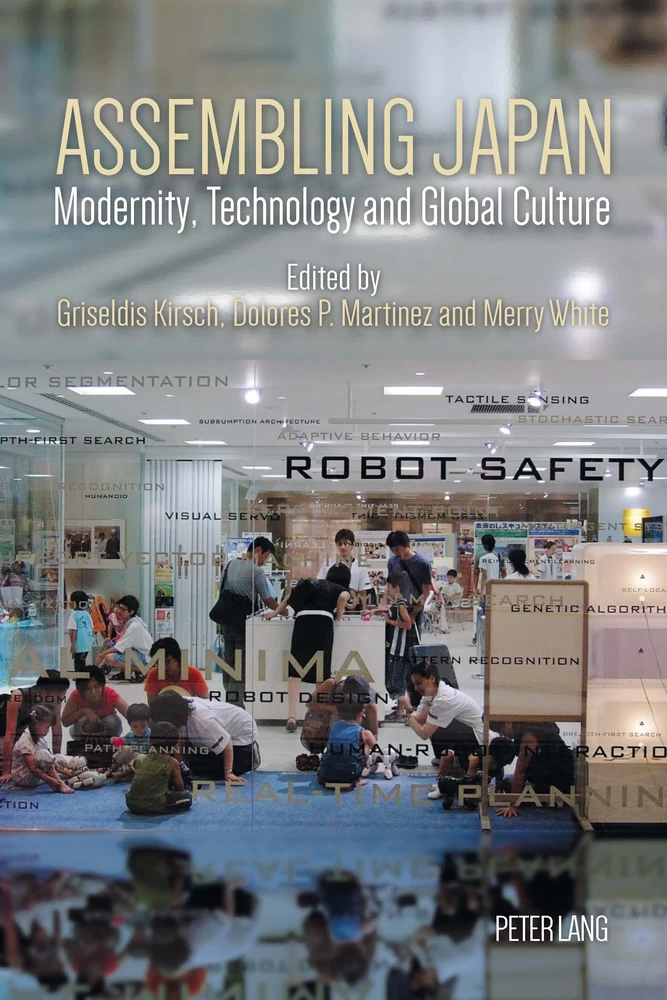
Assembling Japan
Modernity, Technology and Global Culture
Summary
The approaches in this collection are manifold. Some chapters examine the themes of modernity, technology and Japan’s global experience though popular culture, from reggae to football, from television to film. Other topics include coffee, travel, economics, cultural politics and technological innovation in the field of robotics. All of the contributions aim to show how these global interactions have occurred and continue to take place in twenty-first-century Japan.
Excerpt
Table Of Contents
- Cover
- Title
- Copyright
- About the author
- About the book
- This eBook can be cited
- Contents
- Acknowledgements
- Japan as an Assemblage
- Part I Roots and Branches
- Café Society in Japan: Global Coffee and Urban Space
- ‘A Japanese in Every Jet’: Globalism and Gendered Service in the Jet Age
- Rewrapping the Message: Museums, Healing and Communicative Power
- Part II Contemporary Configurations
- Football in the Community: Global Culture, Local Needs and Diversity in Japan
- Relocating Japan? Japan, China and the West in Japanese Television Dramas
- Japanese Reggae and the Def Tech Phenomenon: Global Paths to Intra-cultural Pluralism
- Part III Technological Connections: Past, Present and Future
- The More I Shop at Yaohan, the More I Become a Heung Gong Yahn (Hongkongese): Japan and the Formation of a Hong Kong Identity
- Global Technologies, Local Interventions: Or Musings on Japanese Film
- Branding Humanoid Japan
- Afterword: Reassembling after 3/11
- Notes on Contributors
- Index
Café Society in Japan: Global Coffee and Urban Space
Origins
In Japan coffee is normal; the most common of social beverages – more so than tea. It is of the wider world as well as one of the earliest globalizing commodities and currently trades second only to petroleum. From its first uses in North Africa to the present, it has been on the move and quickly has become a local beverage. However, coffee has always had to travel considerable distances to become an ordinary part of life for most of us: the major consuming countries are not, except for Brazil, major producing countries. Coffee’s markets are diverse and continue to grow as consumers are educated to want more choices and to respond to trends in taste and place.
Japanese engagement in this market flow of beans and the cultures of coffee taste has changed over time: its ‘globalization’ in Japan has in part related to the fact that the beans travel and in part related to the influences of western coffee drinking. In a most interesting twist, it was Japanese production and entrepreneurship, some argue, that gave the impetus to the worldwide coffee market a century ago. Currently we see coffee made in Japanese coffee equipment (most made by the Hario and Kalita companies) all over the world, used with the techniques that these tools demand. Its ‘Japaneseness’ has become a brand. Japan’s beans, like those of specialty coffee menus everywhere, come from Brazil, Ethiopia, Colombia and elsewhere. Japan’s quality testers (QT certified) are finicky and certify a varietal or a roast with fastidious certainty. These blends are often superior: while a blend in most of the rest of the world is less trusted, seen to ← 23 | 24 → be created to hide the taste of lesser beans, in Japan and in specialty coffee shops elsewhere, they are created by a master who knows how to make a brew of complementary beans, a drink better than the sum of its parts. Consumption is about trust.
Coffee has given character to and inspired connoisseurship of several kinds in social spaces in Europe and Asia while also being the catalyst – no more than a cup at a table needed – for a wide range of engagements. In the earliest locations of social coffee drinking, the cafés of the eastern Mediterranean, in Turkey and points east and south, men sit at tables in town squares talking for hours over the cups that come unbidden as soon as one sits down. Coffee bears witness to every type of discussion, confession, challenge and repartee. Coffee offers rest and stimulation, silence and community. The American politician on the stump knows to stop in at a town’s hub, its coffee shop, for a ‘cuppa joe’ and a donut, but more than that, for the contact with the central social organization beyond the town hall, the church and the school. The invitation to share coffee goes well beyond the beverage itself. ‘Let’s have coffee’ has different tonalities depending on the space chosen and on the uses of the moment for which coffee gives ample excuse.
Coffee and its cafés have also provided the loci for artistic and political movements. In Paris, Michelet said that coffee is ‘the great event which created new customs and even modified the human temperament’ (Barthes 1987: 190). In France again it was said that the salon stood for privilege, but the café for equality. This ‘equality’, often a challenge to established power, has sometimes given the space of the café a bad name. As one observer noted: ‘If a café has a police record, it is an interesting place.’
Thus coffee has had its enemies. In seventeenth-century England, shortly after coffee became popular there, women campaigned against the brew because it was said to diminish men’s virility. In Germany Frederick the Great forbade the roasting of coffee – seen as fuel for sedition – and he hired sniffers (Kaffeeschnüffler) to search out coffee roasting in unlicensed establishments. Coffee was the stuff of revolution in America also, as anti-British sentiment drove people to drink coffee instead of tea, and to leave tea to the British whose colonies amply provided them with their imperial drink. The coffeehouses of my political youth on the US East ← 24 | 25 → Coast in the 1970s were also informal headquarters for anti-establishment demonstration planning.1
Coffee in New Japanese Spaces
I focus here on the role of coffee in creating new kinds of places within metropolitan spaces and settings for the development of ‘urbanity’ in Japan, most particularly through the coffeehouse or café (kōhii hausu or kissaten). While a village market square maintains the relationships and character of a face-to-face community, the city café, with open access, encourages new connections as well as anonymous, temporary contiguity. The global and local influence each other in such urban places, but do not necessarily interact more deeply.
Since the first appearance of a modern cafe in Tokyo in April of 1888, cafés have been places where people have gathered to be both together and alone, for social recreation or for being private in public. Learning the new urbanity of the Meiji Era (1868–1912) was a project in which people became modern and democratic, learning the responsibilities of citizens, adopting a set of ideas, behaviours, structures and laws. When cafés were classrooms for modernity, they encouraged patrons (and do sometimes today) to learn to be ‘urbane’, to learn new options for dress and behaviour and to learn what at the time was becoming a form of civil society. This new urbanity was/is different from the Edo (1603–1868) experiences of neighbourhood, class and social engagement. It is part street wisdom, part cultural and political awareness and part what Elias (2000) calls moral character: the proprieties and the values that support or insist on it are the ← 25 | 26 → products of the contacts, movements and settlements of people in such places of witness and exchange.
In such places, urbanity means not the sophisticated glamour or doubtful morals of the flaneur or boulevardier in a transient, placeless culture, but what might be called instead ‘globalism’ – an interaction between likely and unlikely people and places, where an absence of the strictures of roles in the predictable institutions of family, school and workplace, allow for experimentation and choices in a changing society. The Japanese coffeehouse, novel in the early twentieth century, was seen as the symbol of the modern. According to Tipton (2000) the café was more significant than the Japanese Diet (Parliament), as it was the locus of expression of a popular will. Habermas’ (1991) view of the English coffee house of the eighteenth century as a locus of class mingling and democratic communication is a possible parallel to this view.
Details
- Pages
- VI, 251
- Publication Year
- 2016
- ISBN (Softcover)
- 9783034318303
- ISBN (PDF)
- 9783035307672
- ISBN (MOBI)
- 9783035397406
- ISBN (ePUB)
- 9783035397413
- DOI
- 10.3726/978-3-0353-0767-2
- Language
- English
- Publication date
- 2015 (December)
- Keywords
- Japan Nippon Japanese culture robots
- Published
- Oxford, Bern, Berlin, Bruxelles, Frankfurt am Main, New York, Wien, 2015. VI, 251 pp.
- Product Safety
- Peter Lang Group AG
