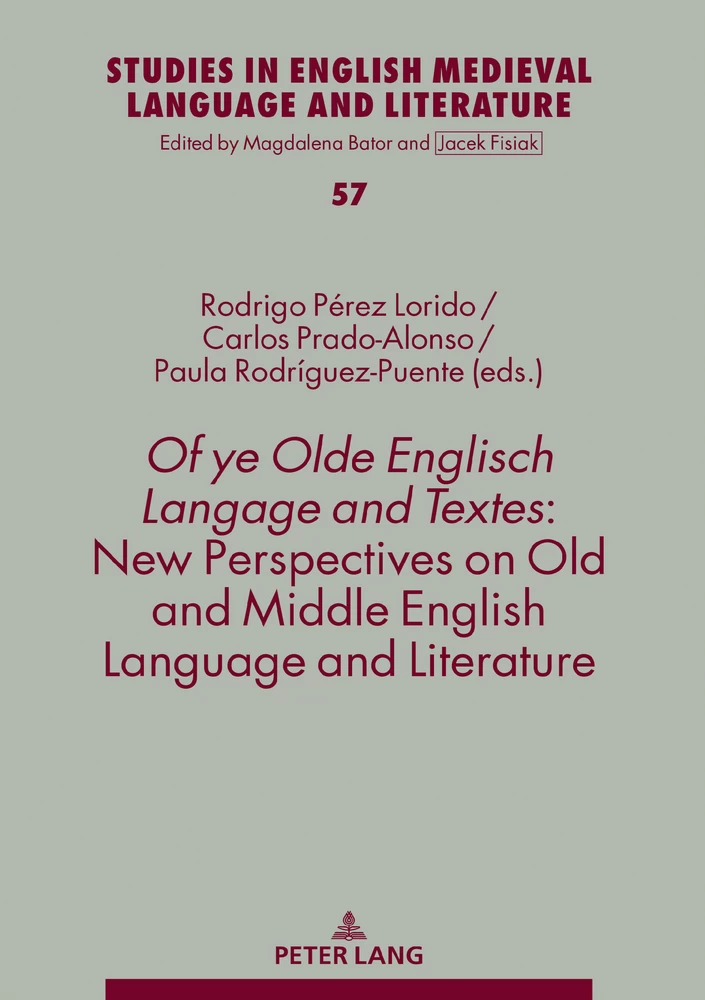
Of ye Olde Englisch Langage and Textes: New Perspectives on Old and Middle English Language and Literature
Summary
Excerpt
Table Of Contents
- Cover
- Title
- Copyright
- About the editors
- About the book
- This eBook can be cited
- Acknowledgements
- Table of Contents
- List of Contributors
- 1. Introduction
- PART I. Language analysis and variation
- I.A Lexis and semantics
- 2. The Expression of non-individual in some Old English nouns (Oxana Kharlamenko)
- 3. The lexicalisation of a Middle English binominal (Olga Timofeeva)
- 4. Tracking down deadly and mortal(ly): The early history (Zeltia Blanco-Suárez)
- I.B. Spelling and phonology
- 5. Coda approximants in British English: A diachronic and synchronic account (Gjertrud F. Stenbrenden)
- 6. Eduard Sievers’ Altgermanisch Metrik 125 years on (Nelson Goering)
- 7. Classifying scripts, with particular reference to Anglicana and Secretary (Jacob Thaisen)
- I.C Register
- 8. Coordination and subordination in Middle English scientific prose: Textual variation in focus (Jesús Romero-Barranco/Paula Rodríguez-Abruñeiras)
- 9. Germanic culinary recipes in the Middle Ages - a comparative typological study (Magdalena Bator/Elżbieta Pawlikowska-Asendrych)
- 10. The periodisation of Older Scots (Sergio López-Martínez)
- PART II. Textual analysis and translation
- II.A Translation
- 11. Revisiting the Latin influence on Middle English interrogative who of (Ayumi Miura)
- 12. “Are the in-laws swearing?”: Editing Old English manuscripts for translation through Beowulf’s Galician aliterative rendering (Jorge Luis Bueno-Alonso)
- II.B Text transmission
- 13. “In hethenesse”: Chaucer’s Knight and Sultan Muḥammad V of Granada (Richard North)
- 14. “For to understand that much work the leech shall have”: The context of the Agnus Castus herbal in MS Sloane 7 (María José Esteve Ramos)
- Series index

Gjertrud F. Stenbrenden
5. Coda approximants in British English: A diachronic and synchronic account
Abstract Present-Day English (PDE) has four approximants: two semi-vowels (/j/ and /w/) and two liquids (/r/ and /l/). Approximants are phonetically vowel-like with little obstruction to the airstream, but phonologically consonant-like, forming syllabic onsets and codas. Phonotactically, the semi-vowels have been restricted to onsets since Middle English. In most varieties of English in England, the /r/ is restricted to onsets too, after R-Dropping. The same process is affecting coda /l/ in many varieties of PDE (L-Vocalisation). Historically, the approximants show other striking similarities, including their tendency to lengthen preceding vowels, and to vocalise and combine with preceding vowels to form diphthongs. This paper briefly outlines the historical developments of English approximants; assesses articulatory-acoustic findings from modern processes affecting approximants, and evaluates how these may elucidate historical processes; and determines which model(s) provide(s) the best account of these changes. I propose that a model combining both articulatory-gestural and acoustic features is best able to describe what happens to coda approximants, and that a model which additionally accommodates syllable structure and re-analysis goes a long way towards explaining the peculiar long-term behaviour of British English approximants.
Keywords: British English approximants, coda approximants, historical phonology, acoustic-articulatory phonetics, gestural timing.
1 Introduction1
Present-Day English (PDE) has four approximants, which are sub-divided into semi-vowels (/j/ and /w/) and liquids (/r/ and /l/). Approximants are phonetically vowel-like, pronounced with little obstruction to the airstream, but phonologically consonant-like, forming syllabic onsets and codas.
Phonotactically, the semi-vowels /j/ and /w/ are restricted to onsets, which restriction dates back to Middle English (ME). In most English varieties in England, the /r/ is restricted to onsets too, after the eighteenth-century process called R-Dropping (Wells 1982: 218–222). Interestingly, the same process seems to be happening to /l/ in many varieties of English worldwide: L-Vocalisation ←109 | 110→(Wells 1982: 213–218, 258–259) entails the vocalisation of the dark [ɫ] allophone into some kind of back rounded vowel, phonetically [o];, [ʊ] or [ɤ].
Thus, there seems to be a long-term ‘conspiracy’ in British English (BrE) to bar approximants from syllabic codas. The fact that coda approximants have been lost, and are being lost, in BrE is commented on by Nishihara & van de Weijer (2015: 198), but they examine /r/ only, and no further back than early Modern English (ModE). To my knowledge, no-one has investigated the long-term development of all the approximants from Old English (OE) to PDE, with respect to phonotactic restrictions.
There are additional similarities in the developments of the approximants. One is that they have tended to vocalise into glides which have combined with the preceding vowel to form diphthongs, which have subsequently been phonemicised. This happened both when OE -ġ [j]; and -w were vocalised and after R-Dropping, and it is perfectly possible that the phonetic diphthongs resulting from PDE L-Vocalisation will become phonemicised once the process ‘settles down’ (cf. Wells 1982: 259). Related to this may be a third feature of approximants, which is their tendency to lengthen the preceding vowel (cf. Stuart-Smith 2007: 1451).
A fourth feature, which is common to the liquids, is the existence of marked allophony, and it is the nature of the coda allophone that makes vocalisation possible. The case is clear for /l/: it is only the dark allophone which is vocalised in the modern process.2 The case for /r/ is less obvious, but evidence from ongoing /r/-loss in accents of Scots suggests that they exhibit striking /r/ allophony, and that only the coda /r/ is subject to derhoticisation (Stuart-Smith 2007).
There is evidence from earlier stages of English to suggest that such processes have affected English approximants long before the early ModE period. The present article proposes that approximants share articulatory and acoustic properties which make them amenable to certain phonetic processes, and that a model which seeks to explain these should include findings from research on modern changes affecting approximants. The historical processes, and the evidence for them, are sketched out in sections 2–6. Findings from research on modern changes are outlined in section 7, and my conclusions are given in section 8. Historical material is mainly culled from A Linguistic Atlas of Early Middle English (LAEME) and A Linguistic Atlas of Late Mediaeval English (LALME, and ←110 | 111→the digital version eLALME), but also from the online Dictionary of Old English Corpus (DOEC).3
2 The development of the semi-vowels /j/ and /w/
In most British-based phonologies, the symbols /j/ and /w/ are reserved for the consonants in e.g. yet/year and wet/water, which is in keeping with the etymologies and early spellings of the words in question: e.g. OE ġiet ‘yet’, ġēar ‘year’, and wǣt ‘wet’, wæter ‘water’.4 In OE, however, <ġ> and <w> were also used for approximants in coda positions, e.g. weġ ‘way’ and brēaw ‘eyebrow’. In other words, there was no phonotactic restriction on semi-vowels in OE. In PDE, on the other hand, both semi-vowels are restricted to onsets, and diphthongal off-glides which are reflexes of historical -ġ and -w are rendered as /ɪ/ and /ʊ/, e.g. /weɪ/ way, /braʊ/ brow. Admittedly, even in OE, vocalic and consonantal spellings co-vary, e.g. <wei>/<weg> ‘way’ and <meu>/<mew> ‘mew’ (Campbell 1959: §§ 266–274).5
What seems to have happened is that the semi-vowels vocalised – ġ after front vowels and w after a range of vowels – and combined with the preceding vowel to form diphthongs. If the preceding vowel was close, the process resulted in a long monophthong (e.g. OE stiġ > sty). As this process did not apply across syllable boundaries in OE, and there was paradigmatic alternation between palatalised and velar consonants, the consonant (spelling) was often paradigmatically restored. In ME, the process expanded to apply across syllable boundaries also, and the vocalised variant was generalised. It is at this date that vocalic spellings greatly increase in number: in LAEME, spellings with a vowel for the <ġ> of OE <dæġ> ‘day’ and <weġ> ‘way’ outnumber those that have a consonant. Thus, even if the initial phases of the phonotactic restriction on semi-vowels may go ←111 | 112→back to early OE (or indeed to West Germanic, vide Campbell 1959: §§ 120, 272), it did not become fully operative until ME.
3 Old English breaking
In OE breaking, front vowels (i.e. i/ī, e/ē, æ/ǣ) somewhat inconsistently ‘broke’ into diphthongs before certain consonants or consonant clusters, i.e. before h [x]; alone or in a cluster, and before /l/+C and /r/+C; Campbell (1959: § 139) includes a following w as well. The evidence is found in the form of digraphs for etymological monophthongs from the earliest recorded OE, e.g. <eald> (besides <ald>) ‘old’, <eorl> ‘earl’, <heah> ‘high’. In classical West-Saxon, the digraphs are <io>, <eo> and <ea> for the product of broken i, e and æ, respectively, but very early spellings for the first two are in fact <iu>, <eu> (Campbell 1959: §§ 139–156, 275–277), which makes Campbell (1959: § 139) conclude that the “vocalic glide would no doubt at first be in all cases a rounded sound”,6 but that the off-glide of the breaking product of æ unrounded “when ǣo from Prim. Gmc. au became ǣa” (1959: §139).
It is likely that /l/ and /r/ had back or ‘dark’ (velarised, uvular, or retroflex) allophones even in early Gmc (cf. Sweet 1888: §§ 899–901, 906, Bisiada 2009),7 and many accounts of breaking assume that the development of glides was a gestural transition phenomenon. An articulatory gesture has been defined as “a clearly identifiable motion towards an apparent target” (cf. Sproat & Fujimura 1993: 304). In the case of breaking, the tongue necessarily had to move from a front vowel to a back consonant, and the transition was perceived as an obscure glide vowel, either a schwa-like sound or a vowel the same height as the original vowel (Campbell 1959: § 139).8
←112 | 113→4 Old English back mutation
‘Back mutation’ is used of a process affecting the prehistoric OE short front vowels i, e and sometimes æ/a when there was a back vowel u, o, a in the second syllable; the front vowels broke into the same diphthongs as those produced by breaking, and back mutation usually only took place when there was a single intervening consonant. Examples are ealu ‘ale’, eofor ‘boar’, heorot ‘hart’. Interestingly, in West-Saxon, back mutation happened only when the intervening consonant was a labial (f, p, w, m) or a liquid (l, r) (Campbell 1959: §§ 205–221). Thus, even if it is arguable whether the approximants were in coda position in these cases, the formation of diphthongs before only these consonants suggests that the ‘mutation’ did not have a single cause: that is, the presence of a back (rounded) vowel in the following syllable may not have been sufficient to cause back mutation. Rather, back mutation was the result of the combined effect of a following labial or liquid plus a back vowel.
5 Middle and early Modern English changes involving /r/
5.1 The effect of /r/ on preceding vowels
Sweet (1888: §§ 789, 904–905) notes the effect of /r/ on preceding vowels. The lowering of /e/ to [a]; before /r/ started in late ME and continued in early ModE (Sweet 1888: § 789); ǣ may likewise have been lowered to [a:] before /r/ (Sweet 1888: § 782).9 In the fifteenth century,10 the short vowels i, e, u before /r/ gradually merged into one vowel, probably mid and central, in what is called the first ←113 | 114→nurse merger (Wells 1982: 199–203); the resulting sound was lengthened and is reflected as PDE /ɜ:/. This Pre-R Lengthening took place in the seventeenth century (Wells 1982: 201), and affected all short vowels before /r/ (e.g. fir, fern, fur, start, north).
5.2 R-Dropping
Sweet (1888: §§ 902–905) refers to the ModE loss of postvocalic /r/, but does not trace the development of the R-Dropping itself. Wells (1982: 218–222) suggests that, in order to account for the lax quality of the nucleus of PDE centring diphthongs /ɪə eə ʊə/, R-Dropping was preceded by Pre-R Laxing of the vowel, and then Pre-R Breaking, such that schwa glides developed between the historical vowel and the following /r/, whereupon the /r/ itself was lost in the eighteenth century (cf. Heselwood 2009, Szalay 2014). Thus, R-Dropping as a process is quite similar to OE breaking, but in the more recent process, the coda /r/ was subsequently lost, and the centring diphthongs were phonemicised.
R-Dropping made the affected accents non-rhotic. Interestingly, certain accents of Scots (which have been firmly rhotic until now) have been undergoing R-Dropping or derhoticisation in the last decade (Stuart-Smith 2007, Lawson et al. 2008). More specifically, coda /r/ in these accents may be “weakened to a pharyngealized vowel” (cf. Lawson et al. 2008: 102) or at least ‘reduced’ in ways that are somewhat elusive. I will return to PDE derhoticisation in section 7, as it may shed light on the historical process of R-Dropping.
6 Middle and Modern English changes involving /l/
6.1 Vocalisation of /l/ in should and would
The loss of /l/ in should (< OE sceold-) and would (< OE wold-) has had consequences for the spelling of could (< OE cūþe): in the latter, there is an unhistorical <l>, presumably based on the spelling of the other two verbs after the /l/ in these was lost (cf. Sweet 1888: § 907). As for the dating of the loss of /l/ in should and would, the following may be observed. LAEME has no examples of the unetymological <l> in could; it has 5 examples of would without <l>, and 10 tokens for should without <l>, as shown in Tab. 1.11 There are two early examples from Suffolk and Worcestershire, but the majority of the <l>-less forms are recorded in early-fourteenth-century sources whose scribal language has been localised to the North, the North-East Midlands, and the South-West ←114 | 115→Midlands. Hence, the beginnings of the /l/-loss in these verbs may be dated to possibly the late twelfth century, but it was certainly not common until the early fourteenth. As the verbs retain the etymological <l> in PDE, it is difficult to date their /l/-loss more precisely; nor is it certain whether the loss of /l/ entailed diphthongisation – the digraph <ou> seems to suggest that such was the case, but the digraph here could well represent ME [u]; (as in country).
A search in eLALME (Tab. 2) produces a very high number of tokens for all the three verbs.12 There are <l>-less forms for should in 34 Linguistic Profiles (LPs), <l>-less forms for would in 16 LPs, and forms with <l> in could in 11 LPs. That is, by late ME, the process of /l/-vocalisation in the two verbs in question was certainly well under way, and the process appears to have started in should. The analogical insertion of <l> in could must be dated to late ME.
Tab. 1: Forms for would and should without <l> in LAEME

Tab. 2: <l>-less forms for should/would, and forms with <l> in could, in LALME
Verb |
Form |
Localisation and LP nos. |
Details
- Pages
- 344
- Publication Year
- 2020
- ISBN (Hardcover)
- 9783631817957
- ISBN (PDF)
- 9783631821329
- ISBN (ePUB)
- 9783631821336
- ISBN (MOBI)
- 9783631821343
- DOI
- 10.3726/b16935
- Language
- English
- Publication date
- 2020 (June)
- Keywords
- Old English Middle English Spelling and phonology Lexis and semantics Syntax and register Textual analysis
- Published
- Berlin, Bern, Bruxelles, New York, Oxford, Warszawa, Wien, 2020. 344 pp., 25 fig. b/w, 56 tables.
- Product Safety
- Peter Lang Group AG
