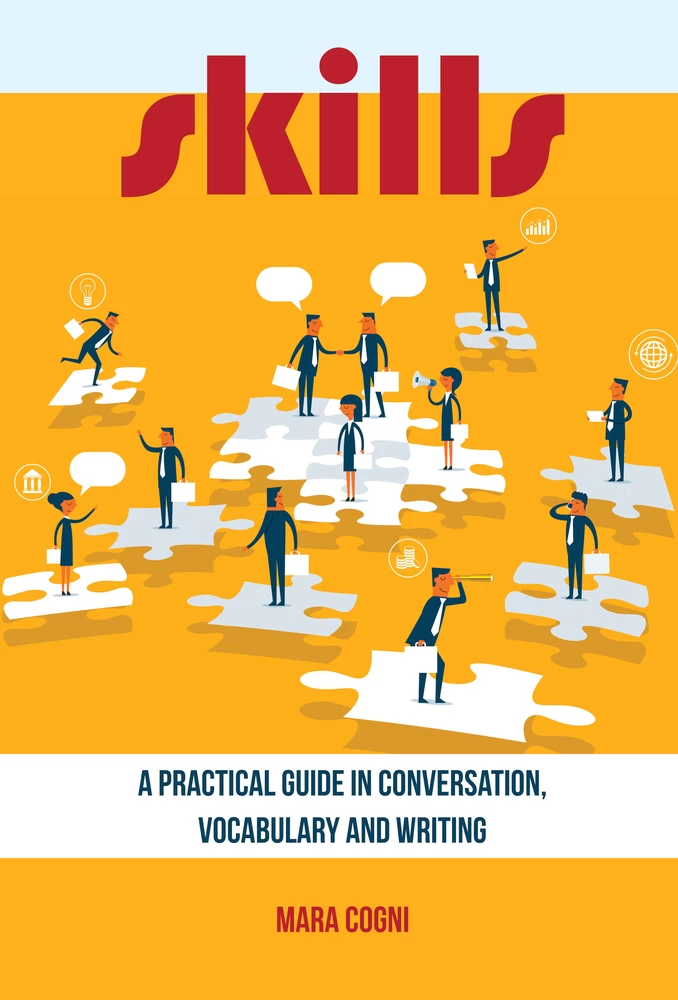
Skills
A Practical Guide in Conversation, Vocabulary and Writing
Summary
This book offers a more reflective approach to thinking and talking about skills. Learners will become well-equipped with knowledge and understanding of a set of skills they can ascribe to themselves and others. This will, consequently, prepare them for a world of work that is very specific in its skillset requirements. The book aims at helping students think critically about skills both orally and in writing. It also includes activities intended to expand vocabulary, which underlies successful communication.
Excerpt
Table Of Contents
- Cover
- Title
- Copyright
- About the author
- About the book
- This eBook can be cited
- Contents
- Introduction
- Chapter 1. Personal Skills
- Flexible
- Diligent
- Detail oriented
- Proactive
- Ambitious
- Perseverant
- Passionate
- Empathetic
- Self-sacrificing
- Curious
- Discipline
- Sociable
- Confident
- Competitive
- Courageous
- Chapter 2. General Skills
- Listening
- Speaking
- Reading
- Writing
- Communication
- Cooperation
- Observation
- Responsibility
- Problem solving
- Conflict management
- Critical thinking
- Self-motivation
- Digital competence
- Emotional intelligence
- Ethical reasoning
- Chapter 3. Skills and Jobs
- Healthcare
- Mental healthcare
- Childcare
- Education
- Engineering
- Food service
- Tradesmanship
- Media and journalism
- Chapter 4. Skills for the Future
- Dealing with ambiguity
- Avoiding confirmation bias
- Cognitive flexibility
- Deep focus
- Dialectical thinking
- Chapter 5. Skills in Literature and Films
- References
Mara Cogni
Skills
A Practical Guide
in Conversation,
Vocabulary
and Writing

PETER LANG
New York • Bern • Berlin
Brussels • Vienna • Oxford • Warsaw
Library of Congress Cataloging-in-Publication Control Number: 2019023837
Bibliographic information published by Die Deutsche Nationalbibliothek. Die Deutsche Nationalbibliothek lists this publication in the “Deutsche Nationalbibliografie”; detailed bibliographic data are available on the Internet at http://dnb.d-nb.de/.
ISBN 978-1-4331-5040-1 (paperback: alk. paper)
ISBN 978-1-4331-7130-7 (ebook pdf)
ISBN 978-1-4331-7131-4 (epub)
ISBN 978-1-4331-7132-1 (mobi)
DOI 10.3726/b15818
© 2019 Peter Lang Publishing, Inc., New York
29 Broadway, 18th floor, New York, NY 10006
www.peterlang.com
All rights reserved.
Reprint or reproduction, even partially, in all forms such as microfilm, xerography, microfiche, microcard, and offset strictly prohibited.
About the book
Many students today have to grapple with questions such as What am I very good at? and What are my strengths and how can I use them for a better life? These are central questions for us as learners, employees, family members, friends and thriving individuals in general. An inquiry into our skills helps us discover our potentialities and the talents we need in order to create a fulfilling life. As a result, it assists us in successfully finding the right role for ourselves in society. Skills: A Practical Guide in Conversation, Vocabulary and Writing is intended to take learners on a reflective skill-investigative journey, in which speaking and writing about skills is both self-exploratory and fun.
This book offers a more reflective approach to thinking and talking about skills. Learners will become well-equipped with knowledge and understanding of a set of skills they can ascribe to themselves and others. This will, consequently, prepare them for a world of work that is very specific in its skillset requirements. The book aims at helping students think critically about skills both orally and in writing. It also includes activities intended to expand vocabulary, which underlies successful communication.
This eBook can be cited
This edition of the eBook can be cited. To enable this we have marked the start and end of a page. In cases where a word straddles a page break, the marker is placed inside the word at exactly the same position as in the physical book. This means that occasionally a word might be bifurcated by this marker.
CONTENTS
Courageous←v | vi→
Details
- Pages
- VIII, 258
- Publication Year
- 2019
- ISBN (Softcover)
- 9781433150401
- ISBN (PDF)
- 9781433171307
- ISBN (ePUB)
- 9781433171314
- ISBN (MOBI)
- 9781433171321
- DOI
- 10.3726/b15818
- Language
- English
- Publication date
- 2019 (July)
- Published
- New York, Bern, Berlin, Bruxelles, Oxford, Wien, 2019. VIII, 258 pp.
- Product Safety
- Peter Lang Group AG
