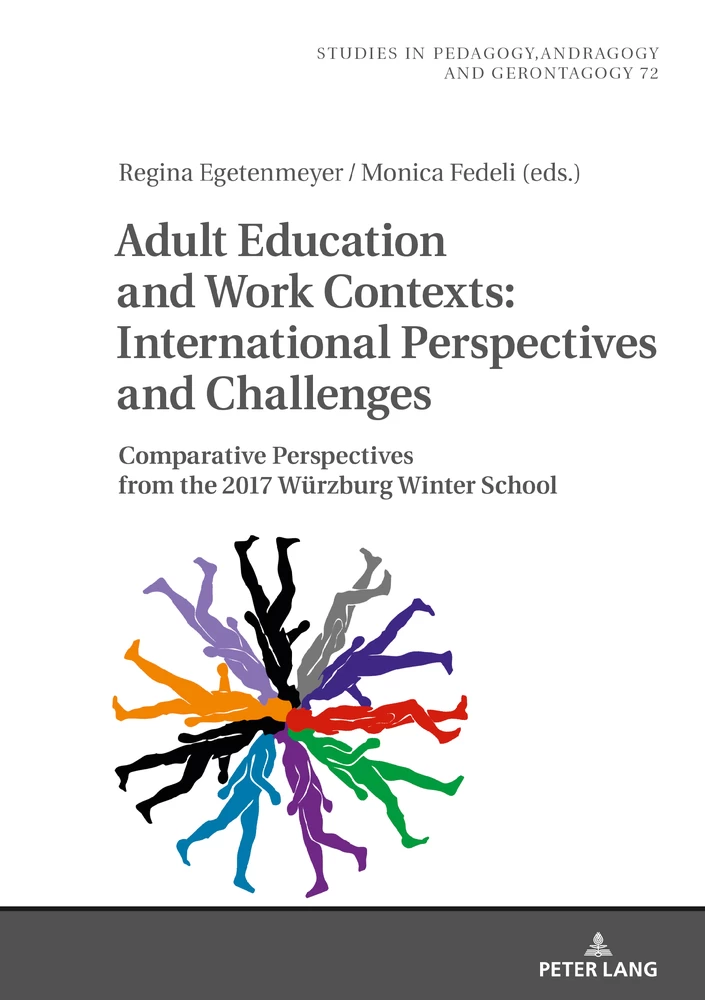
Adult Education and Work Contexts: International Perspectives and Challenges
Comparative Perspectives from the 2017 Würzburg Winter School
 Monica Fedeli (Volume editor)
Summary
Excerpt
Table Of Contents
- Cover
- Title
- Copyright
- About the author
- About the book
- This eBook can be cited
- Table of Contents
- Adult Education for work and beyond (Bernd Käpplinger / Steffi Robak)
- Adult learning and employability: International research and practice (Regina Egetenmeyer / Monica Fedeli)
- Lifelong Learning Policies Targeting Employment Contexts
- Comparing temporal agendas of policies and institutions in (work-related) adult education (Jan Schiller / Sabine Schmidt-Lauff / Fabio Camilloni)
- Lifelong learning and skill development policies and programmes: A comparison between India and South Korea (Arunima Chauhan / Hyejin Bak / Shreelakshmi Subbaswamy / Vijay Kumar Dixit)
- Comparing the Continuing Vocational Education and Training Policies of Italy, Brazil, and India: What could be compared and what could not be compared, and why? (Shalini Singh / Leonardo Silveira / Janiery da Silva Castro)
- Transnational Perspectives on Lifelong Learning Policies
- The influence of PIAAC results on (inter-)national adult education policy: A critical discussion of Austria and Estonia (Reinhard Lechner / Mari Liis Räis / Nitish Anand / Ahmet Murat Yetkin / Paula Guimarães)
- Implementing National Qualifications Frameworks: Difficulties in Cambodia and Germany (Lisa Breitschwerdt / Vicheth Sen)
- Supporting entrepreneurship in higher education for young adults’ employability: A cross-border comparative study (Vanna Boffo / Azeez Babatunde Adebakin / Carlo Terzaroli)
- Employment Perspectives and Professionalisation in Adult Education
- Between educating and teaching: The professional identity of adult educators. A transnational comparison between Portugal, India, and Germany (Christin Cieslak / Rute Ricardo / Jenny Fehrenbacher / Bharti Praveen / Kira Nierobisch)
- The development of employability skills in higher education curricula: A transnational comparison (Gaia Gioli / Nicoletta Tomei / Ashok Kumar / Sunita Sijwali)
- Learning and work: Efficacy of university internships for syrian and ugandan education students (Robert Jjuuko / Zahia Alhallak / Concetta Tino)
- Enhancing employability through innovative teaching methods in adult learning and education: A comparative study of Nigeria and India (Bolanle C. Simeon-Fayomi / Elizabeth A. Ajayi / Nikola Koruga / Geetanjali Baswani)
- Authors
- Reviewers
- Series Index
Bernd Käpplinger & Steffi Robak
Adult Education for work and beyond
Adult education is often closely connected to processes of modernisation (Salling Olesen, 2014; Schrader, 2014). That is why it is also reasonable to explain adult education with the help of modernisation theories, although modernity is and must nowadays also be viewed critically, as modernisation often produces negative outcomes in many respects. The individual in particular might have the feeling of being lost in such big transitions and threatened by a loss of their identity. Economic development is often achieved at the cost of pollution and a lack of sustainability. The so-called first world is exporting production and pollution to the so-called third world. It would be naive to think of modernisation only in terms of improvement. Societies undergoing significant changes caused by technological, political, or social reasons have a greater need for adult education. People cannot be prepared for such changes solely by ‘front-loading’ in school and initial training. Who would have expected 20 years ago that the world would look the way it does now? There are huge limits and challenges in preparing for the unknown future. Education has to prepare for the unknown, and it has to have a wide scope beyond immediate needs, although the actions and decisions of political and economic leaders are often short-sighted.
It has become popular to perceive adult education within a framework of employability and related policies. Being flexible and able to adapt seems to be the only required ability. The lifelong learning agenda from cradle to grave has something offensive and oppressive. It is not by accident that many people feel resistance and annoyance when it comes to learning. Nobody is ready to learn everything all the time. Retraining can be highly stressful. Adult education researchers and practitioners in particular should be aware of that and think critically of employability policies with their implied ideal of flexible women and men. There is a rich tradition of such critical approaches in adult education, which are aware that learning is not something exclusively positive. There is awareness in the discipline that the individual is not always ready to learn and that this reluctance is often absolutely legitimate and has to be respected. Adults should be free to decide if they want to learn or not.
Thus, it is very helpful that this volume makes such intensive reference to policies. Scholars in adult education have to be aware of policies, because their work is highly influenced by them in many respects. At the same time, they have ← 7 | 8 → to look beyond such policies and think critically about whether such policies really give serious consideration to the individual or collective points of view of learners and professionals. In many countries, there is presently strong criticism that policy-makers focus not enough on the people and their situations. Adult education, with its traditional focus on learners, bottom-up movements, and enlightenment, could play a key role in promoting different views in contrast to human resources management theories and top-down policies. The multi-layered system of adult education (cf. Schrader, 2014) cannot be governed top-down. This is only assumed by governments and administrations that overestimate their own influence and power.
The potential of adult education research and practice in offering different perspectives is far from being explored yet. This also means relating to one root of adult education, namely that in the labour movement. Educated workers also have to learn how to influence and shape their working conditions in relation to their own needs and interests. Adapting to the supposed needs of governments or big businesses is not enough. It would mean to lose a lot of the creativity and resources of workers, who often know much better than administrations what is needed in order to improve work results. Work nowadays should be organised beyond Taylorism and Neo-Taylorism, although work is very different in different parts of the world despite globalisation. It is very interesting to study the comparative approaches presented in this book. This book and the connected international Würzburg Summer School is a highly recommendable activity, one that is truly comparative. It enables us to learn more about each other. The Danish scholar Henning Salling Olesen wrote in 2014 (p. 54): ‘We may most productively see modernisation as an infinite process that is still dependent on human efforts and choices on individual, as well on global level.’ Considering the world’s present situation, it is important to remind us that we have to do something to avoid the end of modernisation by returning to oppressive neo-tribalist structures with their fraud and clientilism. Modernisation and democracy are no given, ever-lasting achievements but ongoing projects that require the global engagement and exchange of politicians, policy-makers, scholars, students, practitioners, and learners. This volume is a small but stimulating contribution to this endeavour.
References
Salling Olesen, Henning: “Adult Education in the Danish Modernisation Process”. In: Käpplinger, Bernd / Robak, Steffi (eds.): Changing Configurations in ← 8 | 9 → Adult Education in Transitional Times. Peter Lang: Frankfurt a.M. et al. 2014, pp. 39–56.
Schrader, Josef: “Strategies of Modernisation and their Effects on Configurations of Adult Education”. In: Käpplinger, Bernd / Robak, Steffi (eds.): Changing Configurations in Adult Education in Transitional Times. Peter Lang: Frankfurt a.M. et al. 2014, pp. 57–72. ← 9 | 10 →
Regina Egetenmeyer & Monica Fedeli1
Adult learning and employability: International research and practice
Abstract: Adult education has deep connections with employment contexts. This chapter outlines interrelations within transnational contexts studied during the 2017 Winter School on Comparative Studies in Adult Education and Lifelong Learning (COMPALL). The paper shows that adult education and work contexts are influenced by international and transnational issues.
Introduction
Adult education and employment have long been understood as oppositional contexts in society. Whereas adult education seems to follow pedagogical principles designed to develop people according to their individual abilities and interests, employment contexts seem to primarily follow economic principles of profit maximisation. This dichotomy is quite difficult to uphold in today’s heterogeneous societies, in which individual interests and lives are interdependent with various societal contexts. Whereas school education, in principle, offers pupils a protected space to develop away from real life for several years, adult education is traditionally much more embedded into ‘real life’ and people’s Lebenswelt. Adult education offerings have shorter time perspectives (sometimes just a few hours), and there is often an immediate interest in transferring skills to life and work. Likewise, financial resources frequently show the need for making links. This is already evident in the first studies on adult education participation in Germany (Strzelewicz, Raapke, & Schulenberg, 1966). Furthermore, employment contexts are rather diverse. The economic sector is not the only employment context. Public bodies and civil society also provide employment contexts (for adult education in Germany, see Autorengruppe wb-personalmonitor, 2017).
The chapters in this book focus on the interdependencies between adult learning and education on the one hand and employment contexts on the other. The internationally comparative focus of all papers shows how these interdependencies are interrelated with international developments and their transnational contexts. Employment contexts and employability are the focus of policies of international ← 11 | 12 → stakeholders (e.g. European Union, 2012; see chapters in this volume). Adult and continuing learning and education – besides other educational fields – seem to be understood as an activity promoting the employment opportunities of adults on the one hand and supporting the development of competences required by the employment market on the other hand. Adult and continuing learning and education are not only essential because of the ongoing development of technologies, innovations, and societies. They also become essential because of demographic developments. Education can no longer be understood under the perspective of a ‘normal biography’ (Kohli, 1985) – birth, education, and employment – as it was seen in several European countries. Moreover, individuals experience a range of options but also new pressure to develop their own life. Migration within and between countries and continents challenges people to adapt to new situations. Adult people migrating to find employment are faced with huge learning projects (Tough, 1971) when trying to adapt to the needs of the new employment contexts. But besides the perspectives on individuals and society at large, the contributions from India in this volume in particular show the political focus on skill development, which can be understood as a call from policy makers to adults to develop the skills needed by the economy.
From a transnational perspective, the papers in this volume analyse similarities and differences in adult education and their related developments. Besides all differences, the papers outline similarities in the terminology related to adult education and employment contexts: Terms such as skill development, soft skills, qualification framework, entrepreneurship, employability, and professional identity seem to be used in different international, national, and transnational contexts. The data in this volume only allow for formulating assumptions regarding these interdependencies, and one should be careful to identify an internationally implicit hegemonic development, as is frequently found in the ‘soft law’ discourse (Marcussen, 2004; Bieber & Martens, 2011) concerning the role of international organisations. Political scientists stress that international organisations do not have policies of their own (Klatt, 2014). Moreover, the policies of international organisations represent the agreements of national governments and stakeholders. This means that organisations do not develop policies contradicting those of national governments, and neither do they act as superordinate bodies to national governments. But in contrast to national developments, the development of international policies seems to be less transparent and less accessible compared to national discourses. One may ask if international educational policies can be understood as being above national agreements, or if they represent an agreement of some powerful members of international organisations. The Bologna Process, ← 12 | 13 → as well as the comparative analysis of educational policies performed outside of the COMPALL Winter Schools (Egetenmeyer 2016; Egetenmeyer, Schmidt-Lauff, & Boffo, 2017), indicate that international educational policies have an influence going way beyond member states. This can raise the question of an internationally hegemonic influence of international policies, but it can also raise the question whether international agreements are an expression of the cross-national developments indicated above. Maybe both developments reinforce each other and can even be analysed at the same time.
The contributions in this volume indicate that the employment contexts of university graduates in adult education are framed by international developments: National and international policies frame learning times (Schiller, Schmidt-Lauff, & Camilloni, in this volume). National governments develop qualification frameworks targeting the development of transparency with respect to international concepts (Breitschwerdt & Sen, in this volume). Results of the Programme for the International Assessment of Adult Competencies (PIAAC) serve as a reference for developments in national educational policies (Lechner et. al., in this volume). These few examples support the argument that the employment opportunities of people working in adult education are not only contextualized locally but also influenced by international developments. Besides these developments in the context of international policies, employment contexts in adult education have also become more international as a result of the internationalisation of societies and thereby through the international background of participants and through the development of an international market for continuing education (Egetenmeyer, forthcoming). This supports the argument that the employment contexts of university graduates in adult education are highly interwoven with international developments.
Employment contexts from the perspective of comparative adult education
Details
- Pages
- 226
- Publication Year
- 2017
- ISBN (Hardcover)
- 9783631737026
- ISBN (PDF)
- 9783631737033
- ISBN (ePUB)
- 9783631737040
- ISBN (MOBI)
- 9783631737057
- DOI
- 10.3726/b12114
- Open Access
- CC-BY-NC-ND
- Language
- English
- Publication date
- 2019 (April)
- Keywords
- Adult Education Educational Policies Adult Learning Employability Lifelong Learning
- Published
- Frankfurt am Main, Bern, Bruxelles, New York, Oxford, Warszawa, Wien, 2017. 226 p., 9 ill., 12 tab.
- Product Safety
- Peter Lang Group AG
Biographical notes
Regina Egetenmeyer (Volume editor)
Monica Fedeli (Volume editor)
Regina Egetenmeyer is Professor of Adult and Continuing Education at the University of Würzburg/Germany. Monica Fedeli is Associate Professor of Teaching and Learning Methods in Adult Education at the Università degli Studi di Padova/Italy.
