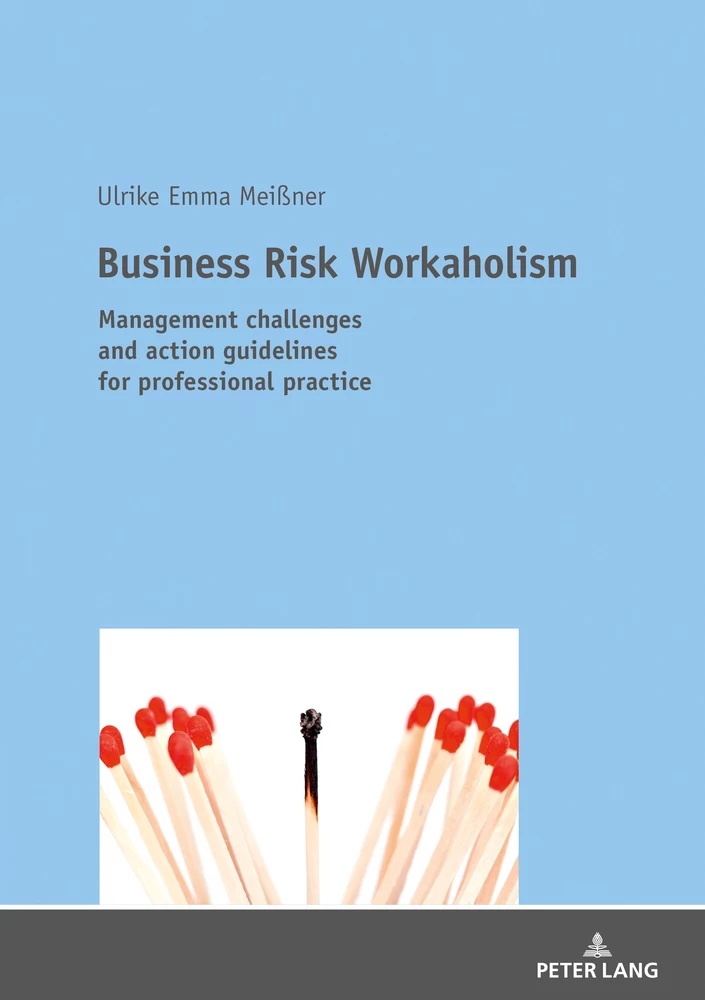
Business Risk Workaholism
Management challenges and action guidelines for professional practice
Summary
Excerpt
Table Of Contents
- Cover
- Title Page
- Copyright Page
- Dedication
- About the author
- About the book
- Citability of the eBook
- Foreword
- Contents
- List of figures
- List of tables
- List of abbreviations
- 1 Introduction
- 2 Theoretical background of workaholism
- 2.1 Differentiation between addiction and workaholism
- 2.2 Types of workaholism
- 2.2.1 Types according to Robinson
- 2.2.2 Types according to Fassel
- 2.3 Characteristics of workaholism
- 2.4 Symptoms, phases and progression of the addiction
- 3 Human resources risk management in regard to workaholism
- 3.1 Definition of human resources risks
- 3.2 Further human resources risks
- 3.3 Human resources risks associated with workaholism and the effects on business
- 3.3.1 Risk potential of compulsive/relentless workaholics and binge/bulimic workaholics
- 3.3.2 Risk potential in other types of workaholism
- 3.4 Human resources risks associated with workaholism and the effects on human resources
- 3.4.1 Human resources risks in regard to colleagues and co-workers
- 3.4.2 Human resources risks in regard to the workaholic
- 3.5 Concluding discussion
- 4 Empirical assessment
- 4.1 Research concept
- 4.1.1 Defining objectives and determining indicators
- 4.1.2 Target group identification and sample size
- 4.1.3 List of theses, questionnaire and data analysis
- 4.2 Empirical data analysis
- 4.2.1 Indications of workaholism
- 4.2.2 Operational influences on the development or promotion of workaholism
- 4.2.3 Operational consequences of workaholism - self assessment
- 4.2.4 Summary and conclusion of the empirical research outcomes
- 5 Risk analysis on the basis of research results
- 5.1 Risk analysis of workaholic behaviour traits
- 5.2 Risk analysis of workaholism symptoms
- 5.3 Risk analysis of operational influences on the development or promotion of workaholism
- 6 Actions guidelines
- 6.1 Possibilities for risk analysis of workaholism in companies
- 6.1.1 Employee surveys and personnel information talk
- 6.1.2 Work-Ability-Index and Work Addiction Risk Test
- 6.1.3 Analysis of work absences and fluctuation, assessing management executives and employees
- 6.1.4 Recommendation for the operational approach of a workaholism risk analysis
- 6.2 Recommendations for action for management
- 7 Summary and outlook
- Bibliography
Figure 1:Cost-Benefit-Graph Workaholism
Figure 3:Overview of areas of human resources risks
Figure 4:Comparison of symptoms 2017 (Workaholics) with 2005 study (Human Resources Departments)
Figure 5:Allocation of the symptoms to the stages of workaholism
Figure 6:Fears relating to colleagues in comparison with the 2005 study
Figure 7:Fears relating to operational framework conditions in comparison with the 2005 study
Figure 8:Fears relating to management in comparison with the 2005 study
Figure 10:Risk portfolio behaviour traits of workaholics
Figure 11:Risk portfolio symptoms of workaholism
Figure 12:Risk portfolio of operational influences on the development/promotion of workaholism
Figure 13:Personnel information talk
Figure 14:House of Work Ability according to Ilmarinen
Figure 15:Development of company action guidelines
Figure 16:Operational escalation phases of workaholism ←13 | 14→ ←14 | 15→
Table 1:Allocation of addiction characteristics to types of workaholism
Table 2:Physical and behavioural symptoms of workaholism
Table 4:Symptoms and stages of workaholism
Table 5:Optimal worker versus workaholic
Table 6:Human resources risks by types of workaholism
Table 7:Overview of thematic groups and question topics
Table 8:Gender distribution compared to further studies
Table 9:Age distribution in the 2017 study compared to case studies
Table 10:Employment status compared to further studies
Table 11:Academic degrees compared to further studies
Table 12:Allocation of illnesses to the stages of workaholism
Table 13:Workaholic behaviours
Table 14:Allocation of behaviours to the types of workaholism
Table 15:Comparison of the behaviours allocated to the types of workaholism with the 2005 study
Table 16:Example of a total cost scenario caused by a workaholic superior
Table 17:‘Visible’/‘invisible’ data analysis of symptoms
Table 18:Questions for the determination of workaholism criteria
Table 19:Comparison WAI-Questionnaire characteristics of workaholism
Details
- Pages
- 142
- Publication Year
- 2018
- ISBN (Softcover)
- 9783631766347
- ISBN (PDF)
- 9783631766354
- ISBN (ePUB)
- 9783631766361
- ISBN (MOBI)
- 9783631766378
- DOI
- 10.3726/b14596
- Language
- English
- Publication date
- 2018 (October)
- Keywords
- Human Resources Risks Addiction Workaholics Risk identification Human resources instruments work addiction
- Published
- Berlin, Bern, Bruxelles, New York, Oxford, Warszawa, Wien, 2018. 142 pp., 16 fig. b/w, 22 tables
- Product Safety
- Peter Lang Group AG
