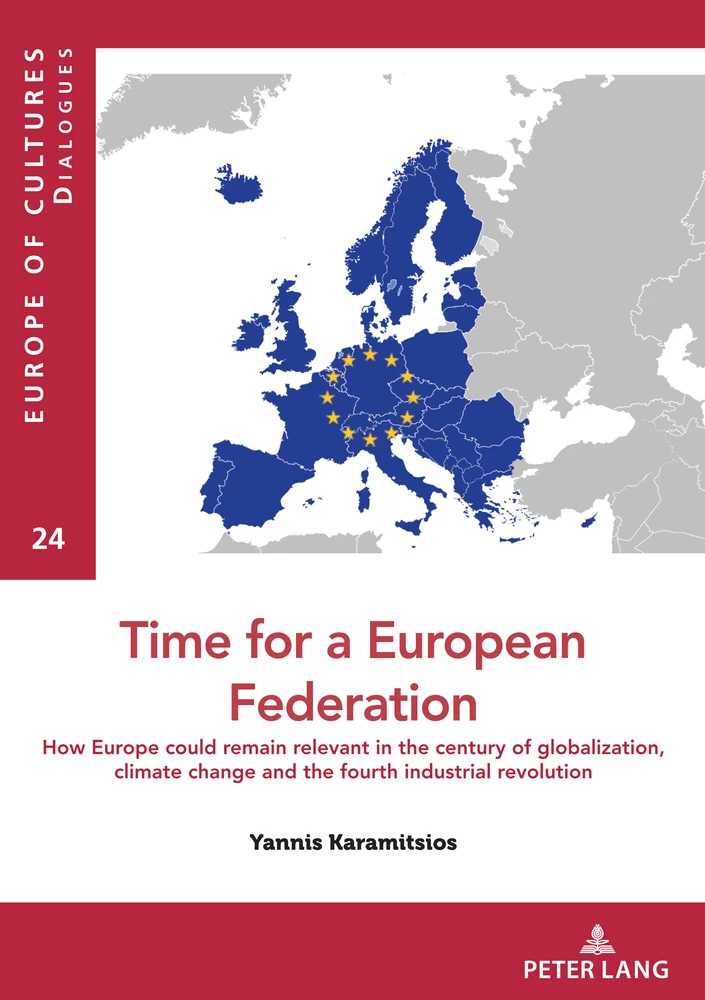
Time for a European federation
How Europe could remain relevant in the century of globalization, climate change and the fourth industrial revolution
Summary
This book proposes the creation of a federal European state that would replace and succeed the EU, its member states and other willing European countries. This is the only way for Europe to successfully address all those challenges and stay at centre stage in world affairs, in the century of globalization, climate change and the fourth industrial revolution. But addressing Europe’s existential challenges is not the only reason to move in that direction. A federal Europe would also become a major, self-sufficient geopolitical power, as strong as orstronger than the USA, Russia or China. It would be a model for other regional federations around the planet.
The book is not restricted to the analysis of why we need a federal European state but further suggests substantial policies for many different sectors: economy, banking, foreign affairs, defence, education, health, social security, immigration, human rights, agriculture, fourth industrial revolution, circular economy and climate – to name some of them. At the end, it presents a rough budget estimation to show that such a federation would not only be desirable but also be feasible.
Excerpt
Table Of Contents
- Cover
- Title
- Copyright
- About the author
- About the book
- This eBook can be cited
- Table of Contents
- Acknowledgements
- Preface
- Prologue
- Part I Conceptual framework for a European Federation
- Chapter 1 The historic need for a European Federation
- 1.1. Europe at the beginning of the 21st century: A brief state of play
- 1.2. Five existential challenges for Europe
- 1.2.1. Europe’s economic, financial and productive decline compared to the rest of the world
- 1.2.2. The demographic deficit: An ageing and stagnant population
- 1.2.3. The menace of climate change: Food dependence and water scarcity
- 1.2.4. Energy dependence on other countries
- 1.2.5. Exclusion from the leading edge of fourth industrial revolution
- 1.3. Scenarios for the way ahead – Why a European Federation?
- Chapter 2 The ideological framework of the European Federation
- 2.1. Federalism
- 2.2. Liberalism
- 2.3. Ecological development
- 2.4. European humanistic values
- 2.5. Practical tools for our common political lives
- 2.6. The European federalist movement
- Part II The four pillars of the European Federation
- Chapter 3 Political governance, democratic institutions and human rights
- 3.1 Political governance
- 3.1.1. The basic framework
- 3.1.2. Federalism and the principle of subsidiarity
- 3.1.3. The constitution
- 3.1.4. The parliament
- 3.1.5. The government
- 3.1.6. The Council of Governance
- 3.1.7. The judiciary
- 3.1.8. The Central Bank
- 3.1.9. Other institutions and advisory bodies
- 3.1.10. Accession to, and exit from, the EF
- 3.1.11. Road map towards the establishment of the EF
- 3.2 Democratic governance
- 3.2.1. Referenda at all levels
- 3.2.2. Democratisation of public decision-making
- 3.2.3. Public administration: Efficient, responsible, transparent and accountable
- 3.2.4. A strong framework against corruption.
- 3.2.5. Civic education – a tool of emancipation
- 3.2.6. Different human rights standards in the EU – a problem to be fixed
- 3.2.7. A common non-discriminatory legal framework for all EF citizens
- 3.2.8. High judicial and prosecutorial standards
- 3.3. Concluding summary
- Chapter 4 Economic governance through an economic, fiscal, monetary and banking union
- 4.1. The need for an economic, fiscal, monetary and banking union
- 4.2. Economic policy: The ten commandments
- 4.2.1. Entrepreneurship first
- 4.2.2. Simple and low taxation
- 4.2.3. Attraction of foreign direct investments
- 4.2.4. Export-driven economy
- 4.2.5. Focus on ecological development and circular economy
- 4.2.6. Knowledge-based economy
- 4.2.7. Business clustering and hubs of excellence
- 4.2.8. Public spending: No higher than 50 % of annual GDP, with a focus on strategic investments
- 4.2.9. Public – private partnerships and investment banks
- 4.2.10. Internal market
- 4.3. Fiscal policy
- 4.3.1. Sustainability of public debt and elimination of budget deficit
- 4.3.2. Simple and low taxation
- 4.3.3. Public revenues stemming from common EF assets
- 4.3.4. Rationalisation of public expenditures
- 4.4. Monetary policy
- 4.4.1. The euro as single currency for the entire EF
- 4.4.2. Two strategic objectives of EF monetary policy: A strong euro and a low level of inflation
- 4.4.3. Ensuring a flexible approach in case of crisis
- 4.5. Banking policy
- 4.5.1. The Liikainen report
- 4.5.2. Five strategic objectives for the banking sector
- 4.6. Concluding summary and budgetary aspects
- Chapter 5 Security governance: Common foreign, defence and security policy
- 5.1. Common foreign, defence and security governance as pillar of a sovereign state
- 5.2. EF’s global strategic objectives
- 5.2.1. Becoming a major geopolitical power
- 5.2.2. Promoting a global model of governance based on federalism and humanistic values
- 5.3 Strategic priorities of EF military defence
- 5.3.1. Joint defence force: A financially realistic objective
- 5.3.2. The five strategic objectives of EF military defence
- 5.4. Membership of NATO
- 5.5. Economic diplomacy
- 5.5.1. Maintain an open trade and investment system
- 5.5.2. Use of economic leverage to enhance the EF’s geostrategic interests
- 5.5.3. Economic diplomacy with Europe’s neighbourhood
- 5.6. Cultural diplomacy
- 5.6.1. Principles and tools of cultural diplomacy
- 5.6.2. Cultural diplomacy practised abroad
- 5.6.3. Cultural diplomacy practised in the EF territory
- 5.6.4. Cultural policy vis-à-vis Europe’s neighbouring regions
- 5.7 Strategic Alliance with Europe’s three big neighbours
- 5.7.1. Russia
- 5.7.2. Ukraine
- 5.7.3. Turkey
- 5.7.4. Assessment: A more universal approach
- 5.8 Concluding summary and budgetary aspects
- Chapter 6 Socio-cultural governance
- 6.1. The need for a joint identity and sense of European society
- 6.2. Social protection
- 6.2.1. Universal basic support
- 6.2.2. Universal basic pension
- 6.2.3. Universal health care and sickness allowance
- 6.2.4. Special allowances for people with disabilities
- 6.2.5. Pros and cons: Universal social protection
- 6.3. Education
- 6.3.1. A common European curriculum for primary and secondary education
- 6.3.2. Reduction of education poverty and inequality
- 6.3.3. Link education to the labour markets of the 21st century
- 6.3.4. World-class universities and research centres
- 6.4. Health
- 6.4.1. Invest in preventive programs to avoid later high health costs and suffering
- 6.4.2. A robust health industry and Europe as a global health hub
- 6.4.3. Achieving a cost-efficient health policy
- 6.5. Social cohesion
- 6.5.1. The managerial approach: Data collection through the Social Monitor
- 6.5.2. The financial approach: Material support and housing projects
- 6.5.2.1. Housing projects for the have-nots
- 6.5.3. The institutional approach: Inclusive participation of the citizens
- 6.5.4. Treatment of prisoners: Care for the down and out
- 6.5.5. Case study: LBJ’s Great Society programme
- 6.6. Concluding summary and budgetary aspects
- Part III Major policy sectors of the new European Federation
- Chapter 7 Immigration and demographic policy
- 7.1. Immigration policy
- 7.1.1. Introduction: The context
- 7.1.2. Reception of two million new immigrants per year
- 7.1.3. A consistent policy on non-invited immigrants: Refugees, economic immigrants and traffickers
- 7.2. Demographic policy
- 7.2.1. Introduction
- 7.2.2. A set of decisive measures
- 7.3. Concluding summary and budgetary issues
- Chapter 8 Agriculture and food policy
- 8.1. Introduction: The big challenges for European agriculture and food security
- 8.2. The EU Farm to Fork strategy
- 8.3. The EF strategic agriculture and food policy objectives
- 8.3.1. Embark on a new “green revolution” to increase agricultural production and food security
- 8.3.2. Rationalise water use
- 8.3.3. Reduce consumption of meat and dairy products
- 8.3.4. Reduce food waste and rationalise our food consumption
- 8.3.5. Increase the proportion of organic farming
- 8.3.6. Ensure access to foreign agricultural land and food production
- 8.4. Concluding summary and budgetary aspects
- Chapter 9 Enterprises, industry and employment during the fourth industrial revolution
- 9.1. The fourth industrial revolution and a new world of disruptions and opportunities
- 9.2. Strategic objectives
- 9.2.1. Support of new-tech business
- 9.2.2. New-tech ethics and social cohesion
- 9.2.3. Small and medium enterprises: Support for their special nature and needs
- 9.2.4. Industrial manufacturing: A new strategic direction
- 9.2.5. Improving the quality of research and investing in new labour skills
- 9.2.6. Employment policy: Protection of labour rights and mutual boost of business and employment
- 9.3. Concluding summary and budgetary issues
- Chapter 10 Climate policy, infrastructure networks and circular economy
- 10.1. Introduction: Basis for optimism and pessimism
- 10.2. The European Green Deal
- 10.3. Integrated networks of clean energy (wind, solar power, hydrogen and nuclear energy)
- 10.3.1. Wind power
- 10.3.2. Solar power
- 10.3.3. Hydrogen: A special opportunity for our future
- 10.3.4. Nuclear energy
- 10.4 Integrated networks of clean transport and water supply
- 10.4.1. Transport networks
- 10.4.2. Water supply networks
- 10.5. Switching to a circular economy: Reducing material and energy losses
- 10.6. The EU post COVID-19 stimulus package for green and digital transition
- 10.7. Concluding summary and budgetary issues
- Epilogue
- Appendix
- Notes
- Series titles
Acknowledgements and disclaimer
The creation of this book was realised thanks to the contribution of several persons.
Brooks Tigner carried out the linguistic revision. He worked on literally every single word of this text, improving and enriching its English, identifying gaps and inconsistencies, and spotting the parts that needed further elaboration. I am very grateful for his support.
Christos Bezirtzoglou stood behind the initial concept. We spent long hours discussing together the project’s basic notions, structure, and strategic objectives. He contributed sources and contacts who helped its development and to reach its maturity. I am also grateful to him.
Anita Seprenyi, Franzesco Guerzoni, Julia Stark, and Kiril Mitrov reviewed several parts of the script. Their valuable comments made it more accurate and thorough, and widened its perspectives.
The publishing house, Peter Lang, contributed its friendly, constructive, and professional co-operation. They embraced this bold political proposal with a very supportive attitude – not easy in a time lacking “euroenthusiasm” – while working diligently to improve its analysis in all respects. I am very grateful for this opportunity.
Most important, a word of special gratitude to my wife Katarzyna and daughter Dimitra for their patience during the long days of work that finally brought this text to fruition. Thanks to their understanding, my concentration on the task proved much easier.
Finally, I should note that I am employed by the European Commission and I am also member of several associations with political and social activity. I must thus clarify that all views expressed in this book are strictly personal and do not represent the positions of those organisations.
Preface
“The time for European sovereignty has come. It is time Europe took its destiny into its own hands. It is time Europe developed what I coined “Weltpolitikfähigkeit” – the capacity to play a role, as a Union, in shaping global affairs. Europe has to become a more sovereign actor in international relations. European sovereignty is born of Member States' national sovereignty and does not replace it. Sharing sovereignty – when and where needed – makes each of our nation states stronger.”
This is an extract from the ‘State of the Union’ speech I delivered in 2018 to the European Parliament, as President of the European Commission, which was among the guiding principles of my term in office between 2014 and 2019. We launched European defence, an extraordinary step forward since this policy area was not part of the Commission's remit. We launched the ‘Juncker Plan’, generating €550 billion in investments all across the Union. We concluded important trade agreements with Japan and Canada, showing that the EU remains an important global economic player. We introduced significant social programmes. And we worked for a more political Commission to make sure the entire Union attains a stronger political image and dimension.
Several events have since occurred that confirm my insistence on the need for European sovereignty: the UK’s withdrawal from the EU; the growing assertiveness of other big powers such as China; the climate crisis; the recent Indo-Pacific alliance of the USA, Australia, and UK that bypasses European partners; and of course the Covid-19 pandemic. They all remind us, as Europeans, of our common challenges and the need to take control of our destiny together.
Yannis Karamitsios’s book proffers a bold proposal for the future of Europe, namely its unification under a sovereign federal state. He argues that this is the only way to move forward in this century of burgeoning globalisation, climate change, and the impact of the fourth industrial revolution. European states can compete, and cooperate, with the rest of the world – but only as an integrated entity. We must seek common ←17 | 18→answers to the major questions of our time: geopolitical competition, diplomacy and defence, new technologies, ecological threats, and energy security, just to name a few.
Of course, not everyone would agree that Europe should evolve into a federation: some would counter that such a goal is too premature, risky or unrealistic in our present era. I think they are right, for the time being. However, no matter whether one endorses the idea or not, we must acknowledge the huge leaps in European integration that have unfolded in recent decades. Twenty-six European countries share a common border space thanks to the Schengen area, for example. Thirty share a common economic space via the European Economic Area (EEA), and nineteen nations share a common currency, the euro. More recently, efforts are under way to create a Health Union, something unimaginable before the Covid-19 pandemic. All these are signs of progress towards stronger – not weaker – European sovereignty.
I am hopeful that this journey will continue successfully. The road is undoubtedly bumpy. There are still gaps in the mentality and culture of EU member states, an inevitable consequence of our union’s now too-large membership. Back in the 1980s, when I attended my first Council meeting as Luxembourg’s young Employment Minister, there were only 10 EU countries. Now there are 27 and growing, as are the challenges.
Immigration remains a divisive issue that puts European solidarity to the test. Illiberal governments have unfortunately become a reality within the EU. Schengen came under heavy pressure during the Syrian refugee crisis and continues to be challenged during the pandemic. Bitter disagreements have taken place between certain ‘frugal’ rich EU members and other, poorer states during negotiations over the pandemic recovery budget. And it will most probably continue like this.
On the other hand, our political resilience is remarkable. We have built up strong institutions and solidarity supported by hundreds of economic, social, and environmental programs. We negotiate international treaties as a single force. We have stood united in the face of Brexit and the ongoing pandemic.
Our next advancements need fresh ideas and political courage. This book offers not only a framework but also the substance for a federal European polity. It touches upon a very wide and complex set of issues, from education to defence, from social security to the economy, immigration, industry, and much more. We may not all agree about the content ←18 | 19→of its proposals, but we should definitely welcome its debate on how to shape and pull those policies together. It provides federalists one more tool for their future proposals. Yet it also offers to all other Europeans the means to consider the direction of their societies…today, as the European Union, and tomorrow – if they so wish – as a European Federation.
Jean-Claude Juncker
Former President of the European Commission
Prologue
The European federalist movement has its origins in the 1920s, 1930s and 1940s. The idea of a European and world federation surfaced in 1941 as the “Ventotene manifesto”, co-authored by Italians Altiero Spinelli and Ernesto Rossi.1 Federalist organisations, like the Union of European Federalists (UEF), have been continuously active since those years. Other various organisations, seminars, manifestos and texts have also appeared since then, stressing the need for a more united Europe and driving a constructive debate on how to reach that objective. With the arrival of COVID-19 in 2020, the rationale for federalism has intensified due to pandemic’s extraordinary stresses and strains on societies and the sense that little will be achieved without enhanced European unity and solidarity.
This text promulgates our position in support of the federalist idea. We propose the creation of a new sovereign entity, the “European Federation” (EF), to succeed and replace the European Union (EU) and its member states, with the latter becoming constituent parts of that federation. The EF would, ideally, include all EU-27 member states of 2021 and the United Kingdom (UK), which, despite Brexit, should be welcomed back into the European family due to its size, economy, population, culture and global clout. The EF would also embrace other willing countries such as Norway, Iceland, Switzerland and the western Balkans nations. It would thus stretch from the Arctic Ocean to the Mediterranean, and from the Atlantic to the borders of Russia, Belarus, Ukraine, and Turkey.
Yet our analysis calls for more than just forging a new European entity. Simply creating a structure is not enough: strategic choices to meet the challenges of the 21st century need to be clearly defined. Therefore this treatise stands apart from its predecessors by focusing on a comprehensive set of proposals for a European federation’s foundation. This comprises a constitutional framework, the EF’s institutions and, most important, substantive policies for its economy, growth, social issues, defence and foreign affairs. Moreover, it explains how to achieve these ←21 | 22→within a budgetary framework and an annual expenditure of less than €8 trillion (in 2021 prices).
This forward-looking analysis focuses on a specific end-destination. We do not therefore linger on current EU affairs such as post-Brexit negotiations, the EU’s budget for 2021–2027, or how to respond to the COVID-19 crisis. We however do use such topics as examples of factors that must be taken into account in the long-term.
Our analysis is structured in three main parts. The first Part deals with the conceptual framework for e federal European republic. The opening chapter introduces the historic imperative for creating a European federation. The second chapter elaborates its ideological framework. The second Part describes and analyses the four pillars needed to build such a European federation: political (Chapter 3), economic (Chapter 4), security (Chapter 5) and socio-cultural governance (Chapter 6). The third and final more policy-oriented Part deals with the major policies and instruments for developing a true European federation: immigration and demographic policy (Chapter 7), agriculture and food policy (Chapter 8), enterprises, industry and employment (Chapter 9) and climate policy, infrastructure networks and circular economy (Chapter 10).
Finally, it should be noted that this analysis is neither a specialist tome nor an academic thesis. It does not aim for an authoritative position on every topic, and should not be taken as such. It is a politically argued analysis with a forward looking perspective. It thus falls to experts to advise their politicians, policy makers, enterprises and civil society groups on how best to use it.
Part I
CONCEPTUAL FRAMEWORK FOR A EUROPEAN FEDERATION
This text introduces a quite radical political proposal to the Old World: the wholesale replacement of 27 advanced European nation-states, as well as their common international organisation (the EU), by a new and cohesive sovereign federal republic. It is thus essential to explain the historic necessity for such a move and, more important, the federal entity’s basic character and ideological principles that would underpin its functioning – principles that justify the detailed proposals in the following chapters.
Chapter 1
The historic need for a European Federation
1.1. Europe at the beginning of the 21st century: A brief state of play
The 21st century is one of extreme globalisation. It is an era whose challenges demand large-scale approaches. The international game of power politics, prosperity and competition is bigger than ever. All the numbers – whether pertaining to people, resources, commerce, capital, investments, communication, transport, debts, or trade – count in the billions or trillions. In such an environment, the political and economic players have to be large or specialised enough to compete successfully and thus safeguard their interests and values, especially as the world is gradually cohering into evermore integrated regional blocks: from ASEAN in South East Asia and Mercosur in South America, to the African Union. Small political or economic entities will inevitably be shunted to the margins and irrelevance.
Are individual EU member states strong enough to face that challenge? According to one estimate, not a single EU nation will count among the top eight economies of the world by 2050.2 It is also doubtful whether any will figure among the top military powers either. Even today’s most populous EU country of Germany ranks only 19th in the global list of countries by population.3
Details
- Pages
- 304
- Publication Year
- 2022
- ISBN (PDF)
- 9782875744296
- ISBN (ePUB)
- 9782875744302
- ISBN (MOBI)
- 9782875744319
- ISBN (Softcover)
- 9782875744289
- DOI
- 10.3726/b18952
- Language
- English
- Publication date
- 2021 (December)
- Published
- Bruxelles, Berlin, Bern, New York, Oxford, Warszawa, Wien, 2022. 304 pp.
- Product Safety
- Peter Lang Group AG
