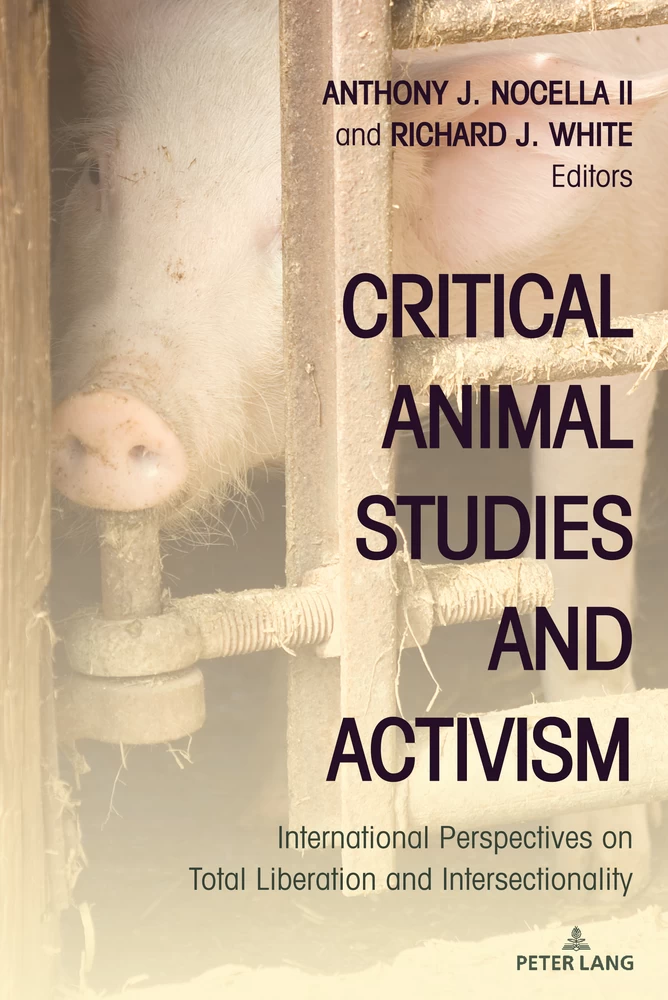
Critical Animal Studies and Activism
International Perspectives on Total Liberation and Intersectionality
Summary
Excerpt
Table Of Contents
- Cover
- Title
- Copyright
- About the author
- About the book
- This eBook can be cited
- Table of Contents
- Acknowledgements
- Foreword (Danni McGhee)
- Preface (S. Marek Muller)
- Introduction: Critical Animal Studies: Taking Action at a Time of Crisis (Richard J. White and Anthony J. Nocella II)
- 1. Bearing Witness to the Animal Condition. Exploring the Complex Motivations, Experiences and Coping-Strategies of Sheffield Save Movement Activists (UK) (Alex Hinchcliffe and Richard J. White)
- 2. Performing Veganism: Building Bridges amongst Academia, Activism, and Community (María Marta Andreatta)
- 3. Becoming Vegan in Slovenia: Some Reflections on Theory and Activism (Anja Radaljac and Aljaž Krivec)
- 4. Strategic Empathy, Intra-Sectional Demonstrations, and Animal Activism: In Pursuit of Total Liberation (Nathan Grande)
- 5. Challenging the Ideologies behind the Animal Agricultural Industry: A Case for Critical Animal Studies and Ecofeminism (Kiana Avlon)
- 6. ‘Before We Talk about Freedom: Let Us Free Our Slaves’: An Activist’s Reflections on Anarchism, Non-human Animals and Total Liberation (Carlos Garcia)
- 7. Animal Victims in the Colombian War (Terry Hurtado)
- 8. Cow Releases as Staged Liberations in Agri-Tourism (Erica von Essen and Michael Allen)
- Afterword
- Contributors’ Biographies (Tony Quintana)
- Index
- Series Index

Critical Animal Studies and
Activism
International Perspectives on Total
Liberation and Intersectionality
Edited by
Anthony J. Nocella II and Richard J. White


About the author
Anthony J. Nocella II, Ph.D., (they/he) long-time intersectional total liberation scholar-activist, is an Assistant Professor in the Department of Criminal Justice at Salt Lake Community College. He is the editor of the Peace Studies Journal, Transformative Justice Journal, and co-editor of fi ve book series including Critical Animal Studies and Theory and Hip Hop Studies and Activism. He is the National Director of Save the Kids and Executive Director of the Institute for Critical Animal Studies. He has published over fi fty book chapters or articles and forty books. He has been interviewed by The New York Times, Washington Post, Houston Chronicles, Fresno Bee, Fox, CBS, CNN, C-SPAN, and Los Angeles Times.
Richard J. White, Ph.D., is Reader/Associate Professor in Human Geography at Sheffield Hallam University, UK. Greatly infl uenced by anarchist praxis Richard’s main research agenda explores a range of ethical and economic landscapes rooted in the intersectional contexts of social justice and total liberation movements. He has co-edited Vegan Geographies (2022); The Radicalization of Pedagogy, Theories of Resistance, The Practice of Freedom (all 2016); and Anarchism and Animal Liberation (2015).
About the book
Weaving together a diverse range of scholarly-activist intersectional voices from around the world, Critical Animal Studies and Activism: International Perspectives on Total Liberation and Intersectionality co-edited by Anthony J. Nocella II and Richard J. White makes a powerful contribution to knowledge and understanding. It is essential reading for environmentalists, animal advocates, social justice organizers, policy-makers, social change-makers, and indeed for all those who care about the future of this planet. This book spans many scholar disciplines and activist social movements, and provides new insights to fundamental debates surrounding inter-species justice, liberation, and democracy. This critical theory for total liberation book expands the understanding of one struggle one fi ght: for human freedom, for animal rights, and for the liberation of the earth herself. Rooted in a radical praxis, the book argues that those in academia that claim critical animal studies, need to hit the streets with the protesters and the protesters need to join the theoretical conversations. Theory and practice and not binaries, but two pieces of a larger goal. Read this book and use its arguments to take the fi ght to smash capitalism, oppression, and domination in all its forms!
This eBook can be cited
This edition of the eBook can be cited. To enable this we have marked the start and end of a page. In cases where a word straddles a page break, the marker is placed inside the word at exactly the same position as in the physical book. This means that occasionally a word might be bifurcated by this marker.
3. Becoming Vegan in Slovenia: Some Reflections on Theory and Activism
Anja Radaljac and Aljaž Krivec
The article was mostly written in the year 2018. While there were some further developments regarding veganism, animal rights theory and animal rights activism, and some of the facts are outdated, the main issues addressed in the article and the general depiction still stand.
Becoming Vegan in Slovenia: The Beginning
At the end of February 2015, in an effort to do everything we personally could, to stop the exploitation of non-human animals, we became vegan. Before going vegan, we were vegetarians—Anja had been a vegetarian ‘on and off’ since elementary school, and Aljaž became a vegetarian when we started helping stray cats in Ljubljana (with food and shelter). It no longer made sense that we were helping cats, yet continued to eat the bodies of other animals. We departed from our vegetarian position to become vegan when we were presented with two incontrovertible facts, namely (1) that calves in the milk industry are taken away from their mothers and raised for slaughter and; (2) that all the male chickens are killed in the egg industry. Becoming aware about those two dreadful practices, and how—even as vegetarians—we were still complicit in the brutal and immoral treatment in the lives of other beings, made all the difference, and pushed us to embrace veganism.
Wanting to better understand and articulate our emerging vegan praxis, we searched for any information we could. We hoped to learn more about ‘animal liberation’, ‘carnism’ and ‘speciesism’, as well as finding out more about what other types of animal rights activism exist. Of the three concepts mentioned “speciesism” was the most crucial for us. It called us to really think critically about how this dominant speciesist ideology held in society ←57 | 58→had been ‘internalised’ in our own values to that point—not only in always privileging the experiences of fellow human being over non-human animals, but also in our consistencies regarding our treatment across different animal species. For most of our lives we had unquestioningly accepted the dominant cultural form of fragmentation and dissociation we had been exposed to; one where ‘caring’ for the lives of certain animals (e.g. cats, dogs), is as strongly encouraged as the indifference is to the violence that other animals (e.g. cows, pigs) experience. From there on it was much easier to understand how speciesism and carnism form and animate the problematic intersections with other forms of oppressions. Nevertheless, it remains a ‘truth’ that it is not always—and not for everyone—easy to grasp. The propaganda that normalizes speciesism, and effectively discourages people in our society from “connecting” the dots is so powerful. ‘Speciesism’ is certainly not a well known form of oppression in Slovenia, let alone the idea that carnism is a prevalent ideology. There is no critical awareness about how both combine to govern our dominant relationships toward non-human animals (at least in the area of food industry). Similarly, we lack the ability to see how these justify our treatment of animals through the belief that eating meat is natural, normal, necessary, and (sometimes) nice. We hope that our reflections and our experiences on becoming vegan will encourage others to raise their own consciousness, make these connections, and offer some support and solidarity on the journey that they may take in doing so.
Details
- Pages
- XX, 178
- Publication Year
- 2023
- ISBN (PDF)
- 9781433199417
- ISBN (ePUB)
- 9781433199424
- ISBN (Softcover)
- 9781433199431
- ISBN (Hardcover)
- 9781636670928
- DOI
- 10.3726/b20288
- Language
- English
- Publication date
- 2023 (April)
- Keywords
- social justice sociology criminology peace social science humanities critical animal studies animal rights environmental studies political science philosophy social theory Critical Animal Studies and Activism International Perspectives on Total Liberation and Intersectionality Anthony J. Nocella II Richard J White
- Published
- New York, Bern, Berlin, Bruxelles, Oxford, Wien, 2023. XX, 178 pp., 3 b/w ill.
- Product Safety
- Peter Lang Group AG
