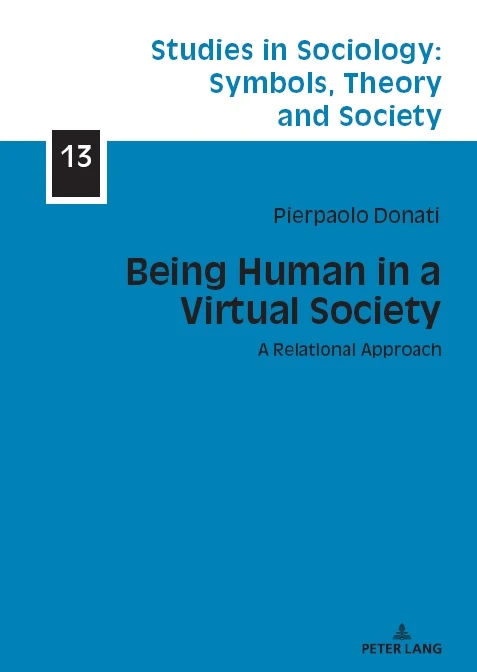
Being Human in a Virtual Society
A Relational Approach
Summary
Excerpt
Table Of Contents
- Cover
- Title
- Copyright
- About the author
- About the book
- This eBook can be cited
- Contents
- Figures
- Tables
- Introduction: Understanding the morphogenesis of the human in a virtual society
- Chapter 1: Transcending the human?
- 1. The issue: ‘transcending the human’ or rather ‘morphogenesis of the human’?
- 2. Rethinking human evolution
- 3. The distinction human/non-human as a transcendental relation, and its enigma
- 4. Perspectives: Human beings transcend themselves in social relations (not in themselves, nor in technologies)
- Chapter 2: Redefining the human in the face of hybridization with the Digital Technological Matrix (DTM)
- 1. The ambivalence of new technologies
- 2. The challenge of hybridization
- 3. Digital revolution, human enhancement and social relations
- 4. Confronting the digital matrix: The transition to the Humanted
- 5. The process of hybridization
- 6. Can an organization using digital technologies achieve human enhancement?
- 7. Personhood and human dignity
- 8. Redefining the human in hybridized organizations
- 9. Summary: Being human before and after the matrix
- Chapter 3: Connecting the human and the social through the Third included
- 1. The removal of the Third (included) is at the origin of today’s existential crises
- 2. Three semantic matrices of the Third, depending on whether it is included or excluded
- 3. Understanding the relational order of reality from which the Third emerges
- 4. The Third included requires a ‘relational gaze’ to be seen
- 5. The Third and the human character of social forms
- 6. The future of any humanism depends on how we understand and manage the Third
- Chapter 4: The enigma of social relations as a badge of humanness
- 1. The social relation as an enigma
- 2. The enigma of the relationship in Western modernity
- 3. The reality of the enigma
- 4. To manage the enigma, one needs to act with relational reflexivity and relational feedbacks
- 5. The solution of the enigma requires a relational social ontology
- 6. On the relational constitution of the human person
- 7. Human flourishing consists in enjoying relational goods
- Chapter 5: Rethinking the essence of being human: Relational essentialism
- 1. On human dignity: dignitas sequitur esse?
- 2. Human essence is relational difference: Can we speak of a ‘relational essentialism’?
- 3. Human identity as the indefinite re-entry of its relational distinctions
- 4. The human and the morphogenic process of hybridisation
- 5. Towards a new semantics of the human (relational humanism)
- 6. Which humanism, if any?
- 7. Conclusions: How to redistinguish humanism
- References
- Index of Names
- Series Index
Figures
Tables
Introduction: Understanding the morphogenesis of the human in a virtual society
It seems that the future of the human can no longer be conceived of in terms of the past forms of humanism which gave the human being a central position at the top of society. It would seem that modern humanism, characterized by self-sufficiency and self-reference, is becoming obsolete due to the artificial world created by human progress, which dominates and minimises, or even dissolves the human. Apparently, the new technologies undermine the idea that human beings have a privileged position compared to the rest of creation and reinforce those ways of thinking that refuse to attribute an exceptional value and superior moral status to human beings.
Indeed, on the one hand, increasingly sophisticated AI shows the weaknesses, inaccuracies, and flaws of humans. On the other hand, owing to the emergence of the Anthropocene and the related ecological issues, the degree to which humans can exploit the natural environment becomes increasingly limited. As a consequence, this seems to increasingly thwart the idea that it is humans who should subjugate the earth and all the beings that live on it.
According to the most accredited theories, the religious idea that it can and should be man who dominates the world, as indicated in the book of Genesis (1, 26–28), is thrown into crisis. With the advent of the digital age, the image of a humankind that builds itself and the world without limits collapses. Humans are reduced to beings of nature like any other product of the material evolution of the world. The Humanist Manifesto III by the American Humanist Association states that ‘Humans are an integral part of nature, the result of unguided evolutionary change.’ This shift leads to a reconsideration of the value of the human being as lying on the same level as artificial products (such as AI and robots), in a single material evolution.
In my opinion, this way of thinking offers a partial view of what really happens.
On the one hand, it is true that we are faced with the crisis of a particular version of humanism, that of early modernity described by Charles Taylor (2007: 19–20), which consider modern humanism synonymous with radical secularisation. In this version, humanism coincides with the view of human beings as the sole authors of their own actions and representations (not fate, God, or some other force or entity), establishing their norms and laws through the exercise of their own will and reason.
On the other hand, however, it is also true that Western civilization continues to live within the ambivalences of humanism that was born in Europe in the fifteenth century, suspended between the secular and the supernatural. In the Oration on the Dignity of Man (De hominis dignitate oratio, 1486), Pico della Mirandola outlined a humanism that maximised the dignity of man, but as a creature of God. In his work, Pico asserted that humankind had been assigned no fixed character or limit by God. Humankind was created with the freedom to make its own choices and create its own future. No dignity, not even divinity itself, was forbidden from human aspiration. The Oratio betrays a rejection of the early humanists’ emphasis on balance and moderation in favour of a straining towards absolutes that would be a major characteristic of later humanism.
In this version, humanism is opposed to the natural world governed by the fixed and immutable laws prescribed by God. It is God himself who creates human beings with the power to decide their essence, either to expire at the level of the brutes, or to rise to merge their spirit with that of the divine. In practice, according to Pico della Mirandola, man does not have a fixed nature: human essence is realised in action. Therefore, human evolution is open to the possibilities of growing, improving, and transforming the world and the self with no other limit than to achieve perfection and eternal happiness.
In essence, the dignity of man of which Pico speaks does not consist in humankind’s being, but in its becoming, which differs from the becoming of natural things. His position is not far from that of Jean Paul Sartre (in his Existentialism is a Humanism) when he says that the human being is the only entity whose existence comes before the essence. In other words, first of all human beings exist, and then they build their essence through their actions. They are completely free (condemned to freedom even), but responsible at the same time.
From this point of view, it may be that the technological society we are building today is neither an anti-human nor a post-human panorama, but instead the realization of a more advanced humanism.
Certainly, today the conviction that human beings are the yardstick of society is no longer sustainable, for various reasons. On the one hand, because human beings have turned out to be increasingly dependent on the other (they are losing self-sufficiency), and on the other hand, because they can no longer resort to self-reference due to the attack of cultures that support anti-speciesism, animalism, and which, in general, deny the existence of a human essence that is clearly distinct from non-human essences. In parallel, the idea of human dignity that came about with modernity is also falling into obsolescence.
But I wonder: does the end of the self-sufficient and self-referent heroic humanism of the secularised homo faber mean the dissolution of the concepts of essence and human dignity? And if it does, what will happen next?
Details
- Pages
- 184
- Publication Year
- 2024
- ISBN (PDF)
- 9783631917985
- ISBN (ePUB)
- 9783631917992
- ISBN (Hardcover)
- 9783631913499
- DOI
- 10.3726/b21930
- Language
- English
- Publication date
- 2024 (April)
- Keywords
- Being Human Virtual Society Human augmented (Humanted) Humanism Relational essentialism Digital Technological Matrix
- Published
- Berlin, Bruxelles, Chennai, Lausanne, New York, Oxford, 2024. 184 pp., 4 fig. b/w, 3 tables.
- Product Safety
- Peter Lang Group AG
