results
-
Hermeneutic Commentaries
ISSN: 1043-5735
"The question of interpretation of the text is at the center of this collection of monographs and commentaries on classical literatures. Interpretation starts with the realisation that at the outset, the sense of a text is an hypothesis to be gradually and constantly revised and ascertained. Grammar, syntax, and rhetoric are certainly the necessary part for this critical operation, but they fall short of giving full sense to the signification of the text. A philological commentary establishes the texts as close as possible to the authors text, and provides the information necessary for modern readers to understand what the text meant to its contemporary users. But besides the impossibility of achieving this task fully, this sort of information does not provide the sense of the text as it opens itself to the questions of its individuality and universality, its historicity and its transhistorical iterability, as it hides the rules and game of its composition, its difference in order to show its identity. These opposite poles are constantly united and create a tension, a continuous oscillation that are the very domaine of the interpretative analysis, and the conditions of the texts ever emerging sense . The hermeneutic circle, through which the critical hypothesis is constantly revised and made more precise, can be viewed also as a sort of deconstructive operation, a decomposing of the text in order to recompose it around its now discovered rules and games, of which the author is not necessarily always fully aware. Because of these conditions the sense of a text is more open to the critics than to its author; this point makes the critics conscious that as they are reading, they are in some way writing the text." "The question of interpretation of the text is at the center of this collection of monographs and commentaries on classical literatures. Interpretation starts with the realisation that at the outset, the sense of a text is an hypothesis to be gradually and constantly revised and ascertained. Grammar, syntax, and rhetoric are certainly the necessary part for this critical operation, but they fall short of giving full sense to the signification of the text. A philological commentary establishes the texts as close as possible to the authors text, and provides the information necessary for modern readers to understand what the text meant to its contemporary users. But besides the impossibility of achieving this task fully, this sort of information does not provide the sense of the text as it opens itself to the questions of its individuality and universality, its historicity and its transhistorical iterability, as it hides the rules and game of its composition, its difference in order to show its identity. These opposite poles are constantly united and create a tension, a continuous oscillation that are the very domaine of the interpretative analysis, and the conditions of the texts ever emerging sense . The hermeneutic circle, through which the critical hypothesis is constantly revised and made more precise, can be viewed also as a sort of deconstructive operation, a decomposing of the text in order to recompose it around its now discovered rules and games, of which the author is not necessarily always fully aware. Because of these conditions the sense of a text is more open to the critics than to its author; this point makes the critics conscious that as they are reading, they are in some way writing the text." "The question of interpretation of the text is at the center of this collection of monographs and commentaries on classical literatures. Interpretation starts with the realisation that at the outset, the sense of a text is an hypothesis to be gradually and constantly revised and ascertained. Grammar, syntax, and rhetoric are certainly the necessary part for this critical operation, but they fall short of giving full sense to the signification of the text. A philological commentary establishes the texts as close as possible to the authors text, and provides the information necessary for modern readers to understand what the text meant to its contemporary users. But besides the impossibility of achieving this task fully, this sort of information does not provide the sense of the text as it opens itself to the questions of its individuality and universality, its historicity and its transhistorical iterability, as it hides the rules and game of its composition, its difference in order to show its identity. These opposite poles are constantly united and create a tension, a continuous oscillation that are the very domaine of the interpretative analysis, and the conditions of the texts ever emerging sense . The hermeneutic circle, through which the critical hypothesis is constantly revised and made more precise, can be viewed also as a sort of deconstructive operation, a decomposing of the text in order to recompose it around its now discovered rules and games, of which the author is not necessarily always fully aware. Because of these conditions the sense of a text is more open to the critics than to its author; this point makes the critics conscious that as they are reading, they are in some way writing the text."
1 publications
-
Hermeneutics of Art
7 publications
-
Phenomenology and Literature
ISSN: 1524-0193
The focus of this series is on studies using the tenets of phenomenology and its various (dogmatic and skeptical) evolutions to elucidate and interpret primarily literary works of art in the contexts of aesthetics, ontology, epistemology, axiology, hermeneutics, communication, reader response, reception, cultural and social theory. Studies of a comparative nature which straddle and/or combine the disciplines of philosophical and literary studies are distinctive features of this monograph series. Emphasis is on subjects that may advance the state of the art, set trends, generate and continue discussion, expand horizons beyond present perspectives, and/or redefine previously held notions. Approaches may center on individual works, authors, schools of phenomelogical thought, and/or abstract notions, including issues of a comparative nature spanning the cultures, languages, and literatures of several nations from the perspectives of world literature and philosophy. The focus of this series is on studies using the tenets of phenomenology and its various (dogmatic and skeptical) evolutions to elucidate and interpret primarily literary works of art in the contexts of aesthetics, ontology, epistemology, axiology, hermeneutics, communication, reader response, reception, cultural and social theory. Studies of a comparative nature which straddle and/or combine the disciplines of philosophical and literary studies are distinctive features of this monograph series. Emphasis is on subjects that may advance the state of the art, set trends, generate and continue discussion, expand horizons beyond present perspectives, and/or redefine previously held notions. Approaches may center on individual works, authors, schools of phenomelogical thought, and/or abstract notions, including issues of a comparative nature spanning the cultures, languages, and literatures of several nations from the perspectives of world literature and philosophy. The focus of this series is on studies using the tenets of phenomenology and its various (dogmatic and skeptical) evolutions to elucidate and interpret primarily literary works of art in the contexts of aesthetics, ontology, epistemology, axiology, hermeneutics, communication, reader response, reception, cultural and social theory. Studies of a comparative nature which straddle and/or combine the disciplines of philosophical and literary studies are distinctive features of this monograph series. Emphasis is on subjects that may advance the state of the art, set trends, generate and continue discussion, expand horizons beyond present perspectives, and/or redefine previously held notions. Approaches may center on individual works, authors, schools of phenomelogical thought, and/or abstract notions, including issues of a comparative nature spanning the cultures, languages, and literatures of several nations from the perspectives of world literature and philosophy.
4 publications
-
New Studies in Phenomenology / Neue Studien zur Phänomenologie
Die Reihe mit Veröffentlichungen in deutscher und englischer Sprache widmet sich ohne Orthodoxie Fragen der transzendentalen bzw. hermeneutischen Phänomenologie, wie sie sich von Husserl und Heidegger her ergeben, und entwickelt, vornehmlich ausgehend von der Rezeption dieser ersten Klassiker der Phänomenologie und zugleich in Befolgung von Husserls Gründungsmaxime "Zu den Sachen selbst" Perspektiven für die künftige Forschung. Die bisherigen Bände bezogen sich u.a. auf folgende bleibenden Sachprobleme: Wahrnehmung, Wille, Weltoffenheit des menschlichen Daseins, Gottesbegriff, Grundstimmungen und politische Welt.
9 publications
-
The Yearbook on History and Interpretation of Phenomenology
The Yearbook on History and Interpretation of Phenomenology is a peer-reviewed annual. It includes contributions about the history of phenomenology because phenomenology has its own specific development anchored in the texts of Edmund Husserl, his predecessors and followers, its distinctive themes and problems set within the frame of the philosophical and scientific discussions of their period. The yearbook is open to inquiries about the interpretation of phenomenology and to different approaches towards understanding phenomenological research, its systematic and methodological insights and its possible contributions to contemporary discussions both about pure philosophy and within the context of more interdisciplinary research. It is also open to broader discussions with other philosophical schools of thought. Volume 5 terminates the series.
5 publications
-
-
Conversations of Curriculum Reform
Students’ and Teachers’ Voices Interpreted Through Autobiographical and Phenomenological Texts©2006 Textbook -
The Place of the Classroom and the Space of the Screen
Relational Pedagogy and Internet Technology©2011 Textbook -
-
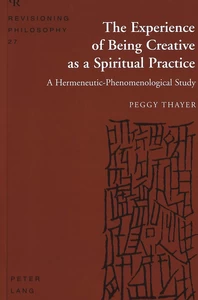
The Experience of Being Creative as a Spiritual Practice
A Hermeneutic-Phenomenological Study©2003 Monographs -
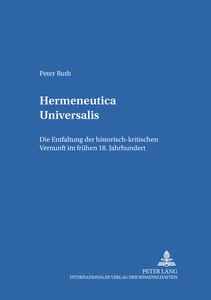
Hermeneutica universalis
Die Entfaltung der historisch-kritischen Vernunft im frühen 18. Jahrhundert©2002 Thesis -
-
-

-
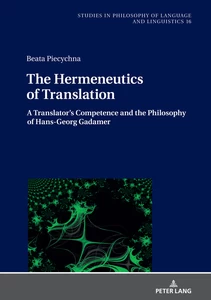
The Hermeneutics of Translation
A Translator’s Competence and the Philosophy of Hans-Georg Gadamer©2021 Monographs -
Phenomenology and the Creative Process
©2024 Monographs -
Introduction to Philosophical Hermeneutics
©2016 Monographs -
An Anglican Hermeneutic of the Transfiguration
©2013 Monographs -
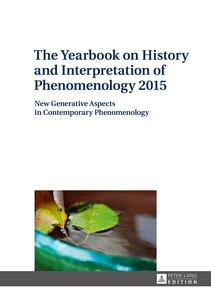
The Yearbook on History and Interpretation of Phenomenology 2015
New Generative Aspects in Contemporary Phenomenology©2016 Thesis -
-

-
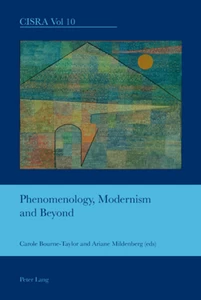
Phenomenology, Modernism and Beyond
©2010 Conference proceedings -
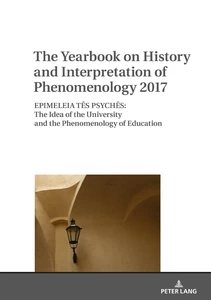
The Yearbook on History and Interpretation of Phenomenology 2017
EPIMELEIA TĒS PSYCHĒS: The Idea of the University and the Phenomenology of Education©2018 Thesis -
The Yearbook on History and Interpretation of Phenomenology 2016
Vocations, Social Identities, Spirituality: Phenomenological Perspectives©2016 Thesis -