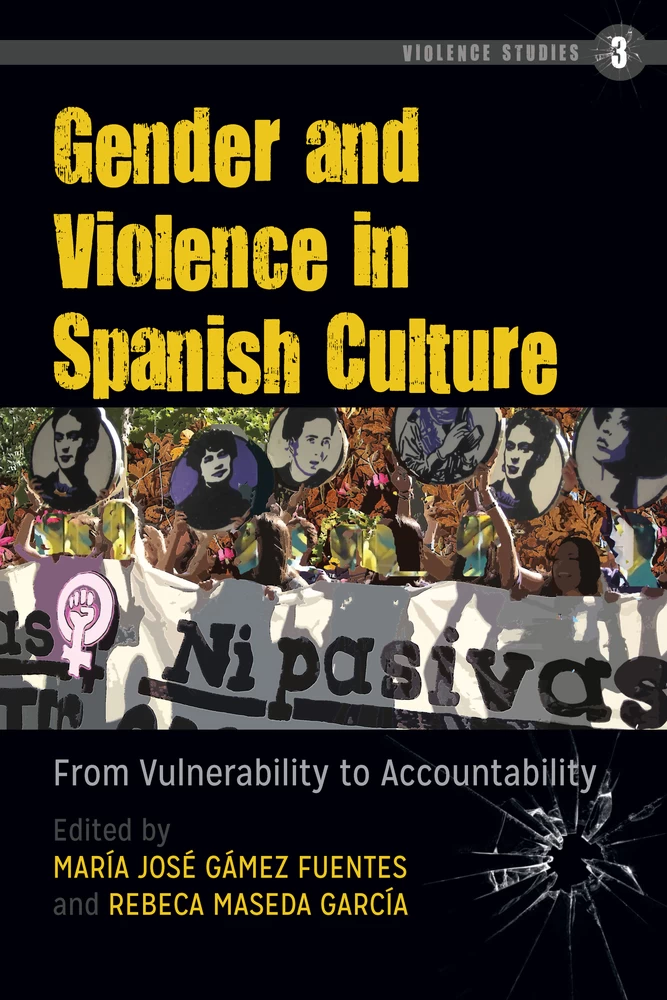
Gender and Violence in Spanish Culture
From Vulnerability to Accountability
©2018
Monographs
XIV,
236 Pages
Series:
Violence Studies, Volume 3
Summary
For the true exercise of citizenship to occur, gender violence must be eradicated, as it is not an interpersonal problem, but an attack on the very concept of democracy. Despite increasing social awareness and legal measures taken to fight gender violence, it is still prevalent worldwide. Even in a country such as Spain, praised in the UN Handbook for Legislation on Violence Against Women (2010) for its advanced approach on gender violence, the legal framework has proved insufficient and deeper sociocultural changes are needed. This book presents, in this respect, groundbreaking investigations in the realm of politics, activism, and cultural production that offer both a complex picture of the agents involved in its transformation and a nuanced panorama of initiatives that subvert the normative framework of recognition of victims of gender violence. As a result, the book chapters articulate a construction of the victim as a subject that reflects and acts upon his/her experience and vulnerability, and also adopt perspectives that frame accountability within the representational tradition, the community, and the state.
Excerpt
Table Of Contents
- Cover
- Title
- Copyright
- About the editors
- About the book
- This eBook can be cited
- Advance Praise for Gender and Violence in Spanish Culture
- Table of Contents
- Illustrations
- Acknowledgements
- The Configuration of Gender Violence: A Matrix to Be Reloaded (María José Gámez Fuentes / Rebeca Maseda García)
- Part One: Theory and Politics
- Chapter One: To Conceptualize Is to Politicize: Why Spain Has Acted as a Pioneer Regarding Gender Violence (Ana de Miguel Álvarez)
- Chapter Two: In the Wake of Ana Orantes: For an Ethical Representation of Violence Against Women (Juana Gallego Ayala)
- Chapter Three: Silenced Voices: Prostitutes, Lesbians, and “Bad Women” in Spanish Public Policies on Gender Violence (Emma Gómez Nicolau)
- Part Two: Activism and Associations
- Chapter Four: Tactical Media and Activism Against Gender-Based Violence: Fetishization and Counterhegemonic Frameworks of Recognition (Sonia Núñez Puente)
- Chapter Five: Feminist Activism and the Role of Memory in Revisiting the Discourse on Gender Violence in Spain (Laura Castillo Mateu)
- Chapter Six: Dialogues Among Diverse Women: Transforming Established Hegemonic Narratives in Associative Initiatives (Lídia Puigvert / Cristina Pulido)
- Part Three: Cultural Production
- Chapter Seven: Narrative Representations of Gendered Violence and Women’s Resistance in Francoist Spain: Dulce Chacón’s La voz dormida (2002) and Almudena Grandes’s Inés y la alegría (2010) (Sarah Leggott)
- Chapter Eight: From The Rape of Europa to Art Against Gender Violence in Spanish Culture (Marián López Fernández Cao / Juan Carlos Gauli)
- Chapter Nine: Homophobia, Ethical Witnessing, and the Matrix of Gendered Violence: Issues of Intersectionality in Luppi/Hornos’s Pasos (Alfredo Martínez-Expósito)
- Chapter Ten: Ella(s): Resisting Victimhood, Unveiling Institutional Violence in Docufiction (Vera Burgos-Hernández)
- Chapter Eleven: Carmina o revienta and Carmina y amén: Female Transgressions of Victimhood in Spanish Popular Cinema (María Castejón Leorza / Rebeca Maseda García)
- Chapter Twelve: No More Victims: Changing the Script (Rebeca Maseda García / María José Gámez Fuentes)
- Contributors
- Index
- Series index
Gender and Violence
in Spanish Culture
From Vulnerability
to Accountability
Details
- Pages
- XIV, 236
- Publication Year
- 2018
- ISBN (Hardcover)
- 9781433139987
- ISBN (PDF)
- 9781433139994
- ISBN (ePUB)
- 9781433140006
- ISBN (MOBI)
- 9781433140013
- DOI
- 10.3726/978-1-4331-3999-4
- Language
- English
- Publication date
- 2018 (January)
- Published
- New York, Bern, Berlin, Bruxelles, Frankfurt am Main, Oxford, Wien, 2018. XIV, 236 pp., 4 b/w ill.
- Product Safety
- Peter Lang Group AG
