Activist Art in Social Justice Pedagogy
Engaging Students in Glocal Issues Through the Arts, Revised Edition
Summary
Excerpt
Table Of Contents
- Cover
- Title
- Copyright
- About the author
- About the book
- Advance Praise For Activist Art in Social Justice Pedagogy
- This eBook can be cited
- Contents
- List of Illustrations
- Acknowledgments
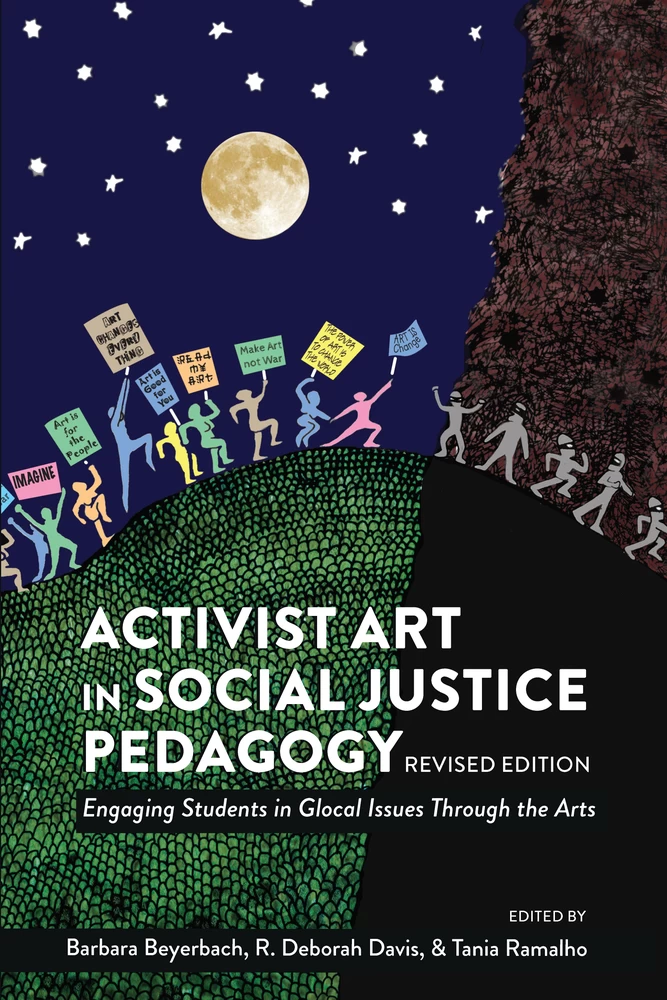
- Note on the Cover Art: “The Night the Artist Became Activist” (A Mixed Media Composition by Cynthia Clabough)
- Introduction (Barbara Beyerbach)
- Chapter One: Social Justice Education Through the Arts (Barbara Beyerbach)
- Chapter Two: Learning About the Farmworkers and the Landless Rural Workers Movements Through the Arts (Tania Ramalho / Leah Russell)
- Chapter Three: Art and Change in the AfroReggae Cultural Group (Leah Russell)
- Chapter Four: Media Literacy and Social Justice in a Visual World (Jacquelyn S. Kibbey)
- Chapter Five: Enlivening the Curriculum Through Imagination (Mary Harrell)
- Chapter Six: Photography and Social Justice: Preservice Teachers and the Ocularized, Urban Other (Dennis Parsons)
- Chapter Seven: Creating Student Activists Through Community Participatory Documentaries (Jane Winslow)
- Chapter Eight: Art Class at the Onondaga Nation School: A Practice of the Good Mind (Jennifer Kagan / Chris Capella)
- Chapter Nine: Indigenous Activism: Art, Identity, and the Politics of the Quincentenary (Lisa Roberts Seppi)
- Chapter Ten: Activist Art and Pedagogy: The Dinner Party Curriculum Project (Carrie Nordlund / Peg Speirs / Marilyn Stewart / Judy Chicago)
- Chapter Eleven: Acting Up In and Out of Class: Student Social Justice Activism in the Tertiary General Education, Fine Arts, and Performing Arts Curriculum (Lisa K. Langlois)
- Chapter Twelve: Interactive Social Media and the Art of Telling Stories: Strategies for Social Justice Through Osw3go.net 2010: Racism on Campus (Patricia E. Clark / Ulises A. Mejias / Peter Cavana / Daniel Herson / Sharon M. Strong)
- Chapter Thirteen: In the Grey: Finding Beauty Without Labels (Barbara Stout)
- Chapter Fourteen: The Art of Growing Food (Suzanne Bellamy)
- Chapter Fifteen: Complexity, Communication, Education, and the Making of Art (Arnon A.m. de Andrade / Tania Ramalho (Translator))
- Chapter Sixteen: It Starts With an Idea: Integrating Arts into the Classroom (Ritu Radhakrishnan)
- Chapter Seventeen: Sharing Our True Identity: Taking Environmental Portraits to Subvert Existing Community Narratives (Anneke McEvoy / Peter Cardone / Elias Williams)
- Chapter Eighteen: A Collective Endeavor—The Creatively Exploring Place, Self, and Collective Identity Project (Cynthia Clabough / Todd Behrendt / Elizabeth Brownell / Christi Harrington / Sharon Kane / Lacey McKinney / Kelly Roe)
- Chapter Nineteen: Activist Art in Social Justice Pedagogy (Barbara Beyerbach / Tania Ramalho)
- About the Authors
- Series index
| Figure 1.1: | Benin Marketplace, B. Beyerbach |
| Figure 1.2: | Drawing for Kenya Massacre, B. Beyerbach |
| Figure 2.1: | A Photo of Me Looking Out at the Fields on a Farm in Upstate New York, Where I Interviewed Farmworkers |
| Figure 2.2: | Detail of the Mural Created by the Youth Arts Group Participants |
| Figure 3.1: | View from the Airplane as I Landed in Rio |
| Figure 3.2: | During My Site Visit, I Was Allowed to Take This One Photo of a Street Within the Favela of Vigario Geral, with Permission from an AfroReggae Conflict Mediator |
| Figure 10.1: | The Dinner Party, 1975–1979. Photo © Donald Woodman. Reproduced with Permission from Through the Flower |
| Figure 12.1: | Osw3go.net 2010: Racism on Campus Usage Summary |
| Figure 13.1: | Barbara Stout with Portraits from Her In the Grey Series |
| Figure 16.1: | Hine (1908) |
| Figure 16.2: | Prewriting Format for Digital Narrative Scripts ← vii | viii → |
| Figure 18.1: | Lacey McKinney (Right) with FLCC Student Kellen Lambert-Vail in Front of the “We All Have Stories” Display of Student Artwork (Left to Right, Top to Bottom are Jon Krocke, Kellen Lambert-Vail, Laura Norcott, Chelsea Pecoraro, Katrina Temple, Alexander Macchioni, Kayleigh Stone, and Carol Henshaw) at the SUNY Oswego Metro Center in Downtown Syracuse. Photograph by Emily Scheutzow |
| Figure 18.2: | Visitor Viewing the Central Perspective Display at the First Wave Culmination Exhibition at the SUNY Oswego Metro Center in Downtown Syracuse. Artwork Credit: Top Row from the Left: Ricardi Jean, Marissa Specioso, PJ Gebhardt, Melissa Digiovanna, and Brittney Wienecke; Middle Row: Brianna Messina; Bottom Row from the Left: Elijah Vary, Marissa Specioso (Behind Viewer), Reid Adler, and Amanda Perri. Photograph by Emily Scheutzow |
We would like to acknowledge the many activist artists, educators, and students whose work has inspired us to write this book. We also thank the contributors, their colleagues, and students whose collective work has provided us with learning and wonderful resources to share. Special thanks to our SUNY Oswego Curriculum and Instruction Department Chair, Marcia Burrell, for always supporting our work. For reading several chapters of the work and providing encouragement, feedback, and valuable suggestions, we thank members of the writing group—Jean Ann, Bonita Hampton, Mary Harrell, Sharon Kane, Bobbi Schnorr, and Chris Walsh. Thanks to Traci Terpening and Beth Canale for reading and editing many of the chapters in the original volume. And last, but certainly not least, thanks to our families for their encouragement and support. ← ix | x →
“The Night the Artist Became Activist”
A MIXED MEDIA COMPOSITION BY CYNTHIA CLABOUGH
ARTIST STATEMENT
It is my opinion that when a work of art needs to come into the world the artist has two choices—make it, or be depressed, frustrated, cranky and full of self-pity and self-loathing until you finally give up on sleep and do the darn work. It doesn’t have to be the greatest work ever made, it can be something as simple as the image on the cover of this book. Once created, the work reveals the story of why it had to be done.
In the case of this piece, it builds off the first piece of activist art that I intentionally made in 1984. The first iteration of this design was created for the “Take Back the Night March” in Carbondale, Illinois. The illustration was featured on T-shirts worn by marchers who chanted and sang as they exercised their right to demonstrate. In the midst of being beaten up by the process of earning a graduate education, I was thrilled when the director of the women’s studies program came into the studio where I worked and asked if I’d be interested in trying to come up with an image that embodied the spirit of the march. I was so excited to get started I forgot to tell her I had no idea what “Take Back the Night” was about.
Fast forward to the fall of 2016. Suddenly, bolting upright at 3 am, I instantly recalled the work of art I hadn’t seen or thought about in 25 years. I knew the time was ripe to revisit it and have it go through a rebirth process. I began sketching the cover you see here. It wasn’t until the work was finished that I realized this act ← xi | xii → of resampling, revising, expanding, and transforming had given me permission to, once again, imagine that I could be among a community of people trying to change the world.
As I colored the figures and made up slogans for their placards, I saw myself as part of a group of individuals who, together, could chase the dark away. It isn’t a radical image, or a radical idea, but it speaks to a truth that I needed to remember and one that others may have forgotten; that the power of art is that it can change the world.
In 2014, on a research trip to Cuba to study the role of arts in the culture, I was fortunate to be part of a group of educators who visited several interesting art communities and public works that illustrate the power of the arts to engage dialogue, awaken awareness of social issues, and bring beauty to the humblest of settings.
Visiting the Callejon de Hammel in Havana, I was able to enjoy a lively rumba concert, view African art, and engage in dialogue about social justice issues with resident artist Salvador Gonzalez Escalona, whose work has an international following. Activist musicians were collecting pens to support schools, performing to raise funds, and engaging in dialogue about Afro-Cuban culture. I was impressed by the many museums displaying politically themed art.
In Cuba, there is a focus both on arts for all, and opportunities to specialize in artistic study. Schools are seen as the cultural centers of the community and I was able to view many student performances and works of art in the public schools we visited. We also toured the modest neighborhoods to view the magnificent tile murals of José Fuster and I was struck by their beauty. It was clear that though a variety of food choices to which we are accustomed were limited in this country due to the then embargo, art was central to the daily lives of Cubans. We were told most families display art in their homes, and communities routinely gather around musical performances. It was clear art brought joy and meaning to the lives of Cubans and their visitors. ← xiii | xiv →
On an earlier occasion, as I framed the explorations for the first edition of this book after a trip to Brazil, I was exploring resources on AfroReggae. I had visited AfroReggae’s programs in several favelas and watched a video of a group of young Afro-Brazilian girls, perhaps second or third graders, on a rooftop of a favela dwelling in Rio de Janeiro, arguably one of the most violent places on earth. They were playing violins—slowly, note-by-note—bowing the tune of John Lennon’s “Imagine.” With them, drummers from AfroReggae’s troupe, a group made up largely of former or would-be drug traffickers from the favela, set the beat and sang the vocals in English. The tempo shifted, the drummers accelerated, the lyrics became Portuguese rap, and the message of hope and peace exploded from this rooftop through a unique juxtaposition of sounds and images.
Embodying the meaning of “glocalization,” global themes in the video were transmuted by local contexts to make meaning relevant to the lives of these diverse community members. Traditional African drumming, classic European violin, hip-hop beats, London-based Beatles lyrics, and samba rhythms combined to form a powerful synergy of creative expression in this moving piece, reflecting the hybridity of our times (Nenhum Motivo Explica a Guerra, 2006). These participants were members of one of AfroReggae’s 60 programs in Rio’s favelas, aimed at bringing about social change through community-based arts and activism.
Details
- Pages
- XX, 272
- Publication Year
- 2017
- ISBN (Softcover)
- 9781433134975
- ISBN (PDF)
- 9781433144363
- ISBN (ePUB)
- 9781433144370
- ISBN (MOBI)
- 9781433144387
- DOI
- 10.3726/b11264
- Language
- English
- Publication date
- 2017 (November)
- Published
- New York, Bern, Berlin, Bruxelles, Frankfurt am Main, Oxford, Wien, 2017. XX, 272 pp., 13 b/w ill.
- Product Safety
- Peter Lang Group AG
