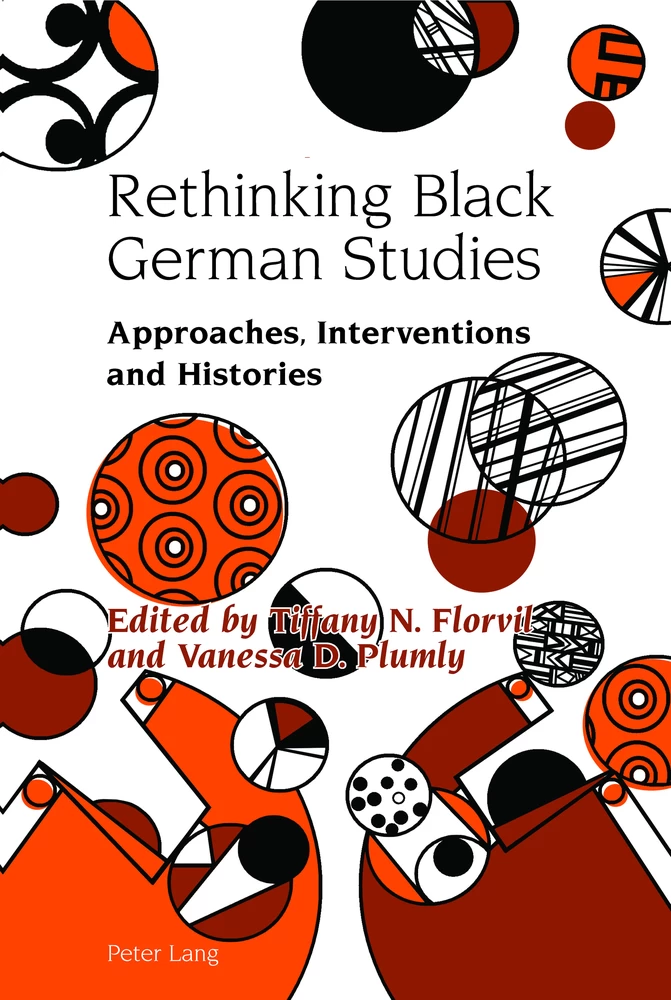
Rethinking Black German Studies
Approaches, Interventions and Histories
Summary
Examining Black German Studies as a critical, hermeneutic field of inquiry, the contributions are organized around three thematically conceptualized sections: German and Austrian literature and history; pedagogy and theory; and art and performance. Presenting critical works in the fields of performance studies, communication and rhetoric, and musicology, the volume complicates traditional historical narratives, interrogates interdisciplinary methods, and introduces theoretical approaches that help to advance the field.
Excerpt
Table Of Contents
- Cover
- Title
- Copyright
- About the author(s)/editor(s)
- About the book
- This eBook can be cited
- Contents
- List of Illustrations
- Acknowledgments
- Introduction: Rethinking Black German Studies (Tiffany N. Florvil / Vanessa D. Plumly)
- Integrating Theory and Praxis
- Understanding Black German Studies
- Overview
- Bibliography
- Part I German and Austrian Literature and History
- 1 ‘Hergestellt unter ausschließlicher Verwendung von Kakaobohnen deutscher Kolonien’: On Representations of Chocolate Consumption as a Colonial Endeavor (Silke Hackenesch)
- Cocoa and Neoslavery
- Representations of German Colonialism
- The Reichardt Company’s Picture Postcards
- What Was ‘German Colonial Chocolate’?
- Print Ads in Der Tropenpflanzer
- Chocolate as a Civilizing Project
- Conclusion
- Bibliography
- 2 Here to Stay: Black Austrian Studies (Nancy P. Nenno)
- Black Austrians Today and Yesterday
- ‘ÖsterREICH für alle GLEICH’ [Austria for all equally]
- Redressing the Past
- Bibliography
- 3 Lucia Engombe’s and Stefanie-Lahya Aukongo’s Autobiographical Accounts of Solidaritätspolitik and Life in the GDR as Namibian Children (Meghan O’Dea)
- Solidarity Politics and the GDR
- Experiences of Solidaritätspolitik and Alltagsrassismus in Kind Nr. 95. Meine deutsch-afrikanische Odyssee and Kalungas Kind: Wie die DDR mein Leben rettete
- Conclusion
- Bibliography
- Part II Theory and Praxis
- 4 Everyday Matters: Haunting and the Black Diasporic Experience (Kimberly Alecia Singletary)
- Colorblind Binds
- Imagining Racial Haunting
- Soul Bruder [Brother] Number I
- Blackening Europe
- Naming Rights
- Erasing Identities
- Conclusion
- Bibliography
- 5 Black, People of Color and Migrant Lives Should Matter: Racial Profiling, Police Brutality and Whiteness in Germany (Kevina King)
- Current Racial Dynamics in Germany
- Racial Profiling in Germany
- The Cologne Controversies
- Resisting Racial Profiling
- Conclusion
- Bibliography
- Part III Art and Performance
- 6 ‘Africa in European Evening Attire’: Defining African American Spirituals and Western Art Music in Central Europe, 1870s–1930s (Kira Thurman)
- Performing Against Primitivism: African American Musicians as Creators of High Art
- Are They African or American? Coming to Terms with the Black Diaspora and African American Spirituals in Nineteenth-Century Central Europe
- Blackness and Art Music Revisited: Central European Reception of African American Spirituals in the Jazz Age
- Conclusion: Postwar Reverberations
- Bibliography
- 7 Re-Fashioning Postwar German Masculinity Through Hip-Hop: The Man(l)y BlackWhite Identities of Samy Deluxe (Vanessa D. Plumly)
- Pre- and Postwar (Re)construction/s: Constructing Masculinity, Constructing Blackness
- Hip-Hop in Germany
- Identifying Samy Deluxe
- Gazing at the Surface
- Conclusion: Under the Covers, Beneath the Surface
- Bibliography
- 8 Performing Oppression and Empowerment in real life: Deutschland (Jamele Watkins)
- Bringing real life to the Stage: From Performance and Process to Empowerment
- Improvisation and Theoretical Tools
- Process(ing) as the Goal
- Black Internationalism and Empowerment
- Conclusion
- Bibliography
- Afterword (Michelle M. Wright)
- Notes on Contributors
- Index
- Series index
1 ‘Hergestellt unter ausschließlicher Verwendung von Kakaobohnen deutscher Kolonien’: On Representations of Chocolate Consumption as a Colonial Endeavor
Figure 1.1. ‘2. Westafrikanische Pflanzungs-Gesellschaft “Viktoria”, Kamerun. Transport der Kakaobohnen zur Trockenhalle’ [2 West African Plantation Company ‘Victoria’, Cameroon. Transportion of cocoa beans to the drying hall], 1910.
6 ‘Africa in European Evening Attire’: Defining African American Spirituals and Western Art Music in Central Europe, 1870s–1930s
Figure 6.1. Rudolf Arnheim, ‘Negersänger’, Stimme von der Galerie: 25 kleine Aufsätze zur Kultur der Zeit [Voice from the Gallery: 25 Short Essays on the Culture of the Time] (Berlin: Verlag Dr. Wilhelm Bernary, 1928).
Figure 6.2. ‘A Black Attack’, Kladderadatsch (16 December 1877), 1.
Figure 6.3. Hans Ewald Heller, ‘Negermusik’, Radio Wien (4 September 1931), 12.
7 Re-Fashioning Postwar German Masculinity Through Hip-Hop: The Man(l)y BlackWhite Identities of Samy Deluxe
Figure 7.1. Cover image of Verschwörungstheorien mit schönen Melodien. ← vii | viii →
Figure 7.2. Cover image of Berühmte letzte Worte.
Figure 7.3. Cover image of Verdammtnochma!
Figure 7.4. Cover image of SchwarzWeiss.
Figure 7.5. Cover image of Männlich.
Permission to reprint all images in Chapter 7 obtained from Gisela Sorge and Management Samy Deluxe.
It seems only fitting that this book evolved out of our very first meeting in Berlin on 29 August 2011, when Silke Hackenesch, a member of the research network Black Diaspora and Germany, introduced us at the ceremonial unveiling of the May Ayim memorial plaque at the May-Ayim-Ufer, two years after its official renaming. Without Silke bringing the two of us together, this collaborative volume and many of our other academic and activist endeavors, including the seminars that we co-organized and co-facilitated at the German Studies Association (GSA) conferences in 2014 and 2015 and the establishment of the Black Diasporic Studies Network at the GSA, with the assistance of professor emeritus at the University of Massachusetts Amherst, Sara Lennox, would never have come to fruition. Our co-operation as scholars has been seamless and easy, and we complement each other quite well. In many ways, it seems as if we have always been destined to work together. We are an excellent team and value each other’s scholarship and friendship, as well as the impact that we have had on one another’s lives; indeed, we are in this together. Our efforts to engage race publicly within German Studies serve as an intervention, and the volume is a source of optimism for us, given the current nativist climate in the United States and across Europe. While this is our first collaboratively published work, it certainly will not be the last one you will see from us. We will continue to foreground the importance of Black German Studies (BGS), as well as the broader scholarship on race, racialization, racial difference and the Black/African Diaspora in the field of German Studies.
Yet, this volume owes a considerable debt to the cultural contributions, activist work and intellectual interventions of Black Germans such as Fatima El-Tayeb, Philipp Khabo Koepsell, Alexander Weheliye, Peggy Piesche, Katharina Oguntoye, Ricky Reiser, Lara-Sophie Milagro and Maisha Auma, to name a few. Without their consistent and incisive work on both sides of the Atlantic, this volume would not exist. To them, we owe our sincere appreciation. We would also like to thank scholars like ← ix | x → Michelle M. Wright, Tina Campt, Sara Lennox and others, who have helped to push the field of BGS in exciting new directions throughout the years. This volume also owes its existence to them.
We want to express our gratitude to the participants in both of our GSA seminars. They helped to make the seminars meaningful and energizing. Many of the participants are contributing to the field of Black German Studies and have been supportive of our work throughout the years. Sadly, there are far too many of them to name. To Rosemarie Peña, we owe our thanks, especially for her establishment of the Black German Heritage and Research Association and her countless efforts to forge a space for Black German Studies that includes the voices of Black Germans. Her dedication to the field has allowed us to build on the network’s conferences and scholarly production and help increase its reach.
We must also thank the amazing contributors to this volume. We certainly appreciated their patience and willingness to work with us. They integrated all of our feedback, producing astute and critical pieces that we are thrilled to include in the volume.
We also want to express our appreciation of Patrica Vester, a Black German graphic artist who designed the beautiful and inspiring cover art for this book, as well as the chapter break images. We are grateful that the book’s exterior reflects the internal content. We are also happy that we can share the beauty of her work with others.
Finally, we want to thank everyone at Peter Lang, especially Laurel Plapp for supporting our project. Laurel’s confidence and her initial suggestion that we co-edit a volume as two junior academics is what empowered us to pursue our work on this volume. Her understanding and encouragement (digitally and face-to-face at the GSA) has made the process of publishing this volume enjoyable.
I, Vanessa, would also like to thank Dr. Tanja Nusser for her unending academic and personal support, as well as Mercedes Rooney, Dr. Anne R. Roschelle, and Dr. Sunita Bose for their guidance, mentorship, friendship and boundless support and concern for my academic career. You have helped sustain me. My family has always encouraged me to pursue my career and become the person I am. Last, but certainly not least, I thank my friend and colleague Tiffany for her unending passion, which continually inspires ← x | xi → me and others, for her intellectual commitment to the field, and for her trust in me. You have made this process seamless.
I, Tiffany, would also like to thank my mom, who has made so many sacrifices that have enabled me to take this academic path. She has continued to support all of my academic endeavors by offering prayers, encouragement, love, and support each step of the way. My husband and best friend, Dave, has been so supportive, especially when I became discouraged with the process. He has continued to lend his ear and assisted me in so many ways. For that, I am truly grateful. I want to thank my son, Isaac, who came into my life halfway through this project. His arrival has transformed my life and made me a better person. I am grateful that I am his mother and enjoy life so much more because of him. Finally, I want to thank my colleague and friend Vanessa, for being such a fabulous collaborator, advocate and scholar. Her dedication and critical editorial eye has only helped to make this process fun and rewarding. I am confident this volume would not be as dynamic without you!
Tiffany N. Florvil and Vanessa D. Plumly
Albuquerque, New Mexico and Kingston, New York
30 June 2018

Introduction: Rethinking Black German Studies
Integrating Theory and Praxis
In the autumn of 2014 and 2015, as the German Studies Association (GSA) met to convene for its annual conferences, something seemingly radical appeared on the program. At the 2014 conference in Kansas City, Missouri, a three-day seminar titled ‘Black German Studies: Then and Now’ was held.1 Focusing our seminar on the themes of ‘Practices, Productions and Progressions’, we sought to examine the field as a critical, hermeneutic point of inquiry and to thematically trace its evolution over the last three decades. During the course of the seminar, questioning the title’s implicit delineation of a past distinct from the present made it clear that it is impossible to separate the intertwining of the two temporalities or to discuss the Black/African2 Diaspora in Germany from a strictly teleological and, ← 1 | 2 → indeed, Western perspective with one origin point.3 Above all, we hoped that our first seminar would initiate exchanges and encourage creative and collaborative work by academics and non-academics alike that would not only underscore the experiences of Black Germans, but also continue to complicate the notions of Blackness, politics, racialized and gendered discourses, as well as diasporic identity across many affective, temporal and spatial borders. In addition, we envisioned that this seminar would help to create an inclusive intellectual community and space and to give this type of critical work on race, racialization and intersectionality a more visible presence at the GSA. Little did the seminar participants or the attendees of the GSA conference know at the time, but activist and writer Sharon Dodua Otoo, who became the first Black British female author to win the prestigious Ingeborg Bachmann Prize for literature in 2016, was also in attendance.4
The following year, the GSA conference took place in Arlington, Virginia, and delivered yet another opportunity for a follow-up seminar. This time the seminar’s theme revolved around ‘Political Activism in the Black European Diaspora: From Theory to Praxis’, and it included different approaches to social, political and cultural activism that engaged a variety ← 2 | 3 → of chronologies, theories and geographies.5 Here, questions of the trajectory of theory into praxis and praxis into theory were critically examined, as both became understood as simultaneously necessary interventions, especially in institutions that structure racism and continue to normalize whiteness. These seminars offered a step forward in enhancing the visibility of Black Germans and the scholarship on the Black Diaspora in Germany and Europe institutionally.6 In fact, both of these seminars can be considered an articulation and enactment of theory and praxis.
Privileging English and African Diaspora Studies scholar Michelle M. Wright’s concept of spacetimes, we recognized that Black/African narratives in Europe challenge linear teleological histories and that Blackness was not a fixed trait, but constantly evolving.7 Our first seminar affirmed the critical role that Black German Studies (BGS) has had on both sides of the Atlantic, albeit in distinctive ways. It also grappled with questions of how the field is structured and might be framed outside of existing hegemonies, for example, through the lens of Queer Studies. The work of Black German critical theorist Fatima El-Tayeb has paved the way through her charge for more inclusive work that ‘queers’ the dimensions of diasporic memory and moves beyond strictly confined, delineated and marked boundaries and genealogies.8 Additionally, our seminar assessed Black German cultural practices (art, literature, theater, music) by examining the range of genres that Black Germans employ and that enable their subjectivity to be ← 3 | 4 → polyphonically performed, represented and affirmed.9 Many of the papers presented in the first seminar that broke new ground for the second one had already evinced how contemporary Black German cultural productions serve as acts of emplacement, in which Black Germans assert themselves as citizens of the German nation. These productions are also forms of social activism, reflecting how political engagement and positioning impacts aesthetic expression and reception.
Using this latter point, the second seminar re-imagined politics and activism across Europe. In it, we stressed the need for decolonizing processes at the academic level through grassroots activist practices that help to engender direct social change. Intercultural and comparative analyses provided a fruitful means to explore the Black European Diaspora – an area rife for future research, and, as a burgeoning field, it offers productive points for articulating nuance across Black/African diasporic landscapes. Thus, our second seminar expressed the idea that activism must not only take place within the realm of knowledge production and dissemination (i.e. the ivory tower, itself a colonizing concept), but just as importantly in the realm of implementation and application through critical intervention and constant rethinking and reworking (i.e. intellectual activism, grassroots activism and public engagement). Here, we believe that social activism, much like the production of history, occurs inside and outside of academia.10 Indeed, this understanding of social activism proves particularly compelling given that every day brings news of yet another Black life taken too soon through unjust actions and institutional violence across Europe and the United States. While the Black Lives Matter (BLM) movement originated in the United States as a form of digital activism in 2013 after the murder of Trayvon Martin in 2012, the last few years have produced sustained movements, with BLM groups and marches in Britain, France ← 4 | 5 → and the Netherlands.11 Last June intersectional and multicultural feminist organizers held their first month-long series of events that culminated with a BLM March in Berlin, which built from the 2016 summer marches.12 Likewise, protests took place in Paris, France, in February 2017 after police sodomized a Black French man named ‘Theo’.13 In addition to these developments, activists practicing intersectional feminism have pursued digital activism with hashtag campaigns in Europe such as #CampusRassismus, #Schauhin and #Rhodesmustfall.14 Each of these campaigns not only reveal ← 5 | 6 → the persistence of everyday racism, including anti-Black, anti-Semitic and Islamophobic hate, but also the global structures and routes of racism in diverse contexts.
Political platforms on social media may be new outlets due to the advent of modern technology, but campaigns like these are anything but novel. Individuals from across the Black/African Diaspora, who have studied, lived, performed and struggled in Germany and its colonies, have often made claims for social justice and recognition. Advocacy in Communities of Color in Germany has a long-standing history. Black Germans and African colonials in the colonies and the metropole, for instance, agitated for racial equality and basic rights from German colonial authorities.15 Other diasporic individuals, such as Mary Church Terrell and George Padmore, used Germany as a space to draw attention to sexism, racism and class oppression. As one of the founding members of the National Association for the Advancement of Colored People (NAACP), Terrell delivered a speech in both German and French at the 1904 International Congress of Women held in Berlin. In 1930, Padmore organized an international conference in Hamburg. He was active in the International Trade Union Committee of Negro Workers (ITUCNW) and edited its journal The Negro Worker.16 Padmore also spent time in Vienna, Austria. Furthermore, ← 6 | 7 → in the 1950s and 1960s, Civil Rights and Black Power activists, such as Dr. Martin Luther King, Jr., Paul Robeson and Angela Davis, traveled to (East and West) Germany, advocating across geographic boundaries and garnering more attention for the civil rights struggle in the United States. African American GIs stationed in the country, oftentimes together with West German students, rallied against American imperialism, especially the war in Vietnam.17 Foreign students from the Congo protested the Prime Minister Moise Tshombe’s visit to West Berlin in 1964, particularly given his involvement in the overthrow of and eventual murder of the first democratically elected Prime Minister of the Democratic Republic of the Congo, Patrice Lumumba.18 This transnational activism demonstrates the necessity of diasporic connections and activist work that extends beyond national and cultural contexts. All of these actions had common goals: the challenging of corrupt political systems and leaders as well as the international liberation of People of Color from oppressive governments ← 7 | 8 → and regimes throughout the world. As these few examples reveal, Black/African diasporic consciousness has always operated in a queer fashion, one that navigates outside of prescribed filial bonds from a rigid Western framework that adheres to normative identities, behaviors and practices. Black German Studies encompasses these histories, movements and lived experiences, among many others.
Learning and adapting to their particular nation-specific and socio-historical conditions, Black Germans have continually expressed dissent about a variety of topics that have impacted and continue to affect their lives. For instance, Black German activist and singer Fasia Jansen was politically active in left-wing circles in the post-World War II period, in which she pushed issues of equality and peace.19 Black German author and artist Ika Hügel-Marshall was active in the West German feminist and lesbian movements of the late 1960s and 1970s.20 U.S.-based Black German journalist Hans Massaquoi also became a figure for civil rights through his career at Jet and then Ebony magazines.21 Activists and intellectuals such as May Ayim, Katharina Oguntoye, John Kantara, Mike Reichel, Jasmin Eding, Helga Emde, Katja Kinder, Eleonore Wiedenroth-Coulilaby, Ricky Reiser and others catalyzed and supported the modern Black German movement of the 1980s and 1990s. This movement began with the establishment of the organizations Initiative Schwarze Deutsche [Initiative of Black Germans, ISD] and Afrodeutsche Frauen [Afro-German Women, ADEFRA].22 Its members have always been attentive to transnational issues ← 8 | 9 → of the Black/African Diaspora and to the need to draw attention to and practice Caribbean American poet Audre Lorde’s idea of ‘connected differences’ with Blacks and Communities of Color in Germany and across the globe.23 Thus, while both of the GSA seminars that convened over the past few years provided the foundation for this edited volume, they are not, by any means, the sole impetuses for its genesis, and it would be a colonizing act for the authors to claim as much. Black German Studies is an academic field of inquiry because of the actions, initiatives, efforts and labor that Black Germans have performed to increase their visibility, advocate for their rights and articulate their positionality as both Black and German.
Though we used the seminars to bring junior and senior scholars as well as activists together to interrogate and inform our own understandings of the concepts of Blackness, Black German, Black Europe and the Black/African Diaspora, the seminars were not devoid of tensions and uncomfortable moments during which several white participants failed to listen and fully understand their own positionalities, privilege and power. Regardless, the seminars were useful, particularly as certain questions arose, such as: who and what do we engage with when we use the category of ← 9 | 10 → Black German Studies? Do non-critical white subjects producing culture on Black Germans constitute a part of Black German Studies and, if not, why? Which scholarly voices get privileged over others and why? Finally, how do we imagine and conceptualize Black Europe? In many ways, our discussions engaged the pressing themes of scholars’ power, voice and public engagement, Black German Studies scholar Tina Campt’s notion of ‘diasporic asymmetries’ and decolonizing German Studies more generally.24 Understanding decolonization in the way in which scholar of Diversity Studies Maisha-Maureen Auma (formerly Maureen Maisha Eggers) explores it is one of the best existing ways to frame the field and its agents.25 She writes in relation to Black women activists that their decolonizing work serves ‘as an interruption of an (exclusive and canonized) focus on texts authored and authorized by the West’, and ‘is a substantial shift of focus away from the imperial center’.26 At the bare minimum, then, we must be attentive to and acknowledge the white hegemonic center that often dominates German Studies, particularly when undertaking work in the field of Black German Studies. Even more so, white scholars must be attentive to and acknowledge their privileged positionality and potential for blind spots. While it is possible for white Germans, white Americans and any other number of white people to critique culturally constructed and historically embedded notions of race and ethnicity, which is what some of the chapters in this volume accomplish, the criticism often remains incomplete. Moreover, it can and often does serve to reify these categories in the process of an attempted deconstruction. Since sexism also intersects with the historical trajectory of race, Auma points to ‘Black women’ as the example of decolonizers par excellence. Some of the chapters in ← 10 | 11 → this volume therefore also emphasize the role of sexism as a transgressive act that intersects with racism, homophobia and classism. In fact, several of the contributions employ intersectional approaches that recognize the interplay of race, gender, class and sexuality.
As scholars, one positioned as a Woman of Color and the other a white woman, and both from the United States, we are aware that our own statuses offer us certain privileges when studying Black Germany’s Diaspora. We also recognize that whiteness is normalized and affords an extreme privilege that operates within diverse institutional settings. This is particularly important given that in Germany there are very few Black, African or People of Color professors, and that there are no Black German or Black European Studies institutes established there.27 While American Studies scholar Sabine Broeck and other white scholars in Bremen made some efforts to create Black Bremen Studies and a Black Knowledges Research Group in 2015, these individuals failed to include Black German or People of Color scholars, and organizations and members of Black communities in Germany and Austria responded to this significant omission.28 With all this being said, in no way, do we claim to speak for or represent Black Germans throughout this volume. Rather, it is our goal to make visible their experiences as well as the variegated power structures that exist and to engage them critically, and at times, perhaps failing to fully do so. For instance, as a white woman, I (Vanessa) am cognizant that I have more privilege than (Tiffany) my co-editor and that my voice likely generates more resonance among white audiences. I (Tiffany), also acknowledge my privilege as an Afro-Caribbean tenure-track scholar working at a research university in the United States. Verbalizing and citing these ‘asymmetrical powers’ is one step; actively seeking to shift them is, of course, another. This, ← 11 | 12 → we believe, is why a constant ‘rethinking’ is what Black German Studies should strive for. Rethinking what might be missing from the narrative, from the analysis, from the discourse and from one’s own perspective is the necessary and critical work that scholars in this field must continually seek to address. Likewise, we must always rethink our own power to simultaneously reaffirm the diverse Black German actors, perspectives and experiences that we want to illuminate through our work and reject categories that often exclude, silence and haunt them. It will never be a complete process, but rather remains an ongoing interrogational and introspective one that is much more productive than laying claim to any intellectual territory and alleging to have mastered it. Herein lies the promise and the potential of the field for the present and the future.
Understanding Black German Studies
Unofficially, Black German Studies began at what Peggy Piesche calls the kitchen table conversations that were had within the modern Black German community – a common practice among other diasporic groups across the globe.29 Likely the very first of such conversations will never be officially documented in textual form because it was something spontaneous that arose out of necessity. The collective origin narrative of BGS thus lies in unmappable territory; it is fugitive and refuses to be bound to a single spacetime. At the level of the individual, the Black German Diaspora and its European counterpart also have a long history that predates any theorizing solely in the academic realm. Indeed, Black male intellectuals ← 12 | 13 → analyzed the societies in which they lived, including Anton Wilhelm Amo, C. R. L. James, Frantz Fanon and Stuart Hall, to name a few well-known examples.30 But we should also not forget the contributions that women such as Jeanne and Paulette Nardal, Una Marson, Claudia Jones and Olive Morris – often outside of the academy – made to Black European intellectualism and internationalism through their activism and literary productions.31 Still, many Black German scholars, writers and activists have contributed to the evolution of the field in just the last thirty years, and their archive includes Farbe bekennen: Afrodeutsche Frauen auf den Spuren ihrer Geschichte, Mythen, Masken und Subjekte: Kritische Weißseinforschung in Deutschland, The BlackBook: Deutschlands Häutungen, re/visionen: Postkoloniale Perspektiven von People of Color auf Rassismus, Kulturpolitik und Widerstand in Deutschland, Euer Schweigen schützt Euch nicht: Audre Lorde und die Schwarze Frauenbewegung in Deutschland, Arriving in the Future: Stories of Home and Exile, Spiegelblicke: Perspektiven Schwarzer Bewegung in Deutschland and Souls and Sisters: Inspirationen von May Ayim.32 These examples, along with countless others, deftly illustrate that ← 13 | 14 → Black German scholars, writers and activists have been critically engaged in promoting their own narratives, developing their own theoretical frameworks for analyzing institutionalized racism and the power of whiteness and producing knowledge for future generations to expand upon and deepen.33 Of course this volume builds on this rich and important legacy.
Representing Black/African intellectualism and internationalism, Black Germans have frequently utilized non-academic initiatives and avenues to highlight their presence, culture and history. Some of these collective, institutional and individual projects include ISD’s Black History Month celebrations and the Homestory Deutschland exhibition; Katharina Oguntoye’s association Joliba, Natasha Kelly’s Edewa; the Each One Teach One e.V. (EOTO)’s Black/African Diaspora library and archive and the Black German theater ensemble Label Noir’s production, Heimat, bittersüße Heimat, among others. Each of these projects organizes programming that ← 14 | 15 → foregrounds topics on Black Germanness, the Black/African Diaspora, multiculturalism and racial discrimination. They also represent Black Germans’ ability to consistently produce spaces for themselves in a majority white German society.
Influenced by African Americans in Germany and modeled after the African American annual observances that historian Carter G. Woodson established in 1926, Black History Month (BHM) began in 1990 in West Berlin. With regional ISD and ADEFRA groups’ assistance, these BHM events helped to signal the importance of the Black/African Diaspora both within and beyond the borders of the German nation. The BHM eventually emerged in cities such as Frankfurt and Hamburg.34 The BHMs certainly became a cultural and political institution that Black Germans looked forward to for a sense of community and empowerment. Moreover, ISD’s traveling exhibition Homestory Deutschland, which began as a collective project in 2006, has featured the narratives of individuals of the Black/African Diaspora across different spacetimes in Germany. These narratives include those of African American, African and Black German individuals, and there is also an accompanying book published in conjunction with the exhibition.35 Homestory Deutschland has traveled and been displayed throughout Germany, the United States and Africa since 2006, albeit in a slightly altered format.36
Katharina Oguntoye, who helped to co-found ISD-Berlin and ADEFRA-Berlin, eventually established Joliba in 1997. Joliba, a non-profit organization, sponsors intercultural projects that engage the themes of migration, war, discrimination and racism. Under Oguntoye’s guidance, Joliba has also helped to promote and advance the knowledge of Black ← 15 | 16 → German youth and other People of Color in Germany; it has become a critical space for youth empowerment as well as the dissemination of materials on youth, parenting and the experiences of People of Color. In addition, Joliba offers integration assistance, encourages mutual understanding and uses cultural events to inform the public. Some of its events include film screenings, workshops, exhibitions and more.37
EOTO, formed on 21 March 2014, has provided both a space of visibility and an archive of Black/African diasporic knowledge for future generations of Black Germans and People of Color in Germany. Their goal, as the title of the initiative makes clear, is to educate themselves and others about their own history, in a similar vein to the women of the first generation of the Black German women’s movement. Consisting of the ISD member Vera Heyer’s personal library and other donated literature and films, EOTO serves as a community-based education and empowerment project that includes over 2,500 works related to individuals of the Black/African Diaspora.38 There is also archival material that Heyer collected on the Black German movement that is currently being processed at EOTO. Housed in Wedding, their location is close to the African quarter, which itself is part of the initiative’s program of educating others on the history of the presence of Black people in Germany and Germany’s colonial past.39 Workshops and networking events are also held at the location. ← 16 | 17 →
Details
- Pages
- XII, 330
- Publication Year
- 2018
- ISBN (PDF)
- 9781787078512
- ISBN (ePUB)
- 9781787078529
- ISBN (MOBI)
- 9781787078536
- ISBN (Hardcover)
- 9783034322256
- DOI
- 10.3726/b11568
- Language
- English
- Publication date
- 2018 (November)
- Keywords
- Black European Studies Performance Studies Critical Race Studies
- Published
- Oxford, Bern, Berlin, Bruxelles, New York, Wien, 2018. xii, 330 pp., 9 fig. b/w
- Product Safety
- Peter Lang Group AG
