Reimagining Irish Studies for the Twenty-First Century
 Eugene O'Brien (Volume editor)
Summary
Excerpt
Table Of Contents
- Cover
- Title
- Copyright
- About the author
- About the book
- This eBook can be cited
- Dedication
- Message from the Series Editor
- Table of Contents
- List of Figures
- Foreword: Future Perfect
- Acknowledgements
- Introduction: – Reimagining Irish Studies for the Twenty-First Century
- 1 Applying a Food Studies Perspective to Irish Studies
- 2 Archives in Irish Studies: Locating Memory and the Archival Space1
- 3 Between Britain and Europe Once More: The Significance of Brexit for the Reimagination of Ireland
- 4 Catching the Mood: George Moore’s Fin-de-Siècle Involvements
- 5 Drinking Spaces in Strange Places: New Directions in Irish Beverage Research
- 6 Ecotheory and Criticism
- 7 Poverty-Trapped: French Traveller Accounts of Poverty in Ireland over the Centuries
- 8 Irish Studies in North America: Reflections
- 9 Irish Women’s Writing
- 10 ‘Monuments of Its Own Magnificence’: Musicology within Irish Studies
- 11 New Directions in Short Fiction
- 12 No Country for Young Girls?: Representations of Gender-Based Violence in Some Recent Fiction by Irish Women Writers
- 13 Northern Ireland’s Future(s)
- 14 ‘Real’ Language Policy in a Time of Crisis: Covid-19, the State and the Irish Language
- 15 Reimagining Irish Film Studies for the Twenty-First Century
- 16 Religion in Irish Studies
- 17 Sport and the Irish
- 18 The Dawning of Difference: Literary and Cultural Theory in Irish Studies
- 19 ‘The Words Will Come’: Today’s Legacies of the Great Irish Famine1
- 20 Language, Time and the Improbable in Contemporary Ireland
- 21 ‘What Would I Say, if I Had a Voice?’: The Irish Novel and the Articulation of Modernity1
- Notes on Contributors

Bibliographic information published by Die Deutsche Nationalbibliothek. Die Deutsche Nationalbibliothek lists this publication in the Deutsche Nationalbibliografie; detailed bibliographic data is available on the Internet at http://dnb.d-nb.de.
A catalogue record for this book is available from the British Library.
Library of Congress Cataloging-in-Publication Data
Names: Maher, Eamon, editor. | O’Brien, Eugene, 1958- editor.
Title: Reimagining Irish Studies for the twenty-first century / Eamon Maher, Eugene O’Brien.
Description: Oxford ; New York : Peter Lang, [2021] | Series: Reimagining Ireland, 1662-9094 ; Vol. 100 | Includes bibliographical references and index.
Identifiers: LCCN 2020054346 (print) | LCCN 2020054347 (ebook) | ISBN 9781800791916 (paperback) | ISBN 9781800791923 (ebook) | ISBN 9781800791930 (epub) | ISBN 9781800791947 (mobi)
Subjects: LCSH: Ireland--Civilization--Study and teaching. | Ireland--Social life and customs--Study and teaching. | Ireland--Historiography.
Classification: LCC DA910 .R45 2021 (print) | LCC DA910 (ebook) | DDC 941.50072--dc23
LC record available at https://lccn.loc.gov/2020054346
LC ebook record available at https://lccn.loc.gov/2020054347
ISSN 1662-9094
ISBN 978-1-80079-191-6 (print) • ISBN 978-1-80079-192-3 (ePDF)
ISBN 978-1-80079-193-0 (ePub) • ISBN 978-1-80079-194-7 (mobi)
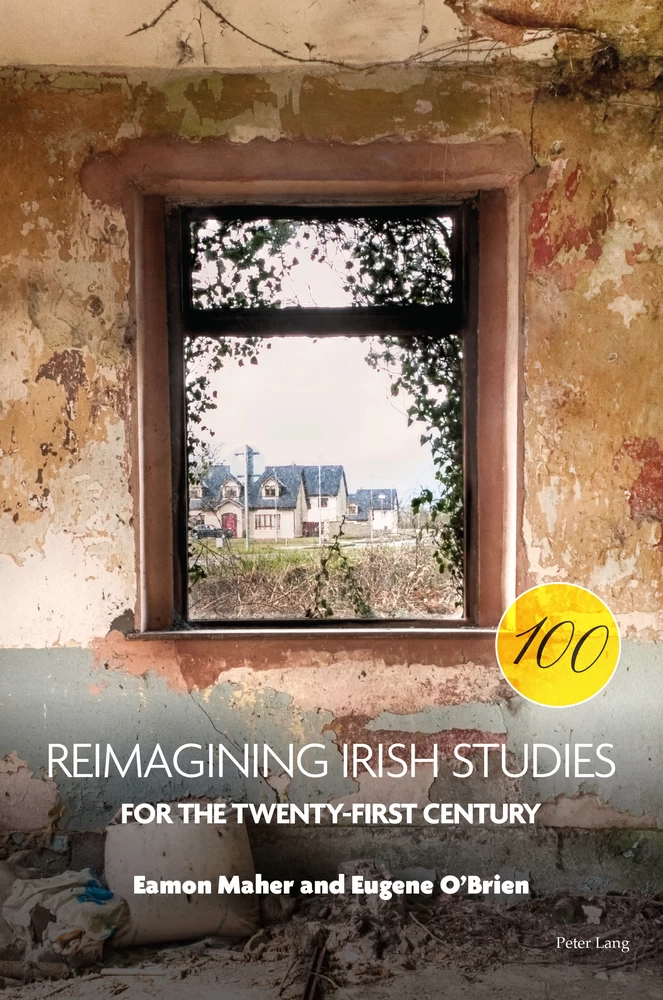
Cover photograph by Paul Butler
© Peter Lang Group AG 2021
Published by Peter Lang Ltd, International Academic Publishers, 52 St Giles, Oxford, OX1 3LU, United Kingdom oxford@peterlang.com, www.peterlang.com
Eamon Maher and Eugene O’Brien have asserted their rights under the Copyright, Designs and Patents Act, 1988, to be identified as Editors of this Work.
All rights reserved.
All parts of this publication are protected by copyright. Any utilisation outside the strict limits of the copyright law,
without the permission of the publisher, is forbidden and liable to prosecution. This applies in particular to reproductions, translations, microfilming, and storage and processing in electronic retrieval systems.
This publication has been peer reviewed.
About the author
Eamon Maher is Director of the National Centre for Franco-Irish Studies in TU Dublin and General Editor of the Reimagining Ireland series with Peter Lang.
Eugene O'Brien is Head of the Department of English Language and Literature in Mary Immaculate College, Limerick, and Director of the MIC Institute for Irish Studies.
About the book
This engrossing, sharply argued, and diverse collection of essays captures the dynamic nature of Irish Studies as it changes and reformulates itself in response to current but also abiding concerns. The multi-disciplinary interventions in this volume brilliantly succeed in revisiting and interrogating the field of Irish Studies, broadening its ambit, and mapping trajectories for future engagement. This is an insightful and explorative collection that expertly takes stock of Irish Studies whilst driving it forward.
- Anne Fogarty, Professor of James Joyce Studies, University College Dublin
From Famine stories to food studies, nineteenth-century travel narratives to contemporary film studies, Fenian invasions to TV stations, the Reimagining Ireland series has pioneered adventurous and enterprising versions and visions of Irish literature, society and culture, This milestone hundredth volume in the series contains essays that reimagine the potential future of Irish Studies in a new century and is remarkable for its diversity, disciplinary range, and dash.
- Joe Cleary, Professor of English, Yale University.
This landmark collection marks the publication of the 100th book in the Reimagining Ireland series. It attempts to provide a 'forward look' (as opposed to what Frank O'Connor once referred to as the 'backward look') at what Irish Studies might look like in the third millennium. With a Foreword by Declan Kiberd, it also contains essays by several other leading Irish Studies experts on (among other areas) literature and critical theory, sport, the Irish language, food and beverage studies, cinema, women's writing, Brexit, religion, Northern Ireland, the legacy of the Great Famine, Ireland in the French imagination, archival research, musicology, and Irish Studies in North America. The book is a tribute to Irish Studies' foundational commitment to revealing and renewing Irishness within and beyond the national space.
This eBook can be cited
This edition of the eBook can be cited. To enable this we have marked the start and end of a page. In cases where a word straddles a page break, the marker is placed inside the word at exactly the same position as in the physical book. This means that occasionally a word might be bifurcated by this marker.
To the highly talented and supportive Irish Studies community who make it such a vibrant space in which to work.
Eugene would also like to dedicate this book to Áine, Eoin, Sinéad and Dara who keep me grounded and supported through everything.
Message from the Series Editor
As we reach the landmark 100th volume in the Reimagining Ireland series, it would be remiss of me not to make reference to a number of people who have contributed majorly to the success of the project.
There have been three Commissioning Editors to date, each of whom has left a positive imprint. When Joe Armstrong first approached me with the idea of setting up a series in Irish Studies, I was immediately inspired by his infectious enthusiasm for, and belief in, what he envisioned. It did not take long to convince me to take on the role of General Editor. When Joe left, Christabel Scaife joined the team and her formidable editing skills, empathetic personality and encouragement of authors brought the series to a level that exceeded even Joe’s and my own expectations. After Christabel’s departure, Tony Mason took over at the helm. Tony was known to me from his work with Manchester University Press and he brought an extensive knowledge of academic publishing, and of Irish Studies in particular, which, combined with a larger than life and enabling personality, have made him an invaluable asset. These three people are owed a great debt of gratitude for their energy, vision and hard work which have made Reimagining Ireland the significant series that it has become and will hopefully remain.
The technical staff at Peter Lang, Oxford, have been a pleasure to work with. They are too numerous to be named individually, but they have shown great efficiency and courtesy in their dealings with me and with authors. The books are always attractively produced and the quick turnaround from manuscript stage to publication is something that marks us out from our competitors. I would also like to thank the various peer reviewers for giving so freely of their time to assess book projects and supply invaluable feedback so that we can stand over the academic quality of our books.
Without the several hundred authors, editors and contributors, there would be no series and so I would like to express my gratitude to them for choosing Reimagining Ireland as the home for their work. Some of these people have done multiple books with us, which proves that their experience has been a positive one. Working with such talented academics is a genuine privilege and a source of pride to me.
Although it is invidious to single out people, I do have to make special mention of Eugene O’Brien, whose ‘Kicking Bishop Brennan up the Arse’: Negotiating Texts and Contexts in Contemporary Irish Studies is the first book in the series, and who has worked with me on a number of subsequent collections, including this special 100th volume. Eugene is an unbelievable source of support and inspiration, and his massive contribution to Reimagining Ireland is just one of the many ways in which he has shown himself to be an invaluable collaborator and friend.
As we look to the future of Irish Studies in this collection, I can but hope that I am blessed with the same talented authors, collaborators and friends for the next 100 volumes of Reimagining Ireland as I have been for the first 100. Success in a project like this is built on people coming together and working towards a common goal. The ever-growing Reimagining Ireland community is an excellent example of what can be achieved when you get that mix right. Long may it continue.
EAMON MAHER
DECLAN KIBERD
Foreword: Future Perfect
This will have been a happy day
– Samuel Beckett
There was a time – within the living memory of some contributors to this excellent volume – when there was no such thing as Irish Studies. If you wanted to buy a novel by Kate O’Brien or Ben Kiely, you sought them out in the general fiction section of a good bookshop. If you wished to read about Parnell, you would as like as not find the desired book on shelves headed ‘biography’ or ‘history’.
All that changed with the foundation in the 1960s of special chairs devoted to Anglo-Irish Literature or Irish History and Political Science. Slowly, other sub-categories emerged: anthropology, sociology, geography and musicology. Some disciplines are still nascent: for years, certain people denied that there was a distinctive Irish cuisine, and, though you can hardly cross a major city now without passing an Irish pub, it will be some time yet before the texts produced by Alison Armstrong, Darina Allen, Máirtín Mac Con Iomaire or Rhona Kenneally generate a clearly themed range of Irish restaurants, not to mention a set of university examination papers interrogating the provenance and meaning of Irish food.
I am – like the contributors to all hundred volumes of this fine series – speaking solely of curricular university study. However, there is a deeper sense in which many of us were practising Irish Studies from the moment we entered primary school; there were times when, in the first five decades of the new state, with all the hours devoted to the Irish language, history, religious past, geography, folk and culinary traditions, we seemed to study little else. Even the syllabus of the English language was a sort of crash-course in Anglo-Irish poetry from William Allingham to Aubrey de Vere and the younger W. B. Yeats.
I can still recall John McGahern urging a class of solemn 8-year-old boys to ‘put a bit more jizz’ into a recital of ‘Up the Airy Mountain’ – and following it with a discourse on the Halloween rituals of rural Ireland. That was in 1959. Nowadays, university students in South Bend and Kyoto study these matters. So, my mother wasn’t wholly wrong when, on being asked what she thought of my book Inventing Ireland, she giggled and said: ‘Ireland always existed, Declan – you know that’.
Details
- Pages
- XXII, 362
- Publication Year
- 2021
- ISBN (Softcover)
- 9781800791916
- ISBN (PDF)
- 9781800791923
- ISBN (ePUB)
- 9781800791930
- ISBN (MOBI)
- 9781800791947
- DOI
- 10.3726/b17973
- Language
- English
- Publication date
- 2021 (March)
- Keywords
- Reimagining Irish Studies Twenty-First Century the legacy of the Great Famine Ireland in the French imagination Irish Studies in North America.
- Published
- : Oxford, Bern, Berlin, Bruxelles, New York, Wien, 2021. XXII, 362 pp., 12 fig. b/w.
- Product Safety
- Peter Lang Group AG
Biographical notes
Eamon Maher (Volume editor)
Eugene O'Brien (Volume editor)
Eamon Maher is Director of the National Centre for Franco-Irish Studies in TU Dublin and General Editor of the Reimagining Ireland series with Peter Lang. Eugene O’Brien is Head of the Department of English Language and Literature in Mary Immaculate College, Limerick, and Director of the MIC Institute for Irish Studies.
