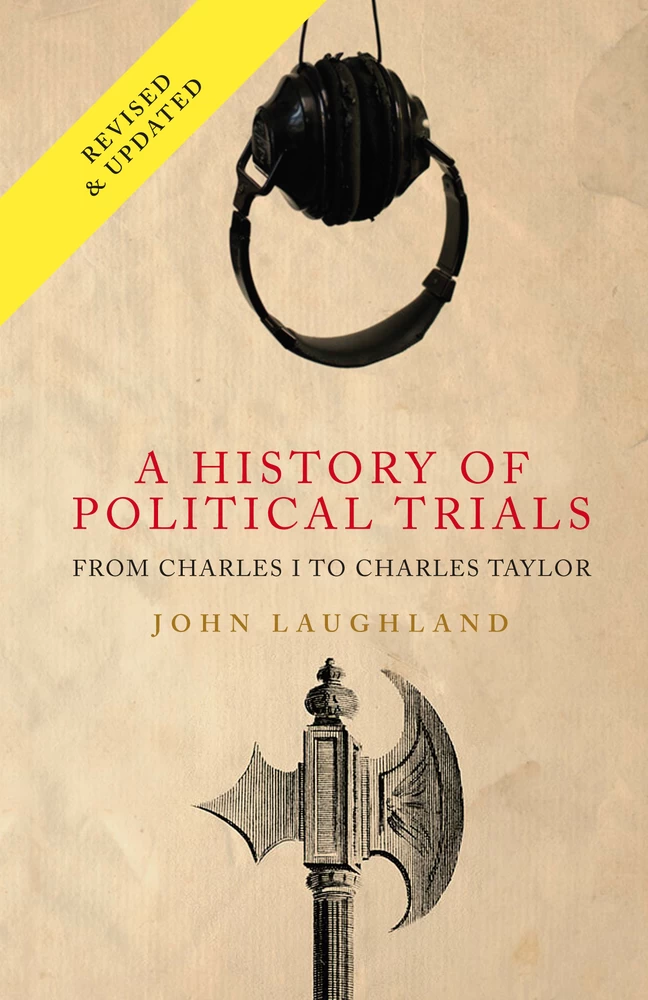
A History of Political Trials
From Charles I to Charles Taylor
Summary
Excerpt
Table Of Contents
- Cover
- Title
- Copyright
- About the author(s)/editor(s)
- About the book
- This eBook can be cited
- Contents
- Acknowledgements
- Introduction
- 1 The Trial of Charles I and the Last Judgement
- 2 The Trial of Louis XVI and the Terror
- 3 War Guilt after World War I
- 4 Defeat in the Dock: the Riom Trial
- 5 Justice as Purge: Marshal Pétain Faces his Accusers
- 6 Treachery on Trial: the Case of Vidkun Quisling
- 7 Nuremberg: Making War Illegal
- 8 Creating Legitimacy: the Trial of Marshal Antonescu
- 9 Ethnic Cleansing and National Cleansing in Czechoslovakia, 1945–1947
- 10 People’s Justice in Liberated Hungary
- 11 From Mass Execution to Amnesty and Pardon: Postwar Trials in Bulgaria, Finland, and Greece
- 12 Politics as Conspiracy: the Tokyo Trials
- 13 The Yassıada Trial, the Greek Colonels, Emperor Bokassa, and the Argentine Generals: Transitional Justice, 1960–2007
- 14 Revolution Returns: the Trial of Nicolae Ceauşescu
- 15 A State on Trial: Erich Honecker in Moabit
- 16 Jean Kambanda, Convicted without Trial
- 17 Kosovo and the New World Order: the Trial of Slobodan Milošević
- 18 Regime Change and the Trial of Saddam Hussein
- 19 The Trial of Charles Taylor
- 20 The Punishment Ethic in International Relations
- Notes
- Bibliography and Further Reading
- Index
In writing this book, I have contacted many people out of the blue, asking them for help. I have been immensely touched by the generosity with which they have responded, spent time on my requests, and imparted their knowledge. I am in debt to the following for their kindness:
Chris Black, David Brewer, Richard Crampton, István Deák, Vesselin Dimitrov, Penelope Evans, James Felak, Aaron Fichtelberg, Ivaylo Gatev, Milan Grba, David Jacobs, László Karsai, Lasse Lehtinen, Radomír Malý, Takis Nitis, Hannu Rautkallio, Filip Reyntjens, Urmi Shah, Phil Taylor, Kjetil Tronvoll, Ilya Vlassov, James Ward.
Whenever heads of state go on trial these days – and the phenomenon is becoming increasingly common – you can usually rely on someone to say that the event is unprecedented. In October 2007 a leading human rights organization said that the extradition of the former Peruvian president, Alberto Fujimori, to his native country from Chile was ‘the first time that a court has ordered the extradition of a former head of state to be tried for gross human rights violations in his home country.’ The same organization had previously said that the conviction for genocide of Jean Kambanda, the former prime minister of Rwanda, in 1998, was ‘historic’; that the trial of Slobodan Milošević, the former president of Yugoslavia, from 2001 to 2006, was ‘ground-breaking’; and that the trial of Charles Taylor, former president of Liberia, which started in late 2007, was ‘a break with the past’.1
The reason why such trials are greeted as marking new events is that they are indeed part of a new trend towards military and judicial interventionism, and towards rule by supranational political and judicial institutions. In most cases, recent trials of heads of state have been conducted before those international or partly international tribunals which have proliferated since the end of the Cold War: the International Criminal Tribunal for the former Yugoslavia (ICTY, created in 1993); the International Criminal Tribunal for Rwanda (ICTR, created in 1994); the Special Court for Sierra Leone (created in 1996, which organized the trial of Charles Taylor, the former president of Liberia, in The Hague); the International Criminal Court (ICC, created in 2002); and the Iraqi Special Tribunal (created by the American-run Coalition Provisional Authority in Iraq in 2003). In other cases, recent trials or attempted trials of heads of state have had an important international component: General Pinochet, the former president of Chile, was arrested in London on an warrant issued by a judge in Spain who invoked universal laws against torture. (The attempted extradition was rejected on medical grounds and Pinochet ← 13 | 14 → eventually returned to Chile, where he faced further legal procedures but died before ever coming to trial.) Meanwhile, former president Fujimori was extradited from Chile to Peru on a similar legal basis.
In tandem with this development, the post-Cold War period has also been marked by a rise in the view that international law should be coercive (instead of consensual, as in the past) and that, if necessary, war should be waged against states for failing to observe it or to protect universal human rights. The new coercive nature of international law was born when the United Nations Security Council authorized a coalition of states under United States leadership to repel Iraqi forces from Kuwait following the invasion of that country in August 1990: on that occasion, the then American president, George H. W. Bush, proclaimed ‘a new world order’2, by which he meant that international law would henceforth be enforced by means of military violence. The same sentiment was expressed at the end of the decade by the chief prosecutor of the ICTY, Louise Arbour, who said, ‘We have passed from an era of co-operation between states into an era in which states can be constrained.’3
The key point about this new development is that states, and the political decisions of their leaders, are henceforth subject to a body of law which is tailor-made for the purpose of controlling them and generally applied by external (international) bodies or by other states calling themselves ‘the international community’. As a leading proponent of this trend has eloquently argued, ‘The movement for global justice has been a struggle against sovereignty.’4 This is because human rights law is specifically law directed to deal with state acts, not with the acts of private individuals: ‘What sets a crime against humanity apart both in wickedness and in the need for special measures of deterrence is the simple fact that it is an act of real brutality ordained by government – or at least by an organisation exercising or asserting political power. It is not the mind of the torturer but the fact that this individual is part of the apparatus of a state which makes the crime so horrific.’5 Human rights law is not interested in torture if it is practised by a drug-dealer to extort money from his clients, but only if it is practised by an officer of a state.
The doctrine of universal human rights has therefore quickly become a basis for overriding national sovereignty, which until then had been the bedrock of the international system. While the doctrine of human rights appears to be incontestably moral and above politics, it is in fact the basis for a highly ambitious political project involving the creation of a new supranational jurisdiction and new law – a new right to rule. This development has inevitably led to the wielding of new political power through war. Whereas non-interference in the internal affairs of states had been a ← 14 | 15 → key principle of international law – for the simple reason that states were not considered to have legal jurisdiction outside their own borders, and because there was no supranational organization which had such jurisdiction either – the proclamation of ‘no-fly zones’ over the North and South of Iraq in 1991, on the basis that human rights were being abused in Iraq, heralded a new departure in international law. On the basis of it, Iraq was bombed, more or less continuously, until the invasion of 2003. This new philosophy of international relations also led to the 1999 attack on Yugoslavia by NATO, a war not authorised by the UN Security Council but justified on the purely moral (not really legal) claim that it was being waged against a state which was abusing its own people and violating their human rights. As the president of Yugoslavia was indicted by the ICTY at the height of the bombing – on the basis of exactly the same allegations as those being made by NATO – the twin principles of military and judicial interventionism became so completely intertwined with one another that they were effectively indistinguishable.
Whereas international affairs (including war) and domestic policing and judicial policy had previously been regarded as separate domains – the international system being based on the principle that all states are both sovereign and equal – they were soon blended together in the anti-egalitarian concept of ‘rogue states’ (some states are better than others) and in the interesting oxymoron, ‘the war on terror’ (which presents international war as being akin to internal policing). And because the policies of interventionism and regime change became so quickly entrenched, it seemed almost natural that the occupying forces in Iraq in 2003 should abrogate the country’s constitution and sack most of its judges, even though the existing international law on the rights of occupying authorities prohibits this, and that the former president, Saddam Hussein, should be put on trial for human rights abuses, as duly occurred in 2005.
Details
- Pages
- IV, 352
- Publication Year
- 2016
- ISBN (Softcover)
- 9781906165529
- ISBN (PDF)
- 9783035307986
- ISBN (MOBI)
- 9783035399875
- ISBN (ePUB)
- 9783035399882
- DOI
- 10.3726/978-3-0353-0798-6
- Language
- English
- Publication date
- 2016 (February)
- Keywords
- Trials Humanity Ethnic cleansing nuremberg
- Published
- Oxford, Bern, Berlin, Bruxelles, Frankfurt am Main, New York, Wien, 2016. 356 pp.
- Product Safety
- Peter Lang Group AG
