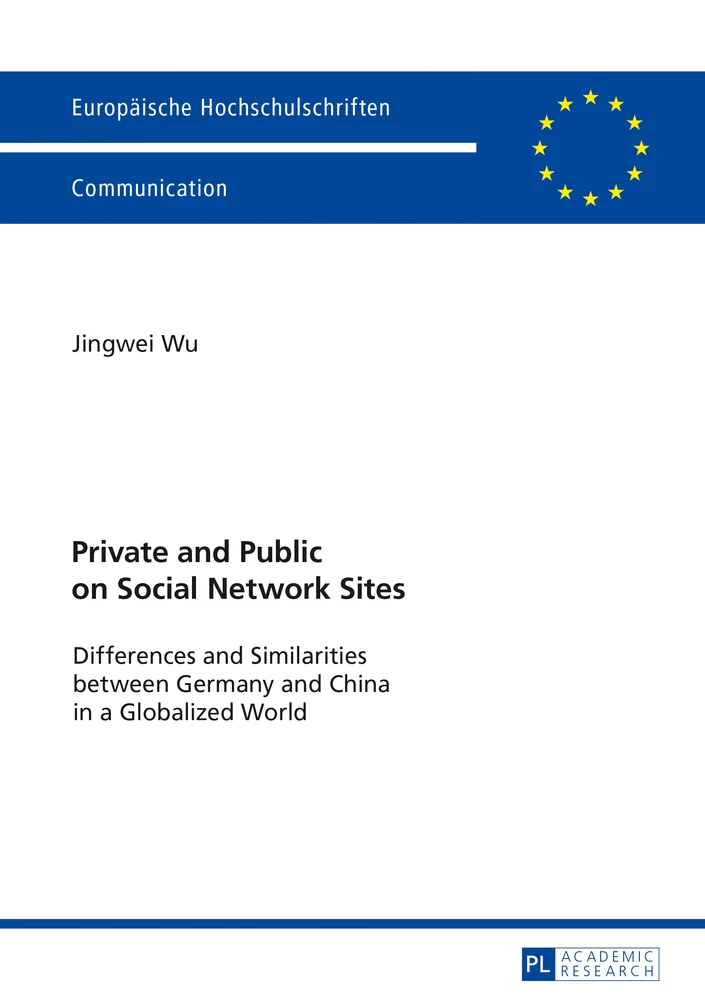
Private and Public on Social Network Sites
Differences and Similarities between Germany and China in a Globalized World
Summary
Excerpt
Table Of Contents
- Cover
- Title
- Copyright
- About the author(s)/editor(s)
- About the book
- This eBook can be cited
- Abstract
- Zusammenfassung
- Acknowledgments
- Contents
- I. Introduction
- 1.1 The Problem
- 1.2 Organization of Dissertation
- II. Conceptual Framework for Studying the Boundary Between “the Private” and “the Public”
- 2.1 A Historical Overview of the Definitions of “the Private” and “the Public”
- 2.2 Theoretical Frameworks of the Boundary between “Private” and “Public”
- 2.3 Private/Public Distinction: Decision by Social Contexts
- 2.4 Focus of Research
- III. Boundary Management Pertaining to SNSs
- 3.1 “Private” and “Public” on SNSs
- 3.1.1 Private Character of SNSs
- 3.1.2 Public Character of SNSs
- 3.1.3 SNSs: Still at the Forefront of Evolving Public Sphere
- 3.2 Information Flow on SNSs: from Private to Public Space
- 3.2.1 Self-disclosure
- 3.2.2 Political Expression
- 3.3 Mechanism of Boundary Management
- 3.3.1 Social Exchange Theory
- 3.3.2 Social Penetration Theory
- 3.3.3 Communication Privacy Management Theory
- 3.3.4 Boundary Management on SNSs
- IV. “The Private” and “The Public”: Differences and Similarities in a Globalized Germany and China
- 4.1 “The Private” and “The Public” in German Society
- 4.1.1 Historical Transformation of Concepts of “Private” and “Public” in Germany
- 4.1.2 Increasing Privacy Concerns and Expanding Public Space on SNSs
- 4.2 “The Private” and “The Public” in Chinese Society
- 4.2.1 Cultural Backgrounds and Historical Review of “The Private” and “The Public” in China
- 4.2.2 “The Private” and “The Public” as Merging Concepts on SNSs
- 4.3 Globalization: Digital Differences and Similarities of the Boundary between “The Private” and “The Public”
- 4.3.1 Media Freedom and Media System
- 4.3.2 Economic Development
- 4.3.3 Globalization and Culture
- V. Proposing Models of the Boundary Between “The Private” and “The Public” on SNSs
- 5.1 Proposing a Model for Self-disclosure
- 5.2 Proposing a Model for Political Expression
- 5.3 Self-disclosure and Political Expression under a Cross-Cultural Context
- VI. Research Method
- 6.1 Combining Quantitative Questionnaires and Qualitative Interviews
- 6.2 The Procedure of Data Collection and Data Quality
- 6.3 Variables and Measurements
- VII. Results
- 7.1 Results of Online Questionnaire
- 7.1.1 Description of Survey Respondents
- 7.1.2 Self-disclosure and Model Testing
- 7.1.3 Political Expression and Model Testing
- 7.1.4 Cross-cultural Differences of the Boundary between “The Private” and “The Public”
- 7.2 Results of Qualitative Interview
- 7.2.1 Name, Photo and Profile Information
- 7.2.2 The Parameters for Personal Information
- 7.2.3 Trust on SNSs
- 7.2.4 Target Audience on SNSs
- 7.2.5 The Boundary of Political Expression
- 7.2.6 The Use of SNSs Increases Political Expression
- 7.2.7 Self-censorship on SNSs
- 7.2.8 Political Efficacy vs. SNSs Efficacy on SNSs
- 7.2.9 Trust in Public/State TV or Private TV
- 7.2.10 SNSs as Private and Public Spaces
- VIII. Conclusions and Discussion
- 8.1 Summary of Research Goals
- 8.2 Review of Research Findings
- 8.2.1 The Boundary between “The Private” and “The Public” on SNS
- 8.2.2 Differences and Similarities in a Globalized Germany and China
- 8.3 Limitations, Discussions and Suggestions for Further Research
- List of Tables
- List of Figures
- References
- Appendixes
- A. Questionnaire
- B. Question for Semi-structured Interview
- C. Interviewed SNSs users’ Demographics
With the diffusion of new communication technology, scholars claimed that the division between the private and public spheres is becoming blurred (Meyrowitz 1985, p. 71, Habermas 1991a, p. 141–158, Thompson 1995, p. 64). The global widespread of Internet and Communication Technology (ICTs) has changed the social structure, communication channels and personal relationships, and called considerable attention to the distinction between “the private” and “the public”. Meanwhile, people around the world seem to become increasingly similar, rather than different, in regards to the usage of ICTs, a phenomenon that may result in the emergence of a global internet culture. The utilization of the Internet gives rise to the spread of “world-system status, privatization, democracy and cosmopolitanism” so that democracy is promulgated far and wide (Guillén and Suárez 2005, p. 45). Internet users also share similarities in their attitudes to online freedom of speech, privacy protection, trust and information security (Bellman, Johnson et al. 2004, p. 3, Dutta, Dutton et al. 2011, p. 6).
Although they hail from different countries, majority of the Internet users support the idea of online privacy. This trend indicates that levels of apprehensiveness are becoming more homogenous across the world, even in countries where no previous tradition of privacy existed, such as China. Accordingly, concerns over privacy increase with the modernization of Chinese society, the development of Chinese market economy and the changing social relations (Yuan, Feng et al. 2013, p. 1027–1029). Users across several countries, not only in China, feel that people should be able to freely express their opinions on the Internet (Dutta, Dutton et al. 2011, p. 12). The emerging Internet and ICTs seem to provide an effective domain for information exchanges, opinion expression and political deliberation process, which may benefit democracy ultimately. With a wide accessibility, the Internet facilitates better political participation and discussion, particularly for the resource-poor groups in civil society. Although members of these groups lack the ease of accessibility to traditional mass media and consequently, find it difficult to get involved in the public sphere, there are alternative platforms that create opportunities for political or civic participation on the Internet accessible to them. Not to mention in the last decade, we have witnessed the emergence of “Grassroots”. Vast arrays of civic forums, through which views are exchanged and deliberated freely among citizens, provide platforms for individuals to express their opinions. The BBC World Service poll conducted across ← 15 | 16 → 26 countries in 2010 revealed that 78% adults felt that they enjoyed more freedom thanks to the Internet (BBC 2010, p. 1).
In practice, recent years have seen the emerging Social Network Sites (SNSs) gaining great popularity and amassing numerous users across the world while changing their communication networks at the same time. According to Ellison and Boyd (2013, p. 151)’s widely used definition:
“A social network site is a networked communication platform in which participants 1) have uniquely identifiable profiles that consist of user-supplied content, content provided by other users, and/or system-provided data; 2) can publicly articulate connections that can be viewed and traversed by others; and 3) can consume, produce, and/or interact with streams of user generated content provided by their connections on the site. The list of other users with whom a connection is shared is not limited to connections like friend (Facebook, MySpace) or relative (Geni), but also includes connections like follower (Twitter), professional (LinkedIn) or subscriber (YouTube).”
SNSs are products of a marriage between ICTs and online networks. Some characteristics of Computer Mediated Communication (CMC) exert considerable effects on the disclosure behavior of people, such as the reduced nonverbal cues, the management of presentation and the pace to react and anonymity (McKenna and Bargh 2000, p. 60–62, Schouten, Valkenburg et al. 2009). CMC is different from Face-to-Face communication (FtFC) in that the former helps to reduce the handicaps of interaction, visual anonymity and uncertainty, and gives rise to sharing more private information (Joinson 2001, p. 188–189, Tidwell and Walther 2002, p. 332); whereas the latter may cause more risks to disclosure due to the uniqueness and ease of recognition of personal identity. Therefore, the inclination of disclosure behavior is a special but important phenomenon for the online interaction. In addition to the aforementioned characteristics of CMC, the most prominent attribute of SNSs is the networked communication. Users are connected via other nodes, so that ego-centered communicational networks are constructed. They get involved in these social networks which connect with huge number of other users. Generally, users are required to fill out some basic personal information, such as name, birthdate and gender, which is a kind of expression behavior. The interaction within these networks, therefore, can be increased, while disclosed information can be defused more widely due to the networked effect. As such, SNSs open a new communication channel with this networking function, one that is totally different from other ICTs platforms. Everyone in these networks needs to create a personal profile in order to connect with others. When they share their daily life, photos or feelings on profiles, this information is diffused through the various networks. ← 16 | 17 →
An increasing worldwide phenomenon indicates that people consume more social networks than any other category of sites. Rough figures claim that one fifth of a day is taken to play PCs while 30% of day is contributed to the mobile phones (Nielson 2012, p. 4). Users of SNSs often demonstrate a desire to present themselves, express feelings and develop relationships, while also seeking to erase feelings of loneliness (Morahan-Martin and Schumacher 2003, p. 665). According to Booth (2000, p. 1–2), some lonely individuals make use of the Internet to reduce stress and alleviative the negative feelings caused by loneliness. ICTs enable normal users to reveal and spread private information, even as the “illusion of privacy” created by the technology itself contributes to boundary problems (Barnes 2006, p. 12). The collection of personal information for commercial and business purposes further problematizes the boundary problem by raising the privacy question. In recent years, more companies have been dabbling in the advertising and marketing aspects of SNSs, especially taking advantage of the ease with which they can reach out to specific groups within a wider audience. As a result, these companies tend to direct the bulk of their advertising costs towards this avenue. On the contrary, users claimed that their profiles on social media, such as Facebook and Instagram, are part of a private domain purely for communication purposes with friends and families, and they do not want to be reached by any commercial organizations.
Habermas (1991a, p. 141–158) explains that the structural evolution that has occurred, and is occurring, within the public sphere is a result of the emergence of different forms of media and social changes introduced by new means of communication technology. Print media, radio, television have changed the public sphere profoundly such that now, the Internet expands the perimeters of the public domain and makes an obvious contribution to the public sphere by providing more platforms to express political opinions, and consequently, facilitating possible political participation while increasing political voices. Expression under a pseudo-anonymous name makes communication freer and more open. New types of communication technology, however, have created a new boundary between “the private” and “the public” (Papacharissi 2002, p. 22, Poor 2005). SNSs, as social domains, display both private (such as the development of private relationships) and public characteristics (such as the provision of discussion platforms) that lead to what Burkell, Fortier et al. (2013, p. 1) reveal to be the “loci of public display rather than private revelation”. Collaboratively with interview results, they argue that the structure of an online profile is based on the idea of enabling ‘everyone’ to see them, although the intended audience is restricted by virtue of the users’ desires. This openness of SNSs is inconsistent with the claim that social media ← 17 | 18 → is a private space (see studies from Ben-Ze’ev (2004, p. 96–104) and Livingstone (2006, p. 138–140), etc.); instead, it appears that participants view and treat online social networks as a public space.
Although the question of a clear distinction between “the private” and “the public” on social platforms have dominated many research exercises within the academic arena in recent years, most of the available studies focus primarily on themes of either “online privacy” or “SNSs as a public sphere” to evoke public discussion and opinion deliberation. The issues of combinative and overlapping private and public spaces have hitherto been ignored. It is hence my contention that SNSs can be considered as both private and public spaces, with a primary function of sharing personal information and distributing political discussion. My claim is corroborated by the high percentage of users who choose to selectively disclose information to a few people instead of the mass public. This presents an overlap of both domains that problematizes the demarcation of a truly private or truly public space. Therefore, SNSs can be also seen as a private space. Self-disclosure of personal information and voluntary expression of personal political opinions are two key branches of information that flow out of the private space into a public one. As such, SNSs should be considered a conflation of both private and public spaces and ought not be studied separately.
Various studies have argued that the division between what is private and what is public is becoming blurred as a consequence of new media technology (Meyrowitz 1985, p. 71, Thompson 1995, p. 120–125). However, Habermas (2004, p. 1) denies the idea of blurred boundary, and supports that “the private” and “the public” “complement each other”. It can be quite difficult to explain the distinction of what constitutes “the private” and “the public”, or to implement a clear dividing line between them in a networked society, particularly when technology complicates people’s ability to control accessibility and visibility. What remains an open question is the location of a boundary between “the private” and “the public” in a networked society. By extension, we have to question how people can work with the current divider. Both are questions of utmost importance in regards to communication on SNSs – a cyber environment where networked communication and information-sharing take place.
Besides the problem of a clear demarcation between “the private” and “the public” in cyberspace, the worldwide emergence of SNSs has also raised questions about how this boundary differs or remains similar across countries. Among individuals and organizations that try to abuse private data, the issue of a boundary has generated some harms to the society, social relationships and even human lives (Thompson 2011, p. 64). Globalization, especially, creates more similarities ← 18 | 19 → among different countries across the world. This is then reflected in the cyberspace as a seemingly similar boundary that divides “the private” and “the public”. More importantly, these international flows of media and technology innovations are seen as “powerful agents of change” (Rantanen 2005, p. 74). As ICTs become integrated into the everyday life, it influences a growing number of nations and promotes a global, rather than national, perspective in its exploration of how SNSs users manage the boundary between “the private” and “the public”. Additionally, ICTs play essential roles in the understanding of how media technology influences concepts and behaviors in different social and cultural contexts. While little is known about how people in different countries define “the private” and “the public” on SNSs, we cannot assume that globalization will result in the homogenization or heterogenization of world cultures, which will further influence the social behaviors related to private and public distinctions.
In a quest for a satisfying answer, my research compares the boundary between “the private” and “the public” in Germany and China through an analysis of various historical, cultural, and social concepts of “private” and “public” definitions. This transnational comparison aims to examine the ways in which SNSs influence different socio-national concepts of “the public” and “the private”. Whereas ideas of “the private” and “the public” are based on social development in Western countries, there is almost no tradition of privacy or of public opinions in China. Although, it must be acknowledged that conceptualizations of what is “private” and what is “public” have arisen with structural changes of social relations, that is itself a result of a rapid transition of contemporary China into a market economy. This allows the growing legitimization of the individual in social practices and the consequential individualization of Chinese society, giving rise especially to the Chinese privacy concerns. Also, platforms to express opinion have been innovated with the change in communication technology. Eastern countries of collectivistic culture do not have any modern notions of a “public” or “private” territory, and are in the works of processing a transformation of social structures and personal relationships. Therefore, it is necessary to conduct a transnational comparison order examine how Western norms of privacy protection and freedom of speech influence Eastern countries with respect to globalization, modernization, individualization and mediatization.
Details
- Pages
- 242
- Publication Year
- 2017
- ISBN (Softcover)
- 9783631681039
- ISBN (ePUB)
- 9783631707302
- ISBN (MOBI)
- 9783631707319
- ISBN (PDF)
- 9783653072228
- DOI
- 10.3726/b11197
- Language
- English
- Publication date
- 2017 (June)
- Keywords
- Public Sphere Privacy Social Media Globalization
- Published
- Frankfurt am Main, Bern, Bruxelles, New York, Oxford, Warszawa, Wien, 2017. 242 pp., 17 b/w ill., 22 tables
- Product Safety
- Peter Lang Group AG
