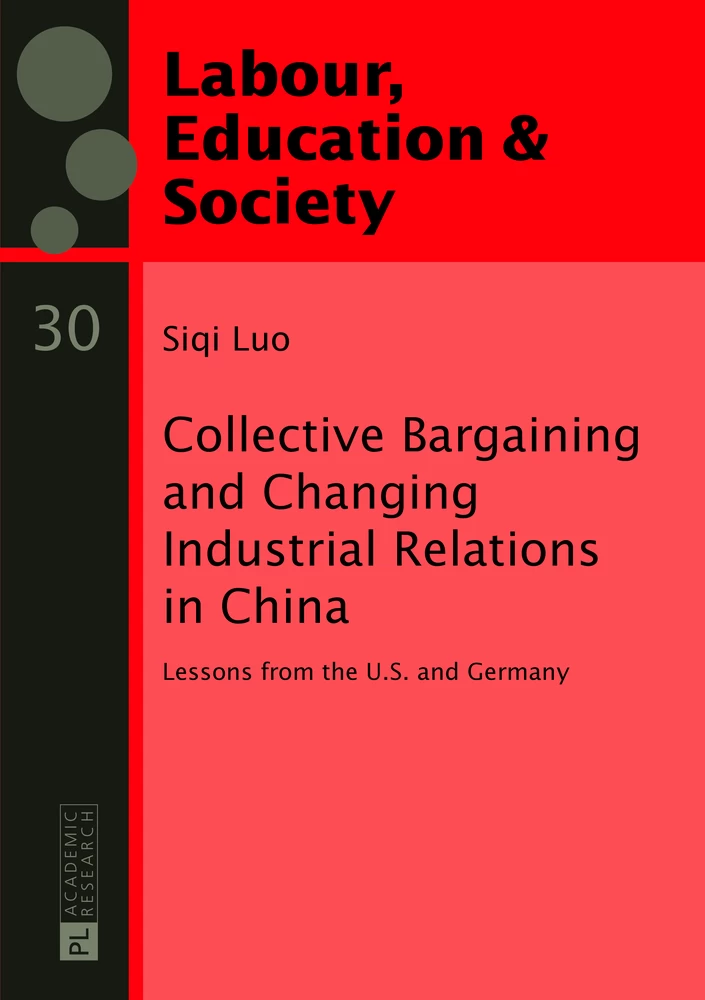
Collective Bargaining and Changing Industrial Relations in China.
Lessons from the U.S. and Germany
©2013
Thèses
VIII,
275 Pages
Série:
Arbeit, Bildung und Gesellschaft / Labour, Education and Society, Volume 30
Résumé
This study focuses on the status and prospects of collective bargaining in China based on lessons learned from the post-war United States and Germany. The author regards collective bargaining as a type of core wage regulation that emerged from production regimes at the factory level and from economic and labor policies of the state. This analysis compares the production regimes and the state-labor-capital relations in China today with the U.S. and German models in order to identify the missing links as well as potential driving forces in the current system of collective contract in China. Finally, the author proposes an ideal model of collective bargaining in China, one that offers solutions to a more just and sustainable trajectory of industrial development and that tailors to the power status of the major actors in industrial relations.
Résumé des informations
- Pages
- VIII, 275
- Année de publication
- 2013
- ISBN (Broché)
- 9783631626467
- ISBN (PDF)
- 9783653021554
- DOI
- 10.3726/978-3-653-02155-4
- Langue
- anglais
- Date de parution
- 2013 (Octobre)
- Mots Clés (Keywords)
- Automobile industry Electronics industry Trade union organization Regulation Industrial workers
- Publié
- Frankfurt am Main, Berlin, Bern, Bruxelles, New York, Oxford, Wien, 2013. VIII, 275 pp., 6 tables
- Sécurité des produits
- Peter Lang Group AG
