Sustainable Landscape Planning and Design
Summary
Excerpt
Table Of Contents
- Cover
- Title
- Copyright
- About the editor
- About the book
- This eBook can be cited
- Contents
- Influence of Urban Furniture Design on Environmental Behavior (Seda H. Bostanci / Pınar Öztürk Demirtaş)
- Permeable Pavements for Pedestrian Use (Fatma Aşilioğlu)
- Sustainable Design Approaches in Children’s Playgrounds (Habibe Acar / Demet Ülkü Gülpinar Sekban / Cengiz Acar)
- Urbanization in Tekırdag and a Case Study about Children’s Independent Mobility (Okşan Tandoğan / Deniz Yetkin Aker)
- Bim for Sustainable Landscape Design (Suzan Girginkaya Akdağ)
- Evaluation of User Perception on the Effects of Landscape Changes: Topography and Ecophysiology (Ercan Gökyer)
- Evaluation of Sustainable Urban Planning Approaches in Terms of the Possibilities for Social Interaction (Aslı Korkut / Tuğba Kiper / Tuğba Üstün Topal)
- Sustainable Ecosystem Services (Murat Atasoy / Filiz Guneysu Atasoy)
- Recent Urban Spaces Produced by the Consumer Society: Shopping Malls (Aysel Yavuz)
- Writing in the Disciplines: Aiding Discipline Specific Writing with a Data Driven Learning Approach (Elif Tokdemir Demir)
- Social Dimension of Squares’ Contributions to Urban Life (Murat Özyavuz / Beste Karakaya Aytin / Deniz Gözde Ertin)
- Universal Design in Public Outdoor Space (Nazan Kuter / Mihriye Çakmak)
- Assessment of the Safety of Playgrounds in Terms of Surface Material and Equipment (Rukiye Duygu Çay)
- Cultural Ecosystem Services and Human Well-Being (E. Seda Arslan Muhacir)
- Industrial Heritage Sites (Elif Ebru Şişman / Pınar Gültürk)
- Imagine Accessible Cities for Everyone (H. Candan Zülfikar / Aysel Yavuz)
- Conservation of Safranbolu – Bağlar Settlement in the Context of Sustainability (Suat Çabuk)
- Biotope Mapping in Landscape Planning (Aysel Gürkan)
- Rural Tourism and Traditional Turkish Villages in the Development Process (A. Esra Cengiz, Çiğdem Kaptan Ayhan, Aybike Ayfer Karadağ / Demet Demiroğlu)
- Driver and Passenger Perception Along the Roadside Landscapes: Safety and Recreation (Melih Öztürk)
- Sustainable Space-Sustainable Living: Physical Activity Friendly Urban Open and Green Spaces (Ayça Yeşim Çağlayan / Betül Atakan Öznam)
- Analysis of Urban Green Spaces; Case Study of Çankiri (B.Cemil Bilgili / Mustafa Ergen / İbrahim Aytaş)
- Designing of a Summer House in the Vineyards of Kayseri (Kemal Demir)
- Participatory Approach Model in Protected Areas: Biosphere Reserves (Yasin Dönmez)
- Water Garden Design in Landscape Architecture (Mahire Özçalik / Murat Özyavuz)
- Use of School Gardens for Sustainable Urban Agriculture (Özgür Burhan Timur / Buse Yazici)
- A Review of the Karabuk University Iron and Steel Campus According to Planting Design Principles (Ömer Lütfü Çorbaci)
- Evaluating Landscape Changes in a Coastal City: Case Of Amasra City, Turkey (Türker Oğuztürk / Ercan Gökyer / Ömer Lütfü Çorbacı)
- Conservation of Steppe Vegetation and its use in The Processes of Adaptation to Climate Change (Zuhal Dilaver / Emel Baylan)
- Today’s Sustainable Placements: Ecovillages (Aybike Ayfer Karadağ / A. Esra Cengiz / Demet Demiroğlu)
- Age Friendly Landscape Design (Tahsin Yilmaz)
- Key Parameter for Enhancing Sustainable Urban Design: Thermal Comfort in Outdoor Urban Spaces (Ülkü Duman Yuksel)
- Postafter Republic Housing in the Edirne City Center (Timur Kaprol)
- The use of Sustainability in Landscape Design (Aylin Salici)
- Energy Efficient Landscape Planning and Design Approach for Sustainability (Nurgül Arisoy)
- Evaluation of Sustainable Lighting Systems in the Context of Landscape Design (Ahmet Benliay / Orhun Soydan)
- Sustainability as a Design Strategy: a Case Study of Three Public Buildings (Deniz Dokgöz / Ferhat Hacialibeyoğlu)
- Importance of Greenways for Sustainable Cities (Umut Pekin Timur / Özgür Burhan Timur / Ferhat Özden)
- The Evaluation of Sanliurfa Traditional City Center in the Framework of Ecological Design (Hülya Öztürk Tel / Elmas Erdoğan)
Murat Özyavuz (ed.)
Sustainable Landscape Planning
and Design
Bibliographic Information published by the Deutsche Nationalbibliothek
The Deutsche Nationalbibliothek lists this publication in the Deutsche Nationalbibliografie; detailed bibliographic data is available in the internet at http://dnb.d-nb.de.
ISBN 978-3-631-73439-1 (Print)
E-ISBN 978-3-631-73440-7 (E-PDF)
E-ISBN 978-3-631-73441-4 (EPUB)
E-ISBN 978-3-631-73442-1 (MOBI)
DOI 10.3726/b11768
© Peter Lang GmbH
Internationaler Verlag der Wissenschaften
Frankfurt am Main 2017
All rights reserved.
Peter Lang Edition ist ein Imprint der Peter Lang GmbH.
Peter Lang – Frankfurt am Main · Bern · Bruxelles · New York · Oxford · Warszawa · Wien
All parts of this publication are protected by copyright. Any utilisation outside the strict limits of the copyright law, without the permission of the publisher, is forbidden and liable to prosecution. This applies in particular to reproductions, translations, microfilming, and storage and processing in electronic retrieval systems.
This publication has been peer reviewed.
About the editor
Murat Özyavuz is an Associate Professor at the Department of Landscape Architecture, Namık Kemal University. He studied Landscape Architecture at Ankara University and obtained a Ph.D. degree from the Landscape Architecture Department of the Institute of Natural and Applied Sciences. He is the author of many national and international publications and has worked for many research projects.
About the book
Theoretical foundations, theories, methods, and applications are essential parts of this reference book for landscape architects and other planning and design professionals. In addition, it addresses several very different subjects of study; landscape management, biodiversity, landscape restoration, landscape design, urban design, urban planning and architectural design related to theory, practice and the results are covered. Due to the varied usage of the term Planning/Landscape Planning, the intended readership for this book is a broad audience including environmentalists, landscape architects, architects, environmentalists, botanists, urban and regional planners, government agencies, non-governmental organizations, agricultural organizations, students at all levels, research organizations, international organizations and all interested parties. Landscape architecture is one of the most important of the sustainable planning and design professions. It is the design of outdoor and public spaces to achieve environmental, socio-behavioral, and/or aesthetic outcomes. It involves the systematic investigation of existing social, ecological, and geological conditions and processes in the landscape, and the design of interventions that will produce the desired outcome.
This eBook can be cited
This edition of the eBook can be cited. To enable this we have marked the start and end of a page. In cases where a word straddles a page break, the marker is placed inside the word at exactly the same position as in the physical book. This means that occasionally a word might be bifurcated by this marker.
Contents
Seda H. Bostanci, Pınar Öztürk Demirtaş
Influence of Urban Furniture Design on Environmental Behavior
Permeable Pavements for Pedestrian Use
Habibe Acar, Demet Ülkü Gülpinar Sekban, Cengiz Acar
Sustainable Design Approaches in Children’s Playgrounds
Okşan Tandoğan, Deniz Yetkin Aker
Urbanization in Tekırdag and a Case Study about Children’s Independent Mobility
Bim for Sustainable Landscape Design
Evaluation of User Perception on the Effects of Landscape Changes: Topography and Ecophysiology
Aslı Korkut, Tuğba Kiper, Tuğba Üstün Topal
Evaluation of Sustainable Urban Planning Approaches in Terms of the Possibilities for Social Interaction
Murat Atasoy, Filiz Guneysu Atasoy
Sustainable Ecosystem Services
Recent Urban Spaces Produced by the Consumer Society: Shopping Malls
Writing in the Disciplines: Aiding Discipline Specific Writing with a Data Driven Learning Approach
Murat Özyavuz, Beste Karakaya Aytin, Deniz Gözde Ertin
Social Dimension of Squares’ Contributions to Urban Life←5 | 6→
Universal Design in Public Outdoor Space
Assessment of the Safety of Playgrounds in Terms of Surface Material and Equipment
Cultural Ecosystem Services and Human Well-Being
Elif Ebru Şişman, Pınar Gültürk
H. Candan Zülfikar, Aysel Yavuz
Imagine Accessible Cities for Everyone
Conservation of Safranbolu – Bağlar Settlement in the Context of Sustainability
Biotope Mapping in Landscape Planning
A. Esra Cengiz, Çiğdem Kaptan Ayhan, Aybike Ayfer Karadağ, Demet Demiroğlu
Rural Tourism and Traditional Turkish Villages in the Development Process
Driver and Passenger Perception Along the Roadside Landscapes: Safety and Recreation
Ayça Yeşim Çağlayan, Betül Atakan Öznam
Sustainable Space-Sustainable Living: Physical Activity Friendly Urban Open and Green Spaces
B.Cemil Bilgili, Mustafa Ergen, İbrahim Aytaş
Analysis of Urban Green Spaces; Case Study of Çankiri
Designing of a Summer House in the Vineyards of Kayseri←6 | 7→
Participatory Approach Model in Protected Areas: Biosphere Reserves
Water Garden Design in Landscape Architecture
Özgür Burhan Timur, Buse Yazici
Use of School Gardens for Sustainable Urban Agriculture
A Review of the Karabuk University Iron and Steel Campus According to Planting Design Principles
Türker Oğuztürk, Ercan Gökyer, Ömer Lütfü Çorbacı
Evaluating Landscape Changes in a Coastal City: Case Of Amasra City, Turkey
Conservation of Steppe Vegetation and its use in The Processes of Adaptation to Climate Change
Aybike Ayfer Karadağ, A. Esra Cengiz, Demet Demiroğlu
Today’s Sustainable Placements: Ecovillages
Key Parameter for Enhancing Sustainable Urban Design: Thermal Comfort in Outdoor Urban Spaces
Postafter Republic Housing in the Edirne City Center
The use of Sustainability in Landscape Design
Energy Efficient Landscape Planning and Design Approach for Sustainability←7 | 8→
Evaluation of Sustainable Lighting Systems in the Context of Landscape Design
Deniz Dokgöz , Ferhat Hacialibeyoğlu
Sustainability as a Design Strategy: a Case Study of Three Public Buildings
Umut Pekin Timur, Özgür Burhan Timur, Ferhat Özden
Importance of Greenways for Sustainable Cities
Hülya Öztürk Tel, Elmas Erdoğan
The Evaluation of Sanliurfa Traditional City Center in the Framework of Ecological Design←8 | 9→
Assoc. Prof. Dr. Seda H. Bostanci1
Assist. Prof. Dr. Pınar Öztürk Demirtaş2
Influence of Urban Furniture Design on Environmental Behavior
1Namık Kemal University, Faculty of Economics and Administrative Sciences, Political Science and Public Administration Department
2Okan University, Faculty of Art, Design and Architecture, Industrial Product Design Department
1. Introduction
Today, at different scales, design products have become the main research area for designers in urban to neighborhood scale design, allowing them to communicate with the user and to meet the user’s behaviors, tendencies, and anticipations. This approach in the field of environmental psychology emerged from a combination of experimental and behavioral issues, which are aesthetic dimensions in the formation of innovative research. Developments in the field of environmental psychology have been demonstrated by various pieces of social, cultural, cognitive and experimental research by experts in this field, where positive urban experiences are seen to cause a change of behavior beyond a change in people’s taste and a level of happiness with aesthetic, cognitive, semantic, functional and perceptual variables [1; 2; 3; 4; 5; 6].
Sustainability is a framework concept that includes economic, social and ecological dimensions to form what we consider to be a human-focused environmental approach, and one that seeks to find an equilibrium between the resources available today and a rational and decent usage of these by future generations, as well as striking a balance between urban conservation and development. The work on sustainability means that the community can fulfill its responsibilities in this field by developing a community structure which is itself sustainable [7]. Sustainable communities are those where there is harmony between nature and the environment. Their lifestyle inspires thoughts about sustainable development and sustainable governance [8]. We can see that the cultural, sociological and economic strata that build diversity and difference within the development of the environmental consciousness, as well as the environmental values of societies among themselves are as decisive in this area as they are elsewhere. It may be thought that some societies need to be directed in←9 | 10→ the field of environmentalism whereas others set a precedent for their traditions in this area. The design of urban furniture can be seen as an innovative tool to design and guide the environmental awareness of social life for the inhabitants of urban open spaces.
Academic studies intended for fostering environmentally friendly behavior are increasing in the fields of product design and marketing [9; 10; 11]. “ ‘Design for Sustainable Behavior’ (DfSB) is a new field of enquiry exploring how design can influence user behavior to reduce negative social or environmental use impacts” [12].
Urban furniture has the main function of improving the quality of life in public spaces such as lighting at night, comfortable elements in parks, garbage collection, recycling of waste, navigation and wayfinding. This study discusses the effects of urban furniture on environmental sustainability. By studying sustainable design concepts with different aspects, the design processes of urban furniture are discussed considering the relation between environmental psychology and design. The study brings forward suggestions about the future of this field by giving examples of local governments, non-governmental organizations and university studies on the achievements of urban furniture design which aims at sustainability.
2. Sustainable Design Approaches
The responsibility of the designer is influential in the effectiveness of the design in terms of sustainability. Design can contribute to sustainability in many ways, such as the use of materials, the form of production, environmental awareness, and the orientation of user behavior. It is important to develop the life cycle of the products [13]. Within the framework of sustainable design, ecosystem design for the environment is included in relevant literature and research. The definitions regarding where the concept of “environment” in terms of sustainability appears in the study can be presented with the titles of design for environment – DfE, eco-design, eco-effective design, environmentally responsible manufacturing, green design and life cycle design. Tingstrom (2007), basing his work on a broad set of references, explained the definitions of these concepts as follows: “Design for environment-DfE: Systematic consideration of environmental, human health and safety impacts in design products and processes. Eco-design: Multi-dimensional features of environmental values to be considered before the cost in product design. Eco-effective design: Design function, quality, product and process targeted at the efficiency and productivity of environmental performance. Environmentally responsible manufacturing: Promotion of the adaptive approach, as in the design←10 | 11→ process of resource use. Green design: An innovative design concept that is seen as an opportunity in the design process, in the direction of sustainable goals of protecting environmental values. Life cycle design: A design concept that evaluates recycled materials by taking the design product as a life cycle” [14].
Considering the above concepts, it is apparent that there are environmental sustainability approaches such as function, cost, quality, minimizing environmental effects, preventing waste formation and environmental sensitivity. Accordingly, the design itself must bear environmental responsibility in terms of structure and function – it should be able to create an environmental point of view for the user and be responsible for creating social behavior.
Recycling waste packaging such as plastic bottles, batteries and beverage cans, as well as receiving a payment or an award in return, is another example of this approach. These recycling vehicles, which are located in public areas, either open or closed, have widespread use in many countries [15].
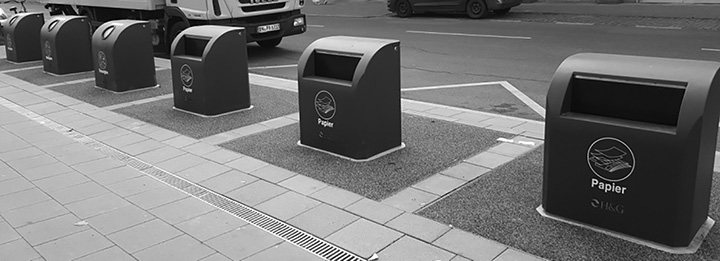
Urban furniture, open to public use and designed for the city, is important in terms of environmental responsibility. From this point of view, there are many design approaches to achieve sustainable behavioral habits. For example, garbage separation and the development of people-oriented design is an approach to direct behavior towards waste separation; and today, as seen in Figure 1, it is used as a social responsibility and policy in many countries.
Figure 1: Developing behavioral patterns for environmental sustainability–Waste disposal– Düsseldorf / Germany (Photo by Pınar Öztürk Demirtaş).
Cultural differences among societies have brought with them different behavioral habits. These differences must be taken into account when creating design approaches to develop environmental responsibility in the community. For example; in some societies, seed sales and consumption have become a habit in open spaces, in parks and in coastal areas, and as a result, seed shells create an←11 | 12→ environmental problem. As shown in Figure 2, it may be a matter of design to develop a behavioral model for the user to solve this problem.
Figure 2: Student design project on seed sales and garbage collection unit in areas such as park, coastal region, etc. (Okan University – Department of Industrial Product Design).
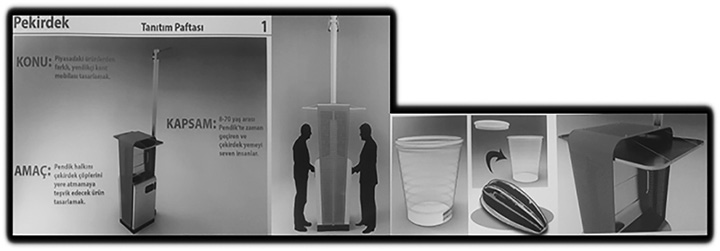
“It is aimed to make people do the things – that they are not willing – voluntarily by performing a positive action. It seems that the designed product is a ‘seed sales unit’ which gives back some of the money as a “deposit” when it is given the garbage. It is planned that the user will be rewarded when the refuse provided during the sale is filled and returned” [16].
Figure 3. Urban road separator areas, the use of waste tires to create an environmental layout in green islands–Düsseldorf–Germany (Photo by Pınar Öztürk Demirtaş).
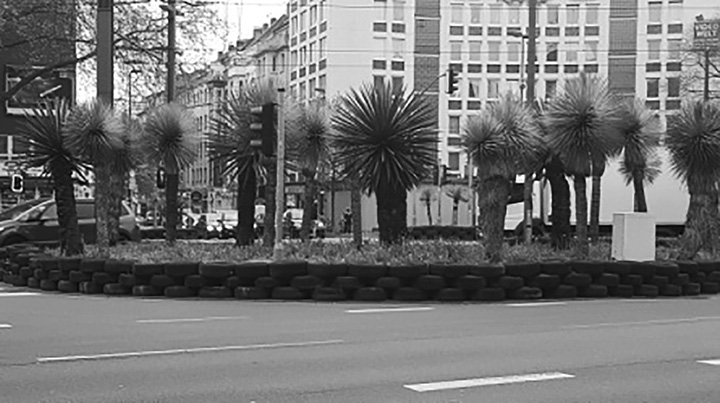
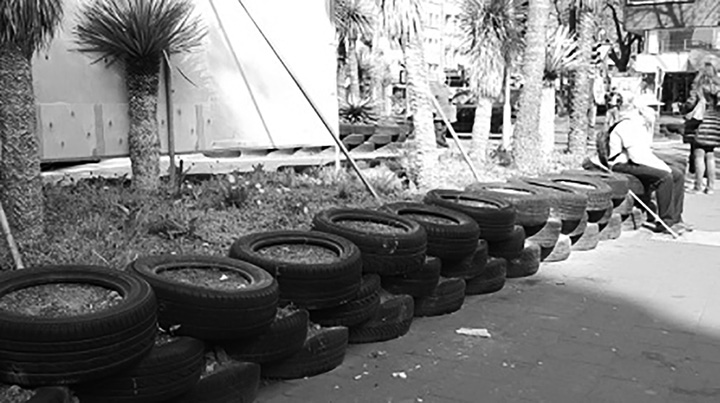
One of the methods for sustainability is using a recyclable material for the design of the chosen material, whereby the expired products can be reused for different purposes is another solution,– as we can see in the example in Figure 3. The design area produces creative solutions with environmental values and sustainable and user-friendly product development interface.
3. Urban Furniture in the Context of the Environmental Behavior and Design Relation
Details
- Pages
- 524
- Publication Year
- 2017
- ISBN (Softcover)
- 9783631734391
- ISBN (PDF)
- 9783631734407
- ISBN (ePUB)
- 9783631734414
- ISBN (MOBI)
- 9783631734421
- DOI
- 10.3726/b11768
- Language
- English
- Publication date
- 2018 (August)
- Keywords
- Landscape architecture Urban design Ecological design Plannning theory
- Published
- Frankfurt am Main, Berlin, Bern, Bruxelles, New York, Oxford, Warszawa, Wien, 2017. 524 p., 145 b/w ill., 44 b/w tables.
- Product Safety
- Peter Lang Group AG
