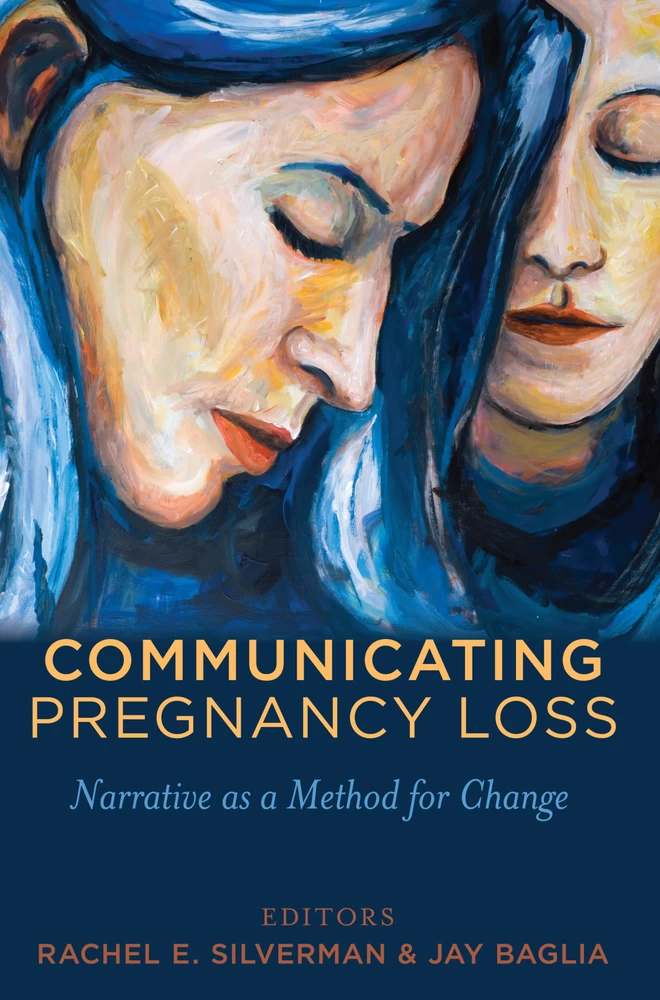
Communicating Pregnancy Loss
Narrative as a Method for Change
Summary
The loss of a desired pregnancy or the inability to experience pregnancy are intensely personal phenomena; these losses are also, in our culture at least, extremely private. Communicating Pregnancy Loss is a collection of first-person narratives about the experience of pregnancy loss. Although there is no shortage of books that help prospective parents cope with an unintended pregnancy loss or ‘survive’ infertility, most of these books are authored by physicians or therapists and address pregnancy loss through the language of guidance. This book is different. It is the first of its kind because the contributors (primarily communication scholars but also healthcare personnel and other scholars from the social sciences) tell their story of loss in their own words, offering a diverse collection of narratives that span experience and identity. The authors employ various feminist theories, narrative theories, and performance theories as well as other well-known communication theories and concepts. The book’s narrative approach to writing about and thereby understanding pregnancy loss offers readers a method for changing the way pregnancy loss is understood personally, culturally, and politically.
Excerpt
Table Of Contents
- Cover
- Title
- Copyright
- About the editors
- About the book
- Praise for Communicating Pregnancy Loss
- This eBook can be cited
- Contents
- Foreword: The Sacred Number Four
- Acknowledgements
- Rachel
- Jay
- Introduction: The Politics of Pregnancy Loss
- Definition: Pregnancy Loss
- The Case for Pregnancy Loss Narratives
- Previous Studies: A Brief Overview of Pregnancy Loss Literature
- A Narrative Approach to Pregnancy Loss
- The Chapters
- Section 1: Pregnancy Loss and Social Support
- 1. Nine Years Later and Still Waiting: When Health CareProviders&’ Social Support Never Arrives
- Communicating With My Midwife After Losing My Baby
- Reflections on How Health Care Providers Can Provide Support to Grieving Women
- Time Does Not Heal All Emotional Wounds
- Wanting TMI (Too Much Information) but Getting NEI (Not Enough Information)
- Providing the “Right” Support at the “Right” Time
- Disconfirming Messages Create Distressful Situations
- Looking Toward a Healthy and Supportive Future
- 2. Honoring Stories of Miscarriage in the Medical Context:A Plea to Health Care Providers
- A Nagging Discontent
- A Narrative Medicine Approach
- The Possibilities and Pitfalls of Narrative Medicine
- The Aftermath
- Concluding Thoughts
- 3. Looking for Their Light: Advancing Knowledge andSupporting Women by Listening to Pregnancy Loss Narratives
- Jennifer’s Story—and Ann’s Story: 2003
- Michael: December 3, 2001
- Michael: Fall 2006
- Michael: February 2008
- Michael’s Story—and Barbara’s Story: Spring 2013
- Conclusion: Our Stories
- 4. Unscripted Loss: A Hesitant Narrativeof a Reconstructed Family
- Our Narrative
- Resisting Silence: Scripting Theory and Narrative Practice
- Section 2: When the Personal Is Professional
- 5. A Story We Can Live With: The Role of the Medical Sonographerin the Diagnosis of Fetal Demise
- Elissa: Experiencing Diagnosis via Ultrasound Examination
- Considering the Role of the Sonographer
- Jodi: Patients Respond in So Many Different Ways
- Responding to the Patient Whose Child has Genetic Anomalies
- Diagnosing Fetal Demise
- Acknowledging a Common Humanity
- A Story We Can Live With
- Elissa: Narrative Ethics and the Sonographer’s Role
- Notes
- 6. Searching for Grace
- 7. When the Professional Is Personal: Case Studiesof Pregnancy Loss, My Story of Pregnancy Loss
- 8. Infertility, Professional Identity, and Consciousness-Raising
- Note
- 9. Hidden in Plain Sight: Mystoriography, MelancholicMourning, and the Poetics of [My Pregnancy] Loss
- Since You Asked
- Crying in the Cat Box
- Dancing With the Dead
- Remembering Mother’s Day, 1999
- A Gift
- Momma Loves You
- Pink or Blue
- Parable: Metaphor for Method
- New Questions, Partial Responses
- Conclusion
- Notes
- Section 3: Space, Time, and Pregnancy Loss
- 10. On the Identity Politics of Pregnancy: An AutoethnographicJourney Through/In Reproductive Time
- 11. The Healing Journey
- Reflecting on the Journey
- 12. Once Upon a Time: A Tale of Infertility, In Vitro Fertilization, and (Re)Birth
- Separation
- Initiation
- How to Make a Child
- Return
- Eggsistential Crisis
- My Infertility Narrative as a Hero’s Journey
- Problems With Viewing My Infertility Narrative as a Hero’s Journey
- 13. The Empty Woman: Dealing With Sadness and Loss Aftera Hysterectomy
- My Narrative of The Empty Woman
- Reading the Operative Report: Shame
- Deciding to Have Surgery: Stress
- Leading Up to the Surgery: Singleness
- Watching Julie and Julia Post-Surgery: Surprise Sadness
- Teaching Classes Post-Surgery: Secrecy
- My Analysis of The Empty Woman
- Identifying Underlying Expectations
- Ideology of Choice
- Ideology of Romantic Partnership
- Ideology of Successful Independence
- Engaging in “Self-Making”
- A Marginalized Woman
- An Empty Woman
- Conclusion
- Section 4: Without the Sense of an Ending
- 14. Melancholy Baby: Time, Emplotment, and Other Noteson Our Miscarriage
- October 2010: Old Friends
- Friday, September 12, 2008
- Spring, 2009: Interpreter of Maladies
- Late Summer, 2009
- Saturday, September 13, 2008
- September 2008: Ritual
- February 7, 2010 (Super Bowl Sunday)
- Today
- Notes
- 15. Dying Inside of Me: Unexplained Recurrent Early Pregnancy Loss
- Loss #1: On the Way to Fetus but Stopped at Embryo
- Loss #4: The One That Got Stuck
- Loss #7: Another “Near Miss”
- 16. Moving Through Miscarriage: A Personal Narrative
- Sitting Up
- Crawling
- Falling Down
- Standing Still
- First Steps
- 17. Barren and Abandoned: Our Representations Left Unsharedand Uncharted
- Health and Fertility/Infertility
- Beginning Context
- Understanding Our Infertility Journey
- Julie’s and Eduardo’s Representations as (Patient) Parallel Charts
- Unshared, Uncharted Representations and Fragmented, Woeful Affiliation
- Notes
- Section 5: Reframing Loss
- 18. Cruel Optimism and the Problem With Positivity: Miscarriageas a Model for Living
- On (Not) Writing Experience
- Miscarriage as a Model for Living
- Notes
- 19. Turning Tragedy Into Triumph: A Hero&’s JourneyFrom Bereaved Parent to International Advocate
- Homeground
- Call to Adventure
- The Guides
- Hero’s Initiation
- Discovering Our Shield
- Council of Heroes
- Instruments of Power
- Confronting and Summiting With the Shadow
- Confronting Obstacles and Blocks
- Rewards and Renewed Homeground
- Conclusion
- 20. Breaking Through the Shame and Silence: A Media-Centered Approach to Consciousness-Raising
- Notes
- Afterword: How to Do Things With Stories
- Personal
- Cultural
- Political
- Note
- Biographies
- Editor Biographies:
- Contributor Biographies:
- Glossary of Terms
- Appendix: Pregnancy Loss in the Media
- Pregnancy Loss on Television
- Pregnancy Loss in Literature
- Pregnancy Loss in Film
- Celebrity Accounts of Pregnancy Loss
- References
- Index
- Series index

Foreword: The Sacred Number Four
I was married for seven years the first time and there were no children. My resistance to having children was most certainly one of the many reasons we divorced. The second time around, in a marriage that has lasted twenty-six years, my husband J.C. and I told each other from the beginning “no children.” After much debate, we reconsidered. But it wasn’t easy. There were months we couldn’t broach the topic, others when J.C. spoke to my expressionless face about a potential cousin for his sister’s child, and still others when I coaxed J.C. into tales of adventures we would take with a child. Somehow, we found ourselves in agreement, bracing for the ride, wherever it took us.
Nature stepped in, and left us powerless to carry any of our pregnancies to term. J.C. and I are true believers in things happening for a reason—and for us that reason is nature taking its course. Maybe our spirits were not ready; maybe our bodies were moving in another direction, maybe we were connected to some other responsibility on this earth. But for us, nature spoke. The first pregnancy ended after eight weeks, the second, ten weeks, and the third time seemed like a charm when we made it to thirteen weeks, one week into what people told us was the “safe zone” of the second trimester. Each loss felt like both devastation and relief, sort of like getting the wind knocked out of you and dodging a bullet in the same moment. The devastation was like waves of pain that kept recurring—this loss, the accumulated losses, and the prospect that we would always be childless. Relief sat right up front with devastation—relief that nature had spoken, and we trusted her, relief because we had doubts that we could be “good” parents, whatever that means, relief that I should just go ahead and believe what the doctors said about miscarriages being caused by the “advanced age” of my late thirties, and relief that we could go on living our lives as we chose. None of it made much sense when we added it all up.
← ix | x → The day we came back home from the hospital after my third D&C, I felt lost and angry. D&C is such vacant shorthand for the procedure that dilated my uterus and scraped away the “genetic material” that was my healthy son. All three times, what they called “fetal tissue” was, in truth, a healthy baby, with no indications of genetic abnormalities. With “the third time’s a charm” mocking me, I felt stupid lying in bed, feeling sorry for myself, with no one I really wanted to call or talk to. J.C. followed me around the house, offering me pleasantries, trying his best to meet me somewhere; I couldn’t face him or my grief. I tugged hard on the cord to bring the attic stairs out of our hallway ceiling to the floor; with one lumbering step at a time, I climbed the eight steps to the top, ducked my head two more steps through the sweltering attic air, and sat down in front of the two beat-up trunks that have traveled with me since high school.
I shuffle through family photos, newspaper clippings, and school grade reports. I land on one black-and-white photo with mom and me side by side, leaning into each other, arms slung around each other’s necks, standing in a wide-open field, on parent visitation day at Girl Scout camp. Her newly blond, bouffant hair is such a contrast to her typically dark-brown style. I am drawn to her familiar short-sleeve, flowered top, pedal pushers, and beige moccasins. I remember my mom this way. She looks happy. I feel happy staring at this photo, dreamily remembering whatever I can about that event-filled summer day.
I wonder what words of comfort mom would offer me today. I can imagine her two hands reaching out to rest lightly on my shoulders, face to mine, engaging my eyes to look into hers, and she would say in a soft whisper:
“It will be okay. This will happen. I can picture your little girl.”
That’s what I want her to say as her lips rendezvous with a tear on my cheek. I would place my hands on top of hers and snuggle into her neck. Her lips would move from my cheek to kiss the top of my head. As I lift my head, the photo stares back, not my mom.
“Patricia, what are you doing?” J.C.’s voice flies up the stairway like a distress flare after an accident. “You need to come down from there. It’s time for lunch. What sounds good?”
I hold my breath. I know he knows where I am, but I feel like hiding.
“Patricia?”
“Okay.” I shift my weight to stand only halfway, back bent so as not to hit my head on the attic’s wooden rafters. I realize my left foot has gone to sleep. “I’m coming. Just a minute. I need a minute.” I massage my foot deeply and the tingles return sensation. My whole body feels numb as I crouch the ← x | xi → two steps to the ladder, and turn to descend. J.C. stands at the base of the ladder, arms outstretched to support me. His gentle hands touch my calves, hips, waist, and back, as my feet hit solid ground. He turns me around to face him and wraps his arms tightly around me, as I drop my forehead to his chest and his chin rests atop my messy mop of hair, unwashed since before the surgery. The stairs become our anchor as we embrace, leaning into each other. No words pass between us and I feel a shiver of perception tumble from my throat to my toes.
I lift my head, and pull away. “I’m not hungry,” I sigh. I’m full with sadness, something I hardly ever feel. The heaviness weighs down the spirited optimism that radiates from me most every day.
“That’s okay. Let’s just take a break.” J.C.’s arms pull me back in as he caresses my shoulders and guides me to our black leather sofa, the dusky early evening light tossing shadows across our hardwood floors. We rest together on the couch, leaning into each other, a tear now and then trickling down his cheek, then mine.
“Maybe we weren’t meant to be parents,” J.C. thinks aloud in an effort to salve our wounds and check in on how I’m faring. We embrace each other and, hesitantly, this truth.
I knew from experience that no one understands the intense pain of losing a wanted and hoped-for child to miscarriage. I can’t say how many times I held my tongue when someone in their most soft and caring voice said things like, “Miscarriage is more common than people realize.” Believe me, I know. “I have a friend who had nine miscarriages, but now her baby boy is two!” Oh good, only five more miscarriages to go. And the best one of all, “God wanted your babies.”
Really? Who does God want next? In my thoughts, I met their patronizing comments with sarcasm. But in my heart I wondered how so many people whom I call my closest friends could try their best to comfort me and fail so miserably to lift my spirits. One close friend came to my house with an Anne Geddes book, In the Garden; this book is filled with photographs of infants (many are newborns) swathed in ways to appear as fruit, vegetables, and insects. A beautiful book under any other circumstance. But disarmingly excruciating at this moment. I stared at each photo, flipping the pages aimlessly, trying to picture what our baby would look like. With each page, each delicately wrapped infant, came the haunting words “no heartbeat,” “genetic material,” and “D&C.” What I saw before me, balanced on my lap, was a heavy, hardcover reminder of what was not to be. My friend had no idea that her whispered, “I know, I know, I know” in response to my ← xi | xii → tears was salt to my wound. She didn’t know the wound was inflicted with her intended comfort.
Only one friend found her way to me in the most loving and comforting way. Jan came to my house, sat on my bed, kissed me, hugged me, said little, and gave me Gloria Steinem’s Revolution From Within. Jan was one of the first people I told of my pregnancies and miscarriages. She too had struggled through infertility, not miscarriage, but the wanting, the aching, and finally a baby girl. We had talked about how infertility sets loose fears and doubts about anything, not just the loss. I don’t know whether she knows how much that moment bonded me to her for the rest of our lives.
In the end, she wasn’t the only one. The week before my trip to the Western States annual academic conference I contracted poison oak. It spread throughout my body. I was miserable with itching and sorrow. A part of me believed that getting out and being with others might be the best medicine, but by the time I arrived at the hotel, all I wanted to do was soak in a tub and sleep. I arrived at the door of our room in Albuquerque, gave a slight knock, and my friend Amira appeared with open arms. She knew how difficult it was for me to travel to this conference. We talked for a short while, focusing mostly on my loss, until she headed out to the opening reception. When she returned hours later, I was scratching like crazy and was mad with grief, desperation, and fear.
Comfortably situated in our beds, Amira reminded me of the sacredness and completeness of the number four—the four directions, the four seasons, the four elements, and the four birds that are the sacred gatekeepers of the four directions. A Huichol woman named Guadalupe had guided her use of the four directions in her work with women. This guidance was just what I needed when loss seemed inevitable. That night intensified the bond between Amira and me and drew me into a circle of hopefulness and healing. Yet, I couldn’t quiet the whisper that there was a reason we were not having a child.
Only a few months later, J.C. and I discovered that getting pregnant the fourth time was as easy as saying, “Hi.” The sacred number four turned out to be a baby girl. Makenna May Martin was born March 30, 1993, a month and a half early from her due date of May 15. Amira became Makenna’s spiritual godmother.
The fourth was a charm. Momentous! I would tell people that she was born with the souls of the three miscarried babies that lived before her, vibrant even now, twenty years later! There in the birthing suite, J.C. and I lean our heads side by side, eyes locked on the tiny, four-pound, but healthy baby girl I cradle close to my belly as she nibbles on my breast. We both inhale that fresh, powdery, newborn scent and my lips are drawn into her soft, fuzzy, ← xii | xiii → strawberry-colored hairline. I look up into J.C.’s face and see the same wonder. His eyes unlock from Makenna and search inside mine. “How are you feeling? You okay?” J.C. asks, as he locks back into our daughter’s eyes, his forefinger tracing the eyebrows, nose, and lips of OUR tiny, little girl.
Such a neat and beautiful ending to a painful, confusing, and complicated passage to parenthood. But what is not present in this ending is the depth of pain and depression that followed as I experienced four more miscarriages when Makenna was two, three, and four years old. We never got pregnant again after that seventh miscarriage, and we have relished all the time we have with our one and only, now twenty-one-year-old “baby girl.”
* * *
Writing the foreword to this collection was an unexpectedly difficult expedition for me as I traveled back through the terrain of my own miscarriages. There was joy and comfort in seeing in others’ words my own feeble voice. There was pain and defiance in reliving what these stories tell; I remember too well the ways that I felt stifled and silenced. But importantly for me, and any reader of this collection, there is inspiration, insight, strength, even liberation in these stories; the words reverberate, resonate, and revive a spark in fibers that have been deadened by words and actions lacking empathy, understanding, and caring. The metaphor of a spiral staircase invokes the emotional and embodied knowledge as readers of this book “come round and round to explore and re-explore, from a flight or two up or down, from a different perspective, always with different insights to our experiences” (Ilse & Jones, p. 67, this volume). We walk alongside the authors as they tell their stories and reveal the diverse, complicated, and enigmatic threads that become their readings of the paths they have attempted to navigate, and are still traveling.
The chapters capture the voices of a community of women and men whose identities have suffered through medical jargon that diminishes lives—“products of conception,” “remains,” “aborted pregnancy,” and “nulligravid” are shorthand words that provide a medical rationality, not a storied world of colliding identities. Revealed as well are the patterns of unacknowledged and unattended emotions that flood the up-and-down terrain of infertility and miscarriage; fear, doubt, guilt, embarrassment, shame, helplessness, unworthiness all shadow every step taken to move forward, recover, and regain “some semblance of power in the midst of trauma” (Ferdinand, p. 237, this volume).
A unique feature of this collection is that it includes pieces written by a divorced couple, a medical sonographer and patient, and an MD who works with women experiencing infertility. These perspectives help us move up and down the staircase and gain ways of knowing from those voices not often included ← xiii | xiv → in stories of miscarriage. When a holistic MD describes her experience with a patient who could not conceive by saying that “her disappointment indicted me; I couldn’t make space for her heartbreak because it meant my failure—now and in the past” (Heinz, p. 93, this volume), we learn another side of the story. These other sides illuminate some of the taken-for-granted assumptions and allow us a fuller picture of people implicated and yet voiceless to defend unintentional absences and neglect.
The storytellers in this volume have offered us examples of positive restitution narratives and quest narratives of communicative bodies (Frank, 2013). The restitution—the storyline from health, to illness, and then to some version of restored health—is offered for their intensive suffering. And the quest—separation, initiation, and return—is provided for all others who can learn from their stories and become that so needed “network of trusted individuals” (Hawkins, p. 223, this volume). I am compelled as a reader to bear witness to “the profound human events that unfold every single day in clinical practice” (Bute, p. 37, this volume) and to walk through the “post-death world through remembering” (Ilse & Jones, p. 267, this volume), and make real for others how “the traces of miscarriage … stick on to our bodies in complex ways” (Rowe, p. 260, this volume). Authors summon us to the days, months, and years of unacknowledged, unattended, and silenced grief so that we may offer our presence and “our capacity to hold the space for disappointment, blame, and grief as it moves into acceptance and grace” (Heinz, p. 93, this volume).
By the end of this volume of stories, we come to recognize all the ways that through the terrain of pregnancy, miscarriage, fertility, infertility, pronatalism, childlessness, and becoming parents our identities can be lost, manipulated, privatized, interrogated, reformed, reclaimed, and newly created. We can see as well that there are cultural forces in society, medicine, and relationships that create our complicity at the same time that they construct our vulnerability. Understanding, even resisting these forces, is predicated on honoring the stories of loss, constructing a more humane ethic of care through miscarriage and infertility, and becoming a community of supporters who reach out and say, “It’s okay … I got you” (Ferdinand, p. 230, this volume).
Acknowledgments
Together, we would like to thank all of the authors who have contributed to this collection. Without your voices, your time and your commitment, this book would have never been possible. We value your engagement with this project and to creating change in the way our world communicates pregnancy loss. In addition, we would like to specifically thank these authors: Michael Arrington, Maria Brann, Jennifer Bute, Jennifer Fairchild, Renata Ferdinand, Jennifer M. Hawkins, Rebecca Kennerly, Michaela Meyer, Julie Novak, Deleasa Randall-Griffiths, Elizabeth Root, Ben Walker, Julie Walker, and Lisa Weckerle, each of whom participated in a peer-strengthening process for each chapter. We would also like to thank the membership of the Organization for the Study of Communication, Language, and Gender (OSCLG) who were instrumental in the growth of this project. We would especially like to thank Elaine Gale, Deborah Ballard-Reisch, Laura Ellingson, Jessica Elton, Robyn Remke, and Maggie Quinlan for their feedback and support of this project. And finally, we would like to thank the people at Peter Lang who made the book a reality. Thank you to our editor, Mary Savigar, who saw promise in our idea as we wandered through the National Communication Association’s book showcase pitching the idea of pregnancy loss to a number of presses. We would not have this book without your vision and belief in our project. Thank you to the production team, including Bernadette Shade and Phyllis Korper. And thank you to Gary Kreps, the series editor, for recognizing the importance of pregnancy loss in the realm of health communication.
My sister and my mother inspired this collection, and so I would like to thank you both. Your experiences initiated my quest for understanding the culture of loss, a culture I hope this book will help transform. I also want to thank the friends and family who shared their stories of loss with me as I shared with them my interest in better understanding the experience of pregnancy loss. And finally, I would like to thank my partner, Abby, for her compassion and support through the many hours, days, and months it took for this collection to be complete.
Details
- Pages
- XVI, 351
- Publication Year
- 2015
- ISBN (Softcover)
- 9781433123962
- ISBN (PDF)
- 9781453913840
- ISBN (MOBI)
- 9781454197713
- ISBN (ePUB)
- 9781454197720
- ISBN (Hardcover)
- 9781433123979
- DOI
- 10.3726/978-1-4539-1384-0
- Language
- English
- Publication date
- 2014 (March)
- Keywords
- infertility identity experience story
- Published
- New York, Bern, Berlin, Bruxelles, Frankfurt am Main, Oxford, Wien, 2015. 351 pp.
- Product Safety
- Peter Lang Group AG
