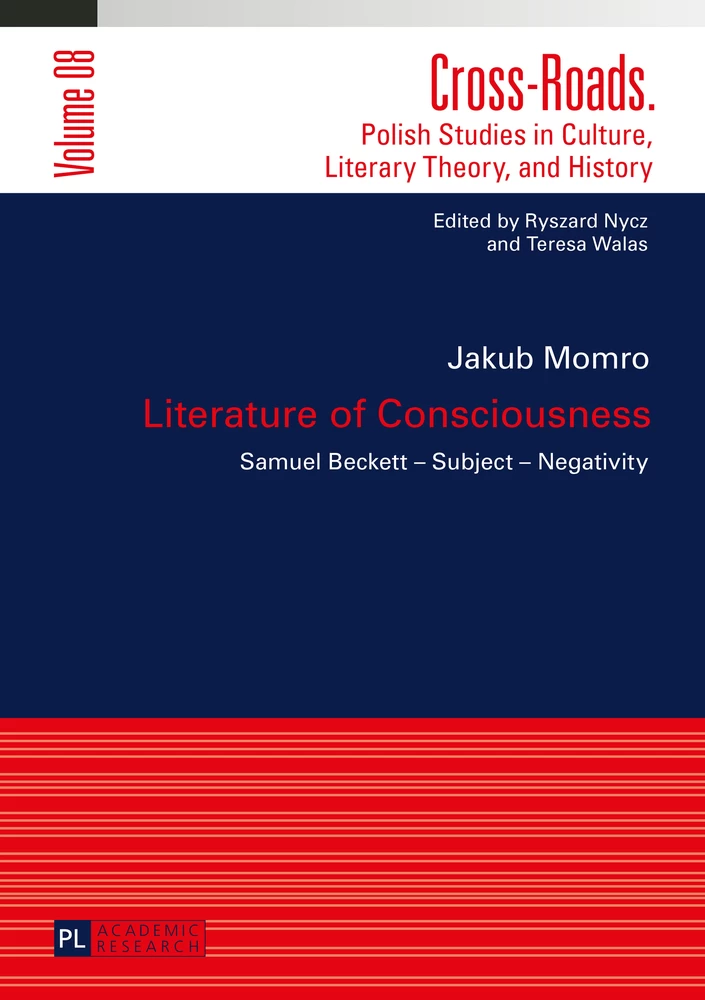
Literature of Consciousness
Samuel Becket – Subject – Negativity
Summary
Excerpt
Table Of Contents
- Cover
- Title
- Copyright
- About the Author
- About the Book
- This eBook can be cited
- Table of Contents
- Preface
- Introduction
- Beckett - Critical Literature
- Subject as Dilemma
- Metaphysical Experience
- The Rhetoric of Impossibility
- Hearing Subject
- Part One Demons of Descartes
- Chapter One. Mistaken Consciousness / Consciousness in Distress
- Necessity to Look, Necessity to Speak
- Se voir
- Illusion of Autonomy
- Necessity of Telling
- Contemplating Emptiness
- Chapter Two. The Invention of Time or the Trap of Consciousness
- The Illness of Time
- Painful Habit
- Subjectivity and Falsehood
- Assisting in One's Own Absence
- Part Two Voice and Death
- Chapter One. A Persistent Trace Inside of Silence
- The Voice and Non-Speech
- Lethal Beginnings
- Consciousness and the "Destruction of the Voice"
- The Ontology of Sound
- The Stage of Life, the Stage of Consciousness
- Chapter Two. Between Nameless and Unnamable
- The Subject that Disappears
- The Gesture of Death
- Trapped in Language
- II faut continuer
- Part Three Long Hours Of Darkness. The Subject In Crisis
- Chapter One. Against the Event
- Genesis of the Event. Between Repetition and Difference
- Language - Immaterial Materiality
- The Absolute Event, the Impossible Event
- Chapter Two. Laughter and the Inexpressible
- The Reality of the Mouth
- Laughter and Death
- Outside of Presence
- Illumination of the Face
- The Explosion of the Poem
- The Time Syncope
- Nothingness and Game
- Reversed Theology
- Chapter Three. Objective Suffering
- Mad Moment
- The Speech of Suffering
- Part Four Dreams of Stability
- Chapter one. Poetry of absence
- Sense as a Fable
- The Place of the Imagination
- Beyond the Power of Sight, or the Presence of Absence
- In the Rhythm of Death
- Chapter Two. Existence as Correction
- The Real - Between Light and Darkness
- The Crisis of Self-Representation - From Intention to Description
- Still as Neutrality
- The Sound to Come
- "How to Say It?"
- Bibliography
- Series Index
… To be an artist is to fail, as no other dare fail, that failure is his world and the shrink from it desertion, art and craft, good housekeeping, living.1
– Samuel Beckett
Art has no universal laws, though in each of its phases there certainly are objectively binding taboos. They radiate from canonical works. Their very existence defines what forthwith is no longer possible.2
– Theodor W. Adorno
The enigmaticalness of artworks remains bound up with history. It was through history that they became an enigma; it is history that ever and again makes them as such, and conversely, it is history alone – which gave them their authority – that holds at a distance the embarrassing question of their raison d’être.3
– Theodor W. Adorno
What is bad in artworks is a reflection that directs them externally, that forces them; where, however, they immanently want to go can only be followed by reflection, and the possibility to do this is spontaneous.4
– Theodor W. Adorno
In all likelihood, most of the readers and spectators of Beckett’s plays sentence themselves, perhaps willingly, to a permanent fascination with author’s face. In photographs, the author of Endgame seems to resemble one of the characters inhabiting his many works – with a sharp, penetrating look, his face is permanently furrowed with creases and with the passing of years, as Polish writer Andrzej Stasiuk observed, it increasingly resembled the inhuman shape of a rare mineral.5 It is a sign of presence that announces yet another form – transformed, a victim of the merciless passage of degrading time. Beckett’s face seems to be an emblem of his entire project as a writer, one that successfully led literary modernity to its conclusion. This point is made absolutely clear by his precise construction and conscious provision of space for what is chaotic, dark, unspeakable, and random.← 7 | 8 →
His face is what brings disillusionment to men who would like to treat themselves as self-aware subjects. At the same time, it preserves the force of sceptical powers, which are constituted by a willingness to save reason and its singularity. Finally, it forces language to undergo definite destruction – a process that is the agent for the revival of the poetic power of the word.
Wolfgang Iser meticulously noted all those troubles, fascinations and contradictions converging in the singular place where we ought to start our reading. Our goal would be to find sense in this text and interpret the world deposited within its boundaries. First, I would like to provide an extensive citation of Iser, which grasps the precise stakes of an encounter with Beckett for any reader:
In some modern texts, this fact can be studied under almost experimental conditions. The works of Beckett are among those whose indeterminacy content is so high that they are often equated with a massive allegorization. The tendency to regard them as allegories is in itself a kind of exasperated form of meaning projection. What causes this exasperation, which can clearly only be pacified by imposing some meaning on the text? Beckett’s works, with their extreme indeterminacy, cause a total mobilization of the reader’s imagination; the effect of this, however, is that the totally mobilized world of imagination finds itself to be powerless when called upon to explain. And yet this impotence on the part of one’s own imagination seems to be necessary if one is to accept Beckett’s work at all, for the individuality of his text only becomes apparent when the world of our imagination is left behind. It is not surprising therefore, that one’s first reaction is to mount a massive operation of meaning-projection in order to haul the texts back within the limits of normal thinking.
If fiction stubbornly refuses to reveal the sought-after meaning, then the reader will decide what it has to mean. But then one realizes that by imposing an allegorical or unequivocal meaning onto the text, one’s approach tends to be superficial or even trivial. Should not this allegorization be seen as an indication of the nature of our current conceptions and preconceptions rather than as a means of explaining the text? If so, then such texts will show us the fundamental lack of freedom resulting from our self-imposed confinement within the world of our own ideas. In making his reader experience the embarrassing predicament of the failure of his understanding, Beckett opens up a road to freedom which can be embarked on whenever we are prepared to shed the preconceived notion that so far have dominated our outlook.
The works of Beckett provoke a desire for understanding, which can only be satisfied if we apply our own ideas to the text, to have them duly rejected as redundant. It is precisely this process that both stimulates and exasperates us, for who likes to learn that his own ideas have to be subjected to a fundamental revision if they are to grasp phenomena that seem to lie beyond their scope?6 ← 8 | 9 →
All the fundamental questions concerning the exceptional status of Beckett’s artistic project are present in the passage cited above: imagination, cognition and the understanding of crisis, or the invention and innovation that accompany the act of reading. Iser noticed a fundamental difficulty that surfaces during the reading of Beckett’s works. It resides in the simultaneous presence of two contradictory tendencies and desires: the necessity to leave the writer’s idiom intact in its autonomy, while establishing, along with every new act of reading, an equally necessary and different context that yields an understanding of the work. The logic that holds both in place is exceptionally demanding. The text is both an open invitation to experience a different world and a simultaneous announcement of the impossibility of arriving at this very destination. In this sense, the work seduces the reader precisely through an interpretive mechanism of exclusion. These two contradictory devices meet as parts of the interpretive experiment and experience of Beckett’s work.7 It is true that Beckett’s works are a peculiar kind of trial, focused on probing the range of consciousness and capabilities of language, which allow for the pronouncement of the most basic and the most difficult intuitions about the human condition. It is also true that Beckett’s work allows readers to experience, or live through, all of these contradictions as an important existential trials, rather than purely textual, philosophical or anthropological exercises.
Iser identifies an additional characteristic of Beckett’s work that is perhaps the most intriguing. The author of Endgame constructs a critical apparatus through texts that are structurally closed, even hermetic. It is in this critical juncture that signs of the writer’s originality are transformed into challenges for his readers, who must attempt to ascribe meaning to the traces of authorial inventiveness, which are dispersed over the surface of the text. Through this procedure, the effect of the crises purposefully evoked by the writer (concerning reference, the ontology of the literary work, and the category of the subject) become opportunities for the reader – chances for communication with the world by means of the text, raising questions about the character of these relations. In my opinion, it is from this simultaneous crisis and tipping point that one should commence a relationship with works of Beckett.← 9 | 10 →
At this point, I ought to indicate main lines of my own interpretive procedure. Beckett is a central figure in this book, but its pages are not entirely occupied by his work. His plays, prose and poetry allowed me to understand that the questions posed in the language of his own creations – which are difficult to translate into other or “external” languages – confer with the central questions tackled by the most prominent thinkers of modernity. If we define the modernist debate as a discussion over the possibilities of existence, the status and shape of the subject, and individual consciousness that attempts to find its place in a world of radical alienation, in which art remains the last surviving method for restoring lost time and experience, then Beckett is one of the most important discussants. It is in this space that these two complex and ambiguous notions appear in different forms throughout this book (happening, experiment, experience, etc.). My interest was more often drawn to tracing and conceptualizing various transformations of forms of subjectivity, rather than strictly literary analysis. More than the universal character of different problems, I was interested in the multiple tensions born from the clash between consciousness and the world. These tensions constitute the building blocks of the history of the struggle of the modern subject with what is negative: death, the void, and the absence of sense and life’s pretensions.
The second half of the book examines the following questions and lines of thought. First, I attempt to take a closer look at strategies employed by Beckett in constructing the subject, with its transformations and dependencies negotiated by figures of voice and death. In the third part, devoted entirely to reading the play Not I, my reflections work at understanding the relation between the happening (occurrence), the conditions of its possibility, and the range of expression and suffering which constitute the proof confirming the veracity of existence. In the chapter entitled “Dreams of Stability,” I try to make out the unwieldy concept of constructing subjectivity that ranges from the early literary works of Beckett to the late works that occupy this first section. Looking at works from the late period of Beckett’s activity, this first section begins from the perspective of Cartesian principles, which were already prominent early in his career. I also discuss an essay about Proust, whose work is juxtaposed with that of Schopenhauer (while still following and commenting on Beckett).
Are we therefore dealing with Beckett as a philosopher? Personally, I would struggle with providing a definite or final answer to this question. As Iser observed, Beckett puts questions of meta-language on a razor’s edge. In order to talk about his texts we need to find new means of description, and continually establish new contexts. But this need is constantly thwarted by the impossibility of going beyond the horizon of the crisis of “perception and understanding.” Beckett is a philosopher only insofar as the term is meant to designate not a systematic thinker and presenter of problems exclusively, but also a writer testifying to literature ← 10 | 11 → as a domain of thought. In other words, he is a philosopher inasmuch as I have attempted to read his texts as such, bearing in mind the impossibility of capitalizing on any economic exchange between his work and general theoretical discourses, notions and conceptualizations. The more Beckett’s works “stay evanescent in their own immanence” – following Paul Klee – the more they demand to be read as an extremely coherent literary project. And as it seems, the process of reading might very well be endless. ← 11 | 12 → ← 12 | 13 →
1Beckett, S. Three Dialogues, in CE, vol. 4, p. 563.
2Adorno, T. Aesthetic Theory, translated by Robert Hullot-Kentor, Minneapolis 1997, p. 308.
3Ibid., p. 120.
4Ibid., p. 174.
5See Stasiuk, A. “Twarz Samuela Becketta,” Kwartalnik Artystyczny, 1996 no. 4, p. 157.
6Iser, W. “Indeterminacy and the Reader’s Response in Prose Literature,” in Prospecting: From Reader Response to Literary Anthropology, Baltimore 1993, pp. 27-28. See also, Der implizite Leser. Kommunikationsformen des Romans von Bunyan bis Beckett, München 1972. In English, The Implied Reader: Patterns of Communication in Prose Fiction from Bunyan to Beckett, Baltimore 1978.
7My intention is to introduce a vague category of experience that appears often in this study. Depending on the context, I will be interested in “experience” understood as a literary, linguistic or thought “experiment,” as well as “familiarity” [Erlebnis], process and experience [Erfharung]. I will also use the term in relation to “happening,” which is sometimes identical in meaning with experience understood as familiarity [Erlebnis], and which sometimes breaks apart its structure (in the sense of Erfharung). For the history of the term in contemporary philosophical discourse, see Jay, M. Songs of Experience: Modern American and European Variations on a Universal Theme, London 2005.
What sprouts out of the ashes of / Samuel Beckett?/ somewhere in this space is/ his fading breath/ and then a motionless utterance/ in the beginning was the word/ in the end the body.8
– Tadeusz Różewicz
The expression that there is nothing to express, nothing with which to express, nothing which to express, no power to express, no desire to express, together with no obligation to express.9
Details
- Pages
- 272
- Publication Year
- 2015
- ISBN (Hardcover)
- 9783631627273
- ISBN (PDF)
- 9783653025903
- ISBN (MOBI)
- 9783653998610
- ISBN (ePUB)
- 9783653998627
- DOI
- 10.3726/978-3-653-02590-3
- Open Access
- CC-BY-NC-ND
- Language
- English
- Publication date
- 2015 (May)
- Keywords
- Modern Subjectivity Deconstruction Critical Theory
- Published
- Frankfurt am Main, Berlin, Bern, Bruxelles, New York, Oxford, Wien, 2015. 272 pp.
- Product Safety
- Peter Lang Group AG
