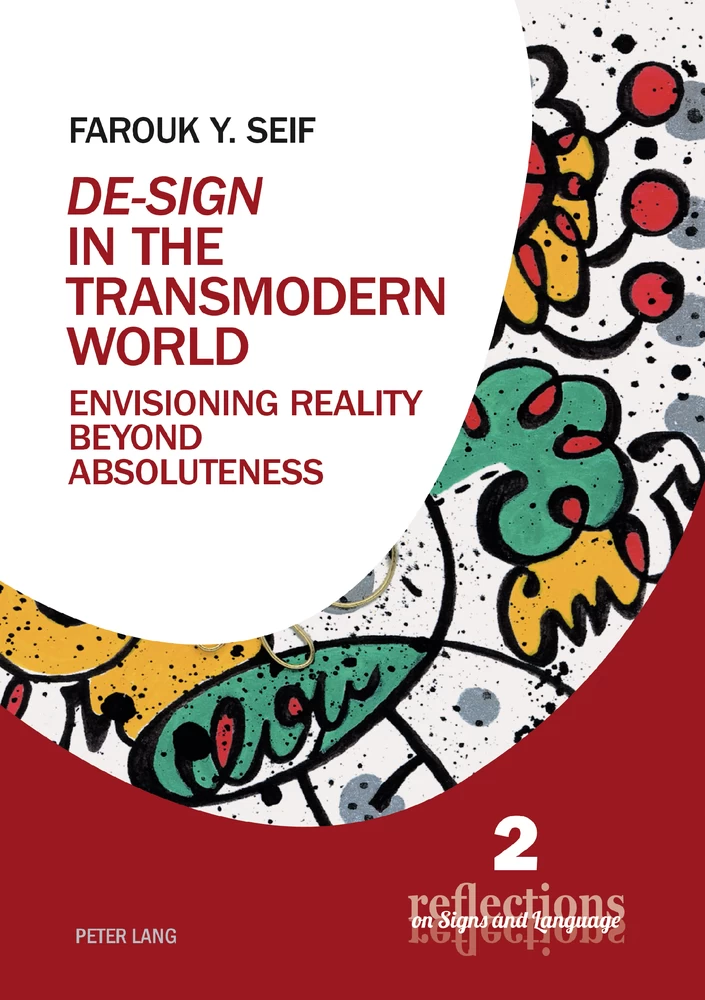
«De-Sign» in the Transmodern World
Envisioning Reality Beyond Absoluteness
Summary
This publication examines the fusion of design and semiotics, which is at the core of evolutionary love that encourages us to go beyond what we conventionally perceive into what we are imaginatively capable of interpreting. As semiotic animals, we are capable of developing awareness, relationships, and mediation toward semiosis of an undivided wholeness in flowing movement. Human beings have unlimited »semioethical« responsibility toward each other and toward other-than-human systems. This ethical implication depends on our ability to liberate ourselves from the fallacy of absolute reality.
Excerpt
Table Of Contents
- Cover
- Title
- Copyright
- About the author(s)/editor(s)
- About the book
- This eBook can be cited
- Contents
- Acknowledgements
- Prologue
- 1. An Unexpected Invitation
- 2. When It All Began
- 3. What is De-sign? and How do I Use the Term?
- 4. Designing the De-sign: Making Sense of the Sequence of the Book
- 5. Digressions as a Way of Inauguration
- Chapter 1. A Subtle Shift in an Unrecognizable Age
- 1. Transmodernity? Can’t See the Forest for the Trees
- 1.1. The Shortcoming of Modernity and Ambivalence of Postmodernity
- 1.2. Chrysalis Process: From Postmodernity to Transmodernity
- 1.3. Transmodernity: A Subtle Shift of Diaphanous Characteristics
- 1.4. Transmodernity as the Great Turning
- 2. Transmodernity and the Emergence of Integral Consciousness
- 2.1. Integrating the Visual, Virtual, and Visceral
- 3. Transmodernity, Diaphanous Perception, and Synechism
- 3.1. Diaphaneity at the Core of Transmodernity
- 3.2. Synechism of Transmodernity
- 3.3. What’s in a Name?
- References
- Chapter 2. When Absolute Reality Becomes Obsolete
- 1. The Fallacy of Absoluteness and Autonomy
- 1.1. Perceiving Reality and Experiencing Lifeworld
- 1.2. Objective Reality: Inseparability of Mind-Dependent and Mind-Independent Being
- 1.3. The Splendor of Language and the Tyranny of Words
- 1.4. Incompatibility of Absolute Reality with Semiotic Consciousness
- 2. Human Perception and Space-Time Deception
- 2.1. The “Unreality” of Space and Time
- 2.2. Peircean Categories of Reality
- 2.3. The Consequential Disposition of Absolutizing Reality
- 3. Absolute Reality and Misconception of God
- 3.1. The Vagueness of the Words “God” and “Reality”
- 3.2. Isolating Human Beings from God and Reality
- 3.3. The Paradox of One and Many
- References
- Chapter 3. What Is Real Is Not Always True!
- 1. The Illusive Notion of Reality
- 1.1. Reality: Is It Real or True?
- 1.2. Peculiarity of the Real and the True
- 1.3. Isomorphic Process: When the Real Becomes True and Vice Versa
- 2. The Real and the True in the Realm of Objects, Things, and Signs
- 2.1. The Difference Between Objects and Things
- 2.2. How Are the Real and the True Related to Objects and Things?
- 3. Challenges to the Real and the True
- 3.1. The Dilemma of Truth and Falsehood
- 3.2. Telling the Truth by Lying
- 3.3. Morality or Integrity?
- 4. The Action of Signs and the Role of Design in Crossing Boundaries
- 4.1. Playing with Boundaries of Space and Time
- 4.2. Traversing Boundaries between the Virtual, Visual, and Visceral
- 5. Tolerating the Undefinable Flux of Reality
- 5.1. Being in Relations with Transmodern Lebenswelt
- 5.2. Resilience of Signs: Traversing the Boundary Between Life and Death
- References
- Chapter 4. Navigating Through Diaphanous Space and Polychronic Time
- 1. The Possibility of the Impossible
- 2. Ipso Facto: Transparency of Space and Circularity of Time
- 2.1. The Fluidity of Space and the Flow of Time
- 2.2. The Bases of Diaphanous Space and Polychronic Time
- 3. The Role of Memory: Playing with the Boundaries of Space and Time
- 3.1. Phantasmagorical Phenomenon: The Muse of Past and Future Memories
- 3.2. Forecasting the Future Versus Imagining the Future
- 4. Gifts of Traversing Across the Boundaries of Space and Time
- 4.1. Living Semiotically: Crossing the Boundary Between Life and Death
- 4.2. Envisioning Relations: Engaging in Imaginary Dialogue
- 5. Diaphanous Space and Polychronic Time in Transmodern World
- 5.1. Playing with the Ensemble of Visual, Virtual, and Visceral Reality
- 5.2. Paradoxes of Navigating Through Diaphanous Space and Polychronic Time
- 5.3. A Heroic Journey: Resilience and Perseverance
- References
- Chapter 5. Transdisciplinarity and the Transmodern Lifeworld
- 1. What Is Transdisciplinarity?
- 1.1. Generalist Versus Expert: Jack of All Trades and Master of None!
- 1.2. Transdisciplinarity: Antinomies of Education and Training
- 2. Transdisciplinarity of Design and Semiotics
- 2.1. Why Is Transdisciplinarity Intrinsic to Design and Semiotics?
- 2.2. Transdisciplinarity: Beyond the Humanities–Science Schism
- 3. Hair-Splitting Analysis? Search, Research, and Inquiry
- 3.1. The Difference that Makes Differences
- 3.2. Three Categories of Knowing: Search, Research, and Inquiry
- 3.3. What Is De-sign Inquiry?
- 3.4. Epistemological Fallibilism and Analog Experience
- 4. Integrating Factual Information with Imaginative Interpretation
- 4.1. The Woven Fabric of Knowledge
- 4.2. De-sign Inquiry and the Integration of Fact and Fiction
- 4.3. Loosening the Rigidity of the Mind, Melting the Hardness of the Heart
- 5. Inseparability of Transdisciplinarity and Transmodernity
- 5.1. Transdisciplinarity and the Reconstruction of Reality
- 5.2. My Initial Encounter with Transdisciplinarity
- References
- Chapter 6. Persistence on Separation and Attempt at Integration
- 1. The Lonesome Two and the Dominant Others
- 1.1. The Familiar Two that Separate, and the Unfamiliar Two that Integrate
- 1.2. The Doubt of the Artifice, and the Belief in Pars Pro Toto
- 1.3. Persistence on the Illegitimacy of Separation
- 1.4. Beyond Polarization: Meeting Dominant Cultures on Their Own Turf
- 2. Some Significant and Modest Attempts Toward Integration
- 2.1. Pioneering Experiments in Making Design and Semiotics Known
- 2.2. Masquerading the Familiar
- 2.3. Sugarcoating the Unfamiliar
- 2.4. Appropriating the Lonesome
- 3. Wrapping up
- References
- Chapter 7. De-sign: The Fusion of Design and Semiotics
- 1. Design Culture and Semiotic Consciousness
- 1.1. The Language of Design and the Action of Signs
- 1.2. The Convergence of Design, Signs, and Life
- 2. Revealing Mutual Reciprocities Between Design and Semiotics
- 2.1. The Roots of Words “Design” and “Sign”
- 2.2. Design and Semiotics: A Vocation of Pragmatism (or Pragmaticism)
- 2.3. Intentionality in Design and Semiotics
- 2.4. The Art of Deception: Design and Signs Tell the Truth by Lying!
- 3. The Kernel of Design and Semiotics
- 3.1. Design Ability and Semiotic Competency: The Fallacy of a Chosen Few!
- 3.2. The Interrelation Between Design Thinking and Semiotic Interpretation
- 3.3. De-sign: Beyond Problem Solving and the Pars Pro Toto Fallacy
- 4. Paradoxical Thinking in Design and Semiotics
- 4.1. Paradoxes Are Not Problems
- 4.2. Divergence and Convergence, Analysis and Synthesis
- 4.3. Knowing and Not-Knowing, Sophistication and Innocence, Control and Surrender
- 4.4. Continuity and Change
- 4.5. The Real and the Imaginary
- 4.6. Technology and Teleology, Means Versus Ends
- 5. Summing Up
- References
- Chapter 8. Perseverance Through the Paradoxes of De-sign
- 1. The Ever-Present Existential Nature of Paradoxes
- 2. Paradoxes Are Not All Equal
- 2.1. Paradoxes: The Frivolous, the Playful, and the Challenging
- 2.2. The Par Pro Toto Fallacy of Problems as Paradoxes
- 2.3. Paradoxes and the Limit of Common Sense
- 2.4. Paradoxical Challenges: Cognitive Dissonance and De-sign Consciousness
- 3. My Close Encounters with Paradoxes and Perseverance
- 3.1. When the Rose Turns Red
- 3.2. A Dark Night in the Belly of the Paradox
- 3.3. Determinism and Free Will: At-Home, Away-From-Home
- 4. A Destiny of Negation: Persevering Through Paradoxes of De-sign
- 4.1. The Two Faces of Perseverance
- 4.2. Dwelling in Uncertainty and Tolerating the Ambiguity of De-sign
- 4.3. Paradoxical Thinking Elevates Understanding and Alleviates Contradictions
- 5. The Promise of Persevering Through Paradoxes of De-sign
- 5.1. Perseverance and Negation: The Hallmark of Transmodern Lifeworld
- 5.2. Destiny of Negation: Mirabile Dictu of Paradoxes
- References
- Chapter 9. The Splendor of Design and The Transparency of Signs
- 1. The Phenomenology of Design and Sign
- 1.1. De-sign and Phenomenological Categories
- 1.2. The Palingenesia of Design and the Transparency of Signs
- 2. The Audacity of Design and the Resilience of Signs
- 2.1. The Diaphaneity and Ambiguity of De-sign Consciousness
- 2.2. De-sign Consciousness and the Wonder of Uncommon Sense
- 2.3. De-sign Consciousness and Imagination
- 2.4. De-sign Consciousness and Intentionality
- 3. De-sign: Dialoging and Imagining
- 3.1. Dialogical Imagination: Beyond Debates and Conversations
- 3.2. De-sign and Dia-logue: Toward Imaginative Interpretation
- 3.3. De-sign: Imagination and Falling in Love
- 4. De-sign and the Unrelenting Desire for Wholeness
- 4.1. Actualization of Wholeness: The Implicate Order of De-sign
- 4.2. De-sign and the Phenomenon of Wholophilia
- 5. Manifestations of De-sign in the Transmodern World
- 5.1. Voila! Designers Think Semiotically and Semioticians Practice Design
- 5.2. Design and Semiotics: A Heavenly Marriage!
- References
- Chapter 10. Inseparable Braid: Design, Semiotics, and Love
- 1. Introduction: What’s Love Got to Do with Design and Semiotics?
- 1.1. Invisible Relations of Love and Visible Manifestations of De-sign
- 1.2. The Sensuous and Magical Spell of De-sign
- 2. Eros of De-sign and the Nature of Eroticism
- 2.1. Eroticism in De-sign and the Infinity of Love
- 2.2. De-sign as an Erotic Encounter
- 3. De-sign and the Seductive Nature of Eros
- 3.1. De-sign as Manifestations of the Imaginal Intelligence-of-the-Heart
- 3.2. Seductive Relation Beyond Persuasive Communication
- 3.3. Seduction and Conspiracy to De-sign
- 4. The Teleology of De-sign
- 4.1. De-sign Consciousness: The Embodiment of Self-Transcendence
- 4.2. De-sign, Love, and the Quest for Meaning
- 4.3. Design and Semiotics: A Dyad on the Path of Evolutionary Love
- 5. De-sign and the “Generator-of-Desire”
- References
- Chapter 11. The Love of Knowing and the Desire for Creation
- 1. De-sign as Philomathic and Philomorphic Processes
- 1.1. The Paradoxical Interplay of Knowing and the Act of Creation
- 1.2. Erotic Encounter Between the Divine and Humans
- 1.3. Encountering the Unknown Through the Act of Creation
- 1.4. De-sign: From the Pursuit of Happiness to Creation of Wellbeing
- 2. The Degrees of Knowledge and the Risk of Creation
- 2.1. Paradoxical Exchange: The Beautiful and the Grotesque
- 2.2. The Beautiful Side of Ugliness and the Ugly Side of Beauty
- 2.3. Experiencing the Sublime: The Love of Beauty and Grotesqueness
- 3. De-sign and Ethical Imagination
- 3.1. Morality Versus Integrity
- 3.2. Eros of De-sign and the Integrity of Imagination
- 3.3. Hovering Between Good Eros and Bad Eris
- 3.4. Is Evil a Figment of our Imagination?
- References
- Epilogue. De-sign: The Mutual Fulfillment of God and Humans
- 1. The Nature of Reality and the Meaning of God
- 1.1. Evolutionary Love: The Will of God and the Desires of Humans
- 1.2. De-sign, Reality, and God: A Neglected Antediluvian Nexus
- 2. Pure Play of Musement: Imagining God
- 2.1. Reciprocal Divination: The Imagined and the Imaginer
- 2.2. De-sign as the Continuity of Musement
- 2.3. God and Humans: The Ethereal and Invisible Relation
- 3. Are We Playing God?
- References
- Index of names
- Index of Subjects and Terms
- Series index
I would like to express my deep gratitude to Susan Petrilli, Professor of Philosophy of Language and Semiotics, and Augusto Ponzio, Professor of Philosophy of Language, both at University of Bari Aldo Moro, Italy, for their kind invitation and encouragement to write this book as part of their book series Reflections on Signs and Language. Without such an invitation, this book would have never come to fruition.
Thanks to the staff at the International Academic Publishers: Peter Lang, particularly; Dr. Bianca Matzek, Publishing Director; and Renate Wettach, Production Manager, for their prompt responses to my frequent inquiries for more than two years.
Many thanks to Marcel Danesi, Professor of Semiotics and Linguistic Anthropology at University of Toronto, who, at the conclusion of one of my presentations at the Semiotic Society of America conferences, reminded me that I should write my book; André De Tienne, Director and General Editor of the Peirce Edition Project at Indiana University—Purdue University Indianapolis, for his poetically cheering words at the early stage of preparing the executive summary of this book; and Ormond Smythe, former Vice President of Academic Affairs and Dean of Faculty at Antioch University Seattle for his support and encouragement.
Undoubtedly, the contents of this book reveal how much I have profited from the many writings of my colleagues and friends at the Semiotic Society of America. I am indebted to all for the ongoing thoughtful conversations over the years. I am grateful to faculty members at Antioch University Seattle, who endured my design mania, and to my graduate students for asking great questions and enthusiastically practicing design thinking and semiotic interpretation.
I also want to acknowledge the efforts of several friends who have edited different versions of the manuscript; Susan McBain with her sharp eyes to see what I overlooked, who often challenged me to connect with a larger audience, and whose questions sharpened my skills of communicating what I really mean; and Baranna Baker, who enthusiastically read an early draft of the manuscript and expressed her surprise how the subject matter coincided with her own life experience. ← 15 | 16 →
A special thanks to my friend Brooke Williams Deely for her indefatigable scholarly support and genuine fraternal love. Her suggestions and keen observations of my contemplative writings have been taken with momentous consideration and great appreciation. After reading the entire manuscript, Brooke generously commented on many topics and sent me a tenderhearted note: “The book flows beyond the boundaries of space and time.”
Most of all, I want thank my beloved wife, Michele Streich, for her altruism, devotion, and perseverance through my frequent solitude. Without Michele’s constant reminder to walk away from my desk and enjoy an occasional dose of fresh air on beautiful Orcas Island, where we live, I would have been consumed by my own passionate desire for De-sign.
The idea of this book came to fruition as a response to the gracious invitation I received in October 2016 from Susan Petrilli and Augusto Ponzio to contribute to their series of Reflections on Signs and Language (Petrilli 2016). The intent of the series is to propose a vision that is open to transdisciplinary dialogue, which has been at the core of my interests in signs and design for a long time. When I received this invitation, I was in the process of preparing another manuscript for a book on “Paradoxes and Perseverance.” What surprised me was the discovery that by writing this book, De-sign in the Transmodern World, I have established the appropriate theoretical and philosophical foundation for my next book. I often wonder whether ideas find us or we discover them. This remains a mystery.
During the mid-1980s, a great part of my academic work and professional practice was to introduce semiotics to design, specifically architectural design, exemplified in my doctoral dissertation, Semiotics and Urban Morphogenesis: Metaphysical Aspects of Ancient Egyptian Monumentality as a Theoretical Approach to Urban Form. Through the semiotic framework, the dissertation served to mediate between the visible and the invisible, the physical and metaphysical aspects of reality. While this graduate inquiry initially developed as a moral obligation to my ancestors, the ancient Egyptians, it was also a search for continuity between my birthplace, which I left in 1977, and my adopted home, the United States (Seif 1990).
Although I was overwhelmed by the abstruse language of Charles Sanders Peirce (1839–1914), I developed a special interest in semiotics. ← 17 | 18 → It was through the inspiring philosophical work of John Deely—particularly the early book Frontiers in Semiotics, edited by him, Brooke Williams, and Felicia Kruse (1986)—that I was able to acquire not only a good understanding of, but also a fascination with, semiotics. I was consumed by the desire to augment design with semiotics, and I became aware of the need to introduce the idea of design to semiotic understanding.
This awareness was first demonstrated at the 7th International World Congress of the International Association for Semiotic Studies, held in Dresden, Germany in 1999, where I presented my paper, “Sign Processes and Notational Design: Demystifying Design Thinking and Its Representation” (Seif 1999). Judging from the favorable comments at the time, I was encouraged by colleagues to further pursue this line of inquiry. All of this marked the beginning of a series of personal and professional events that led to the writing of this book, connecting design with semiotics.
When I met John Deely at the ROSS Conference in Slănic-Moldova, Romania, in October 2008, he was genuinely interested in knowing about my Coptic Christian upbringing, design practice, and semiotic interest (Seif 2016). My presentation at the conference, “At Home with Transmodernity: Reconstruction Cultural Identity in a Globalizing World,” provided a context for discussion and later for debate over whether semiotics is a postmodern or transmodern development (Seif 2008). John was very curious about the topic, and our debate evolved into discussion at conferences and one-on-one dialogue, which became the bases for a true friendship crowned by a couple of gracious visits John made to my home on Orcas Island in Washington State. Subsequently, he acknowledged that Charles Sanders Peirce is a transmodern thinker and that semiotics is indeed a transmodern development (see Deely 2014).
Introducing semiotics to design, or augmenting semiotics with design, was not enough for me. Intuitively, I felt something that I could not previously identify, yet was staring me in the face. The more I delved deeply into semiotic discourse and reflected on my own design understanding, the more astonished I was about how the “two lonesomes”—design (as a third culture) and semiotics (as a new branch of knowledge)—share more attributes than most designers and semioticians realize. Both design and semiotics seem to struggle for legitimacy between the two dominant cultures, humanities and sciences. Mutual reciprocities between design and semiotics were desperately screeching to be revealed. ← 18 | 19 →
I came to the realization that my efforts would be most effective in bringing together design thinking and semiotic interpretation. It seemed reasonable not only to integrate both design and semiotics but also to infuse them into a coherent body of work that could best be called “De-sign.” However, before naming this work as such, my effort was exemplified in various published articles and lectures at several conferences throughout the world.
To the best of my knowledge, the term “de-sign” (lowercase) was first introduced by the Czech-born philosopher Vilém Flusser (1920–1991) in the posthumous book The Shape of Things: A Philosophy of Design (see Flusser 1993). For Flusser, de-sign began not with sciences, not with fabricated things and objects, not even with the humanities; rather, it began with the meaning of the word and ensuing discovery of identity that proliferates throughout all aspects of life (Flusser 1993). Unfortunately, Flusser unexpectedly died in 1991 before he could elaborate on his idea of de-sign.1
The connection between design and semiotics has barely been explored in literature other than in linguistic terms (for example, see Jencks 1977). The Romanian scholar Mihai Nadin showed interest in this idea in his article “Design and Semiotics,” but he did not go far enough to integrate design thinking and semiotic interpretation. Flusser did not have the opportunity to go beyond the etymological roots of the word de-sign, nor did Nadin articulate explicitly how design and signs connect beyond marketing and technological purposes.
3. What is De-sign? and How do I Use the Term?
Perhaps it is confusing to attempt to understand something new in terms of an older, obsolete format; it is like “putting new wine in old bottles.” We ← 19 | 20 → cannot use an old word to express a new way of thinking. Neither can we use a new and unfamiliar word to express something new and unfamiliar. The challenge is that, to say something new, we have to either use new words, or use old words in new ways. In either case, we can hardly avoid creating misunderstandings. Paradoxically, those misunderstandings and how we deal with them are significant in achieving understanding.
While the notion of “De-sign” is a sui generis enterprise, the word itself is simple enough that it should not create misunderstanding or serve as merely an esoteric expression. So, I need to make clear how I intend to use this notion. What do I mean by De-sign? I envision De-sign as the way of thinking and being in the world that integrates design and signs—design and semiotics. Why is De-sign (with a capital “D”) different from de-sign (with a lowercase “d”)? First, I want to make a distinction between Flusser’s use of the term and my own. And second, I want to emphasize the inclusive and large scope of design as a way of thinking, a sort of cognitive activity that does not specifically refer to any design professions such as architecture, industrial design, or graphic design.
To emphasize the wide-ranging scope of design, I was initially tempted to use the word “Design” with a capital D. However, it would not be enticing to see the word “Design” capitalized in every sentence—that would be distasteful or repugnant to readers. Therefore, whenever I use the word “design” I mean Design with a capital D. In addition, whenever I use the italicized De-sign as a modifier, I use the lowercase, for example: de-sign processes, de-sign outcomes, de-sign consciousness, de-signers. My hope is this explanation will be sufficient and eliminate any confusion.
4. Designing the De-sign: Making Sense of the Sequence of the Book
The sequence of the book is based on the design process, which is driven by love and desire rather than needs and necessities, reframing the challenges and leading to an unexpected emergent outcome. In order to make a case for De-sign, I started Chapter 1 by drawing attention to the subtle shift from postmodernity to transmodernity as being an unrecognizable age. This shift leads to the major argument in Chapter 2 that reality is not absolute; such ← 20 | 21 → a perception is obsolete and not only is incompatible with semiotic consciousness but also leads to many unintended consequences and even to the misconception of God.
Chapter 3 takes a step further concerning the fallacy of absolute reality by making an argument that what is real is not always true. Through revealing the illusive relations among things, objects, and signs (Deely 2009), it also explores the dilemma of truth and falsehood, thereby challenging the notion of morality. By playing with boundaries of space and time, the action of signs and the role of design traverse all kinds of boundaries, offering remarkable insights into human perceptions of opposites, including even life and death.
Building on the outcomes of this discussion, Chapter 4 explores the cognitive skills of what I call navigating through diaphanous space and polychronic time as a heroic journey of resilience and perseverance. The role of memory as a “phantasmagorical” phenomenon (Bergson 1912) is introduced as a way of playing with boundaries of space and time to imagine a desired future.
The preceding chapters laid the foundation for Chapter 5 to highlight the necessary connections between transdisciplinary knowledge and the transmodern lifeworld, the antinomies of education and training, and the difference between generalist and expert. The discussion underscores the necessity of bridging the gap between the humanities and sciences, and introduces de-sign inquiry as an integration of traditional search and research methods in reconstructing reality.
The separation of the humanities and sciences is discussed in Chapter 6, offering evidence that design and semiotics have remained as the unfamiliar “two lonesomes” struggling for legitimacy in the dominant familiar cultures of humanities and sciences. During the 20th century, a few attempts toward making design and semiotics known to other disciplines were made by integrating one or both into the humanities and sciences using different strategies: masquerading the familiar, sugarcoating the unfamiliar, and appropriating the lonesomes design and semiotics.
Chapter 7 focuses on De-sign as the fusion of design and semiotics by stressing the necessity of the co-survival of design culture and semiotic consciousness, and by revealing the kernels and mutual reciprocities between design and semiotics. Elaborating on the paradoxical thinking that is innate to both design and semiotics, the chapter further legitimatizes the concept of fusion. ← 21 | 22 →
In Chapter 8, I explain why perseverance through paradoxes as a destiny of negation is fundamental to De-sign (Seif 2015). I also discuss why design, as a magnificent way of thinking and acting, is intertwined with the integrative nature and transparency of signs, and how they lead to imagining and actualizing a desirable reality; this intertwining points at the splendor of design and diaphaneity of signs, upon which the next chapter expounds.
Chapter 9 discusses the notion of De-sign in relation to Charles S. Peirce’s universal phenomenological categories—firstness, secondness, and thirdness (CP 1.25)—and makes a line of reasoning that de-sign consciousness demands the wonder of uncommon sense, where imagination resides and intentionality is recognized. The chapter concludes with the unrelenting human desire for wholeness; consequently, the inseparability of de-signing, dialoguing, and loving can be manifested in the transmodern world.
This is where Chapter 10 picks up, discussing the ultimate purpose of De-sign and making a connection between De-sign and eroticism and how they relate to the seductive nature of Eros, as the generator-of-desire.
Chapter 11 goes beyond the duality of good and evil, the beautiful and the grotesque as de-sign outcomes, suggesting how humans deal with the paradoxes of knowledge and take a risk in the act of creation, and how humans, as semiotic animals, can make a sagacious judgement about ethical imagination in their pursuit of De-sign.
In the form of an epilogue, the final chapter reaches an unexpected outcome in which De-sign is to be discerned as the mutual fulfillment of God and humans. By dismantling the fallacy of absolute reality and by challenging the notion of an absolute God, the very nature of reality and the genuine meaning of God are revealed. Going beyond the philosophical debate over determinism and free will, the will of God and the desires of humans are intertwined through evolutionary love. An existential inquiry is explored as to whether or not we are playing God in this transmodern world.
Some contents of these chapters first appeared in my own articles, which have been previously published by other publishers. A direct reference can be found in the relevant chapter as a note. ← 22 | 23 →
5. Digressions as a Way of Inauguration
My formal education and professional training were primarily in architecture and physical design. In fact, like Alfred North Whitehead, I never had any formal education in philosophy, nor did I study semiotics before my graduate education. But my strong inclination toward metaphysics has led me to the integration of the philosophies of design and semiotics. In the broadest sense of the term, philosophy is semiotics. As a theory of categories, semiotics is an expression of modes of being, an inquiry into knowledge for the purpose of understanding aspects of reality and what we can do about them. This purpose of semiotics requires design and implies that being-in-the-world has much to do with the philosophies of design and semiotics. In the pragmatic sense, philosophy (philo-sophy), as the love of wisdom, not only is implicit in the way of thinking, but also is manifested in the act of creation—De-sign.
Initially, I intended for this book to address semioticians and designers in the academic domains; however, as I proceeded, I realized that the notion of De-sign as a “sign” may attract a larger audience. A sign is transparent and goes beyond itself; so is De-sign. Heraclitus (500 BCE) claims that the everlasting word “Logos” is necessary for life, where the word is a sign. In his fragment 93, Heraclitus says, “The Lord whose oracle is at Delphi neither speaks nor conceals, but gives a sign.” I am merely an envoy, a messenger, who carries the caduceus, the sign of De-sign.
Farouk Y. Seif
Orcas Island, Washington, Nov. 11, 2018
References
Bergson, Henri (1912). Matter and Memory, trans. Nancy Margaret Paul and W. Scott Palmer. New York: The Macmillan Company.
Deely, John (2009). Purely Objective Reality. Berlin, New York: Mouton de Gruyter. ← 23 | 24 →
Deely, John N. (2014). “The Cenoscopic Science of Signs: Reflections on Cornelis de Waal’s Book ‘Peirce: A Guide for the Perplexed,’ ” The American Journal of Semiotics 30.3–4 (2014), 251–351.
Deely, John N., Brooke Williams, and Felicia E. Kruse (eds.) (1986). Frontiers in Semiotics. Bloomington: Indiana University Press.
Eco, Umberto (1976). A Theory of Semiotics. Bloomington, IN: Indiana University Press.
Flusser, Vilém (1993). The Shape of Things: A Philosophy of Design, trans. Anthony Mathews, intro. Martin Pawley. London: Reaktion Books, 1999.
Jencks, Charles (1977). The Language of Post-Modern Architecture. London: Rizzoli International Publications, Inc.
Nadin, Mihai (1990). “Design and Semiotics,” Semiotics in the Individual Sciences, Vol. II, ed. Walter A. Koch. Bochum: N. Brockmeyer, 1990, 418–436.
Peirce, Charles Sanders (1839–1914). The Collected Papers of Charles S. Peirce, Vols. I–VI, ed. Charles Hartshorne and Paul Weiss. Cambridge, MA: Harvard University Press. Vols. VII–VIII, ed. Arthur W. Burks (same publisher, 1958). References from this source are abbreviated as CP followed by numbers that refer to the volume and paragraph with a period in between.
Petrilli, Susan (2016). The Global World and its Manifold Faces: Otherness as the Basis of Communication. Bern: Peter Lang AG.
Seif, Farouk Y. (1990). Semiotics and Urban Morphogenesis: Metaphysical Aspects of Ancient Egyptian Monumentality as a Theoretical Approach to Urban Form, Doctoral Dissertation. Seattle, WA: University of Washington.
Seif, Farouk Y. (1999). “Sign Processes and Notational Design: Demystifying Design Thinking and Its Representation,” Sign Processes in Complex Systems, Proceedings of the 7th International Congress of the International Association for Semiotic Studies–Association Internationale de Sémiotique, 7–11 October 1999, ed. Walter Schmitz. Dresden, Germany: Technische Universität Dresden.
Seif, Farouk Y. (2008). “At Home with Transmodernity: Reconstructing Cultural Identity in a Globalizing World,” in Transmodernity: Managing Global Communication, ed. Doina Cmeçiu, Proceedings of the 2nd ROASS Conference, Slavic-Moldova, Romania, 23–26 October 2008. Bacãu, Romania: Alma Mater Publishing House, 2009, 248–256. ← 24 | 25 →
Seif, Farouk Y. (2015). “Paradoxes and Perseverance: Designing Through Antinomies of Life,” Semiotics 2014: The Semiotics of Paradox. New York: Legas, 2015, 135–160.
Seif, Farouk Y. (2016). “Foreword: In Loving Memory of John Deely (1942–2017),” Semiotics 2016: Archaeology of Concepts, The Semiotic Society of America, 2017, v–vii.
1 Before his ill-fated visit to Prague in 1991, Vilém Flusser’s last contribution took the form of several lectures and seminars on communication at the Ruhr University. They were published posthumously in The Shape of Things: A Philosophy of Design. According to Martin Pawley, Flusser died on 27 November 1991 in a road accident near Prague, shortly after visiting the city of his birth for the first time in more than 50 years (see Flusser 1999).
Details
- Pages
- 402
- Publication Year
- 2019
- ISBN (Softcover)
- 9783034328661
- ISBN (PDF)
- 9783034328807
- ISBN (ePUB)
- 9783034328814
- ISBN (MOBI)
- 9783034328821
- DOI
- 10.3726/b15862
- Language
- English
- Publication date
- 2019 (October)
- Keywords
- communication communication sciences globalization language semiotics signs
- Published
- Bern, Berlin, Bruxelles, New York, Oxford, Warszawa, Wien, 2019. 400 pp., 13 fig. b/w.
- Product Safety
- Peter Lang Group AG
