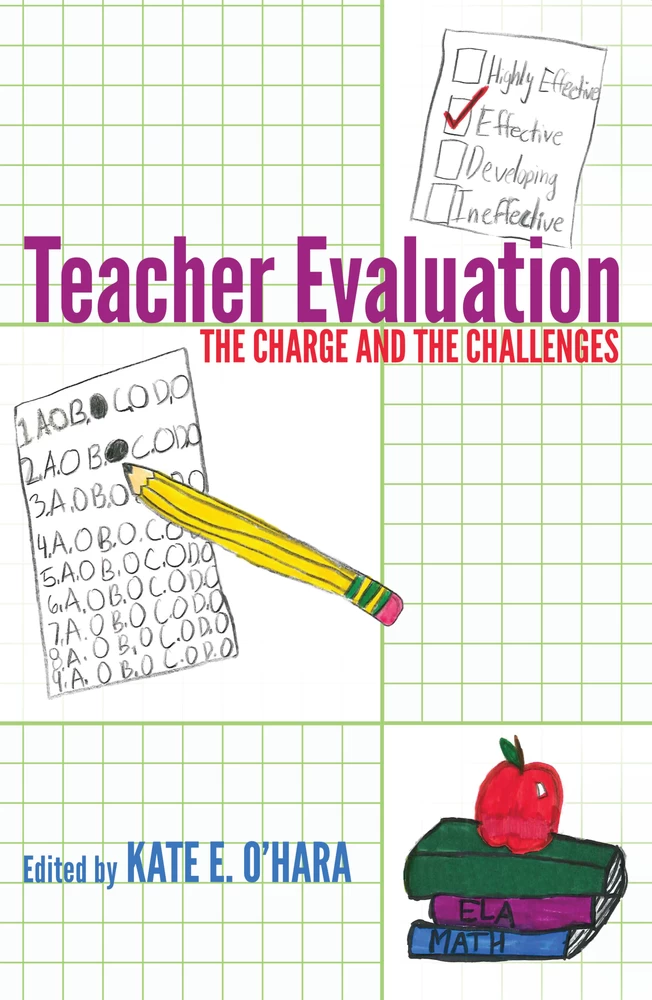
Teacher Evaluation
The Charge and the Challenges
Summary
Excerpt
Table Of Contents
- Cover
- Title
- Copyright
- About the author
- About the book
- This eBook can be cited
- Contents
- Acknowledgements
- Introduction
- Section 1: Critiques and Commentary: Framing the Evaluation Picture
- Section 2: Dis/Connecting Practice
- Section 3: Envisioning Change
- References
- Section 1: Critiques and Commentary: Framing the Evaluation Picture
- Chapter 1. Teacher Evaluation in the Current Era: Implications for Teacher Education Policy and Pedagogy
- Why Educate in a Democracy?
- Teacher Evaluation Systems and Emerging Constructs for Public Schooling
- Pillars of Public Schooling
- The Case of Louisiana and the Expansion of Value-Added Models
- The Case of Florida: A Political Victory
- edTPA and Teacher Education
- Conclusions
- References
- Chapter 2. Producing Professionals: Analyzing What Counts for edTPA
- Structure of the Chapter
- Thesis
- Literature Review
- The Format of edTPA
- Evaluating the Act of Teaching
- Rubric 2—Planning to Support Varied Student Learning Needs
- Rubric 5—Planning Assessment to Monitor and Support Student Learning
- Quantifying a Complex Process
- What Is Missing?
- Summary and Conclusion
- References
- Chapter 3. Measurement as Politics by Other Means: the Case of Test-Based Teacher Evaluation
- Measurement’s Political Imposter
- A Critique of Operationism
- Operationism as Governance
- The Arbitrary Content of the Operational Method
- Test-Based Teacher Evaluation and Compensation: An Overview
- The Operational Basis of Test-Based Teacher Evaluation and Compensation
- The Political Functions of Measuring Effectiveness in New York State
- An Invitation
- Notes
- References
- Chapter 4. Evaluating Teachers: Making Meaning Out of the Madness
- At the Start
- Impact on Local Layers
- Unfolding: Definitions and Disillusionment
- Uncovering Flaws
- Stopping the Madness
- Notes
- References
- Section 2: Dis/Connecting Practice
- Chapter 5. On the Ramparts: Edtpa and the Fight to Reclaim Our Beloved Profession
- References
- Chapter 6. Crash [dis-]Course: a Critical View of Teaching, Testing, and the Times
- Critical Lens on Tests and Testing
- Support: The Great Potential Equalizer
- Metacognitive Experiences Versus Noncritical Thinking
- Recasting and Revisioning: Teaching Worth Supporting
- Learning as Community: Situated Learning
- Closing Thoughts
- References
- Chapter 7. Remembrances of Things Past: Teacher Evaluation, High Stakes Testing, and the Marginalization of Social Studies and History Instruction
- A History of “Quality” Teaching
- Pedagogical Approaches to Teaching History—Looking for “Quality”
- Still Searching
- References
- Section 3: Envisioning Change
- Chapter 8. Curricular Relevance: Students’ Needs and Teachers’ Practice
- Relevance Reviewed
- Connections to Personal Interests
- Connections to Culture
- Connections to the Real World
- The Study
- Data Sources
- Teachers Discuss Students’ Need for Relevance
- The Discrepancy
- The Question of the Disconnect
- References
- Chapter 9. Aligning Multidimensional Teacher Evaluation with Professional Development Centered on English Language Learners
- Vision: Images of ELLs and Their Futures
- Motivation: Reasons and Incentives
- Reflection: Engaging in Reasoning
- Knowledge: Uniting Content and Pedagogy
- Practice: Classroom Instruction
- Context: Power Relations and Professional Growth
- QTEL Professional Development
- Pedagogical Scaffolding
- Principles of Quality Teaching for English Learners
- Professional Development Design and Implementation
- Triangulating Teacher Evaluation
- Quality Teaching for English Learners Observation Instrument
- Teacher Portfolios of Student Work
- Challenges and Possibilities
- References
- Chapter 10. How do We Relate to Teachers as Revolutionaries in a System that Evaluates Them?
- Evaluations and Outcomes
- Improvising with the Script
- Evaluation, Alienation, and Stress
- Revolutionary Teaching Practice: A Marxist Revolutionary Postmodern Methodology
- Zones of Proximal Development
- Karl Marx, Let’s Change our Relationship
- Investigations for Teacher Revolutionaries
- A Performatory Social Therapeutic Approach to Teacher Evaluation
- References
- Contributors
- Index
ACKNOWLEDGEMENTS
I would like to thank Chris Myers and Shirley Steinberg for the opportunity to make my vision a reality, and to the authors for their insightful contributions. It has been a pleasure to work with all of you on this project.
A heartfelt thank you to my family and friends, especially my dad, Bill O’Hara, for lending his wordsmith skills at a moment’s notice; Meg and Will, my children, for their love, laughter, and late night chats; Kathi Cochran and Jim Martinez for their friendship and support; and Georgia, Bennie, and Red for their good company. ← ix | x →
← x | xi →
INTRODUCTION
Kate E. O’Hara
We are teaching and learning in turbulent times. The idea for this book emerged from the outrage I have felt, and continue to feel, about the onslaught of attacks on public education, the current wave of excessive standardized testing of students, the present-day demonization of teachers, and the push for limited and biased teacher evaluation practices. Twenty years ago, as a classroom teacher in the Bronx, I felt the pressure of teaching curriculum narrowed by standardized exams and teaching under the constraints of “reform” initiatives created by those far removed from daily classroom life. Yet, what I experienced decades ago pales in comparison with the experiences of the in-service teachers I work with today. The toxic education climate is rapidly decaying their morale, their creativity, and their inspiration. In my most recent work with teachers entering the profession, I witness the damaging effects on once energetic and idealistic individuals who are now unsure as to whether they are making the right professional choice, struggling to meet the new scripted requirements of being “allowed” to teach, and fearful of entering their own future classroom stifled with standardization.
However, the neoliberal agenda portrays a very different story, with positive messages relayed about the need for federal funding and monitoring of ← xi | xii → the education system and the push to move schools from public to private. In a 2012 speech, “Change is Hard,” Arne Duncan warned us that “America is slipping,” but we’ll be okay when we work together, informing us that the “Common Core standards were developed by educators,” that as a nation, we all want an evaluation system that is “fair, honest, and realistic” and that teachers “deserve much better pay—especially if it’s tied to effectiveness.”
The title of the Duncan speech reminds me of the title of Bob Dylan’s song, A Hard Rain’s A-Gonna Fall. In an interview about the song, Dylan explained that it wasn’t about atomic rain or fallout rain, but rather, a hard rain, “some sort of end that’s just gotta happen” (Cott, 2006, p.7). He goes on to describe his own words:
In that last verse when I say, ‘When the pellets of poison are flooding the waters,’ that means all the lies, you know, all the lies that people get told on their radios and in their newspapers. All you have to do is think for a minute. They’re trying to take people’s brains away. Which maybe has been done already.’ (Cott, 2006, p. 8)
Neoliberalism penetrates our common sense understandings (Harvey, 2005), or as Dylan aptly put it, takes our brains away. What Duncan proposes seems to make perfect sense: America is slipping, the Common Core State Standards were developed by educators, we are a unified force in wanting an evaluation system that is fair, honest, and realistic, and teachers deserve better pay, especially if it is tied to their effectiveness. I did not hear Duncan’s speech on my radio or read about it in my newspaper; instead, I accessed the script from a federal website. However, regardless of the medium, I am still sickened by the falsehoods presented in his message. But, if the message is laden with lies, where do people find the truth? And, are we looking for one truth? Joe Kincheloe, a brilliant and inspiring teacher, whom I miss greatly, spoke often of multiple truths and urged us to question the notion of “universal truth” (Kincheloe, 2003).
Who, then, questions universal truths and instead speaks multiple truths? The authors in this volume do. As readers, they challenge us to critique, to uncover what is deceptive and misleading, and to envision better ways, multiple ways, of evaluating a teacher.
As I read the chapters and speak with the authors, I am reminded of Foucault’s (2001) concept of “parrhesia.” One who uses parrhesia is the “parrhesiastes” or the one who speaks the truth. Each contributing author of this volume is a parrhesiastes, for several reasons. ← xii | xiii →
The word parrhesia encompasses more than a singular definition. It has several distinguishable characteristics:
- Parrhesia is aligned to frankness. The parrhesiastes speaks openly and from the heart about his or her opinions through direct words.
- Parrhesia maintains an active relationship with truth. A parrhesiastes says what is true because he or she knows it to be true; the words move beyond sincere opinion to what is known to be true, thus a characteristic of parrhesia is that there is always a correlation between belief and truth.
- Parrhesia is entwined with danger. A parrhesiastes merits consideration only if he or she encounters risk or danger for telling the truth. However, the risk need not be a risk of life but it in some way linked to courage for telling the truth in the face of some varying degree of danger.
- Parrhesia demonstrates the truth to someone else but also has the function and form of criticism. The criticism is toward another or toward oneself, but in either instance, the parrhesiastes is always less powerful than the one with whom he or she is speaking. The parrhesiastes risks his or her privilege to speak freely when disclosing a truth that in some way threatens the majority.
- Parrhesia regards truth telling as a duty. The parrhesiastes is not forced to speak but does so for a moral reason, and oftentimes the act of parrhesia results in yielding a freedom.
Each contributing author is a parrhesiastes, speaking truth through frankness and relating truth that has a certain relationship to their own life in regard to both risk and criticism. In reading the authors’ words, you will learn as I did, that their truth telling is a moral duty to improve the well-being of others, paving the way for new freedoms from oppressive practices.
The organization of this book falls under three categories. Section 1, “Critiques and Commentary: Framing the Evaluation Picture,” provides readers with a critique of teacher evaluation systems in relation to agendas, expectations, and implementation at the local, state, and national levels. Section 2, “Dis/connecting Practice,” illuminates the connections, and more often, the disconnections between preservice and in-service classroom practice and evaluation measures. Section 3, “Envisioning Change,” speaks to the possibilities and the channels for reform. ← xiii | xiv →
Section 1: Critiques and Commentary: Framing the Evaluation Picture
In the first chapter, Kevin Froner and Nicholas M. Michelli address the importance of standards and evaluation when applied in the right context and especially when measuring the more significant educational goals in a democracy. They argue that value-added models being adopted and implemented today are problematic and also unreliable when used to make judgments about individual teachers. Froner and Michelli make the unambiguous statement that their opposition to these models not be misconstrued; the authors are not against assessment but rather they hold the strong belief that we are in need of a transparent, authentic assessment for our preservice and in-service teachers. They advise that we be cognizant of the negative effects of value-added measures and recognize “the real danger of all of these approaches to assessment is a severe narrowing of the curriculum and, with the advent of edTPA, the narrowing of pedagogy.” Their belief in, and outline of, four purposes of education in a democracy guide us in a framework for promise.
In the second chapter, David A. Gorlewski and Julie A. Gorlewski contend that edTPA “does not represent positivism but a false positivism (Saltman, 2012). The language of the rubrics does not, in fact, create objectivity; rather, it presents the perception of objectivity.” They provide readers a narrative that exemplifies how edTPA’s support and assessment system divides the multifaceted and complex acts of teaching and learning into distinct subcategories. Gorlewski and Gorlewski include in their chapter the contention that edTPA’s assessment system unquestionably conveys to teacher candidates that the multiple aspects and characteristics of their teaching and learning processes are deemed either important or unimportant, based on the given areas edTPA chooses to rate. This leaves many teacher candidates narrowing their practice by teaching through a standards-based approach.
In Chapter 3, Mark Garrison presents the argument that the key problems with test-based teacher evaluation and compensation systems are not simply technical in nature, but instead, they reveal “fundamental problems of both a political and philosophical nature.” Garrison takes readers through a review of the meaning, as well as a critique of, the operational theory of measurement. He goes on to make the case that “operationism” is best understood as a political act, documenting the role of operationism in the rise ← xiv | xv → of test-based teacher evaluation systems. Garrison ends his chapter with an invitation to view operationism as “a technique for social control, not for knowledge production that engages the public and serves the common good.” He asks readers to learn from past experience and create a new vision and governance structure to guide education.
As the author of Chapter 4, I present readers with accounts of the damaging effects of a neoliberal agenda for education “reform.” I critique and analyze universal truths from the federal, state, and local levels and relate stories of the destructive impact at the classroom level, through the eyes of teachers and students. Within a critical framework, I also propose ways to respond to the national rhetoric, uncover multiple truths, and work in solidarity for change.
Section 2: Dis/Connecting Practice
In Chapter 5, Elizabeth A. Bloom, Barbara Regenspan, and Jennifer McDowall introduce readers to a conversation among three people: a field supervisor of teacher candidates, a teacher educator/teacher candidate advisor, and a teacher candidate. The three authors are deeply involved with edTPA in different capacities, and they collectively share their negative experiences. Their stories touch on the implementation of edTPA and its negative impact on curriculum development in teacher preparation coursework and in the K-12 classroom, teaching to the test, and the “narrowing and instrumentalizing” of teacher candidate work. A candid depiction of a “failing” teacher candidate is also presented. Bloom, Regenspan, and McDowall ask readers to consider models for resisting edTPA and “other elements of the neoliberal ‘accountability’ agenda.”
In the sixth chapter, Pamela Althea Joyce, Joy Barnes-Johnson, and Joanne M. Carris incorporate a critical theoretical lens to present their thoughts and observations about the controversial topics of student assessment and teacher evaluation. These three veteran teachers provide insight from pedagogical and ontological perspectives, relating narrative accounts and critiques and challenging readers to ask if the American education system is truly promoting “an umbrella effect of teaching that is all-encompassing and able to produce student achievement results from collaborative efforts based on an awareness of an expansive learning environment.” Joyce, Barnes-Johnson, and Carris make the claim that in order to do so, we must facilitate change and innovations with “the force of collective power.” ← xv | xvi →
In Chapter 7, Lynda Kennedy explores what it means to define quality teaching and learning in regard to social studies and history content. She poses the following questions to readers: What is deemed worthy historical content? What is quality history teaching and learning? Who gets to decide? Kennedy also addresses the training of teachers in social studies and history content areas, teacher effectiveness, and the marginalization of disciplines due to a current emphasis on high-stakes testing in mathematics and English language arts. She ends her chapter with the caveat that “radical change in what we value as essential student learning and what we accept as authentic assessment of effective teaching” is needed.
Details
- Pages
- XVIII, 212
- Publication Year
- 2015
- ISBN (Softcover)
- 9781433123542
- ISBN (PDF)
- 9781453913932
- ISBN (MOBI)
- 9781454197973
- ISBN (ePUB)
- 9781454197980
- ISBN (Hardcover)
- 9781433123559
- DOI
- 10.3726/978-1-4539-1393-2
- Language
- English
- Publication date
- 2014 (January)
- Keywords
- national discussion standardization rhetoric
- Published
- New York, Bern, Berlin, Bruxelles, Frankfurt am Main, Oxford, Wien, 2015. 212 pp.
- Product Safety
- Peter Lang Group AG
