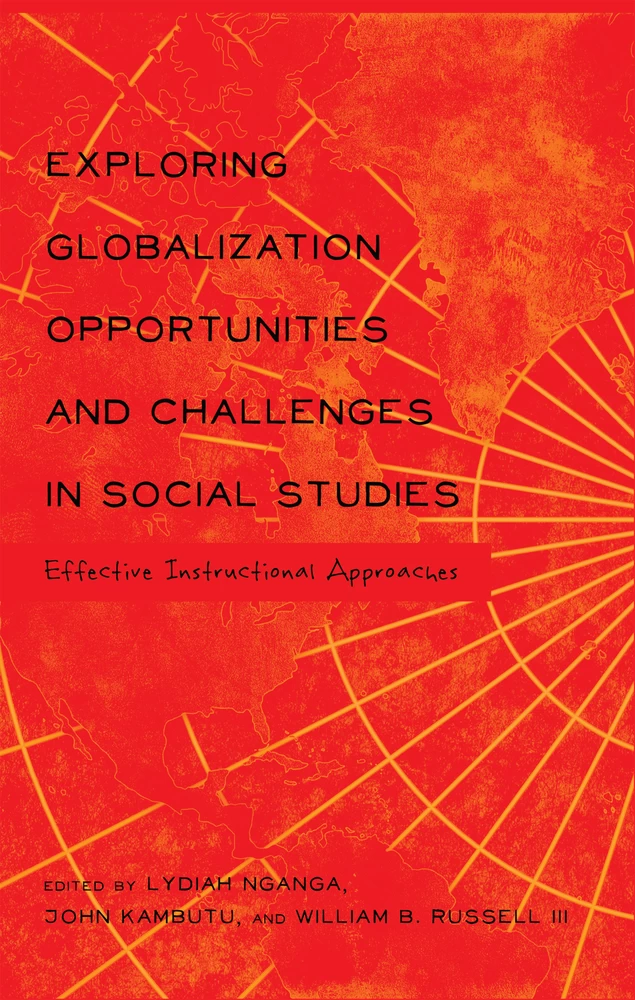
Exploring Globalization Opportunities and Challenges in Social Studies
Effective Instructional Approaches
Summary
Excerpt
ACKNOWLEDGMENTS
I express appreciation to all the educators who answered the call for manuscripts. Due to their generous contribution of quality chapters, this book is now a reality. Because these educators have shared their experiences and wisdom generously, Exploring Globalization Opportunities and Challenges in Social Studies: Effective Instructional Approaches is now available as a resource for global and social studies educators. Although this work is perhaps most beneficial to such educators, others will most certainly benefit because these chapter contributors have employed a variety of philosophical, theoretical and experiential lenses relative to globalization and global education.
Many thanks to the following chapter reviewers for providing meaningful feedback: Rebecca C. Aguayo, Linda Bennett, Aaron Bodle, Kenneth T. Carano, Antonio J. Castro, Catherine Cooke-Canitz, Paul G. Fitchett, Erik Garrett, Rosanna M. Gatens, Jason R. Harshman, Mirynne Igualada, Joshua Kenna, Toni Fuss Kirkwood-Tucker, Joe O’Brien, Cynthia Poole, Dilys Schoorman, Rachayita Shah, Daniel W. Stuckart, Karen Thomas-Brown, Thomas N. Turner, Ozum Ucok-Sayrak, Stewart Waters and Cameron White. I am deeply indebted to these reviewers and chapter contributors because their efforts were on a voluntary basis.
I am equally indebted to my co-editors, John Kambutu and William B. Russell III. This book project would not have been possible without their support and expertise.
Finally, many thanks to Michael A. Peters, Chris Myers, Stephen Mazur, Phyllis Korper, Sarah Stack, and Jackie Pavlovic of Peter Lang Publishing for facilitating the publication of this book.
Lydiah Nganga
University of Wyoming, Casper College Center
← ix | x → ← x | xi →
PREFACE
What is global education? What is the role of education in a global world? How do we prepare students to become effective citizens in a global community? How do we effectively teach global education? These questions have spawned many debates and scholarly discussions and are not easily answered. No matter if you align with the core constructs of global interconnectedness or perspective consciousness, global education curriculum and pedagogy form an important educational concept that has and will continue to arouse interest and ignite discussion.
Exploring Globalization Opportunities and Challenges in Social Studies: Effective Instructional Approaches examines global education and how it should be taught in the social studies. This volume includes twenty-one chapters and is divided into two sections. Part 1, Global Issues, Trends, Policies, Practices, and Implications, includes chapters that examine relevant global issues. This section begins with a chapter by John Kambutu that examines globalization, its history, impact, and role in education. The following chapter by Catherine Cooke-Canitz analyzes the challenges of teacher acculturation and presents four main orientations to help in understanding the various responses that teachers have toward their immigrant students. Chapter 3, by Paul G. Fitchett, explores the dynamics of neoliberalism, its impact on immigrant identity, and the manner in which social studies textbooks and curricula have propagated neoliberal principles. Fitchett’s chapter is followed by Lydiah Nganga and Keonghee Tao Han’s examination of immigration issues related to economic globalization and how these issues call for K–12 teachers and university instructors to become well informed and proactive global multicultural educators. Chapter 5, by Karen Thomas-Brown, analyzes perspectives from a Caribbean island on preparing teachers for global citizenship. The following chapter by Ozum Ucok-Sayrak and Erik Garrett offers service-learning as a pedagogical practice for preparing students to be global citizens. Chapter 7, by Cameron White, discusses global classrooms and how to contextualize global education in a contemporary classroom. White’s chapter is followed by Linda B. Bennett’s examination of various higher education institutions’ undergraduate academic international/global experiences. This section concludes with a chapter by Antonio J. Castro and Rebecca C. Aguayo, which discusses the complexities of genocide education and global citizenship.
Part 2, Global Issues and Innovative Instructional Practices for Teaching Global Education, includes chapters that explore innovative instructional practices to teach effectively to specific global issues. This section begins with a chapter by Stewart Waters and William B. Russell III that examines how films ← xi | xii → can be used to facilitate relevant and powerful discussions in the classroom to encourage the development of global citizens of character. Waters and Russell’s chapter is followed by Mirynne Igualada and Dilys Schoorman’s discussion of the challenges facing the teaching of global education in a time of standardization. The following chapter, by Emma K. Humphries and Elizabeth Yeager Washington, examines a conceptual framework through which educators can help students to understand the terms “citizenship” and “civic engagement.” Chapter 13, by Joseph O’Brien and Jason L. Endacott, explores how the U.S. history curriculum can be globalized with historical empathy. Chapter 14, by Jason R. Harshman, emphasizes global education and the importance of including multiple perspectives when teaching cultural, human, and physical geography. In chapter 15, Kenneth T. Carano and Daniel W. Stuckart explore using Weblogs, or blogs, as a pedagogical tool in the development of global literacy and cross-cultural awareness. This chapter is followed by Thomas N. Turner, Dorothy Blanks, Sarah Philpot, and Lance McConkey’s exploration of using storytelling and drama to teach understanding and respect for global values and beliefs. Chapter 17, by Aaron T. Bodle, discusses teaching and learning about globalization by exploring local places in search of global connections. Bodle’s chapter is followed by Rachayita Shah, Rose Gatens, Dilys Schoorman, and Julie Wachtel’s analysis of professional development training of human rights violations and its context to globalization. Chapter 19, by Lydiah Nganga, explores a variety of instructional strategies for social studies method courses to help students gain a better understanding of the world. Nganga’s chapter is followed by Toni Fuss Kirkwood-Tucker’s discussion of creative pedagogies for teacher candidates in teacher education programs and practicing teachers in schools, helping them to effectively teach about the world and its people despite extant state and district curricular guidelines. This section concludes with a chapter by Lydiah Nganga and John Kambutu, summarizing the role of social studies and global education in a globalized era.
The twenty-one chapters included in this volume represent the vast of amount of relevant topics related to global education in social studies. This volume serves as both a foundation and a springboard for dialog, scholarship, curriculum, and pedagogy as global education and social studies education move forward into the twenty-first century.
Details
- Pages
- XII, 267
- Publication Year
- 2013
- ISBN (Hardcover)
- 9781433121296
- ISBN (PDF)
- 9781453909645
- ISBN (MOBI)
- 9781454189794
- ISBN (ePUB)
- 9781454189800
- ISBN (Softcover)
- 9781433121289
- DOI
- 10.3726/978-1-4539-0964-5
- Language
- English
- Publication date
- 2013 (September)
- Keywords
- policies reforms education
- Published
- New York, Bern, Berlin, Bruxelles, Frankfurt am Main, Oxford, Wien, 2013. 267 pp.
- Product Safety
- Peter Lang Group AG
