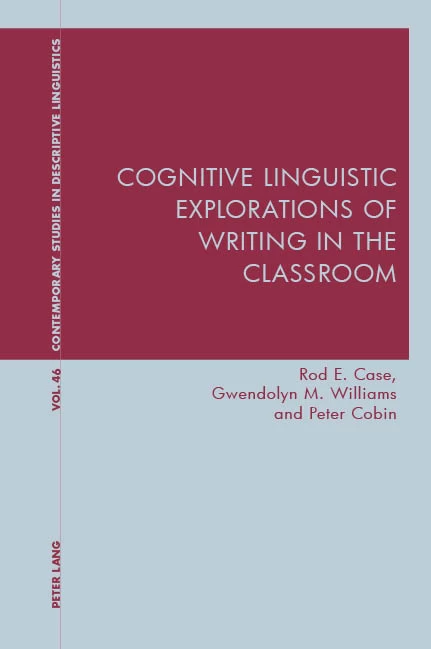
Cognitive Linguistic Explorations of Writing in the Classroom
Summary
This book offers research into the analysis of classroom writing that does not use a set standard or rubric to assess student writing but instead relies on insights from cognitive linguistics to explore the connections between cognition and language in student writing. The result is a creative and linguistically driven analysis of classroom writing that allows the linguist or teacher to view student writing on its own terms.
Excerpt
Table Of Contents
- Cover
- Title
- Copyright
- About the authors
- About the book
- This eBook can be cited
- Contents
- List of Figures
- List of Tables
- Preface
- List of Abbreviations
- Introduction
- Chapter 1 Overview of Cognitive Linguistics
- Chapter 2 Models of Writing Instruction
- Chapter 3 Metaphor and Writing
- Chapter 4 Event Structures in Children’s Writing
- Chapter 5 Making Connections across Studies
- Bibliography
- Appendix
- Index
- Series index
This book draws on the field of cognitive linguistics to explore the connections between cognition and writing extended texts across the two groups of students, third-graders and graduate students. They are uniquely situated at two ends of the educational spectrum, yet the challenges that both groups face in producing extended texts are surprisingly similar. They must learn to write extended texts on any number of academic topics for the first times in their lives. The third-graders moved from writing single sentences in the second grade to writing three-part stories that range from five or six sentences to 14 or 15 sentences. The graduate students completed multi-part 20-page research proposals for the first time, moving from the simple literature reviews that characterize undergraduate education to a multi-part argument that moves the reader through a review of the literature that identifies a need for research that the student defines, research questions and a carefully designed description of research methods.
This book argues that these similarities are most apparent when they are examined through a cognitive linguistic lens. The first chapter opens the text by reviewing the basics of cognitive linguistics and some associated work in event cognition which represent the building blocks of the framework for this book. The second chapter reviews the research on teaching writing in order to provide a picture of various methods for teaching writing from elementary school through college-age students. Chapters 3 and 4 are the findings from research into the extended writing of third-graders and graduate students. The final chapter documents the common themes across both groups through a cognitive linguistic lens in order to add an alternative to the lock-step approach to teaching writing that begs the question of why so many students produce such disparate texts. Instead of going back to writing instruction research to look through a narrow range of approaches and solutions, we propose that writers look outside of traditional approaches of writing towards models that embrace cognitive linguistics.←1 | 2→ ←2 | 3→
Overview of Cognitive Linguistics
To begin, this chapter will contextualize the field of cognitive linguistics by explaining how this discipline grew out of the larger domain of linguistics. After tracing the historical emergence of CL, we then proceed to describe the major components of CL that will be needed to understand the studies described in this book.
The field of cognitive linguistics originated in the early 1970s as a response to growing frustration with traditional approaches to generative and formal linguistics (Evans & Green, 2006; Holme, 2009). Specifically, generative linguistics focused on the task of defining universal principles that are common across languages based on deductive analysis of individual languages, but such an objective remained elusively beyond the grasp of the researchers because the conclusions drawn were on the nature of language and not universal themes across languages (Lakoff & Johnson, 1999). Formal linguistics focused on defining an object when it matched a set of criteria that determined the essence of the phenomenon (Holme, 2009). Despite the contributions of these fields, cognitive linguistics emerged through its focus on the organization and uses of language as they occurred in everyday life (Evans & Green, 2006).
One difficulty with generative linguistics was its primary focus on syntax for analysis (Holme, 2009). In Chomsky’s minimalist model, language study concentrated on either syntax or the lexicon (Chomsky, 1995), so for generative linguistics, most language study focused on syntax (Holme, 2009). Chomsky’s theory of universal grammar exclusively concentrated on grammatical competence and did not address the pragmatic functions of language (Johnson, 2004). Students began to realize that the dichotomous labeling of verbs as transitive or intransitive was not working for many idioms that occurred (Holme, 2009). The expressions were then taken out of the syntactic system of language and described as a construction with some being ruled by the syntax rules and others not (Holme, 2009). This inconsistency made it difficult to make systematic conclusions about the syntax of a given language.←3 | 4→
An additional criticism of generative linguistics was that while generative linguists claimed the universal grammar across languages allowed individuals to create a multitude of different sentences without having a sophisticated knowledge of grammar (Holme, 2009), this appeared not to be true because the knowledge needed to accomplish these sentences was highly complicated and not achievable without the grammar knowledge (Holme, 2009). From such a perspective, cognitive development was a way to reduce mental processing in order to focus on language acquisition. Furthermore, universal grammar was thought to be housed in a specific area of the brain, called the Language Acquisition Device (Chomsky, 1965), but research on the brain has not uncovered any area of the brain that is uniquely structured to contain such a mechanism (Behme & Deacon, 2008).
A final critique of linguistics that led to the emergence of cognitive linguistics was the issue of how meanings were derived from the world (Holme, 2009). Saussure (1974) acknowledged that language could just embody objects or states of being in the world. Individuals needed to have words that represented conceptual meaning, not just a one to one equivalent representation. Formal linguistics held that a word had to possess all the prescribed set of features in order to be officially identified as a given word (Holme, 2009). However, such an assertion had already been challenged by Wittgenstein (1953) who reasoned that some words did not need to exhibit all the characteristics of an entity to be classified as that concept. Another reproach to linguistics was that abstract categories, such as pleasure, had no objective features that could be matched for the purpose of identification (Holme, 2009). all of these criticisms, cognitive linguistics emerged in the early 1970s and were shaped by other fields, such as philosophy and cognitive science (Evans, 2012).
Details
- Pages
- XVI, 166
- Publication Year
- 2019
- ISBN (Softcover)
- 9781787073449
- ISBN (PDF)
- 9781787073456
- ISBN (ePUB)
- 9781787073463
- ISBN (MOBI)
- 9781787073470
- DOI
- 10.3726/b16167
- Language
- English
- Publication date
- 2019 (November)
- Keywords
- Applied Linguistics English Language and Literatures
- Published
- Oxford, Bern, Berlin, Bruxelles, New York, Wien, 2019. XVI, 166 pp., 4 fig. b/w
- Product Safety
- Peter Lang Group AG
