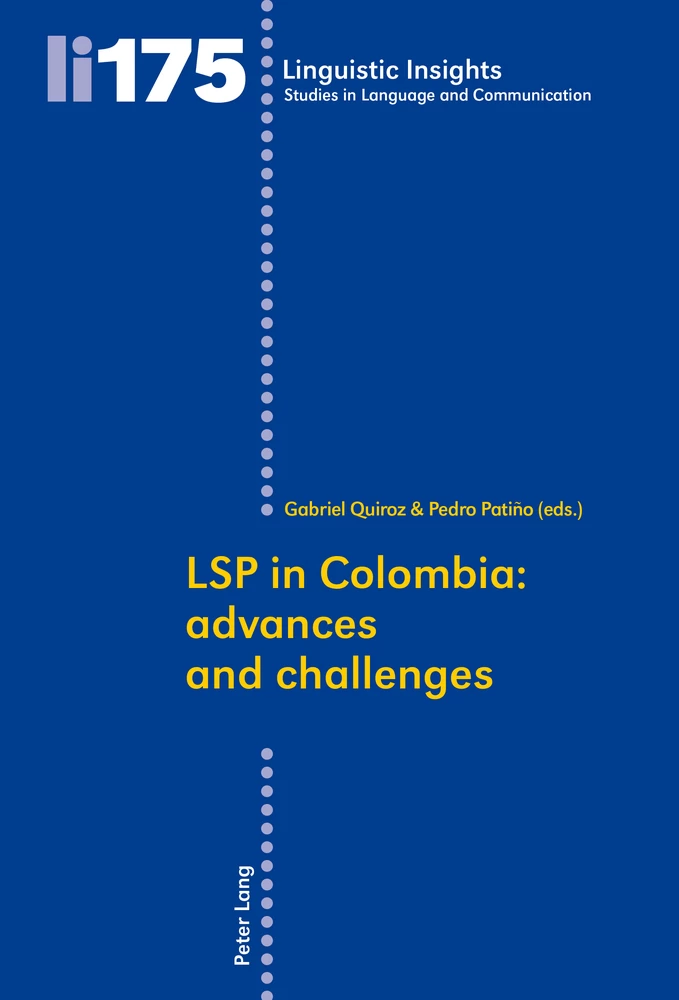
LSP in Colombia
Advances and challenges
©2014
Edited Collection
354 Pages
Series:
Linguistic Insights, Volume 175
Summary
Studies in LSP in Colombia began in the 1990’s, mainly in the discipline of terminology. Since then, studies in translation, terminology, and LSP have spread out throughout the country. Many papers have been written since then in national and international journals by Colombian authors. This book comprises a set of 20 chapters derived from M.A. and Ph.D. theses of Colombian authors written in Austria, Chile, Colombia, France, Norway, and Spain. The multidisciplinary view of this book includes scholars from translation, linguistics, computer engineering, philosophy, and library and information science. These chapters deal with linguistic, phraseological, terminological, didactic, and textual issues related to terminology, translation, corpus linguistics, and computational linguistics from the Universidad de Antioquia, Universidad de Medellín, Universidad Nacional de Medellín, Universidad Autónoma de Manizales, Universidad EAFIT, Wake Forest University, NHH Norwegian School of Economics, Université Grenoble Alpes, and Université Paris VII.
Excerpt
Table Of Contents
- Cover
- Title
- Copyright
- About the Editors
- About the Book
- This eBook can be cited
- Contents
- Foreword: Gabriel Quiroz / Pedro Patiño
- 1. The origins
- 2. Contents of the book
- 2.1. Linguistic issues
- 2.2. Phraseological issues
- 2.3. Terminological issues
- 2.4. Didactic issues
- 2.5. Textual issues
- 3. Concluding remarks
- Linguistic Issues
- Some Criteria for a Spanish Initialisms Recognition System: John Jairo Giraldo
- 1. Initialism definition and typology
- 1.1. Definition of initialisms
- 1.2. Typology of initialisms
- 1.2.1. Proper initialism
- 1.2.2. Non-proper initialism
- 2. Qualitative analysis of initialisms
- 2.1. Corpus compilation
- 2.2. Morphological analysis
- 2.2.1. Prefix+initialism
- 2.2.2. Initialism+initialism
- 2.2.3. Gender and number
- 2.3. Syntactic analysis
- 3. Quantitative analysis of initialisms
- 3.1. Descriptive statistics of Genomics initialisms
- 3.2. Descriptive statistics of environment initialisms
- 4. Criteria for a Spanish initialism recognition system
- 4.1. Initialism formation rules
- 4.1.1. Basic rules of initialism formation
- 4.1.2. Complementary rules for initialism formation
- 4.2. Initialism recognition patterns
- 4.2.1. Initialism candidate recognition patterns
- 4.2.2. Initialism-expansion pair recognition patterns
- 5. Conclusions
- 6. References
- Syntactic Features in Specialized Texts: A Comparison of Two Syntactic Patterns in Texts of Different Levels of Specialization: Oscar Andrés Calvache / Mercedes Suárez
- 1. Introduction
- 2. Theoretical framework
- 2.1. Syntactic features of specialized texts
- 3. Methodology
- 3.1. Criteria of corpus selection
- 3.2. Identification and extraction of specialized noun phrases and passive voice
- 4. Analysis and results
- 4.1. Comparison of syntactic features vs. levels of specialization
- 4.1.1. Specialized noun phrases
- 4.1.2. Passive voice
- 6. Conclusions
- 7. Acknowledgements
- 8. References
- Applying Linguistic Methods for a Semiautomatic Analysis of Corporative Documents: Standard Operating Procedure: Bell Manrique, Diego Burgos, Carlos Zapata
- 1. Introduction
- 2. Conceptual framework
- 2.1. Specialized discourse analysis
- 2.2. Linguistic analysis and corpus linguistics
- 2.3. Corporate technical documentation
- 3. State-of-the-art review
- 3.1. Analysis of linguistic features from documents
- 3.2. Identification of the knowledge domain and business process
- 4. Linguistic analysis
- 4.1. Rhetorical analysis
- 4.2. Morphosyntactic analysis
- 4.3. Semantic analysis
- 5. Evaluation
- 5.1. Preliminary analysis of the verbs
- 5.2. Preprocessing of SOP from the evaluation corpus
- 5.3. Processing with dependency parser
- 6. Conclusions and future work
- 7. Acknowledgements
- 8. References
- Advances and Challenges of an Ontology Focused on Verbs Related to Political Violence: Ana María Tangarife, Germán Urrego, Jorge Antonio Mejía
- 1. Introduction
- 2. Verbs
- 2.1. Verb management
- 2.2. Ontologies of verbs
- 3. An ontology based on verbs in the field of political violence
- 3.1. Corpus or base of knowledge
- 3.2. Classes and conceptual categories
- 3.3. Types of words
- 3.4. Selected verbs
- 3.5. Classification of verbs
- 4. Role of verbs in relation to other elements
- 5. Model of a textual analysis system based on verbs
- 5.1. Agents of system
- 5.2. System Process
- 5.3. Description of Protégé model
- 5.4. System functional requirements
- 6. Methodology
- 7. Conclusions
- 8. References
- Identification of Knowledge Units Contained in Spanish Texts: Julio César Foronda, Germán Urrego, Gloria Giraldo
- 1. Introduction
- 2. Knowledge units
- 3. Basic concepts about the Spanish language grammar
- 3.1. Syntactic and semantic features
- 3.2. The predicate of the sentence
- 4. Formalism for representing atomic knowledge units
- 5. Identification of knowledge units
- 6. Results and conclusions
- 7. References
- Phraseological Issues
- Challenges in the Translation of General and Specialized Phraseology: Germán Mira, John Jairo Giraldo
- 1. Introduction
- 2. Corpora
- 3. The translation of phraseology
- 4. Analysis and results
- 4.1. GL analysis
- 4.1.1. Full correspondence
- 4.1.2. Full correspondence in content but not in constituents
- 4.1.3. Full correspondence in content but partial correspondence in constituents
- 4.1.4. Partial correspondence in semantic or pragmatic value
- 4.1.5. Calque
- 4.1.6. Paraphrase
- 4.1.7. Omission
- 4.1.8. Single lexeme (reduction)
- 4.2. LSP analysis
- 4.2.1. Equivalent SPU
- 4.2.2. Paraphrase
- 4.2.3. Semantic calquing
- 4.2.4. Lexical calquing
- 4.2.5. Loan
- 4.2.6. Single lexeme
- 4.2.7. Omission
- 4.2.8. Overtranslation
- 5. Conclusions
- 6. References
- Towards a Definition of Specialized Collocations: Pedro Patiño
- 1. Introduction
- 2. Criteria for collocability
- 2.1. Criteria of collocability
- 2.1.1. Frequency of co-occurrence
- 2.1.2. Combinatory restrictions
- 2.1.3. Degree of composionality
- 2.1.4. Degree of transparency
- 2.1.5. Adjacency versus span of words between node and collocate
- 3. Specialized features
- 4. Conclusion
- 4.1. Future work
- 5. Acknowledgements
- 6. References
- Terminological Issues
- On Premodified Terms in Five Specialized Dictionaries: Gabriel Quiroz, Alejandro Arroyave
- 1. Introduction
- 2. Importance of dictionaries in LSP
- 3. Criteria and selection of the terminological corpus
- 4. Results
- 4.1. Length and frequency of NP
- 4.3. Frequency of patterns
- 4.4. Frequency of patterns by length
- 4.5. Morphological features of premodification
- 5. Conclusions
- 6. References
- An Image-Term Co-occurrence Model for Multilingual Terminology Alignment and Cross-Language Image Indexing: Diego Burgos
- 1. Introduction
- 2. The BC model
- 2.1. Theoretical rationale
- 2.2. Implementation of the BC model and concluding remarks
- 2.2.1. Search space characterization
- 2.2.2. Search space drawbacks
- 2.2.3. Image-term alignment
- 2.2.3.1. MWT recognition
- 2.2.3.2. Noun classification
- 2.4. Description of the prototype
- 3. Related work
- 4. References
- International Terminology Standards in the Export Sector in Colombia: Juan Carlos Díaz
- 1. Introduction
- 2. International terminological standardization
- 3. Perspectives of terminology development in Colombia
- 4. Analysis of the Colombian export sector
- 5. Organizations of the Colombian export sector
- 5.1. Proexport
- 5.2. Norexport
- 6. Application of the international terminology standards
- 7. Conclusions
- 8. References
- Translation Subcompetences and Terminological Implication Levels in Professional Translators: Olga Umaña, Mercedes Suárez
- 1. Introduction
- 2. Theoretical framework
- 2.1. Translation competence
- 2.2. Terminological competence
- 2.3. Translation problems
- 3. Methodology
- 3.1. Type of research
- 3.2. Participants selection criteria
- 3.3 Instruments to measure translation subcompetences and terminological implication levels
- 3.3.1. Texts labelled with translation problems
- 3.3.2. Value scale of the labelled texts
- 3.3.3. Semi-structured interview
- 3.3.4. Structured interview
- 4. Analysis and results
- 4.1. Comparison of translation subcompetences according to directionality
- 4.1.1. Direct translation task
- 4.1.2. Inverse translation task
- 4.1.3. Semi-structured interview
- 4.1.4. Structured interview
- 5. Conclusions
- 6. Acknowledgments
- 7. References
- Didactic Issues
- Translating Scientific and Technical Texts: The Translation Workshop as a Didactic Tool: Norman Gómez
- 1. Introduction
- 1.1. General context of scientific and technical translation courses in Colombia
- 1.2. Rationale for the design of “Traducir textos científicos y técnicos”
- 2. Theoretical framework
- 2.1. Brief introduction to the scientific language
- 2.2 Translation competence
- 2.3. Text typology, register and genre
- 2.4. Translation assessment
- 3. The book “Traducir textos científicos y técnicos”
- 3.1. Use of I&CT in the workshops
- 4. Sample answers from the students’ portfolios
- 5. Conclusions
- 6. References
- Some Didactic Strategies for the Teaching of Noun Phrases with Complex Premodification from English into Spanish: Alejandro Arroyave, Gabriel Quiroz
- 1. Introduction
- 2. Problems found in translation trainees
- 2.1. Identification of the head
- 2.2. Translation of NP
- 2.2. Translation problems found
- 3. Experiment in translation trainees
- 3.1. Description of the experiment
- 3.1.1. Participants
- 3.1.2. Materials
- 4. Results of the experiment
- 4.1. Data analysis
- 4.1.1. Results of the pretest
- 4.1.2. Application of the workshop
- 4.1.3. Results of the posttest
- 5. Some Didactic Strategies
- 5.1. Strategies generated for the translator trainees
- 5.2. Strategies generated for the translation teacher
- 6. Discussion
- 7. References
- Toward the Design of a Hybrid Learning Environment Based on Text Linguistics for Teacher Training in French as a Foreign Language (FFL) in Colombian Universities: Jorge M. Molina, Georges Antoniadis
- 1. Introduction
- 2. Research context: the formation of FFL teachers in Colombia
- 3. Problem and working hypotheses
- 4. Project foundations
- 4.1. A project based on text linguistics
- 4.2. CALL and NLP
- 4.3. Towards a blended learning environment
- 5. Project actions
- 5.1. Corpus compilation
- 5.2. Elaboration of pedagogical sequences
- 5.2.1. Phases included in the sequences
- 5.2.2. Types of tasks
- 5.2.3. Design and computer implementation
- 6. Conclusion
- 7. References
- Textual Issues
- Rhetorical Description of the PhD History Thesis Genre: an Analysis from two Discourse Communities on the Basis of the Corpus TeDiCE-2010: Juan David Martínez
- 1. Introduction
- 2.1. Theoretical framework
- 2.1.1. Discourse community and discourse genre
- 2.1.2. The doctoral thesis genre and its rhetorical analysis
- 3. Methodology
- 4. Results and discussion
- 4.1. Rhetorical-functional structure of doctoral theses in history
- 4.1.1. The displacement
- 5. Conclusions
- 6. References
- Metaphor in Colombian Slang: A Quantitative Analysis: Juan Manuel Pérez
- 1. Introduction
- 2. Theoretical framework
- 3. Methodology and data analysis
- 3.1. Evaluation
- 3.2. Behavior
- 3.3. Shape (concrete)
- 3.4. Result
- 3.5. Function
- 4. Conclusions
- 5. References
- Variation of Metaphor Use across Rhetorical Structure in two Genres: Rafael Zapata Dederle
- 1. Introduction
- 2. Rationale
- 2.1. Identification of linguistic metaphors
- 2.2. Quantitative aspects of metaphor
- 2.3. Identification of rhetorical goal units
- 3. Corpus
- 3.1. Sampling method
- 3.2. Reliability tests: inter-rater agreement
- 4. Results
- 4.1. Three-way interaction between rhetorical goal, metaphor and word class in newsletters and research articles
- 5. Conclusion
- 6. Acknowledgements
- 7. References
- Text Functions and Citation Patterns in Specialized Texts: A Contrastive Study of the Case Report Genre: Carlos Muñoz Torres
- 1. Introduction
- 2. Theoretical framework
- 3. Methodology
- 3.1. Corpus
- 3.2. Methodology of Analysis
- 4. Analysis and results
- 5. Citation and citation patterns
- 6. Conclusions
- 7. References
- Explicit Denominative Variation Markers and their Implications in Translation: Mercedes Suárez
- 1. Introduction
- 2. Theoretical framework
- 2.1. Semantic relations and discourse markers
- 3. Methodology
- 3.1. Specialized corpus and selection criteria
- 3.2. Detection and selection of the Terminological Units (TUs) characteristic of the subject
- 3.3. Screening and selection of explicit denominative variants
- 3.4. Performance of the explicit denominative variation markers
- 4. Analysis and results of the ST
- 4.1. Expansion
- 4.1.1. Metaphorical expansion
- 4.1.2. Nonmetaphorical Expansion
- 4.2. Reduction
- 4.2.1. Reduction by elision
- 4.2.2. Reduction by abbreviation
- 4.3. Refocalization
- 4.3.1. External Refocalization
- 4.3.2. Internal Refocalization
- 5. Contrastive analysis and results
- 5.1. Absolute coincidence of the EDV in the TT
- 5.2. Relative coincidence of the EDV in the TT
- 5.2.1. Identical variation type and subtype, different marker
- 6. Conclusions
- 7. Acknowledgments
- 8. References
- Notes on Contributors
Details
- Pages
- 354
- Publication Year
- 2014
- ISBN (Softcover)
- 9783034314343
- ISBN (PDF)
- 9783035105902
- ISBN (MOBI)
- 9783035198393
- ISBN (ePUB)
- 9783035198409
- DOI
- 10.3726/978-3-0351-0590-2
- Language
- English
- Publication date
- 2014 (April)
- Keywords
- translation linguistics philosophy information science
- Published
- Bern, Berlin, Bruxelles, Frankfurt am Main, New York, Oxford, Wien, 2014. 354 pp., num. tables and graphs
- Product Safety
- Peter Lang Group AG
