Classroom Struggle
Organizing Elementary School Teaching in the 19th Century

Summary
Excerpt
Table Of Contents
- Cover
- Title
- Copyright
- About the author
- About the book
- This eBook can be cited
- Table of Contents
- Foreword
- Classroom Struggle: Organizing Elementary Teaching in the 19th Century
- Struggling with Political and Economic Contexts
- From Competing Technologies of Mass Schooling to the Spiritual Enlightenment of the Nation: The Reception of the Monitorial System of Education in Denmark 1814–1849
- Educational Reform, Political Change, and Penury: Primary Schooling and the Monitorial System of Education in Chile, approx. 1810–1833
- Perfect Imperfection: Lancasterian Teaching and the Brussels Educational System (1815–1875)
- Struggling for a Rationalized Pattern of Teaching
- The Invention of the Modern School in Brazil: Methods and Materials in Brazilian Schools in the 19th Century
- Mass Teaching without the Masses: Challenges during the Rise of Mass Education in Sweden, approx. 1810–1880
- From Monitorial to Graded Schooling in 19th Century Mexico: Politics and Pedagogy in the Definition of Modern Education
- Struggling with Competing Systems of Teaching
- From Tutor to Teacher: The Birth of Popular Schooling in Early 19th Century Italy
- Grappling with the Unavoidable: Mixing Systems of Teaching in Schleswig and Holstein (1819–1830)
- Adopting Different Teaching Systems. Data from the Portuguese Extraordinary Inspection of 1875
- Pax Hispanica?: The Mixed System of Teaching and Competing Groups of ‘Experts’ in Spain during the 19th Century
- Postscript
- Retrospect and Prospects
- Authors
Marcelo Caruso (ed.)
Classroom Struggle
Organizing Elementary School Teaching in the 19th Century

Bibliographic Information published by the Deutsche Nationalbibliothek The Deutsche Nationalbibliothek lists this publication in the Deutsche Nationalbibliografie; detailed bibliographic data is available in the internet at http://dnb.d-nb.de.
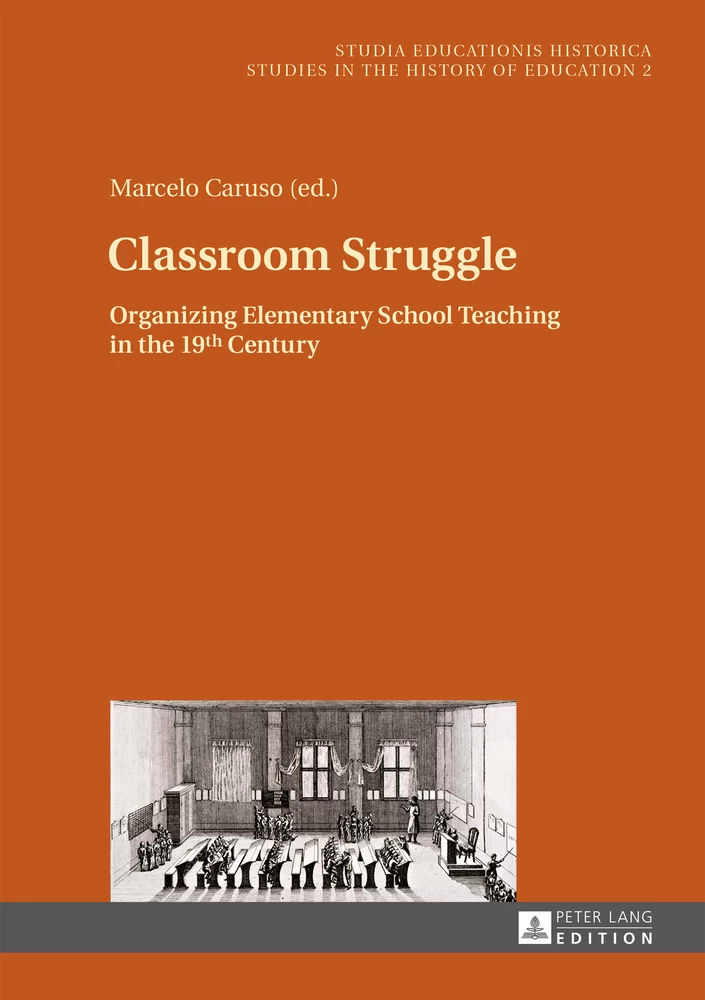
Cover illustration:
Etching “Knabenschule von acht Klassen”.
In: Neujahrsblatt der Hülfsgesellschaft in Zürich, 20 (1820), p. 2.
ISSN 2195-5158
ISBN 978-3-631-62925-3 (Print)
E-ISBN 978-3-653-03228-4 (E-Book)
DOI 10.3726/978-3-653-03228-4
© Peter Lang GmbH
Internationaler Verlag der Wissenschaften
Frankfurt am Main 2015
All rights reserved.
Peter Lang Edition is an Imprint of Peter Lang GmbH.
Peter Lang – Frankfurt am Main · Bern · Bruxelles · New York · Oxford · Warszawa · Wien
All parts of this publication are protected by copyright. Any utilisation outside the strict limits of the copyright law, without the permission of the publisher, is forbidden and liable to
prosecution. This applies in particular to reproductions, translations, microfilming, and storage and processing in electronic retrieval systems.
This publication has been peer reviewed.
www.peterlang.com
Every book is the result of collective efforts. This statement, while obvious, applies even more strongly to edited books with an international outlook. Working with authors from three continents and putting together pieces of scholarship written in languages other than English required the intense cooperation of all authors and of the staff of the department of History of Education at the Humboldt University in Berlin. Particularly Janika Olschewski and Johannes Türstig reviewed and helped to edit texts and intensively communicated with the authors and the editor. Some insights presented in the introduction and in the two pieces that I have (co)authored are partly the result of the discussions with Till Eble, Anne Frank, Judith Kutter, Maria Moritz, and Fritzi Titzmann in our project on the mixed systems of teaching in the second half of the 19th century. The German Research Fund (Deutsche Forschungsgemeinschaft) generously financed our research project “Negotiation and implementation of norms for ‘mixed’ systems of organising classroom instruction: A comparison of transfer processes (Spain, Ireland, and India, circa 1848–1900)”. Crucial elements of the theoretical and historiographical approach of the project are presented in this volume. Mary (Kate) Horning has carefully revised some of the manuscripts and done her best effort to put them in understandable and elegant English.
Marcelo Caruso, Berlin/Phoenix, November 2014
← 7 | 8 →
Struggling with Political and Economic Contexts
In the crucial years of the establishment of inclusive schooling in Denmark after the school bills of 1814, the Bell-Lancaster system, also known as the monitorial system of education, was imported from England. The import, reception and implementation were, however, specific to the Danish case and context. Among these specific features, the role played by the absolutist state and the military was without doubt a central one. With royal support and power, the whole Danish school world was strong armed into using this new system.
This article will take a closer look at this form of schooling that dominated Danish school life from around 1819 till its zenith in 1830 and its astonishing Wirkungsgeschichte due to the educator Nikolaj Frederik Severin Grundtvig (1783–1872). In general terms, Denmark was hitherto in educational matters in many ways a continuation of Northern Germany.1 But the case of the adoption of the monitorial system of education in Denmark was an exception to this orientation – now the country of reference was England. The reception of the monitorial model varied substantially in different countries. Developed more or less independently by the two British educators Andrew Bell and Joseph Lancaster in recognizable versions, it spread from England to France, Denmark, Sweden, Spain, large parts of South and North America, Africa, Asia etc. but hardly gained foothold in the German states.2 This transcontinental reception from around 1800 and onwards is of interest for this article as a main context of its fate in Denmark. ← 41 | 42 →
The principal argument of this article is that the Danish state can fruitfully be analyzed as a survival unit in Norbert Elias’ sense of the term.3 For Elias, the state is a unit that is placed in an environment of other potentially hostile states. The consequence hereof is that the state must organize itself in order to procure at least a sufficient defense. This defense should be regarded in broadest possible terms ranging from soldiers and military weapons to, for instance, culture, ideology and social organization itself.4 The education of a population can thus in this perspective be seen as a means of the state to compete with other states. This applies to the Danish state of the early 19th century struggling for military survival as well as to the present Danish state struggling to attract foreign investments with a well-educated workforce. On the basis of this rather simple heuristic model, the adoption of monitorial schooling in Denmark can be regarded as a consequence of the new and precarious situation of the Danish state after the disastrous Napoleonic wars: the dual loss of Norway and the fleet, which by then was the third largest in Europe. In addition, the French revolution was still a recent event and there was a widespread anxiety of the possibility that something similar could happen in Denmark. In this situation, the Danish King Frederick VI (1768–1839, reign 1808–1839) intervened personally in the Danish school policy. He dismissed his school administration, which was dominated by the Church and its clergy. Instead he entrusted a captain from the Danish military to change the school system in a much more disciplinary manner. Regarding the monitorial system, choreographies were changed, timeframes tightened etc. to the point where some contemporary observers found that it had “degenerated” (udartet) in Denmark in comparison with the English model. The specific Danish reception of monitorial schooling with its tremendous stress on obedience must therefore be seen as related to the precarious situation of the Danish state in these years. As an unintended consequence of its import, the method gave rise to new ideas of “mutuality” in education that inspired Grundtvig in his formulation of an educational ethos that later shaped the Nordic Folk High School tradition.
Educational Reform in the Enlightenment Era
The ties between the military and education had a long history in Denmark at the beginning of the 19th century. From the early 18th century and onwards, the Danish military had shown a strong interest in mass schooling. This interest surfaced ← 42 | 43 → both with regards to the first compulsory schools in Denmark, namely the so-called equestrian schools from 1721 as well as the mandatory religious confirmation in 1736 and the consequential introduction of compulsory schooling in 1739 in the rural areas. With regards to the equestrian schools, the suggestion to establish these schools on the royal estates came from a military commission.5
Under the leadership of the young Fredrick as a crown prince many sweeping reforms were executed in the 1780’ties and 1790’ties, informed by enlightenment ideas of the happiness of the people and by cameralistic ideas of better methods in agriculture. These were financially good times for Denmark and an atmosphere of optimism took hold in an age of unprecedented reform. The members of the new Danish Chancery (Danske Kancelli) after the coup in 1784 counted among others the eager reformers of schooling Ernst Heinrich von Schimmelmann (1747–1831) and Christian Ditlev F. Reventlow (1748–1827).6 These belonged to the enlightened German speaking nobility but they had their strong loyalty to the Danish king. They were an educationally active group that also included C. D. F. Reventlow’s brother, Johann Ludvig Reventlow (1751–1801). This group of men had pursued school reforms at their own expense at their landed estates since the beginning of the 1780’ties mostly inspired by German philanthropic ideas from Basedow and Rochow. A Commission for the Better Organization of the National Schools (Den Store Skolekommission) was established in 1789 that counted the above-mentioned central political figures as well as a more conservative representative of the church, Bishop Nicolai Edinger Balle (1744–1816). This commission carried on its work all the way from the prosperous late 18th century into the more unfortunate times of war and crisis in the early 19th century. There were numerous educational initiatives of local and regional kind emanating from this commission’s work. Suggestions for a school bill in 1799 was full of philanthropic ideas of schooling built on “common sense” and aiming at creating “happy people” and “useful citizens”.7 ← 43 | 44 →
Although Rewentlow considered the improvement of the schools as decisive for the welfare of the state, the first bills following from the work of the commission that covered the entire area under the Danish crown were not put into place before 1814. This was a year after a state bankruptcy and the year of the loss of Norway to Sweden after the Napoleonic wars. The result of the actual 1814 bills was less of the “common sense” and “happy people” that had permeated the first suggested school bills of the commission especially in the years following immediately after its inception in 1789. Instead, as the consequences of the French revolution became apparent, the focus shifted towards a much greater concern with avoiding rebellion. Politically dangerous words like “citizen” and “reason” were thus deliberately left out of the final acts of 1814.
The School Reform of 1814 was enacted, but the increased expenditure and the low price of grain posed a set of difficulties for the large landowners. As a result, they complained to the King, who in 1816 seems to have been on the verge of revoking the 1814 reform. The Danish Chancery opposed the intention of the King in a report of June 21st 1816.8 As a result, he resolved to continue with the reform of 1814, although the pace of implementation was somewhat reduced.9 In addition to the deceleration of the reform process, some of the newly established teacher-training colleges were closed down, and the income of the schoolmasters was reduced.
The Danish reception of the monitorial system of education and the Red Bishop
The introduction of the Bell-Lancaster monitorial system of education or the “mutual” teaching method as it was called in Danish (Den indbyrdes Underviisningsmetode) must be seen against this background, which to a large extent was a consequence of the military and economic pressure on the state. A crucial argument behind the introduction of the monitorial system in the first grade, out of the two grades in the national schools, was that the changed circumstances of the time made it necessary to introduce the system in order to fulfill the requirements of the school laws of 1814.10 ← 44 | 45 →
Some of these more practical and military concerns have also been seen as instrumental in the Danish reception and wholesale implementation of the monitorial system. At least contemporary observers saw the problem of providing organized schooling in Copenhagen and some other large cities as the main reason for its implementation and, from this point of view, its introduction can be counted, to some extent, as a success.11
The Danish Court, with Frederick VI as king and Marie Sofie Frederikke as queen, gained knowledge of the new monitorial system of schooling from several sources, whose record reach back to 1815. The Societé pour l’amélioration de l’enseignement elémentaire in Paris, largely responsible for introducing the new system of teaching in France, was established in 1815 and was particularly responsible for the implementation of the system in French military schools. Here the occupation armies after Napoleon’s defeat got familiar with the method and brought notice of this to their respective home countries. King Frederick VI became acquainted with the method and around Christmas 1816 he ordered the Danish Chancery to make experiments with it in urban schools in Copenhagen.12 The Chancery, however, did not take action. Another channel for the import of the method was to be far more decisive. In the years of 1818–1819, the British and Foreign School Society (BFSS), which promoted the Lancaster version of the new system, sent its secretary William Allen (1770–1843) on a promotion tour throughout Europe. From the royal court in Stockholm he sent a description of the method through the Swedish countess Bjelke to the Danish queen. And the Danish Chancery was then forced to respond to this. The bishop of Zealand since 1808 Friedrich Münter (1761–1830) responded quite negatively. This new method was mostly useful for schools with many children and few teachers, which were few in Denmark, he asserted, but more seriously he doubted that “children alone with this method can be supervised in reading with reflection” and in religion and geography this method was very insufficient.13 The Chancery supported this statement. The mentioned members of the chancery were keen philanthropists and also the clergy was negative towards the Bell-Lancaster-system. Despite the fact that the entire Danish Chancery seems to ← 45 | 46 → have been against the method, King Frederick in the event decided to introduce it in Denmark.
In this process Joseph Nicolai Benjamin Abrahamson (1789–1847) played a decisive role. He was a trusted member of the generaladjudantstab, the leadership of the Danish military with direct access to the king. Early in his carrier the king had entrusted him with the writing of his “secret protocol,” i.e. the king’s covert correspondence. During his time of many military promotions, among others to Knight of Dannebrog in 1817 (Ridder af Dannebrog), Abrahamson was an officer in the occupation army for three years (ca. 1815–1818) with stays in France, England and Switzerland. Here Abrahamson studied the monitorial system in its details and returned to Denmark with first-sight news about its functioning.
Danish Chancery and Københavns Skoledirection was as already mentioned rather skeptical towards the new method. King Frederick seems to have been dissatisfied with Danish Chancery and this seems to be the reason why he decided to bypass normal administrative procedures. Events followed rapidly. In January 1819, Abrahamson returned from France. On February 3rd he was ordered to try the method at a military school in Sølvgade in Copenhagen. On March 9th, the King personally visited the school and was very pleased with what he saw. In order to bypass the resistance from the School authorities in Danish Chancery and from the clergy, the school was exempted from the supervision of the Copenhagen school authorities, and Abrahamson was not to report to the Copenhagen school directorate, or to the Chancery, but directly to the king. The Chancery was overruled and must have found it best not to oppose the king. In a very interesting turn of things, the members of the Chancery now stressed the “liveliness” of the method and found that its efficiency should make the children learn the necessary skills of reading, writing and arithmetic much faster than under the previous method, and thus make the necessary education shorter.14 Thus a king in late absolutism with strong affinity to and admiration of the military was singlehandedly able to turn the educational policy completely around in 1819.
The mentioned military school in Copenhagen (Sølvgade Kaserneskole) became a model school for furthering the mutual teaching method, to which schoolmasters could come and acquaint themselves with the method. The personal interest of the King and the fact that Abrahamson reported directly to him and not through the usual school authorities put Abrahamson in a powerful position. By a rescript of 28th April 1819, a special commission was appointed. This consisted of Abrahamson, county dean P. H. Mönster, titular councillor of ← 46 | 47 → state C. L. Lassen, Bishop Münter and Bishop Boisen. Abrahamson, Mönster and Lassen were in favor of the method and thus had a majority on the commission. It submitted its report to Danish Chancery three months later, on August 18th 1819. It recommended the method in the first of the two classes of the elementary schools for the common people.15 In the Danish Chancery there was strong disagreement as to whether the introduction of the method should be ordered, or simply allowed and encouraged.16 In 1822, the King resolved that the method should be allowed, not ordered, possibly taking into account the expected resistance from the Church.17 In the event, it was introduced in the vast majority of Danish elementary schools.18
The noticeable spread of the system certainly profited from a series of mechanisms and decisions. An important factor in this process was the rescript of December 22nd 1826, making it mandatory that all school districts pay for the printing of the tables that were to be used. This meant that those schools not themselves using the mutual teaching method nonetheless had to contribute. Another mechanism encouraging the introduction of the method was that local school authorities had to specifically report whether or not they were implementing it. If they were not, they had to justify their choice. Abrahamson used this information in his reports to the King. The clergy, in charge of the supervision of the schools, were to pay specific attention to the mutual teaching method and to strive for its promotion. The efforts of the priests and rural deans in this respect were taken into consideration during assessments for promotion.19 Finally, in a rescript of August 10th 1830, priests were instructed to ensure that the mutual teaching method was used in exactly the specified way. It was further stated that the schoolmasters were to follow the instructions of the priests, or face dismissal. The result of these inducements was that the mutual teaching method during the 1820s became the dominant teaching method in the first elementary class. With these policies the absolutist State put pressure on the clergy to work for the method. ← 47 | 48 →
The eager Abrahamson made it his personal struggle to promote and implement the method with all means. He was soon to be called “the Red Bishop” as he allegedly could decide on promotions and non-promotions, and threaten teachers or local clergy that were not cooperative in implementing this method.20 The Royal Court was for it – who dared to be against it? The method was described as the “worthy cause” and the “good cause” and another school organizer of the military, Jens Worm Bruun, found Lancaster to be the “third savior” of the world after Jesus and Luther (sic).21
The basic argument of the Commission regarding the mutual teaching method was that the method was cheaper and yielded better results.22 In the report from Danish Chancery, which led to the King’s allowing the introduction of the mutual teaching method, the King justified his approval on the grounds that its intention was to ease the difficult work with small children, and diminish the burden of cost that elementary schools were visiting on the common people.23 Economics seem then to have been important but good and useful effects seems to have been even more important. These were mainly of a disciplinary nature. The most important consequence according to the Commission regarding the mutual teaching method was the obedience that the children were to imbibe at their most receptive age.24 Further on the commission argued that indiscipline was the main problem with ordinary teaching, which valued freedom at the expense of obedience. Willfulness, conceitedness, ignorance, and impertinence were the consequences of present-day teaching and the pedagogical paradigm of the brothers Reventlow, who had pursued enlightened school reforms at their own expense at their landed estates since the beginning of the 1780’ties mostly inspired by German philanthropic ideas from Basedow and Rochow. These two grand old men of Danish education were thus implicitly criticized.25
The focus on discipline and obedience is essentially different from the intentions of the late 18th century reformers, and of the reform of 1814. This change corresponds with the increased stress laid on obedience in the years during which the monitorial teaching method was at a high point. The official texts dealing with the mutual teaching method do not explicitly set out their conceptions of the state, the peasantry, or the purpose of educating them. Nevertheless these ← 48 | 49 → conceptions can be inferred from documents relating to the legislation, which brought in the monitorial teaching method, and from the writings of Abrahamson and Mönster. The most significant change, then, from the philanthropic endeavors of the brothers Reventlow and others, is this stress laid on obedience. The official policy of the state was that it required a peasantry, which so was obedient, that their will could be conveniently directed.
Abrahamson and Bishop Peter Hans Mønster were close allies throughout the following years. They executed the Kings intensions as central members of the commission, both in the sense of implementation and legitimation of the method At the zenith of their power from 1821 to 1828 they published three large volumes in Danish, firstly on the details of the method and finally on the global success of the system.26 In 1830 Mønster died and Abrahamson wrote his last rapport to the king about the, quite astonishing, success of the implementation of the teaching method in Denmark. In 1833 More than 2100 schools were then functioning more or less according to this system – or around 80% of all Danish schools.27
The fall of the method in Denmark from around 1830 has been ascribed to a very critical and ironic article about the vulgar lickspittle of Abrahamson’s annual rapports to the king. This article by the theologian H. N. Clausen assisted by the famous Latinist J. N. Madvig was published in a journal issued by a group of national liberal professors at Copenhagen University, Maanedskrift for Litteratur. This proved to be enough to end the rule of The Red Bishop. The continuity was restored of neo-humanism and clergy influence on educational matters. But how could one critical article from a few professors at the University of Copenhagen, have that great an influence? The times were changing. An absolute monarch had to be more careful after July 1830 than before. Abrahamson resigned, and the king gave him a new position in 1830 as responsible for the foundation of a Royal Military High School. Thus Abrahamson was no more the powerful player he had been. In 1849, when professor Madvig had become one of the first democratically elected ministers responsible for education (Kultusminister), he removed the demand that clergy should be certified at the normal school and he recommended the use of Børresens ABC, a beginners book in reading in stead of the tables of the Bell-Lancaster-system.28 ← 49 | 50 →
The years following the Napoleonic Wars was thus a scene of a harsh battle between competing technologies of schooling in Denmark. The Danish educational sphere was, before the educational coup, very much like the German one not least influenced by philanthropinism and neo-humanism. German nobility were prime movers in implementing these novel ideas in their estates. And German nobility were the most insisting opponents to the imposition of the monitorial system. Christian Ditlev Reventlow and Johan Ludvig Reventlow both resisted the introduction of the monitorial system in the schools of their estates until the end of the central drive for imposing it. Although the heyday of the monitorial school was over, the normal school in Sølvgade continued to exist until 1856 and the special tables for the method came in new prints all the way till the 1890ties.29
Choreographies of schooling: Danish variations
The purported effectiveness and economy of the monitorial system of education was somehow out of place in the Danish case. Here classes were usually not larger than before – and never the 1000 pupils to a teacher as the well-known commercial title of a publication suggested as being possible, which was more the case in the British blueprint for the new factories of teaching. Classes in Denmark were small in most instances. A German observer thus found a much more direct role of the teacher in the Danish normal school than in the British blueprint.30
Details
- Pages
- 322
- Publication Year
- 2015
- ISBN (Hardcover)
- 9783631629253
- ISBN (PDF)
- 9783653032284
- ISBN (MOBI)
- 9783653997446
- ISBN (ePUB)
- 9783653997453
- DOI
- 10.3726/978-3-653-03228-4
- Language
- English
- Publication date
- 2015 (April)
- Keywords
- International History group teaching Classroom organization
- Published
- Frankfurt am Main, Berlin, Bern, Bruxelles, New York, Oxford, Wien, 2015. 322 pp., 2 b/w fig., 2 tables, 5 graphs
- Product Safety
- Peter Lang Group AG
Biographical notes
Marcelo Caruso (Volume editor)
Marcelo Caruso is Professor of History of Education at Humboldt University, Berlin. His research interests focus on technologies of compulsory schooling and their transnational circulation, the transformation of educational cultures, and the historical relations between politics and education.
