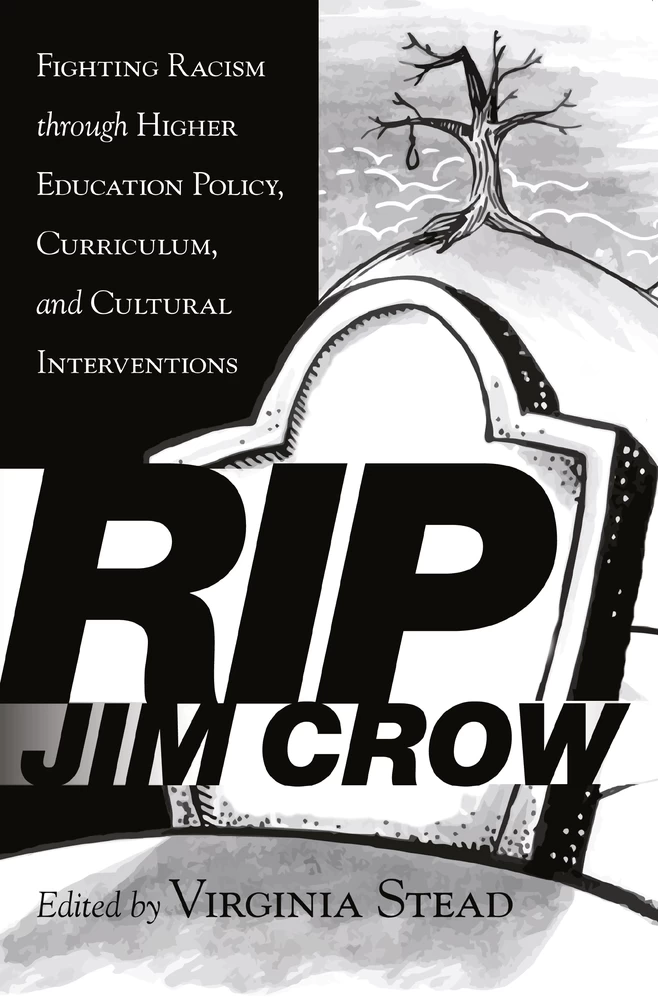
RIP Jim Crow
Fighting Racism through Higher Education Policy, Curriculum, and Cultural Interventions
Summary
This book shouts out ways that we can and must respond to the sickening accumulation of racially inspired and systemically sanctioned deaths. Today, we remember the passing of young, Black Michael Brown in Ferguson, Missouri. In responding to this event, we are determined to dismantle the alexithymia (indifference to the suffering of others) that pervades our campuses. It is nothing less than a by-product of racism protected by the illusion of democracy.
RIP Jim Crow contains three sections: (1) Antiracist Theory and Policy; (2) Antiracist Administration, Curriculum, and Pedagogy; and (3) Antiracist Cultural Interventions.
Each of the 31 chapters contributes to the normalization of anti-racist policy within academic institutions, antiracist discourse within academic cultures, and institutional praxis that upholds speaking out against racist activity. The hope is that this book will also reduce racism in the broader world through academic relationships with community partners.
Excerpt
Table Of Contents
- Cover
- Title
- Copyright
- About the Editor
- About the Book
- This eBook can be cited
- Table of Contents
- Acknowledgments
- Preface … and a Call to Action
- Section I: Fighting Racism Through Higher Education
- Chapter One: Disturbing the Comfortable: Antiracism as an Institutional Value in Higher Education
- Chapter Two: Who’s Afraid of the Black Male Scholar? A Voice from Within the Walls of Academia
- Chapter Three: Racial Profiling, Trayvon Martin, and Preservice Teachers: From Disengagement to Activism
- Chapter Four: An Indigenous Perspective: Ending “Jim Crow” Through Worldview Studies Across the Curriculum
- Chapter Five: Absence of Color: How Higher Education Preparation Programs Are Sustaining Racism
- Chapter Six: Muslim Perspectives on Racism and Equitable Practice in Canadian Universities
- Chapter Seven: “Basta Ya!” “Enough!” “Pa’lante!” A Lesson on Latinidad Struggle and Activism in the Academy
- Chapter Eight: Spiral Dynamic Theory as an Instrument for Praxis: Memetic Racism and Cultural Transfer
- Chapter Nine: Casualties in the Classroom: How Critical Race Theory Is Weaponized to Safeguard White Supremacy
- Chapter Ten: Reducing Systemic Racism: Movements Toward Change in Higher Education
- Section II: Fighting Racism Through Administrative Procedures, Curriculum, and Pedagogy
- Chapter Eleven: Toward a Kinder and Gentler Ivory Tower
- Chapter Twelve: Bridges of Accessibility: Signature Pedagogies in Graduate Education
- Chapter Thirteen: Leading Negotiation: Exploring the Experiences of Aboriginal Teacher Candidates in a Canadian Faculty of Education
- Chapter Fourteen: Antiracist Curriculum and Pedagogy: Teaching Critical Theory, Participatory Action Research, and Narrative Storytelling to Reduce Oppression
- Chapter Fifteen: There’s a Black Kid in the Classroom and I Don’t Want to Piss Him Off
- Chapter Sixteen: Transforming Whiteness in Teacher Education: The Call for Anti-Racist Pedagogy
- Chapter Seventeen: Hands Up, Don’t Shoot! Indicting Remedial Education
- Chapter Eighteen: Dangerous Black Professor: Challenging the Ghettoization of Race in Higher Education Through Life Texts Pedagogy
- Chapter Nineteen: Dissertation Advising and the Apartheid of Scholarship in Higher Education Leadership
- Chapter Twenty: Culturally Competent Faculty for the Future: Leading Forward in Addressing Racial Bias
- Section III: Fighting Racism Through Cultural Interventions
- Chapter Twenty-One: “I Can’t Breathe!” Learning to Respect and Respond to Subtle and Acute Distress Calls
- Chapter Twenty-Two: Internecine Warfare: White Privilege and American Indians in Colleges and Universities
- Chapter Twenty-Three: Evolutionary, Neuroscientific, and Social Psychological Perspectives on Antiracism and Antisexism
- Chapter Twenty-Four: Reconstruction of Enslaved Policy, Procedures, and Practice in Institutional, Political, Academic, and Social Spaces
- Chapter Twenty-Five: Black Learning Matters: Experiences of Exclusion and Lessons for Inclusion of Students of Color in Higher Education
- Chapter Twenty-Six: The Resurgence of Jim Crow in Education
- Chapter Twenty-Seven: When Riot Is Reason: How Higher Education Can Help Eradicate Institutional Racism
- Chapter Twenty-Eight: Blanking Out “[ ]” (Whiteness): Decolonizing Systems of Domination and Reinhabiting Ancestral Place-Cultures
- Chapter Twenty-Nine: Acceptable Forms of Violence in Academia and Ethnic Studies as Defenses Against Racial Inequity
- Chapter Thirty: Hiding in Plain Sight: Championing the Academy’s Responsibility to Expose Racism
- Chapter Thirty-One: Even the Dirt Is Dangerous: Racism in American Study Abroad Programs
- About the Contributors
- Index


This series, Equity in Higher Education Theory, Policy, and Praxis, has been made possible through the outstanding support of the Peter Lang Publishing Group’s North American managing director, Christopher S. Myers, and his highly professional team in the New York office. Special appreciation goes out to Patricia Mulrane Clayton (sales and marketing director), Bernadette (Bernie) Shade (director of production), Sophie Appel (design and production supervisor), and Stephen Mazur (editorial assistant).
This book, Volume 6, RIP Jim Crow: Fighting Racism Through Higher Education Policy, Curriculum, and Cultural Interventions, has been inspired by so many social justice leaders, many of whose names appear in the references at the end of each chapter.
Volume 1, International Perspectives on Higher Education Admission Policy: A Reader, was published in January 2015. Outstanding congratulations and heartfelt thanks are extended to its authors in light of the following decision: In July 2015 Chief Justice John G. Roberts, Jr., of the United States Supreme Court included this book as background reading material for the 2015–2016 “affirmative action” case 14–981 Fisher v. University of Texas at Austin, 758 F.3d 633. It’s good to know that our work is making a difference.
Most importantly, I wish to acknowledge the unwavering patience and support that my spouse, Robert Edward Stead, has so generously provided. His belief in both the value of the series and the importance of each new volume has steadied me through moments of exhaustion and uncertainty … and what joy it has been to celebrate together the arrival of each new book! ← xiii | xiv → ← xiv | xv →
How does one begin to introduce a text that challenges the horrors of racism in higher education? Many are the pauses and tears that these chapters have afforded me as they illuminate the intense cruelties of vestigial slavery. We need to confront every form of fundamentalism and polarization whether their sources be past or present, legislative or religious, or even academic custom. Let us follow in the footsteps of the likes of Abraham Lincoln, Martin Luther King, Jr., Rosa Parks, and Malala Yousafazi.
As members of the academy, we are privileged members of diverse heritages and contrasting cultures. Beware that this privilege is the foundation of enduring power, for as we interact with our colleagues and students, we constantly choose whether to fight racism or to let it continue unchecked in our professional communities.
Hidden forms of slavery are rampant within the academy, yet these gravely unjust influences can be overcome through new forms of social awareness and determination. It is impossible to underestimate the difficulty that accompanies the confrontation of such pervasive practices, for slavery and its aftermath are simply manifestations of inequity masquerading as academic freedom and democratic expression. Yet, if we each commit to ridding the academy of the racist scourge, we may succeed in creating a peaceful society in which all of us—our indigenous predecessors, those who were brought to our shores in the agonizing clutches of slavery, and those whose forebears immigrated to escape persecution and poverty—live within a culture of difference and mutual respect. Our work is urgent and foundational for generations to come. ← xv | xvi → ← xvi | 1 →
It was a protest about Black rights. It was a bigger scope of things. It wasn’t another Ferguson protest.
—MITCHELL (REPORTED BY A STUDENT AFTER THE “HOMECOMING BLACKOUT” DEMONSTRATION, 2014)
INTRODUCTION
The protests in reaction to the deaths of Trayvon Martin in Sanford, Florida, Michael Brown in Ferguson, Missouri, Tamir Rice in Cleveland, Ohio, and Eric Garner in Staten Island, New York have resonated in the hallowed halls of higher education. While not directly about campus events, these occurrences have stood as representative of long-standing racial issues that remain largely unaddressed in contemporary society, in an era many Americans would like to consider postracial. Students, staff, and faculty have responded in a variety of ways, expressing a range of reactions from outrage to solidarity to anxious avoidance. In perhaps a strange twist of irony, the activism on a number of campuses has not always been met with the support and acceptance of the institutional power structure, and has in some cases been inconsistent with mission statements of diversity and inclusiveness.
A telling example is the reaction at a southwest Missouri university where students staged a “Homecoming Blackout” demonstration. Students there chalked the campus sidewalks in various places in accordance with the campus policy. Brightly ← 3 | 4 → colored messages included captions that ranged from “Hands up, Don’t Shoot!” to “Black Lives Matter!” Nevertheless, administrators had messages power-washed from the sidewalks before the homecoming tailgate events and football game. Students, most wearing all black clothing and protesting by walking silently with their signs, were called racial epithets and were physically bumped and pushed, and at least one student was threatened by a man who said he would shoot [her] and held ‘his hand up like a gun’, saying, “Boom. Boom. Boom” (Mitchell, 2014). When confronted, administrators at the institution responded (a few days after the protest) that there had been a miscommunication and that the messages should not have been removed from the sidewalk. One student tweeted, “there are people against the Blackout because it’ll be ‘disruptive to homecoming.’” The student’s response was, “Yeah… that’s kinda the point.”
THE COMFORTABLE
Higher education in the United States has historically rooted itself in the pursuit of the “American Dream”—the idea that “life should be better and richer and fuller for everyone, with opportunity for each according to ability or achievement” (Adams, 1931, p. 214). Economic security and stability presumably would be ensured and enhanced by the achievement of a liberal education, notwithstanding the fact that at the time Adams penned these words, access to higher education was limited legally by race, financially by social class, and societally by gender. Bowen, Kurzweil, and Tobin (2005) tout that the central purpose of higher education “is to prepare talented young people to assume productive roles in their societies—to foster the creation of ‘human capital’” (p. 2). Additional purposes for higher education often include notions of educating leaders in our democracy, or some other civic engagement function (Kahlenberg, 2011), and advancing learning and knowledge in this “free marketplace of ideas,” a metaphor first developed by John Stuart Mill in 1859.
The democratic ideal that students will become productive citizen leaders in society by having been given opportunities for a broad-based education is a theme pervasive in educational literature (King, 1947; Roosevelt, 1930). The notions of the opportunities to pursue a good life, become civically engaged, and share in and learn from the marketplace of ideas are comfortably nestled in our democratic principles and educational institutions, and few would argue their value. Further, all of these ideals have historically been associated with a meritocracy—the notion that those who work for it will achieve, and those who achieve or succeed are the most deserving.
Uncomfortable though it may be, the unacknowledged backdrop during the early 19th-century establishment of many institutions of higher education in the United States was simply that women and minorities, constituting over half of the population, were ineligible to attend. Therefore, the examination of these supposed ← 4 | 5 → democratic ideals through the lens of Critical Race Theory is necessary to better understand how higher education has failed to deliver on the first and most basic promise of furthering the American Dream, and why structural analysis and reform will be necessary if racial disparities and the accompanying reactions from communities of color across this nation are to be redressed.
CRITICAL RACE THEORY
History
Conversations about race in the United States can be seen to follow an undulating pattern of attention, avoidance, and hostility, depending largely on the race of the speaker and the particular topic being discussed, but racial disparities persist in every area of contemporary society: generational wealth accumulation, lifespan, poverty, educational attainment, lending access, leadership, business opportunities, legal sentencing and imprisonment, and medical treatment (Kochhar, Fry, & Taylor, 2011; Shapiro, 2005; Wise, 2010). Many contemporary scholars and citizens are alarmed at the relative lack of significant change in the nation’s attitudes toward people of color, revealed in public and private dialogues responding to the most recent police actions in Staten Island, New York (Eric Garner), Ferguson, Missouri (Michael Brown), Cleveland, Ohio (Tamir Rice), and Oakland, California (Oscar Grant).
Pioneered in the mid 1970s by Derrick Bell, a New York University law professor, Critical Race Theory (CRT) involves scholars and activists who have dedicated their work to exploring the structural and systemic impact of race and racism. A decade after the Civil Rights Movement in the United States, legal scholars sought to explain the deterioration of apparent progress in the American ideal of justice being (color)blind. First appearing as a legal challenge to the incremental progress presumed in civil rights law, critical race scholars instead establish the pervasiveness of racism as embedded in the very foundation of legal and societal policies, practices, and social interpretations. Since its introduction, CRT has expanded to include other disciplines, including education, and has captured the attention of critical scholars and practitioners alike.
Key Concepts
Delgado and Stefancic (2001) propose general tenets of CRT based on the social (non-biological) construction of race that is part of the ordinary and familiar fabric of United States society. The authors explore additional concepts of pervasiveness, color-blindness, intersectionality, and the importance of valuing the voices of those ← 5 | 6 → with minority status. We will further explore several key concepts necessary to address the challenges of institutionalizing antiracism in higher education.
Pervasiveness of Racism
It is difficult to explain continued racial disparities 50 years after laws were established to prevent race-based discrimination, and 60 years since educational institutions were compelled to admit people of color (Brown v. Board of Education, 1954). The concept of “interest convergence” proposes that people believe what most potentially benefits them, and more particularly, that Whites will support antiracism only when it benefits them (Bell, 1979). Because large segments of society benefit from racism (historically, the country’s economy depended on virtually free slave labor), both Whites and those in the middle class “have little incentive to eradicate it” (Delgado & Stefancic, 2001, p. 7). Perhaps we have not recognized that
racism is lodged in the structure of society, that it permeates the workings of the economic, political, educational, and legal institutions of the United States. Without that recognition, however, we will be unable to resolve the pernicious problems of race that confront us as Americans. (Brown, Kurzweil, & Tobin, 2005, pp. 35–36)
The belief that racism is both ordinary and pervasive also challenges the common notion that the election of Barack Obama is sina qua non evidence that we are a postracial society.
Color-blind liberalism. Central to the writings of CRT scholars is a critique of objectivity, meritocracy, and color-blindness. This notion that we can see the individual beyond color or race persists across the political spectrum from conservative (seeing the individual, and accusing others of making the issue about race) to liberal (seeing each person on their individual merits and believing themselves to have transcended racial categories). Bonilla-Silva (2003) names this color-blind liberalism “a kinder, gentler White supremacy” (p. 272).
If color-blindness were possible or even desirable, we could conclude that a meritocracy is in place and that all who are in positions of leadership and power are deserving, and those who are not either are not qualified or simply have not worked hard enough—premises disputed by CRT. Colleges and universities often position themselves as bastions of liberalism in the sense of liberty and equality, professing the value of diversity and believing themselves to be societal leaders in creating race-neutral environments. However, given the persistent racialized achievement gap (Bauman, Bustillos, Bensimon, Brown, & Bartee, 2005), and faculty and administrative underrepresentation and challenges (Bass, 2012), particularly in predominantly White institutions (PWI) (Jackson, 2001), a critical analysis of color-blindness is needed. ← 6 | 7 →
Social Justice
CRT is more than an analysis of social and legal policies and practices; it is a call to action. CRT offers a framework from which to challenge the incremental changes often characterized by statements such as, “Things are better than they used to be,” or “I treat everyone the same. I don’t see color,” and Racism 2.0, “the newer, slicker, enlightened exceptionalism … which still holds the larger Black and Brown communities of our nation in low regard but is willing to carve out exceptions for those who make some Whites sufficiently comfortable” (Wise, 2009, p. 24). In order to call attention to systemic or embedded fuel to the fire of racism, we must first examine our systems critically, then take action to change them.
Ladson-Billings and Tate brought a critical race focus to education in 1995, offering the critique that our educational inequalities are the “logical and predictable results of a racialized society” (p. 47). The authors propose that the educational system has wrongfully sacrificed a critical analysis of racism for the more palatable and meaningless paradigm of multiculturalism while underscoring “the difficulty of maintaining the spirit and intent of justice for the oppressed while simultaneously permitting the hegemonic rules of the oppressor” (Ladson-Billings & Tate, 1995, p. 62). It is from this framework that we propose a critical review of our institutions of higher education and an institutionalization of antiracism as the only hope for meaningful change toward social justice and opportunity for all.
COMFORTABLE VALUES OF HIGHER EDUCATION
History and Traditional Roots
Under what circumstances do people systematically disengage or disqualify themselves from achievement academically? The answer is multiple: under racial discrimination manifested in the collective historical experience of Blacks in America since slavery, including decades of lynchings, the Tuskegee syphilis experiment, and dual school systems; under contemporary racist stereotypes and representations such as those delineated in The Bell Curve, or in the Senate’s former majority leader’s wistful yearning for the Dixiecrat Party’s segregationist agenda; under racially discriminatory treatment of people of color by the judicial system, the electoral system, the health care system, the labor market, the housing market, even the supermarket; and—not least—under the isolation of the chilly, White top academic tracks of most high schools and flagship university campuses, an isolation that signals the ‘‘otherness’’ of Blacks, Latinos, and Native Americans (Mickelson, 2003, p. 1076). ← 7 | 8 →
Institutional Structures Favor History
Institutional history is often the first source of pride for a college or university, and whether through famous alumni, school songs and colors, sports teams, or other accolades, institutions of higher education rest comfortably in their history. While clearly important to those who have been a part of the history, what is often left out of this his-story is who was left out of the instutution. Peggy McIntosh, in notes about her exploration of privilege, writes about being a Teaching Fellow at Harvard and initially feeling that she “did not know enough,” and then after twenty years, realizing that
those authors of the millions of books in Harvard’s Widener Library “did not know enough” either. For example, their books left out the female half of humankind, and excluded the knowledge of most people of color worldwide about their own cultures and their versions of history. (McIntosh, n.d.)
Many diverse groups and first-generation students have not grown up with stories of the history of “Old Whatever” and all of the generational history that family members and often administrators and families associate with it; many times, they were expressly left out of that history. The bonfire, the fight song and the mascot as well as other institutional symbols just do not convey the significance and the power for these students, faculty, and staff that they do for those who have been a part of it. In this way, there is a marked and often invisible disconnect. In the blind walk to keep traditions going, often, higher education simply continues with the expectation that new students should feel the same and embrace these symbols passionately when often they create barriers and hold painful reminders of an exclusionary past.
An interesting example of how this manifests comes from a midwestern state university whose school mascot is a bear. Students developed an online newspaper that they titled The Black Bear, sending the message that the school bear as represented in the school’s official newspaper does not speak for them, or that their voice was not clearly represented and they needed an additional mouthpiece.
We must learn to integrate the reality that the vestiges of the past and the traditions that are associated with them can hold negative memories, stereotypes, and other aspects of racism that many students want to forget rather than see celebrated at sporting events and other activities. The notion of homecoming is not the same for students who don’t feel like this is a home, or who may not regard the university or college in a completely positive way because of their (or their identity community’s) past experiences. For those who were part of the traditions, homecoming has an almost sacred and comfortable tradition such that anything that interrupts or disturbs it is often seen as questioning the very foundations of the institution itself—“Yeah, that’s the point” (Mitchell, 2014). ← 8 | 9 →
When we seek an honest assessment of the traditions of the institution we must examine the core of our values and traditions. For instance, a common tradition is to name buildings and residence halls for donors who achieve a certain threshold in their giving. It is not clear that we are concerned with how they obtained their wealth. But the clear message it sends is that to be honored, or to make this kind of contribution to the institution, you must have a certain financial status. How do we value those who contribute to society and have impact in many ways but cannot give financially to the university? What does this convey? And of course, for some donors it is not completely motivated by generosity to the alma mater but also for personal tax benefit, or for the prestige from name recognition.
The real opportunity is to look again at the traditions that represent and reinforce the history, and clearly understand what those stories convey to today’s student—this will require seeking and valuing the voices of people of color, who were not welcome on campuses at the genesis of many of these traditions. This is clearly uncomfortable for many, but it is precisely the necessary disturbing about which the authors are speaking. Diverse students and first-generation students may interpret their history at their alma maters differently than legacy students, and may not have experiences as positive as those traditional alumni first have had in the past. Accepting this uncomfortable truth allows us to create a new, inclusive paradigm.
Presumptions of Equality
Higher education institutions often promote themselves as being based in meritocracy, and as environments where diversity and inclusion are valued, even if there is strong evidence otherwise (Caplan & Ford, 2014). For many reasons associated with embedded racism (including systems of privilege, generational compounding of wealth or poverty, differential access, microaggressive campus climates and other patterns of exclusion), the experiences of students on our campuses differ by race. In one manifestation of this dilemma, Travis Reginal (2013), a first-generation Black man at Yale, explains how not knowing how to navigate the system and facing years of lowered expectations from teachers and counsellors hampered his initial success at the university, but never his drive. Conley (1999) adds the compounding element when he writes, “young African American men may have the opportunity to obtain the same education, income and wealth as Whites, in actuality, they are on a slippery slope, for the discrimination their parents faced in the housing and credit markets sets the stage for perpetual economic disadvantage” (p. 152). The challenges are to go beyond language of inclusion to more inclusive behaviors, policies, practices, and curriculum. Adding more inclusive language is important, but doesn’t automatically make the institution inclusive. One strategy is to ask the hard questions through campus climate focus groups, and provide tracking indicators through the disaggregation of various forms of data, as suggested by Williams (2013). White ← 9 | 10 → administrators often see disaggregation of data as creating a race problem rather than reflecting it, and may be reluctant to highlight the differential experiences of domestic diversity (Anderson, 2012; Caplan & Ford, 2014). This is rooted in the color-blind desire to see all as individuals and not to acknowledge the impact of race and racism.
Intergenerational Support
Often overlooked is the impact of accumulated wealth in individual families and in communities where either financial support or transmission of knowledge about scholarships or other resources is available. “Since wealth accumulation depends heavily on intergenerational support issues such as gifts, informal loans, and inheritances, net worth has the ability to pick up both the current dynamics of race and the legacy of past inequalities that may be obscured in simple measures of income, occupation, or education” (Conley, 1999, p. 6).
Presumed Guilt
As a reflection of implicit bias, stereotypes, and expectations, Black students, faculty, and staff are more likely to be presumed guilty until proven innocent (Staats, 2014), a theme that is repeated in incidents from the well-publicized account of Harvard professor Henry Louis Gates, arrested in 2009 on suspicion of breaking into a house that was his own home, to the more recent case of the Yale student approached with a drawn gun because “he matched the description of a suspect” on campus (Lauerman & Staiti, 2015). These events illustrate what Laymon (2013) explores in essay form about the profound differences in American life for Black and White children.
Protecting Our Image
A related issue is embedded in the belief in our homogeniety, which often makes revealing the truth more uncomfortable. In a widely publicized story (“Missouri State,” 2011) the Missouri State University Pride Band played the song “Dixie” at a dedication of Park Central Square in Springfield, Missouri. The town square is the site of a well-known lynching of three innocent Black men in 1906. The irony of this was not lost on the larger community, who complained to the university and discussed the inappropriate song choice combined with the sensitivity of the location. The interim president apologized to the community and encouraged diversity training for all of those involved. Still, there were those who felt it was unfortunate that it was an issue at all, and didn’t like the fact that this was in the media. ← 10 | 11 → Institutions often are more concerned about their images and possibly offending donors and alumni than about examining the institutional culture that would think it is acceptable to play “Dixie” in the year 2011. This can sometimes make raising issues a challenge because of the anticipated push-back. Administrators sometimes demonstrate the desire to maintain image at all costs.
Fear of Reprisal
For those within the institutional structure it is not always as simple as it sounds to critique the institution from within or share with those who are without. The culture of the university precedes the newcomers, and they very quickly learn the informal dos and don’ts if they want to be somewhat successful and have a career. Consistently for people of color it encompasses the ideology, don’t make waves, don’t create trouble. An additional pressure in systems of higher education is the risk of being branded a troublemaker, with the accompanying threat of not securing tenure. The message is never openly conveyed, but still clear that to be successful one must stick with the plan and not embarrass the university. Obviously, this makes change difficult, because to question the procedures is to fit the troublemaker stereotype and be dismissed. Wolfe and Freeman (2013) wrote, “stereotyping, prejudice, institutional and interpersonal discrimination goes ignored because these issues—if highlighted—are threatening to the dominant group” (p. 4). In other words, don’t disturb the comfortable.
HEGEMONY
Delgado and Stefancic (2001) define hegemony as “domination by the ruling class, and unconscious acceptance of that state of affairs” (p. 147). The presence of all- (or majority-) White administration is not questioned, and majority-White student populations are seen as merit-based. This contributes to an issue of image versus transparency. Universities protect historical (as in racist and exclusionary historical) images to please, or at least comfort, major donors and other (often invisible) stakeholders.
History of Diversity Efforts on Campus
As diversity efforts on campuses have progressed through legal phases (post–Brown v. Board of Education) to enrichment phases marked by multicultural resource centers, the challenge is to truly institutionalize diversity efforts, often through the position of a high-ranking officer reporting to the president (Williams, 2013; Williams & Clowney, 2007; Williams & Wade-Golden, 2013). The challenges inherent ← 11 | 12 → in the creation and maintenance of these positions are embedded in challenging the color-blind liberal attitudes described throughout this chapter (Anderson, 2012; Clark, Fasching-Varner, & Brimhall-Vargas, 2012), and in reversing stilted diversity frameworks often trivialized or reduced to a festival atmosphere.
Food, Fun, and Festivals
There are many examples of diversity efforts on campuses that are not being taken seriously, that are underfunded, and that are expected to deal with “all things diversity” including student success, support, professional development for staff and faculty, image management, and any crisis remotely related to diversity that occurs on campus or in the community. This by itself can be seen as a recipe for disaster, or at a minimum, less than successful organizational and program implementation. It also functions as a self-fulfilling defeat by isolating and overburdening programs without budgetary or system-wide support, so that diversity efforts are blamed for their own failures.
After many years of campus efforts at diversity, and higher education touting its improvement and commitment to diversity and inclusion, there is still much to be improved. Faculty still often give “extra credit” for going to diversity-related events, and have to explain to students why these types of activities are helpful for them as they progress through the university. Many in campus communities still think of the diversity agenda as the food, festival, and fun events that various ethnic groups conduct on campus, and fail to see it as much more—as embedded into the societal structure about which they remain dangerously uninformed. And yet, with underfunded budgets, overburdened agendas, and the absence of comprehensive efforts, diversity and inclusion units will necessarily fail.
DISTURBING THE COMFORTABLE BY INSTITUTIONALIZING ANTIRACISM
If stakeholders truly want to matriculate people of color from access to influence and power, they must first promote policies that advance equity. (Wolfe & Freeman, 2013, p. 6)
Using a critical race view of race means to see racism as ordinary—not isolated, but embedded and systemic in our society and in our institutions. It is precisely the persistence of comfortable practices established during more overtly racialized periods (of slavery and the Jim Crow era) and still evident throughout society that underscore the importance of a comprehensive approach to antiracism that is necessary. As racism is primarily a “problem of power” (Bonilla-Silva, 2006), ← 12 | 13 → institutional policies and practice are inherently racist in their underpinnings, and function currently in ways that are largely both invisible and unconscious, because they silence the voices of people of color.
Presenting a Model for Change
Campuses must create synergy within and across organizational systems through the alignment of structures, politics, curricular frameworks, faculty development policies, resources, symbols, and cultures. (Williams, Berger, & McClendon, 2005, p. 3)
The authors propose a model for institutionalizing antiracism in higher education, drawn from the Association of American Colleges and Universities’ Making Excellence Inclusive series (Bauman et al., 2005; Milem, Chang, & Antonio, 2005; Williams, Berger, & McClendon, 2005), and integrating the critical aspects of meaningful community relationships. No longer can universities sit in the comfortable ivory tower while our communities burn, but meaningful change toward embracing diversity will take years of conscious and deliberative efforts (Williams & Wade-Golden, 2013).
COMPREHENSIVE CHANGE ENGAGES THE COMMUNITY
We challenge higher education to expose the hidden systems of institutionalized racism and lead toward equity and empowerment. In order to effect substantive and comprehensive change toward more inclusive campuses, our recommendations necessarily span multiple areas.
Access and Success
We must take account of profound demographic changes—the “browning of America” as detailed by the College Board (2005), as well as the differential needs of Black and Brown students on college campuses, with a need to disaggregate data and revise policies and practices in response. Universities need to recognize the differences in the cultural transmission of options and possibilities to increase access to the hidden knowledge about navigating campus life. “In this way, campuses can close the “preparedness gaps” regarding pre-collegiate preparation, including limitations of resources (time and money), that impact the capacity to develop abilities and inclinations for success in higher education” (Bowen, Kurzweil, & Tobin, 2005, p. 251). ← 13 | 14 →
Details
- Pages
- XII, 462
- Publication Year
- 2016
- ISBN (Softcover)
- 9781433130687
- ISBN (PDF)
- 9781453915806
- ISBN (MOBI)
- 9781454189565
- ISBN (ePUB)
- 9781454189572
- ISBN (Hardcover)
- 9781433130694
- DOI
- 10.3726/978-1-4539-1580-6
- Language
- English
- Publication date
- 2015 (March)
- Keywords
- Alexithymia Antiracist theory Antirasist Administration Curriculum Pedagogy Indifference to the suffering of others
- Published
- New York, Bern, Berlin, Bruxelles, Frankfurt am Main, Oxford, Wien, 2016. XII, 462 pp.
- Product Safety
- Peter Lang Group AG
