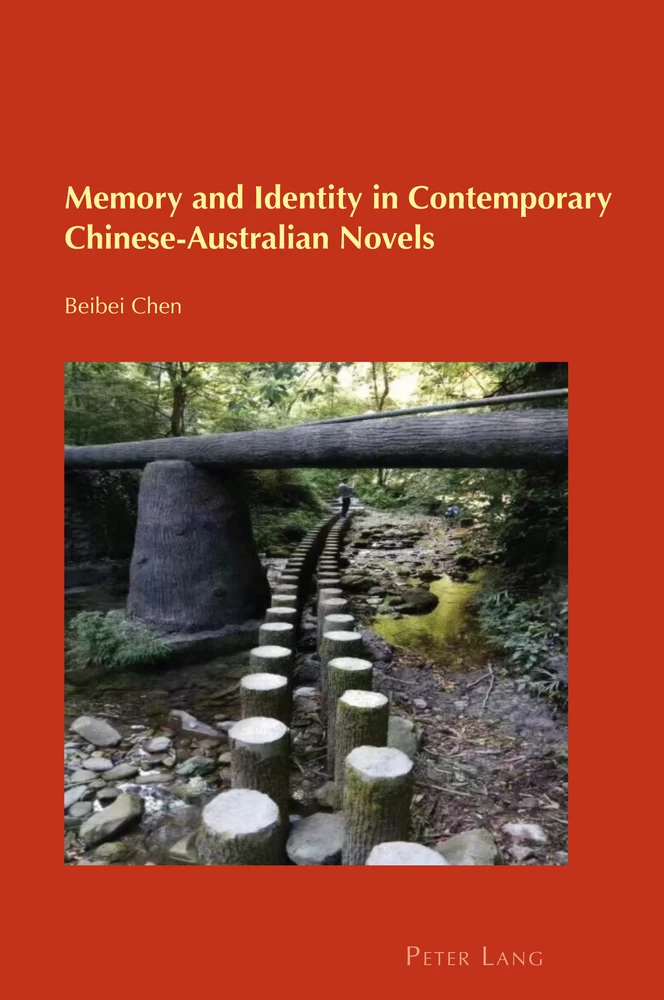
Memory and Identity in Contemporary Chinese-Australian Novels
Summary
(Professor Nicole Moore, UNSW Canberra)
«If memory is the broken mirror of history, diasporic memories are intricate mosaics of multitudinous pasts: personal, collective, national, cosmopolitan, cultural and political. Reading Chinese Australian literature as a mimesis of memory, Beibei Chen offers invaluable insights into the entanglement of past and present and its effect on diasporic identity.»
(Professor Wenche Ommundsen, University of Wollongong)
Inspired by the «transnational turn» in global literature, this book explores the significance of transnational memory and identity in Chinese-Australian literature by closely examining representations of these two concepts in selected texts. By attending to diverse forms of memory such as collective memory, individual memory, cosmopolitan memory and transgenerational memory, this book offers unique observations on how different types of memory exert influence on the formation of identity in Chinese diasporic writings and tackles the complexity of reading literary texts in light of theories of memory, sociological studies and psychological analysis.
Excerpt
Table Of Contents
- Cover
- Title
- Copyright
- About the author
- About the book
- This eBook can be cited
- Contents
- Introduction
- Chapter 1. Theories on Memory, Diaspora and Identity
- Chapter 2. Memory, Trauma and Identity in Lillian Ng's Silver Sister
- Chapter 3. “Cosmopolitan Memory” and Unstable Identity in Brian Castro's Shanghai Dancing
- Chapter 4. Language, Cultural Memory and Translated Identity in Ouyang Yu's The English Class
- Chapter 5. Political Memory, Amnesia and Identity in Lau Siew Mei's Playing Madame Mao
- Chapter 6. Transgenerational Memory and “Future Identity” in Hsu-Ming Teo's Behind the Moon
- Afterword
- Bibliography
- Index
- Series Index
Introduction
The development of cultural globalization has led to dramatic changes in the field of literary studies. Anglophone literature is no longer confined to “English literature produced by local writers” and has been transformed by the fluid identities of writers and the transnational works produced by them. Diasporic writers, a rapidly developing group in recent times, have attracted the attention of literary scholars and critics because of the distinctive way in which their writing represents diaspora, memory and identity. As a consequence of decolonization, migration and globalization, Anglophone literature is being challenged by a broader concept: transnational literature. Such literature may be written by migrants (those who speak English as a second language) who are connected to at least two countries, have experience of two cultures and write in English about their “double experience”. Chinese-Australian literature in English, as a newly emerging body of transnational literature, is now the subject of extensive scholarly discussions. Authors such as Brian Castro, Ouyang Yu and Tom Cho, for instance, are well-known writers of Chinese-Australian literary works.
Inspired by the “transnational turn” in global literature (Jay 10), this book examines representations of memory and identity in Chinese-Australian novels, especially those written in English and published between 1990 and 2010. This period saw the publication of the best examples of Chinese-Australian literary works, which have yet to be explored in an in-depth manner. In these novels, traumatic experiences in the homeland, confusion about the issue of belonging, and unforgettable memories are highlighted as key characteristics of Chinese-Australian literature. Memory and identity are of particular interest in Chinese-Australian literature not only because such literature is based on the authors’ consideration of their real or imagined pasts, but also because the issues of identity and belonging are closely associated with the concept of memory. By examining representations of diverse forms of memory in these novels, this book demonstrates ←1 | 2→the influence of memory on the formation or deconstruction of identity in a diasporic context.
In order to illustrate how memory and identity are represented in the selected novels, this book begins by defining Chinese-Australian literature as a newly emerging category. To start with, the definition of Asian-Australian literature needs to be clarified. Some critics, such as Deborah L. Madsen and Olivia Khoo, have attempted to define Asian-Australian literature. According to Madsen, “‘Asian Australian literature’ is difficult to define in strictly nationalistic terms, where ‘Australian literature’ is the controlling noun and ‘Asian’ functions as an adjective” (2007: 105). She treats “Asian-Australian literature” as “works written by Anglophone Asian Australian writers”. Madsen bases her definition on the speaking language of the writers, noting the linguistic elements, while Olivia Khoo focuses more on the cultural historical side. Compared to the field of Asian-American literature, Asian-Australian literature is still very new. As a literary category, Asian-Australian writing is slowly beginning to establish itself, although it remains far less institutionalized (both in publishing and in academia) than Asian-American literature. Khoo argues that the category “Asian-Australian literature” is still in a process of being defined. It both straddles and seeks to differentiate itself from the sometimes conflicting constellations of diasporic Asian literature and Australian literature. Nevertheless, there is a strong and ever-growing body of work and writing that we might call “Asian-Australian literature” (literature by or about Asian-Australians) in its own right.1 Wenche Ommundsen shares Khoo’s view that, although earlier Asian-Australian literary works have been discovered and recorded by the AustLit database, “as a category of writing, Asian-Australian writing did not emerge until the 1990s, and its currency within literary scholarship dates back not much more than a decade” (2012: 1). Asian-Australian literature is regarded as a similar category of literature to Asian-American literature, though significantly less research has been carried out on the former. In this book, Asian-Australian literature is defined as literature ←2 | 3→created by Asian-Australian writers of Asian descent, whether they are first-generation or Australian-born. Thus, Chinese-Australian literature is the literature produced by Australian writers of Chinese heritage. Many of the research questions raised in this book are discussed with reference to this definition.
To understand the development of Chinese-Australian literature in Australia, critics would first note the significance of the policy of multiculturalism. However, the policy of multiculturalism in Australia has given rise to both opportunities and challenges. Under the policy of multiculturalism, the Australian government claims to allow everyone in Australia to freely maintain the culture of their country of origin, to practise their own religion, to be employed with equal opportunities and to be treated equally. These policies have had a positive influence on the development of Asian-Australian literature, especially Chinese-Australian literature written in the English language. Many migrant writers, including Chinese-Australian writers, have seized the opportunity to label their writing as multicultural in order to obtain broader readerships. As an emerging minor literature, however, Chinese-Australian literature as a whole is still dwarfed by more mainstream White Australian literature.
In this complex cultural environment, Chinese-Australian literature written in both Chinese and English began to be produced in the host land. In comparison, Chinese-Australian literature in Chinese languages emerged when migrants came from China in the 1980s for the sake of education, along with Southeast Asian refugees and refugees from other backgrounds. The boom experienced by this kind of literature was the result of special economic and political factors. From the 1980s, Chinese students began to publish literary journals in Chinese languages, such as Otherland (原乡) and The Great World (大世界). Otherland, for instance, was established by Ouyang Yu, Ding Xiaoqi and Sun Haoliang in 1995. The first issue was published in 1996 under the editorship of Ouyang Yu. Otherland became a bilingual literary journal in 2000 and is still active today. It mainly publishes works by Chinese writers in Australia; works by Chinese writers from China are sometimes also published. The development of Chinese-Australian literature in Chinese languages is also supported by the Australian Chinese Writers’ Association branches in the different states of Australia. The first ←3 | 4→branch was established in 1992 in Melbourne and two more branches were founded in Sydney and Brisbane. These journals and literary associations are a testament to the boom in Chinese writing in Australia, a boom that encouraged more Chinese writers to write and have their work published.
In the 1990s, more and more Chinese students regarded Australia as their country of choice for studying overseas because of the promotion of English-taught courses by the Australian government and the development of international trade between China and Australia. Moreover, in around 1990, Chinese students sought to study overseas in the United States, the United Kingdom, Canada and Australia. This group of Chinese students needed an outlet to respond to the trauma and difficulty of settling into their new lives. This was the time when “Chinese-language newspapers in Sydney, Melbourne, and Brisbane, all with literary sections, increased significantly and at the same time began to develop national distribution outlets” (Lee 1998: 579).
The boom in Chinese-Australian literature in Chinese in Australia was stimulated by political events in China, while Chinese newspapers expanded in major Australian cities, which resulted in these works being exposed to a larger readership within the Chinese community in Australia and in China as well. According to Ommundsen, this category of writers – that is, writers who have lived or spent time in Australia, but write in Chinese – includes Sang Ye, Tian Di, Bi Xiyan, Liu Xirang, Shen Zhimin, Huang Yuye (Xin Shui, Laurence Wong), Da Lu, Xian Qianbo, etc. It should be noted that many of these writers are not regarded as “literary” enough to be the subjects of literary criticism (Ommundsen 2011: 86). Chinese-Australian literature in Chinese has not attracted a broad readership in Australia because of the dominance of English language and culture, the lack of accurate translations and the fact that it is not regarded as sufficiently interesting. In contrast, English-language works by Brian Castro, Ouyang Yu, Hsu-Ming Teo, Tom Cho and Beth Yahp have received attention. Thus, this book focuses on Chinese-Australian English-language literature. I have chosen to study Chinese-Australian writers like Brian Castro, Lillian Ng, Lau Siew Mei, Ouyang Yu and Hsu-Ming Teo because they write cross-boundary fiction in English, have received more attention in the field of Australian ←4 | 5→literature and are considered part of Australian literature and, more specifically, Asian-Australian literature.
Details
- Pages
- VI, 176
- Publication Year
- 2023
- ISBN (PDF)
- 9781789974393
- ISBN (ePUB)
- 9781789974409
- ISBN (MOBI)
- 9781789974416
- ISBN (Softcover)
- 9781789974386
- DOI
- 10.3726/b15698
- Language
- English
- Publication date
- 2023 (March)
- Keywords
- Memory Identity politics Chinese Australian novels Beibei Chen Memory and Identity in Contemporary Chinese Australian Novels
- Published
- Oxford, Bern, Berlin, Bruxelles, New York, Wien, 2023. VI, 176 pp.
- Product Safety
- Peter Lang Group AG
