results
-
-
Gender and the History of Institutions
The aim of this book series is to examine the history of institutions around the world through the lens of gender. Of interest are institutions established with the specific purpose of regulating gender and sexuality (e.g. the Magdalen asylums, Magdalen hospitals, penitentiaries, refuges, mother and baby institutions) as well as those with more general purposes where gender has had an important role in their operation and function (e.g. prisons, workhouses, lunatic asylums), including both religious and private organisations. The series supports the increasing interest in these institutions internationally, both in academia and in the treatment of ‘historical’ abuse. The series highlights the range of archives that can be considered in examining this history, not only in English-speaking countries but also in countries where the institutions described above have existed and determined the lives of many people. It will also broaden the conversation by widening the scope of institutions being considered. The series has as its main objective expanding the discussion of gender in reference to these lesser known institutions. At the same time, its purpose is to provide academia with a forum for discussion and a critical approach to the concepts of gender and institutions that attract both researchers and the general public. All projects undergo rigorous peer review before acceptance for publication.
0 publications
-
Institutionelle und Sozial-Ökonomie / Institutional and Socio-Economics
"In the "Institutional and Socio-Economics" book series, the economy is studied as a genuinely social system of heterogeneous agents in an institutional context. The series includes a broad range of different methodological approaches, theoretical perspectives and subjects of study. Interdependencies among agents in complex social systems can be studied using evolutionary economic models, as well as institutional economic and simulation studies. Hence, the focus is being laid on approaches that are more explorative than the standard equilibrium analysis; on approaches that allow for complexity; on approaches that consider development, history, institutions, and values. Thus, we may conclude that institutions are more than just devices for the reduction of transaction costs. From an institutionalist perspective, institutions are the common and collective solutions to social decision problems, particularly social dilemma problems, coordination problems, and collective-good problems. Such solutions require recognized interdependence and learned coordination and cooperation, thus a learned culture of a long-run perspective emerging as the result of a process of interactions. Institutions often are transitory only, part of the ongoing dynamics, adequately modeled possibly as an evolutionary process. Also, they may be instrumental solutions to a social decision problem at first and may degenerate into ceremonial power-and-status-based phenomena later, thus limiting the possibility of further innovation and development. In a genealogy of economics, the thematic and methodological spectrum of this book series would embrace the history of thought beginning with the classics including great names such as Adam Smith and Karl Marx but also the late classics who already have struggled with issues like complexity, process, historical time, and evolution. In newer times, the spectrum continues with Veblenian, Keynesian, and Post-Keynesian thinking; it would also include works in the traditions of original institutionalist economics, ecological economics, Neo-Schumpeterian thinking, evolutionary economics, and game theory. Social economics and social policy analysis, behavioral economics, complex modeling, system dynamics, and agent-based computational economics would be embraced as well. Such lists, however, can never be exhaustive. Last not least, institutional and socio-economics deals with the epistemology and substance of values, norms and ethics, value warrants of economic behavior as well as the normative foundations of economics. This series, thus, stands in the best traditions of plural economic research areas and pluralistic theoretical perspectives. It may be called heterodox, but it shall always be cutting-edge and of high quality. Enjoy exploring the works of this book series. The Editors: Wolfram Elsner Editor-in-Chief University of Bremen Torsten Heinrich Managing Editor University of Bremen Wilfred Dolfsma Co-Editor University of Groningen Arne Heise Co-Editor University of Hamburg Helge Peukert Co-Editor University of Erfurt Werner Schönig Co-Editor Catholic University of Applied Sciences Cologne Homepage der Herausgeber: Prof. Dr. Wolfram Elsner (Editor-in-Chief) Dr. rer. pol. Torsten Heinrich (Managing Editor) " "In the "Institutional and Socio-Economics" book series, the economy is studied as a genuinely social system of heterogeneous agents in an institutional context. The series includes a broad range of different methodological approaches, theoretical perspectives and subjects of study. Interdependencies among agents in complex social systems can be studied using evolutionary economic models, as well as institutional economic and simulation studies. Hence, the focus is being laid on approaches that are more explorative than the standard equilibrium analysis; on approaches that allow for complexity; on approaches that consider development, history, institutions, and values. Thus, we may conclude that institutions are more than just devices for the reduction of transaction costs. From an institutionalist perspective, institutions are the common and collective solutions to social decision problems, particularly social dilemma problems, coordination problems, and collective-good problems. Such solutions require recognized interdependence and learned coordination and cooperation, thus a learned culture of a long-run perspective emerging as the result of a process of interactions. Institutions often are transitory only, part of the ongoing dynamics, adequately modeled possibly as an evolutionary process. Also, they may be instrumental solutions to a social decision problem at first and may degenerate into ceremonial power-and-status-based phenomena later, thus limiting the possibility of further innovation and development. In a genealogy of economics, the thematic and methodological spectrum of this book series would embrace the history of thought beginning with the classics including great names such as Adam Smith and Karl Marx but also the late classics who already have struggled with issues like complexity, process, historical time, and evolution. In newer times, the spectrum continues with Veblenian, Keynesian, and Post-Keynesian thinking; it would also include works in the traditions of original institutionalist economics, ecological economics, Neo-Schumpeterian thinking, evolutionary economics, and game theory. Social economics and social policy analysis, behavioral economics, complex modeling, system dynamics, and agent-based computational economics would be embraced as well. Such lists, however, can never be exhaustive. Last not least, institutional and socio-economics deals with the epistemology and substance of values, norms and ethics, value warrants of economic behavior as well as the normative foundations of economics. This series, thus, stands in the best traditions of plural economic research areas and pluralistic theoretical perspectives. It may be called heterodox, but it shall always be cutting-edge and of high quality. Enjoy exploring the works of this book series. May 2012 The Editors: Wolfram Elsner Editor-in-Chief University of Bremen Torsten Heinrich Managing Editor University of Bremen Wilfred Dolfsma Co-Editor University of Groningen Arne Heise Co-Editor University of Hamburg Helge Peukert Co-Editor University of Erfurt Werner Schönig Co-Editor Catholic University of Applied Sciences Cologne Homepage der Herausgeber: Prof. Dr. Wolfram Elsner (Editor-in-Chief) Dr. rer. pol. Torsten Heinrich (Managing Editor) " "In the "Institutional and Socio-Economics" book series, the economy is studied as a genuinely social system of heterogeneous agents in an institutional context. The series includes a broad range of different methodological approaches, theoretical perspectives and subjects of study. Interdependencies among agents in complex social systems can be studied using evolutionary economic models, as well as institutional economic and simulation studies. Hence, the focus is being laid on approaches that are more explorative than the standard equilibrium analysis; on approaches that allow for complexity; on approaches that consider development, history, institutions, and values. Thus, we may conclude that institutions are more than just devices for the reduction of transaction costs. From an institutionalist perspective, institutions are the common and collective solutions to social decision problems, particularly social dilemma problems, coordination problems, and collective-good problems. Such solutions require recognized interdependence and learned coordination and cooperation, thus a learned culture of a long-run perspective emerging as the result of a process of interactions. Institutions often are transitory only, part of the ongoing dynamics, adequately modeled possibly as an evolutionary process. Also, they may be instrumental solutions to a social decision problem at first and may degenerate into ceremonial power-and-status-based phenomena later, thus limiting the possibility of further innovation and development. In a genealogy of economics, the thematic and methodological spectrum of this book series would embrace the history of thought beginning with the classics including great names such as Adam Smith and Karl Marx but also the late classics who already have struggled with issues like complexity, process, historical time, and evolution. In newer times, the spectrum continues with Veblenian, Keynesian, and Post-Keynesian thinking; it would also include works in the traditions of original institutionalist economics, ecological economics, Neo-Schumpeterian thinking, evolutionary economics, and game theory. Social economics and social policy analysis, behavioral economics, complex modeling, system dynamics, and agent-based computational economics would be embraced as well. Such lists, however, can never be exhaustive. Last not least, institutional and socio-economics deals with the epistemology and substance of values, norms and ethics, value warrants of economic behavior as well as the normative foundations of economics. This series, thus, stands in the best traditions of plural economic research areas and pluralistic theoretical perspectives. It may be called heterodox, but it shall always be cutting-edge and of high quality. Enjoy exploring the works of this book series. The Editors: Wolfram Elsner Editor-in-Chief University of Bremen Torsten Heinrich Managing Editor University of Bremen Wilfred Dolfsma Co-Editor University of Groningen Arne Heise Co-Editor University of Hamburg Helge Peukert Co-Editor University of Erfurt Werner Schönig Co-Editor Catholic University of Applied Sciences Cologne Homepage der Herausgeber: Prof. Dr. Wolfram Elsner (Editor-in-Chief) Dr. rer. pol. Torsten Heinrich (Managing Editor) "
11 publications
-
-
-

The Constitution and the Nation
The Civil War and American Constitutionalism, 1830-1890©2003 Textbook -
-
-
-
German trade tax and constitution
Constitutional Problems arising from the differing Treatment of mixed Activities of Partnerships and Sole Proprietorships©2007 Monographs -

The German Constitution Turns 60
Basic Law and Commonwealth Constitution- German and Australian Perspectives©2011 Conference proceedings -

Law, Politics, and the Constitution
New Perspectives from Legal and Political Theory©2014 Edited Collection -

Green Constitutionalism
An Anti-capitalist Legal Framework to Tackle Climate Change©2026 Monographs -
The Preamble and Mission of the Constitution
©2019 Monographs -
Constitutional Courts in Post-Soviet States
Between the Model of a State of Law and Its Local Application©2019 Edited Collection -

The Dialogue of Constitutional Judges
Monographs -
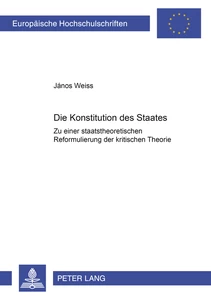
Die Konstitution des Staates
Zu einer staatstheoretischen Reformulierung der kritischen Theorie©2006 Postdoctoral Thesis -
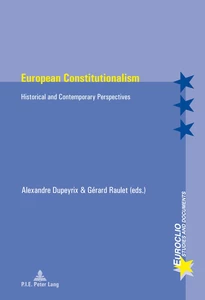
-
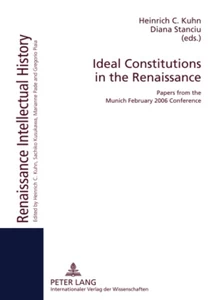
Ideal Constitutions in the Renaissance
Papers from the Munich February 2006 Conference©2009 Edited Collection -
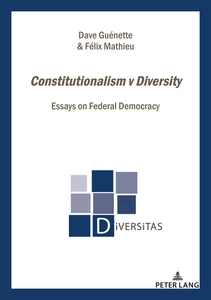
-
Die Konstitution der sozialen Welt
Zur Erkenntniskritik der Sozial- und Kulturwissenschaften©2003 Thesis -

Natural Law, Constitutionalism, Reason of State, and War
Counter-Reformation Spanish Political Thought, Volume I©2005 Monographs -
Constitutional Consciousness
In Search of a Remedy for the Crisis of Discourse and Democracy Deficit in the European Union©2023 Edited Collection -

The Constitution and the American Presidency
©2021 Monographs -