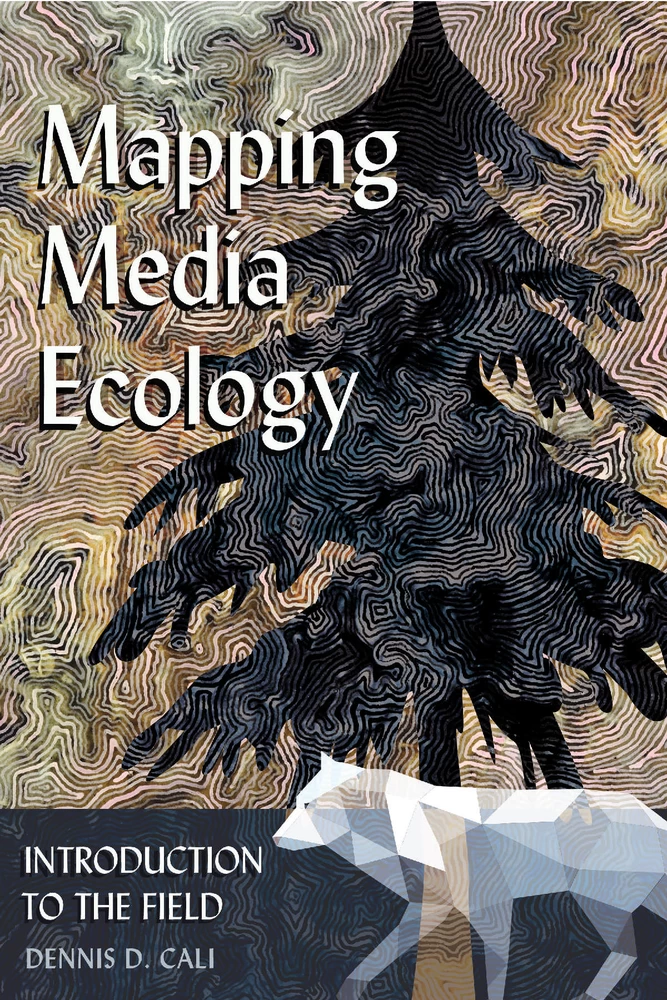
Mapping Media Ecology
Introduction to the Field
Summary
Offering an accessible introduction, and written from the perspective of a «second generation» scholar, this single-authored work provides a unified, systematic framework for the study of media ecology. It identifies the key themes, processes, and figures in media ecology that have coalesced over the last few decades and presents an elegant schema with which to engage future exploration of the role of media in shaping culture and consciousness.
Dennis D. Cali offers a survey of a field as consequential as it is fascinating. Designed to be used primarily in media and communication courses, the book’s goal is to hone insight into the role of media in society and to extend the understanding of the themes, processes, and interactions of media ecology to an ever-broader intellectual community.
Excerpt
Table Of Contents
- Cover
- Title
- Copyright
- About the author
- About the book
- Advance praise for Mapping Media Ecology
- This eBook can be cited
- Contents
- Foreword
- Preface
- Section One: Foundational Questions
- Chapter 1. What Is Media Ecology?
- Media Ecology as Metaphor
- Media Ecology as Theory Group
- Media Ecology as Bibliography (Great Books)
- Media Ecology as the Study of Media as Environments
- Media Ecology as Discipline
- Media Ecology as Metameme
- Media Ecology as Perspective
- Chapter 2. What Are the Primary Themes of Media Ecology?
- Consciousness
- Technology
- Change
- Balance
- Environment
- Culture
- Interconnectedness
- Chapter 3. What Are the Margins of Media Ecology?
- The Philosophy of Technology
- Computer-Mediated Communication
- Medium Theory
- Mediatization
- Section Two: Canonical Figures
- Chapter 4. Marshall McLuhan—Canada’s and the Field’s Intellectual Comet
- Religious Influence
- Mentors’, Colleagues’, and Students’ Influence
- Scholarly Contributions
- Heuristics
- Chapter 5. Walter J. Ong: Voice of Consciousness in Orality-Literacy
- Geographic Influence
- Jesuit Influence
- Scholarly Contributions
- Dialogic Orientation
- Heuristics
- Chapter 6. Jacques Ellul: Prophet of La Technique
- Influences
- Scholarly Contributions
- Heuristics
- Section Three: Orality-Literacy Studies
- Chapter 7. Orality-Literacy Studies
- Eric Havelock: Hound of the Homeric State of Mind
- Jack Goody: Domesticator of the Savage Mind
- Elizabeth Eisenstein: Historian of the Printing Press
- Section Four: Technology Studies
- Chapter 8. Technology Studies
- Neil Postman: “Postman” of a Field and of a Moral Message
- Lewis Mumford: Postindustrial Prophet and Field Forerunner
- Albert Borgmann: Detective of Device Design and Philosopher of Focal Practices
- Section Five: Culture Studies
- Chapter 9. Culture Studies
- James Carey: Restoring Conversation and Ritual in Communication
- Edmund Snow Carpenter: “Phantom” of the Field
- Camille Paglia: Fiery Phenom and Culture Critic
- Section Six: Bias Studies
- Chapter 10. Bias Studies
- Harold Adams Innis: Herald of Communication Studies
- Daniel Joseph Boorstin: Surveyor of Pseudo-Reality
- Jean Baudrillard: Hyper-Intellectual of the Hyperreal
- Section Seven: Language Studies
- Chapter 11. Language Studies
- Alfred Korzybski: Mapping Semantic Environments
- Susanne Langer: Finding a New Key to Symbolic Transformation
- Benjamin Lee Whorf: Relating Language to Culture and Cognition
- Section Eight: “Doing” Media Ecology
- Chapter 12. Doing Media Ecology
- Multiple Approaches
- A Roadmap for Doing Media Ecology
- Springboards for Media Ecological Study
- Index
- Series index
Library of Congress Cataloging-in-Publication Data
Names: Cali, Dennis D., author.
Title: Mapping media ecology: introduction to the field / Dennis D. Cali.
Description: New York: Peter Lang, 2017.
Series: Understanding media ecology; Vol. 4 | ISSN 2374-7676
Includes bibliographical references and index.
Identifiers: LCCN 2016043868| ISBN 978-1-4331-2763-2 (paperback: alk. paper)
ISBN 978-1-4539-1871-5 (ebook pdf) | ISBN 978-1-4331-3782-2 (epub)
ISBN 978-1-4331-3783-9 (mobi)
Subjects: LCSH: Mass media—Philosophy. | Mass media and language.
Classification: LCC P90 .C25 2017 | DDC 302.2301—dc23
LC record available at https://lccn.loc.gov/2016043868
DOI: 10.3726/978-1-4539-1871-5
Bibliographic information published by Die Deutsche Nationalbibliothek.
Die Deutsche Nationalbibliothek lists this publication in the “Deutsche Nationalbibliografie”; detailed bibliographic data are available on the Internet at http://dnb.d-nb.de/.
© 2017 Peter Lang Publishing, Inc., New York
29 Broadway, 18th floor, New York, NY 10006
www.peterlang.com
All rights reserved.
Reprint or reproduction, even partially, in all forms such as microfilm,
xerography, microfiche, microcard, and offset strictly prohibited.
This eBook can be cited
This edition of the eBook can be cited. To enable this we have marked the start and end of a page. In cases where a word straddles a page break, the marker is placed inside the word at exactly the same position as in the physical book. This means that occasionally a word might be bifurcated by this marker.
The publication of Professor Dennis Cali’s Mapping Media Ecology is a noteworthy development in communication, for a number of good reasons. To begin with, it is a rich and extremely well-written introduction to a fascinating subject in the study of media and culture. Media ecology—as an intellectual tradition in understanding the symbiotic relationships among culture, communication, and technology—evolved into being from a multitude of academic disciplines since the beginning of the ecological movement in the 1800s. Whereas most existing research in the discipline has tended to focus on studying the roles and impacts of communication media as they pertain to content, representation, economics or ownership, and the like, media ecology is a theoretical perspective on understanding media as physical, sensorial, perceptual, and symbolic environments or structures within which people’s sense-making experience manifests itself through and in communication. That is, it seeks to shed light on how changes in communication technology may facilitate social and cultural changes, and vice versa. Some of the most notable seminal figures in media ecology include Lewis Mumford, Eric Havelock, Harold Innis, Walter Ong, Jacques Ellul, Marshall McLuhan, Elizabeth Eisenstein, James W. Carey, and Neil Postman, to name just a few. ← ix | x →
But media ecology has also been a relatively new theoretical perspective in the communication discipline even as its intellectual roots germinated as early as in the late nineteenth century. The term made its formal debut in an address by Postman to the 1968 annual meeting of the National Council of Teachers of English. In fact, the term media ecology was largely unheard of through the mid-1990s in mainstream communication publications, including the like of Journal of Communication. However, a resurgence since the late 1990s of interests in McLuhan’s writings and a number of other developments had helped promote media ecology scholarship since.
The gradual rise of media ecology as a theory group in the past twenty years has been the result of ongoing contributions in teaching and research by a loose network of like-minded colleagues from multiple disciplinary as well as institutional backgrounds, namely, those associating themselves with the Toronto School, so-called in part due to its deep-seeded intellectual heritage tied to the work by the like of Edmund Carpenter, Eric Havelock, Harold Innis, and McLuhan at the University of Toronto; scholars from the research tradition set forth at St. Louis University, the home base of Ong, one of media ecology’s paradigm thinkers; graduates from the doctoral program at NYU under Postman or “the New York school,” a number of whom found their academic home at institutions in the New York Metropolitan Region and elsewhere; and so on.
A number of what can be considered significant events in this regard are noteworthy in the ongoing development or institutionalization of media ecology as a field of study: the 1998 founding of the Media Ecology Association (MEA) in New York City by five graduates from the doctoral program at NYU mentioned above, the 2000 inception of MEA’s first annual convention at Fordham University, the 2002 launching of MEA’s official quarterly journal, Explorations in Media Ecology (EME), as well as Lance Strate’s book series with a focus on publishing books with an explicit media ecology theme first at Hampton Press and at this writing at Peter Lang.
Details
- Pages
- XXIV, 258
- ISBN (Softcover)
- 9781433127632
- ISBN (ePUB)
- 9781433137822
- ISBN (MOBI)
- 9781433137839
- ISBN (PDF)
- 9781453918715
- DOI
- 10.3726/978-1-4539-1871-5
- Language
- English
- Publication date
- 2017 (August)
- Keywords
- Media Ecology Media and Society Media and Culture Marshall McLuhan Walter Ong Jacque Ellul
- Published
- New York, Bern, Berlin, Bruxelles, Frankfurt am Main, Oxford, Wien, 2016. XXIV, 258 pp.
- Product Safety
- Peter Lang Group AG
