Here's Looking at You
Hollywood, Film and Politics, Fourth Edition
Summary
The book contradicts the film industry’s assertion that it produces nothing but entertainment. While it is true that the vast majority of Hollywood films are strictly commercial ventures, hundreds of movies—from Birth of a Nation to The Help, recreated stories like Argo and Zero Dark Thirty and historical pieces such as Lincoln and The Conspirator—contain political messages, both overt and covert.
This new edition begins with President Obama’s re-election and includes new photos and statistical data, three new chapters and eight case studies that provide in-depth analysis of special films that are certain to challenge existing views and stimulate classroom discussion. Here’s Looking at You serves as a basic text for courses in film and politics and as a supplement in American government and film studies courses. Film buffs and general readers will also find it of interest.
Excerpt
Table Of Contents
- Cover
- Title
- Copyright
- About the author(s)/editor(s)
- About the book
- This eBook can be cited
- Contents
- List of Illustrations
- List of Tables
- Preface
- Acknowledgments
- Prologue. President Obama Returns to the White House
- Chapter 1. Film and Politics: The Hollywood-Washington Connection
- Chapter 2. In Search of the Political Film
- Chapter 3. Nonfiction Film: Picturing Reality?
- Chapter 4. Kiss, Kiss, Bang, Bang: Hollywood, Sex and Violence
- Chapter 5. HUAC and the Blacklist: The Red Scare Comes To Hollywood
- Chapter 6. Real to Reel Politicians: Idealists, Saviors and Scoundrels
- Chapter 7. Picturing Justice: The Law and Lawyers in Hollywood Films
- Chapter 8. Hollywood Goes To War: From the Great War to the Good War to the Forgotten War
- Chapter 9. Remembering Vietnam on Film: Lessons Learned and Forgotten
- Chapter 10. Mission Accomplished? Hollywood and the Afghanistan-Iraq War Films
- Chapter 11. Hollywood Confronts Nuclear War and Global Terrorism
- Chapter 12. Hollywood, Race and Obama: Feel-Good Racism
- Chapter 13. Hollywood and Women: Cracks in the Celluloid Ceiling
- Chapter 14. Epilogue: Is There a Future for Political Films in Hollywood?
- Notes
- Selected Bibliography
- Selected Filmography
- Index

Permission to include movie stills and to reprint cartoons is acknowledged.
0.1. Obama’s Election Victory: The White, Black, Brown, Yellow and Red House, election cartoon, 2012. Reprinted with permission, Clay Bennett Editorial Cartoon, the Washington Post Writers Group and the Cartoonist Group
2.1. The Roosevelt Clan at Hyde Park, Hyde Park on Hudson, 2012.
Reprinted with permission, Focus Features/Photofest
4.1. BULLY Poster: 2011.
Reprinted with permission, The Weinstein Company/Photofest
6.1. A Pensive Lincoln in Steven Spielberg’s Film, Lincoln, 2012.
Reprinted with permission, Walt Disney Studios Motion Pictures/Photofest
8.1. Korean War Memorial, Olympia, Washington, 2009.
Reprinted with permission, David Giglio
9.1. Vietnam Wall Memorial, Washington, D.C., 1985.
Reprinted with permission, Michael Roskin
10.1. The Hunt for Osama bin Laden in Zero Dark Thirty, 2012.
Reprinted with permission, Columbia Pictures/Photofest
11.1. Unthinkable, 2010.
Reprinted with permission, Sidney Kimmel Entertainment/Photofest
12.1. The Help, 2011. Maid Octavia Spencer Delivering Her Special Pie to Her Ex-Employer.
Reprinted with permission, Walt Disney Studios Motion Pictures/Photofest
13.1. Recreating the Judith Miller-Valerie Plame Affair in Nothing But the Truth, 2008.
Reprinted with permission, Yari Film Group/Photofest
0.1. 2012 Presidential Election Profile
4.1. CARA’s Ratings Assigned to Films, 2000–11
4.2. CARA Ratings and Catholic Church Classifications
7.1. Women in the Judiciary
7.2. Law School Enrollment
13.1. Suggestions and Action Plans
14.1. Major Studio Market Share
14.2. Comparison Box Office for Pirates of the Caribbean Franchise
Many people and institutions assisted in the process of researching and writing four editions of this book. I can only cite a few here.
Reference librarians from the Library of Congress, the University of Wisconsin Film & TV Archives and the UW State Historical Society, the British Film Institute, and librarians at Lycoming, Yavapai and Prescott Colleges all contributed their time and knowledge.
A number of colleagues provided suggestions, comments and feedback from students, including: Jack Schrems, Ron Briley, John Williams, Richard Ostrom, Kevan Yenerall, Barbara Allen, Christa Slaton, David Whiteman, Jay Parker, Jeffrey Sadow, Michael Haas and Thomas Powell. Hollywood also lent a hand: assistance came from Richard Heffner, former head of CARA and Joan Graves, CARA’s current head.
I must recognize those who were especially helpful on the fourth edition. First is the encouragement I received from Mary Savigar, Senior Acquisitions Editor, Media and Communications Studies at Peter Lang, who supported another edition of Here’s Looking at You: Hollywood, Film & Politics. Second, a word of gratitude is due my daughter Elisabeth and her husband Nick, a freelance sound editor for the movies, who gave me “the best room in the house” in which to write while I was teaching at Dutchess Community College. Finally, I am indebted to my assistant, Loryn Isaacs, a Prescott College graduate, who collected and updated the statistics and provided editorial review. Without his contribution, the fourth edition would have remained in draft form.
Finally, to all my colleagues who have used Here’s Looking at You and all the students who have read the book at some point during the past decade, as well as film aficionados, I appreciated your positive comments.
Prescott, AZ & Staatsburg, NY
President Obama Returns to the White House
President Obama was in the second year of his first term when the third edition of this book went to press, much too early for even a preliminary assessment. This edition continues from where the third ended in early 2010 and traces domestic developments and foreign events into the first year of the president’s second term.
In 2008, Democratic presidential candidate Barack Obama appeared to the American public as the patron saint of liberal causes: inclusive and affordable healthcare, green energy policy, regulation of Wall Street and the banking sector and a reasonable immigration policy. No wonder his victory reminded film buffs of Jimmy Stewart’s Boy Ranger idealism and his inspiring rhetoric in the Hollywood film Mr. Smith Goes to Washington or the promise of John F. Kennedy’s New Frontier in the 1960s. Obama’s rise to power couldn’t have been more of a blockbuster if Hollywood had written the script itself. But the reality of his first term was quite different, with the president spending much of his time deadlocked with the Republican-controlled House of Representatives as he sought to implement his campaign promises. He did manage to secure several stimulus packages to help failing banks, revitalize the American auto industry, and push through the Affordable Care Act to reform the nation’s health care system. However, ObamaCare, as the healthcare law came to be called, would prove to be an expensive achievement in terms of the president’s prestige and political capital.
The Two-Year Campaign
Not having to worry about renomination in 2012, the president and vice president, Joe Biden, became spectators to an almost two-year Republican Party primary that saw the Republican candidates engage in campaign rhetoric that eventually eliminated one another. What must the rest of the world think of these American national elections that cost an obscene amount of money yet change the political dynamics very little? American elections are more like ← xvii | xviii → running a marathon than standing for public office. This was readily seen in the Republican primary, where there were many candidates seeking to challenge the president in 2012.
As the selection process began, seven men and one woman sought the Republican presidential nomination and were duly dubbed “Snow White and the Seven Dwarfs” by the media. They included Michele Bachman as Snow White and Mitt Romney, Newt Gingrich, Rick Santorum, Ron Paul, Herman Cain, Rick Perry, and Jon Huntsman as the Seven Dwarfs.1 As the months rolled by, the candidates, one by one, dropped out of the race for a variety of reasons: lack of financial support, personal problems, and, in one case, accusations of improper sexual behavior. It was not until May of 2012 that Governor Romney had the candidates’ field to himself wherein he selected Representative Paul Ryan of Wisconsin, a neoconservative, as his vice presidential running mate.
The Republican Presidential Convention met in Tampa, Florida, to formally approve the nomination of Governor Romney as its standard bearer. The highlight of the convention was not the candidate himself nor his wife nor even Ryan. Much to the surprise of the convention delegates and the millions of television viewers, the guest appearance of actor-director Clint Eastwood kept the media humming for days. Eastwood, a conservative Republican and former Mayor of Carmel, California, came to the podium and spent 15 minutes or so talking to an empty chair as if it were occupied by President Obama. The convention crowd was mystified as Eastwood rambled on and they contemplated whether to laugh, clap, or just sit silently. Afterwards, the late-night talk show hosts, cartoonists, and memes had a field day with Eastwood’s performance. Although highly respected by his film colleagues for his craft, Eastwood should have known better than to try and duplicate the performance of Jimmy Stewart as the alcoholic Elwood P. Dowd talking to an invisible rabbit in the 1950 film comedy Harvey.
By contrast, the Democratic Convention in Charlotte, North Carolina, was a less showy affair, though highlighted with dramatic and passionate speeches by Vice President Biden and Massachusetts Governor Deval Patrick. If the Hollywood crowd was present, it remained in its seats. Both Ann Romney and Michelle Obama, at their respective conventions, gave speeches that were tributes to their husbands. But it was the performance of former President Bill Clinton that electrified the crowd with a stinging attack on Republican obstructionism. He made Eastwood’s performance appear amateurish.
Four television debates were scheduled during October, with three involving the presidential candidates and one the vice presidential candidates. By consensus, the pundits agreed that Romney had won the first debate on domestic affairs. He appeared refreshed, confident, and ready for the challenge. In contrast, the president seemed tired and distracted. Speculators saw Obama as being ill like Nixon in the first Kennedy-Nixon 1960 televised debate. The president recovered in the second and third debates, however, by becoming aggressive. Romney held his ground but Obama out-jabbed him.
The vice presidential debate pitted Biden, a veteran politician, against Paul Ryan, a younger, less experienced foe. Biden’s objective appeared to be to unnerve his challenger by bullying the young representative, but Ryan remained calm despite Biden’s constant interruptions. When the debates finished and the fact checkers recorded the mistakes, exaggerations, misinformation, and false accusations, it left the author wondering what, if anything had been ← xviii | xix → gained. Both candidates were guilty of trying to misrepresent their opponent’s positions. Add the “dirty tricks” advertisements by both parties to this mass of erroneous information and there were few in the country who were unhappy that the election lead-up was over.
Victory, But No Slam Dunk
On November 6, 2012, almost 120 million Americans went to the polls to vote for a president who would lead them for the next four years. Normally, the final election results are available late election night or within 24 hours. But not in 2012, as votes were still being counted for the makeup of the 113th U.S. Congress. The president received 51 percent of the popular vote,2 almost three million more than former Governor Romney, due in large part to the cobbled coalition of Latinos, blacks, Asians, and women. The Electoral College vote showed that Obama had received 332 votes (270 are required to win) to Romney’s 206, which might leave those unfamiliar with the American election system with the impression that the president had won handily. But that was not the case. It was a hard-fought battle up to the end. In the American political system the candidate who wins a state’s popular vote, even by a single vote, captures all of that state’s electoral votes (except for Maine and Nebraska, which split them). This electoral feature made the president’s victory appear greater than it was, since his popular vote margin was around 2 percent. The closeness of the election is best understood by looking at the narrow popular vote margins in the important swing states, all won by Obama: Florida by 0.8 percent, Ohio by 1.9 percent, and Virginia by 3 percent. These three states provided Obama with 60 electorate votes and sealed his victory.
Table 0.1. 2012 Presidential Election Profile3
Figure 0.1. Obama’s Election Victory: The White, Black, Brown, Yellow and Red House, election cartoon, 2012. Reprinted with permission, Clay Bennett Editorial Cartoon, the Washington Post Writers Group and the Cartoonist Group
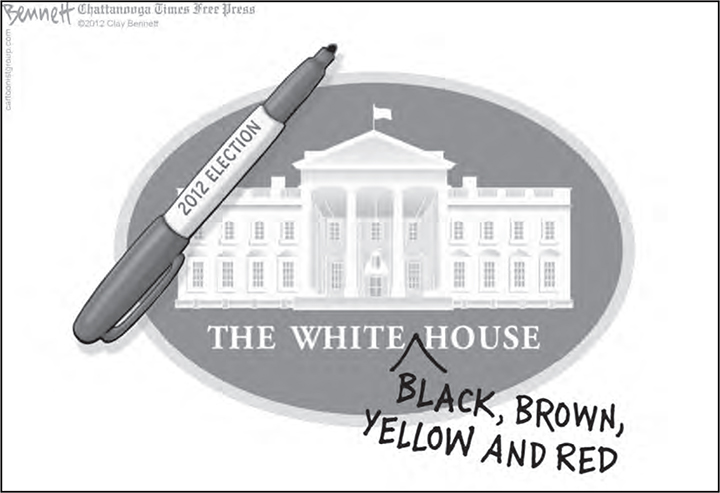
Obama’s narrow margin in the popular vote meant there was no coattails effect that would enable the Democrats to control the next Congress. While the Democratic Party continued to hold the Senate, the Republicans emerged with a firm grip on the lower House of Representatives with a 40-seat majority. In summary, the election results showed that after the political parties spent almost $6 billion, the 113th Congress was very much like the gridlocked 112th in political ideology.
The Second Term
Although the president had won the election, the people had not given him a mandate since the Congress was politically divided. Thus he was left to do battle with the domestic challenges of an underperforming economy, including high unemployment, and a rising poverty level, and with a Congress that wanted to modify his healthcare act and force him to agree to budget cuts to avoid the nation defaulting on its debt.
These serious economic problems were overshadowed in 2011–12 by horrific acts of violence as gunmen engaged in three shooting rampages: one against a Tucson Representative at a constituency meeting, a second at a midnight showing of Hollywood film The Dark Knight Rises at a Colorado theater in the summer of 2012, and a third at an elementary school in Connecticut where a gunman killed 26 people, including 20 children. These were not unusual incidents, either, as 33 people were killed in eight other shootings in 2012 ← xx | xxi → alone. These shootings led the president to propose changes to the country’s gun laws. But anti-gun advocates wondered why he had not also taken the opportunity to scold Hollywood for the excessive violence in its movies.4
Meanwhile, Obama had to contend with notable security issues as well. Terrorist attacks against U.S. citizens occurred in 2013 during the Boston Marathon when two bombs went off near the finish line, killing three people and injuring 170 others, and in Ankara, Turkey, where an attack on the U.S. Embassy killed a Turkish guard and injured a journalist, although no Americans were hurt.
On the foreign affairs front, both Iran and North Korea proved irksome. Iran persisted in developing its nuclear weapons program despite Western sanctions. North Korea continued its belligerent attitude in testing nuclear weapons in the Sea of Japan as part of its campaign to intimidate South Korea. In the Middle East, where the Arab Spring was raging, the president decided against pursuing an aggressive course, refusing to commit U.S. forces in the Syrian civil war and intervene in Egypt as the military toppled the elected government. On a positive note, he kept his promise to withdraw U.S. troops from Iraq and present a drawdown plan for the withdrawal of American troops from Afghanistan.
After enjoying a scandal-free first term, President Obama’s second term saw irregularities and improper behavior by the Internal Revenue Service (IRS) and the National Security Administration (NSA) and an investigation into the 2012 Benghazi terrorist attack that killed the U.S. ambassador and three of his staff.
Hollywood, meanwhile, went about its usual business of making films regardless of the party occupying the White House. And rightly so, as it is Congress that the film industry must lobby to protect its global interests and prevent the unlawful piracy of its films. With these interests in mind, Hollywood hired former U.S. Senator Christopher Dodd (Connecticut) to be its new leader. Still, there was reason to wonder whether the election of the first African-American president might not affect the kind of films Hollywood would make. Would it really be business as usual or would having Obama in the White House compel the film industry to become sensitive to minority hiring and racial issues on the big screen? Certainly it seems possible that Dodd, a fellow Democrat, will hasten the making of a movie about the first African-American president, either describing his journey into politics or extolling a legacy still unfinished. The only certainty seems to be that Hollywood’s Obama films will never equal the number made about Abraham Lincoln, the president’s hero. But then who can ever be sure what will happen when the real world of politics meets the reel world of Hollywood?
The Hollywood-Washington Connection
“Just because you do not take an interest in politics doesn’t mean politics won’t take an interest in you.”
—Pericles, 430 BC
“The price of apathy towards public affairs is to be ruled by evil men.”
—Plato
“For us, the cinema is the most important of the arts.”
—Vladimir Ilyich Lenin
“Film is one of the three universal languages, the other two: mathematics and music.”
—Filmmaker Frank Capra
In this era of polling and public opinion surveys, suppose the author were to conduct a word association poll asking random people on the street what image came to mind when Hollywood was mentioned? Of course, there would be the usual suspects: entertainment, movies, movie stars, big-budget epics, and so forth. The author is willing to wager, however, that the word “politics” is unlikely to come to mind. And the reason is quite simple: Hollywood wants the public to believe that the industry only makes entertainment pictures. To be sure, in any given year, 90 to 95 percent of what comes out of Hollywood is strictly commercial, designed to bring customers into theaters and make money for the studios and their corporate owners. This book is about the 5 to 10 percent of films where Hollywood’s public relations department either denies any political intention or tries to disguise any political message.
Common sense dictates that if entertainment were Hollywood’s only focus, then the Motion Picture Association of America’s (MPAA) major offices would be located in Los Angeles or New York instead of Washington, D.C. While the film industry has offices in both of those coastal cities, its headquarters is in the nation’s capital because, being an ← 1 | 2 → international business, the MPAA’s concerns are global; it seeks to prevent the piracy of its films, to secure favorable trade agreements with foreign distributors, and to extend its film distribution into the emerging markets of the third world. Indeed, movies are America’s second biggest export, after military hardware and equipment. For a good example of what movies mean to our economy, it is instructive to note whom the film industry selects as its leaders: Will Hays, former U.S. Postmaster General, Jack Valenti, assistant to President Lyndon Johnson, Dan Glickman, former Congressman and former U.S. Senator Christopher Dodd, its current president. To the author’s knowledge, not one attended film school, directed or produced a movie, or knew anything about the film industry before their appointment. But they all had the kind of knowledge and contacts inside the Beltway that promised success for the industry.
Many Hollywood movies deliver a fantasy world on the big screen, where Americans live in suburban mansions or plush urban apartments. It is an imagined world unknown to the underclass, though such images would be a surprise to many middle-class families as well. Hollywood is very good at creating deceptions in the reel world. But the industry’s leaders are also good at tracking domestic legislation and foreign policies that would hurt the industry or its profits. That is why the MPAA does business in Washington while its West Coast offices sell a fantasy world to the American public. When the industry was criticized in the 1920s for its screen content it hired Will Hays, chairman of the Republican National Committee and postmaster general in Warren Harding’s administration, as well as a Presbyterian elder, to buffer government and public criticism and to restore the industry’s tarnished image. In accepting the position as the MPAA’s first president, Hays assured the public that “American motion pictures continue to be free from any but the highest possible entertainment purpose.”1 To this day, Hollywood continues to sell that image to the American people.
Entertainment Yes, Politics No
Details
- Pages
- XXII, 412
- Publication Year
- 2014
- ISBN (Softcover)
- 9781433153648
- ISBN (PDF)
- 9781433153655
- ISBN (ePUB)
- 9781433153662
- ISBN (MOBI)
- 9781433153679
- DOI
- 10.3726/b15627
- Language
- English
- Publication date
- 2019 (March)
- Published
- New York, Bern, Berlin, Bruxelles, Oxford, Wien, 2014. XXII, 412 pp., 10 b/w ill., 8 tables
- Product Safety
- Peter Lang Group AG
