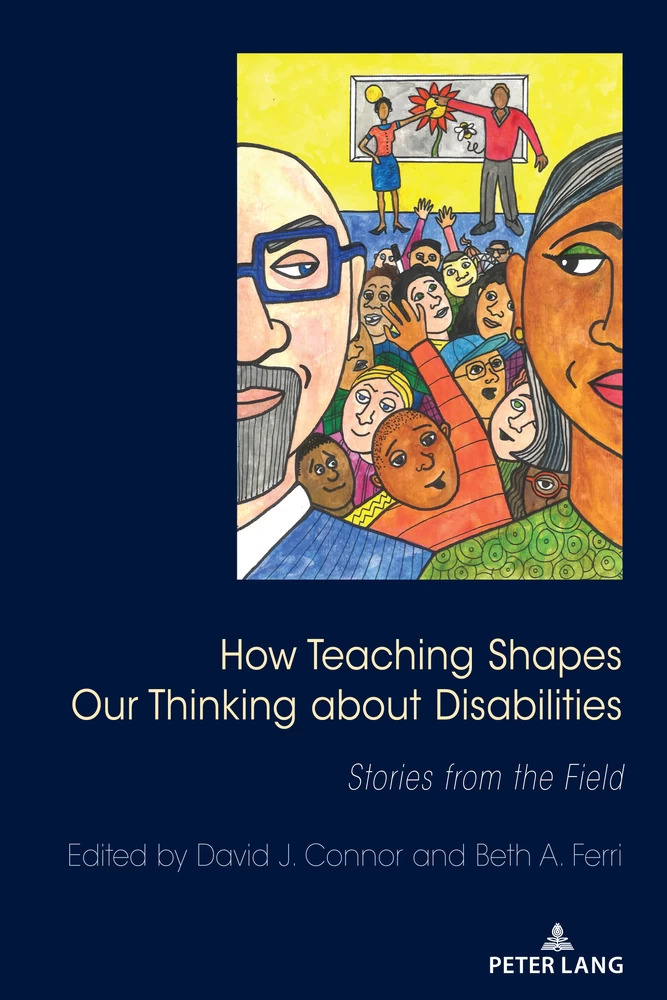
How Teaching Shapes Our Thinking About Disabilities
Stories from the Field
Summary
Excerpt
Table Of Contents
- Cover
- Title Page
- Copyright
- About the authors
- About the book
- This eBook can be cited
- Dedication
- Table of Contents
- Acknowledgments
- Introduction: Learning from Teachers’ Lives
- Section 1: Historical Contexts
- 1. How I Got Here from There: The Road to Disability Studies in Education
- 2. To My Students, with Gratitude: A Retrospective Journey of Teaching [Special Education]
- 3. Snapshots of School
- 4. From Harmful to Helpful
- Section 2: Classroom Spaces and School Structures
- 5. “Why Is Lisa’s classroom in the basement?” Reflections on Noticing and Disrupting Exclusion
- 6. Fictionalized Memories: The Making of a Research Identity in Four Seasons
- 7. Paintings on Clear Plastic that Hang from the Ceiling
- 8. The Promises We Keep
- Section 3: Pedagogy and Practices
- 9. Humanizing “Special” Educational Practices
- 10. “Off to Another Glorious Day of Educational Opportunity”: But for Whom?
- 11. How I Learned to Be a Teacher in Room 137
- 12. Giving Points, Pathologizing Race, and Reading Harry Potter
- Section 4: Families
- 13. Surprising Home Visits
- 14. Teaching as Oppression; Teaching as Liberation
- 15. Searching for Competence: (T)reading the Spaces between Ways of Knowing
- 16. No Bat Required
- Section 5: Both Sides of the Desk
- 17. Education Is Power: But Only if You Can Get into the Building
- 18. Recovering the Spirit
- 19. Journey as a Special Education Teacher of Color with Dis/abilities
- 20. My Disabled Teacher Presence
- Conclusion: Bridging Theory and Practice through Story
- Matrix: Themes and Connections Among Authors
- List of Contributors
- Index

Library of Congress Cataloging-in-Publication Data
Names: Connor, David J., editor. | Ferri, Beth A., editor.
Title: How teaching shapes our thinking about disabilities: stories from
the field / edited by David J. Connor, Beth A. Ferri.
Description: New York: Peter Lang, 2021.
Series: Disability studies in education; vol. 26 | ISSN 1548-7210
Includes bibliographical references and index.
Identifiers: LCCN 2020055673 (print) | LCCN 2020055674 (ebook)
ISBN 978-1-4331-8561-8 (paperback) | ISBN 978-1-4331-8562-5 (ebook pdf)
ISBN 978-1-4331-8563-2 (epub) | ISBN 978-1-4331-8564-9 (mobi)
Subjects: LCSH: Special education teachers—United States. | Special
education—Fieldwork—United States. | Education—Biographical
methods—United States.
Classification: LCC LC3981 .H65 2021 (print) | LCC LC3981 (ebook) |
DDC 371.9—dc23
LC record available at https://lccn.loc.gov/2020055673
LC ebook record available at https://lccn.loc.gov/2020055674
DOI 10.3726/b18015
Bibliographic information published by Die Deutsche Nationalbibliothek.
Die Deutsche Nationalbibliothek lists this publication in the “Deutsche
Nationalbibliografie”; detailed bibliographic data are available
on the Internet at http://dnb.d-nb.de/.
© 2021 Peter Lang Publishing, Inc., New York
80 Broad Street, 5th floor, New York, NY 10004
All rights reserved.
Reprint or reproduction, even partially, in all forms such as microfilm,
xerography, microfiche, microcard, and offset strictly prohibited.
About the authors
David J. Connor (Ed.D., Teachers College, Columbia University) is Professor Emeritus of Hunter College (Learning Disabilities Program) and the Graduate Center (Urban Education Program), City University of New York. He is the author/editor of numerous books and articles, many in collaboration with Beth A. Ferri.
Beth A. Ferri (Ph.D., University of Georgia) is Professor of Inclusive Education and Disability Studies at Syracuse University, where she also coordinates the doctoral program in Special Education. She, frequently in collaboration with David J. Connor, has published widely on the intersections of race, disability, and gender.
About the book
This book purposefully connects practice to research, and vice versa, through the use of deeply personal stories in the form of autoethnographic memoirs. In this collection, twenty contributors share selected tales of teaching students with dis/abilities in K-12 settings across the USA, including tentative triumphs, frustrating failures, and a deep desire to understand the dynamics of teaching and learning. The authors also share an early awareness of significant dissonance between academic knowledge taught to them in teacher education programs and their own experiential knowledge in schools. Coming to question established practices within the field of special education in relation to the children they taught, each author grew increasingly critical of deficit-models of disability that emphasized commonplace practices of physical and social exclusion, dysfunction and disorders, repetitive remediation and punitive punishments. The authors describe how their interactions with children and youth, parents, and administrators, in the context of their classrooms and schools, influenced a shift away from the limiting discourse of special education and toward becoming critical special educators and/or engaging with disability studies as a way to reclaim, reframe, and reimagine disability as a natural part of human diversity. Furthermore, the authors document how these early experiences in the everydayness of schooling helped ground them as teachers and later, teacher educators, who galvanized their research trajectories around studying issues of access and equality throughout educational structures and systems, while developing new theoretical models within Disability Studies in Education, aimed to impact practices and policies.
This eBook can be cited
This edition of the eBook can be cited. To enable this we have marked the start and end of a page. In cases where a word straddles a page break, the marker is placed inside the word at exactly the same position as in the physical book. This means that occasionally a word might be bifurcated by this marker.
To
Beth A. Ferri
In gratitude for our career-long academic partnership
—DC
To
Eileen McCartney and all those first colleagues and students who helped to make those early teaching experiences so unforgettable and a lot more fun
—BF
Acknowledgements
Our thanks go to Scot Danforth and Susan Gabel for their support and enthusiasm for the project. Also, to Patty Mulrane Clayton at Peter Lang for working with us for over 15 years.
Finally, our sincere thanks to all of the contributors of this book who shared their experiences while living through an extremely challenging time that included a global pandemic and political instability. We know they were juggling virtual teaching, handling numerous online administrative tasks, supporting students, coordinating childcare, taking care of extended families, working on other academic projects, and managing personal situations. Bringing their experiences together in this book was truly a labor of love.
Details
- Pages
- XIV, 330
- Publication Year
- 2021
- ISBN (Softcover)
- 9781433185618
- ISBN (PDF)
- 9781433185625
- ISBN (ePUB)
- 9781433185632
- ISBN (MOBI)
- 9781433185649
- DOI
- 10.3726/b18015
- Language
- English
- Publication date
- 2021 (April)
- Published
- New York, Bern, Berlin, Bruxelles, Oxford, Wien, 2021. XIV, 330 pp., 2 b/w ill.
- Product Safety
- Peter Lang Group AG
