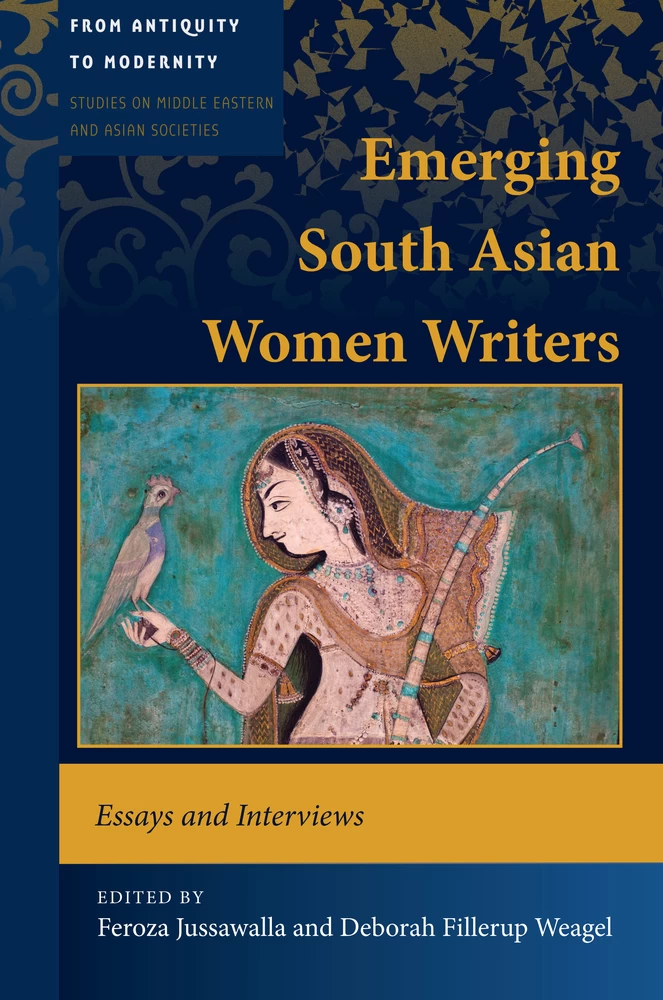
Emerging South Asian Women Writers
Essays and Interviews
Summary
Many South Asian women writers engage with the overall quest for survival, which can be affiliated with all the themes expressed in this volume: trauma, diaspora, injustice, resistance, place, space, language, and identity. The texts discussed herein contribute to the ongoing discourse related to such themes in postcolonial studies and transnational literature, and could be used in courses on South Asian literature, women’s writing, postcolonial studies and literature, and world or transnational literature.
Excerpt
Table Of Contents
- Cover
- Title
- Copyright
- About the editors
- About the book
- Praise for Emerging South Asian Women Writers
- This eBook can be cited
- Contents
- List of Illustrations
- Acknowledgments
- Introduction
- Essays
- 1. Chandani Lokugé’s If the Moon Smiled : Female Subjectivity and Trauma at the South Asian/Australian Cultural Crossroads
- 2. Injustice, Resistance, and Subversion: A Study of Selected Plays by Indian Women Playwrights
- 3. Transnational Feminism in Sidhwa’s Cracking India: A Geocritical Study of the Great Divide of the Indian Subcontinent
- 4. South Asian Muslim Women Speak for Their Rights and Resistance
- 5. Women Trapped in a Quagmire: A Study of Mrinal Pande’s My Own Witness
- 6. Constructing “Home”: Eros, Thanatos, and Migration in the Novels of Anita Rau Badami
- 7. “Womenspace” : Negotiating Class and Gender in Indian English Novels
- 8. Neelum Saran Gour: Novelist of Small Town India and Beyond
- 9. Hybridity and the Politics of Identity in the Writings/Texts of Diasporic South Asian Women
- Interviews
- 10. Language, Diaspora, and Identity: An Interview with Yasmine Gooneratne
- 11. A Journey from Sri Lanka to Australia: A Conversation with Chandani Lokugé
- 12. Gender without Borders: An Interview with C.S. Lakshmi/Ambai
- 13. Speech-Act: An Interview with Susan Visvanathan
- 14. Afterword
- Contributors
- Series index

Illustrations
Figure 3. Yasmine Gooneratne. Photo by Effy Alexakis.
Figure 4. Susan Visvanathan. ← xi | xii →
Acknowledgments
We express sincere appreciation to those who have assisted in the publication of this volume. First and foremost, we thank the authors for their contributions and for their patience as we have worked on this book. We are also grateful to international scholars who have participated in the peer review process and who have provided useful feedback for some of the essays and interviews. We acknowledge emerging South Asian women writers who have inspired the collection and who are an important focal point in the articles and interviews. It is our desire to recognize their efforts and to help their work become better known.
Some of these essays and interviews were included in a Special Topic Issue of the South Asian Review 29.1 (2008), “Perspectives on South Asian Women’s Writing,”guest edited by Feroza Jussawalla and Deborah Weagel. We are grateful in particular to Professor K.D. Verma, former general editor of the Special Topic Issue, for providing support and editorial advice. We also deeply appreciate Professor Pradyumna S. Chauhan, current editor of the South Asian Reivew, for permission to reprint and revise the following essays from that particular issue:
Chanda, Geetanjali Singh. “‘Womenspace’: Negotiating Class and Gender in Indian English Novels.”
Ganapathy-Doré, Geetha. “Speech-Act: An Interview with Susan Visvanathan.”
Herrero, M. Dolores. “Chandani Lokuge’s If the Moon Smiled: Female Subjectivity and Trauma at the South Asian/Australian Cultural Crossroads.”
Jussawalla, Feroza. “South Asian Muslim Women Speak for Their Rights and Resistance.”
Jussawalla, Feroza, and Deborah Weagel. “Guesteditors’ Introduction.”
← xiii | xiv →Malik, Seema. “Injustice, Resistance and Subversion: A Study of Selected Plays by Indian Women Playwrights.”
Ryan, Laurel. “Constructing ‘Home’: Eros, Thanatos, and Migration in the Novels of Anita Rau Badami.”
Weagel, Deborah. “Language, Diaspora, and Identity: An Interview with Yasmine Gooneratne.”
We thank our colleagues at the University of New Mexico for their encouragement and support.
Ezra Meier has been particularly helpful with editing and proofreading assistance. Feroza Jussawalla expresses gratitude to Senior Vice Provost Carol Parker and the UNM Dean’s Office for support.
Finally, we would like to acknowledge Dr. Jamsheed Choksy, the series editor, and the staff at Peter Lang Publishing who have helped us to bring our efforts to fruition. They have provided significant assistance with this project.
Introduction
FEROZA JUSSAWALLA AND DEBORAH FILLERUP WEAGEL
Writing by men and women of South Asian origin has received considerable attention in the western publishing world and with the reading public over the last few decades. Much of this attention can be traced to the success of Salman Rushdie’s groundbreaking work Midnight’s Children (1980), for which he received the Man Booker Prize in 1981, the Booker of Bookers in 1993, and the Best of the Bookers in 2008. Arundhati Roy also gained recognition for her novel The God of Small Things, for which she was awarded the Booker Prize in 1997. The novel was on the New York Times bestseller list for approximately thirty-six weeks and was named one of the New York Times Notable Books of the Year. On both sides of the Atlantic, major literary lists, publishers, and prizes have borne witness to the fecundity of South Asian creativity, making whatever we want to call it—“postcolonial literature,” “world literature written in English,” or “national literature in English” (such as “Indian literature in English” or “Bangladeshi literature in English”)—central to contemporary literary production. These literatures have also become central to the literary dialogues current both in the media and in academia. Consequently, these literatures have also become central to the academic study of literature per se, bringing with them the theoretical perspectives that have been used to understand them, from the early approaches such as Commonwealth Literatures, focusing mostly on the development of national identities, to the more complex theoretical approaches that constitute postcolonial criticism.
As Professor K.R. Srinivasa Iyengar’s seminal work Indian Writing in English,published as far back as 1962, shows, literature in English from South Asia and particularly from India, in English, is a not a novel phenomenon. Since the 1800s there have been major writers in English literature emanating from India, and women have been at the forefront of writing. Indian literature in English is largely identified by the writings of R.K. Narayan, ← 1 | 2 →Raja Rao, Mulk Raj Anand, and Khushwant Singh, who were widely read both in India and abroad. Familiar names of women authors include Aru and Toru Dutt, Cornelia Sorabji, and Sarojini Naidu, all of whom have been very well known. It was not until the work of Kamala Markandaya (1924–2004) and Ruth Prawer Jhabvala (1927–2013) that South Asian women’s writing started to be recognized on a larger scale.
In the past, various South Asian women succeeded in publishing their works, sometimes on a small scale. In the late nineteenth century, Toru Dutt (Torulata) wrote two novels, one in English and the other in French. Both were published posthumously: Bianca, or The Young Spanish Maiden (which was not completed) in Bengal Magazine in 1878, and Le Journal de Mademoiselle d’Arvers in France. Although only twenty-one years old at the time of her death, Dutt drew upon her own limited experience to tell her stories. Other South Asian women writers who produced novels during the latter part of the century include Raj Lakshmi Debi (The Hindu Wife, or the Enchanted Fruit, 1876) and Krupabai Satthianadhan (Kamala, A Story of Hindu Life, 1894, and Saguna:A Story of Native Christian Life, 1895). Other poets and authors published their work into the early twentieth century: Sarojini Naidu (The Golden Threshold, 1896; 1905); Santha and Seetha Chatterjee (Tales of Bengal, 1922); Svarnakumari Debi Ghosal (The Fatal Garland, 1910, and An Unfinished Song, 1913); and Iqbalunnisa Hussain (Purdah and Polygamy: Life in an Indian Muslim Household, 1944). The latter novel deals with the theme of purdah and veiling, which Feroza Jussawalla’s essay considers in the current contemporary context of the controversy about wearing the headscarf. Cornelia Sorabji, the first Parsi woman writer to have both studied and published overseas, was an ardent defender of purdahshins or veiled women. In 1901 she published her landmark Love and Life Behind the Purdah and several other memoirs and a play. Her nephew, Sir Richard Sorabji, published Opening Doors: The Untold Story of Cornelia Sorabji (2010). Parsi writers, both men and women, have been central to the development of South Asian Writing in English. While Rohinton Mistry is the male Parsi writer most acclaimed for his stories about the small migrant Zoroastrian community from Persia that made India their home, Pakistani writer Bapsi Sidhwa is best known for her novel of Partition, subsequent feminist works, and collaboration with Deepa Mehta. In addition, Bachi Karkaria is acclaimed for her journalistic writing. We have included here an essay on Thrity Umrigar. US academic Tinaz Pavri has just published Bombay in the Age of Disco (2015).
India has really been the leader in literary production in South Asia, which is why much of this literary history relies on Indian writers’ production. In fact, during the mid-twentieth century, many writers from smaller ← 2 | 3 →countries carved out of the subcontinent—and even the continent of Africa—trace their literary roots to India. Unfortunately, most of this literary history is ignored in favor of the current and contemporary scene. And yet, even the contemporary scene underscores the fact that South Asian women continue to write, even more ferociously and urge to be heard, even if they are ignored by mainstream western media. This volume seeks to give voice to those unheard voices.
Over the last decade or so, South Asian women’s writing seems to have literally exploded. Almost every week, The New York Times Book Review seems to have a review of at least one South Asian (primarily from India) woman’s book. Often The New Yorker will have a short story or a narrative. Between the Arundhati Roys and the Jhumpa Lahiris, however, there is a sea of names, sometimes supposedly well published by reputable New York publishers, who are lost in the mix and have short shelf lives. Sometimes a negative review causes an author to be put aside even as she is emerging. Those who we think of as the stalwarts of literary publishing are not necessarily so, nor recognized as being so, in South Asia. Women in South Asia are doing their best to get their voices heard, regardless of recognized outlets such as New York publishing houses. Arundhati Roy’s novel, for instance, has not been as well received in India as has her political writing. Not only do Indian women seek whatever outlet to be published, but have had a long history of establishing themselves through self-publishing. And so it is that none of the Western media and academic world cover half the women who are producing today.
Small publishing houses, like Rupa in India, or Zubaan (for scholarly publishing), Nurjehan Aziz’s Toronto South Asian Review Press in Canada, and others in the UK and Australia, are giving voice to the many Indian women who are producing good, if not great, literature. Nurjehan Aziz’s short story collection series, Her Mother’s Ashes, includes many writers seeking publication. Most important among these smaller self-founded publishing houses is Kali, a feminist press founded by Urvashi Butalia and Ritu Menon. Butalia has had great success with her Duke University Press book The Other Side of Silence: Voices from the Partition in India (2000). There are probably more women of South Asian extraction or origin, whether in South Asia itself, in countries like India and Pakistan, or overseas, not just in the US and the UK, but in the Caribbean, the African diaspora, and as this volume shows particularly, in Australia, writing their experiences, allowing their creativity to flow, than elsewhere. This is a bold claim and one which invites research. But a cursory look at the names of the many South Asian women writers, often not considered in reviews or academic studies, shows us how many new writers are emerging literally on a daily basis.
← 3 | 4 →As readers and scholars we know the familiar names, Bharati Mukherjee, Arundhati Roy, Anita Desai, Chitra Divakaruni Bannerjee, and to a lesser extent, someone like Anita Desai’s daughter, Kiran Desai, but do we know the names, Tanuja Desai Hidier, Shani Motoo, Kamila Shamsie, Quratullain Hyder, Uzma Aslan Khan, or even less so Renita D’Silva (Monsoon Memories), Madhulika Chauhan (The One Night Affair), Nitasha Kaul (Residue), or British Bangladeshi writer Rekha Waheed (Saris and the City), also published by a small press?
Other well-known writers of the in-between generation include Anees Jung (Unveiling India, 1987), Shashi Deshpande (That Long Silence, 1989), and Sunetra Gupta (The Glass Blower’s Breath, 1993). Academic women writers include Kirin Narayan, Miriam Pirbhai, and, of course, Chandani Lokugé who is written up in this collection. Physician Sunetra Gupta is known for her fiction and her work in epidemiology. Manju Kapur, Professor of English, at Miranda House published Difficult Daughters (2010) which received the Commonwealth Award, Custody (2011), and several other works. Other writers have needed or maintained academic positions in South Asian countries and overseas.
Even some very well published authors, like Abha Daweswar (Babyji, 2005, and That Summer in Paris, 2006), or Kiran Desai (Hullaballoo in the Guava Orchard, 2006), appear and disappear simultaneously as it were. Some other well published recent names that have made something of a mark, but have not been taken up either by the academic scholarly world of Postcolonial Literatures, or of the widely reviewing world of the mainstream media, are Indu Sundaresan (The Twelfth Wife, 2002, and The Mountain of Light, 2013), Anita Nair (Mistress, 2006), Amulya Malladi, (A Breath of Fresh Air, 2002), and Kirin Narayan (Love, Stars and All That, 1994). Parsi writer Thrity Umrigar is finding some recognition as we can see in the article by Geetanjali Chanda. Among Pakistani writers writing about contemporary issues is such a work as Kamila Shamshie’s Broken Verses. A cross cultural author published by a small literary press in the US, FiveChapters, an online publisher of short stories, is Nina McConigley (Cowboys and East Indians), which tells of the cross cultural adventures of an Indian woman in Wyoming. The most grievous omission from critical consideration perhaps is Gita Mehta, wife of publisher Sunny Mehta (Knopf) whose finely wrought works from Karma Cola (1979) to Raj (1989), River Sutra (1993), and Eternal Ganesha (2006) (non-fiction), deserve more serious consideration. Even a writer as well known and filmically produced as Bapsi Sidhwa, recently said to me in an email that she considers herself also “still emerging.” The vagaries of acknowledgment of these writers are quite quixotic.
← 4 | 5 →Meanwhile as we said before, publishing in India is burgeoning, as it always has. Rupa, IndiaInk, and Zubaan make up some of the newer local presses that have subsisted alongside the India offices of almost all major publishers, with Mills and Boon entering the “Romance” market after the success of novels such as Shobha De’s Bollywood Nights (1992), considered altogether too steamy for proper Indian fiction. Orient Longman has always been part of the Indian publishing scene, publishing such stalwarts as Shanta Rama Rao and Anita Desai, in their Orient paperbacks. Of course, the ground-breaking well-respected publishing house in the Indian publishing scene has always been Professor P. Lal’s Kolkata Writers Workshop,1 giving such writers as Anita Desai and Agha Shahid Ali their start.
In terms of literary fiction, Rasana Atreya is an Amazon-India self-publishing phenomenon, who was short listed for the Tibor Jones award for her unpublished manuscript and who has gone on to stake her place in the cannon of Indian literature in English. At the Hyderabad Literary Festival 2015, she encouraged women to publish with Amazon and to let their voices be heard. Better to be heard in whatever way one can be, than to be left unheard. This volume attempts to give voice to those whose work, despite publishing and some academic recognition, remain unheard.
Historically, there have been two trends in the publishing and establishment of Indian literature in English. Writers like Aru and Toru Dutt and Sarojini Naidu packaged and sent off their materials to mentors like Edmund Gosse, who was enchanted with the exoticism, published them, and called them the “Nightingales of India.” Ruth Prawer Jhabvala is said to have written her stories on Aerogramme paper and mailed them to The New Yorker, whose editors, impressed simply by the effort of the air mail envelope containing thin blue paper, published them and found them to be a big hit, telling, as they seemed to, the stories of a Polish woman attempting to understand an exotic India.
This method of publishing was also true of the men who found British publishers. R.K. Narayan is said to have sent his stories to Graham Greene and found a publisher through him. Others sent manuscripts off to E.M. Forster. Most often they found a sympathetic audience in these writers because of the Indian material. Now with the proliferation of such writing, the publishing has gotten harder. Sri Lankan critic Maryse Jayasuriya says this in the excerpt we have quoted below. It has not exactly been easy for Indian women to get published despite the material. In a recent email to me, Uma Parmeswaran, one of the earliest critics of Indian Writing in English and perhaps the first Indian critic to interview Salman Rushdie, told me of her findings at the Harry Ransom Center in Texas. Anita Desai’s archival materials showed that ← 5 | 6 →she sent her work out to a long list of publishers. But since she was in India, she simply requested the publishers and agents on her list to send her manuscript on to the next person on the list if they were not interested. Similarly, Feroza Jussawalla found in the archive at Columbia University the list of agents and publishers whom Bapsi Sidhwa had approached. It seemed to be trendy in those days for authors to simply write a hand written letter and send it off to an agent or a publisher to see whose eye it caught. This exotic means of approaching a publisher has long faded. Bapsi has noted how she would write her stories on “bridge score cards.” Somewhere in an archive these materials must be available.
Self-publishing has been a major part of Indian women’s writing historically. Bilkiz Alladin published For the Love of a Begum (1989), the story of Sir James Achilles Kirkpatrick and his love for a Hyderabadi woman called Khair-un-Nissa, from her home and her own press, Hydeco. Kirkpatrick, who was a diplomatic official in Hyderabad, built what was called the Residency, a majestic building to house the future British envoys to the Mughal state of Hyderabad. After Indian independence, this became a women’s college. Feroza Jussawalla was raised on this campus where her mother was a principal. Her essay, “Hyderabad’s Garden of Memories,” published in Mirror, also tells of Kirkpatrick’s love story and of the twins who were born there. Twenty-five years later, William Dalrymple popularized this story as White Moghuls (2002). Other books about Hyderabad include Bilkees Latif’s The Fragrance of Forgotten Years and Meheroo Jussawalla’s On Six Dollars to America.
This volume was conceived as a space to provide visibility for those women whose work has not had much exposure in the West and elsewhere. Ironically, it is when the western establishment finds a text that it gains currency in its own native land. In the architectural designs of knowledge laid out by the academy, there has been no space created for these particular authors. This is why we wish to build a space of recognition. Our work thus truly contributes to the creation of knowledge in the wider fields of postcolonial literature, postcolonial studies, and feminist studies, which take into consideration the sociological and societal value of these contributions. We are contributing to the knowledge of South Asian women writers by including scholarship not only on little known writers but also by scholars from India—in particular, even those critics whose voices do not necessarily find themselves in western academic publications. Much of the scholarship on South Asian writing, or postcolonial writing from the subcontinent, is generated by “star” academics in the United States and relies upon the work of a few well-placed “postcolonial” critics who serve as “translators” of the work on the subcontinent.
Details
- Pages
- XIV, 216
- Publication Year
- 2016
- ISBN (Hardcover)
- 9781433128905
- ISBN (PDF)
- 9781453915776
- ISBN (MOBI)
- 9781454192107
- ISBN (ePUB)
- 9781454192114
- DOI
- 10.3726/978-1-4539-1577-6
- Language
- English
- Publication date
- 2015 (December)
- Keywords
- Subalternity Women third world Postcolonialism
- Published
- New York, Bern, Berlin, Bruxelles, Frankfurt am Main, Oxford, Wien, 2016. XIV, 216 pp., num. ill.
- Product Safety
- Peter Lang Group AG
