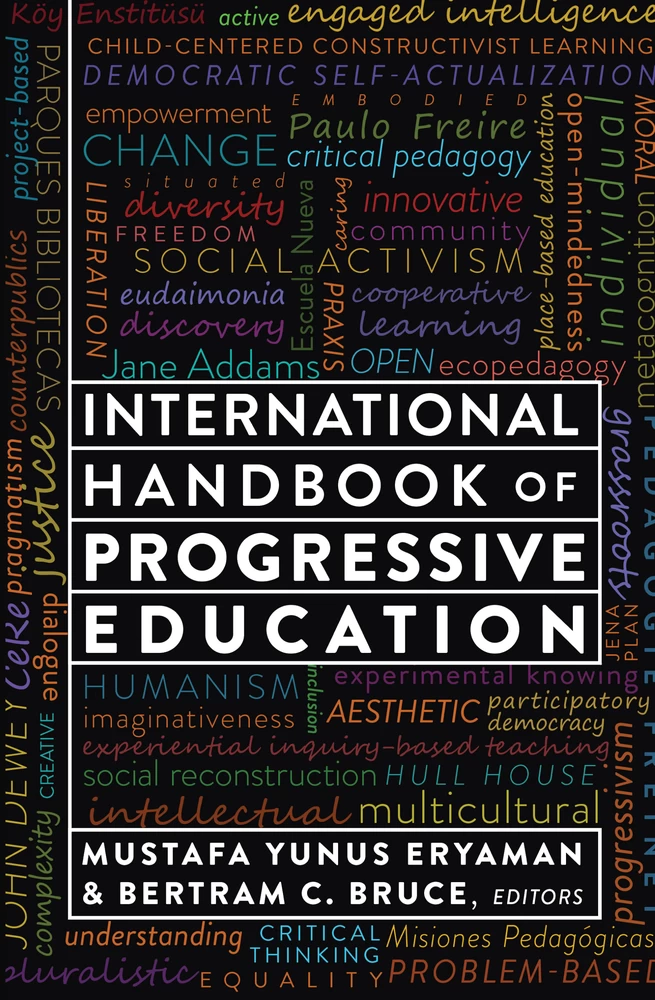
Summary
Excerpt
Table Of Contents
- Cover
- Title
- Copyright
- About the author(s)/editor(s)
- About the book
- This eBook can be cited
- Contents
- Acknowledgments
- Editors’ Preface
- Introduction: The Progressive Impulse in Education
- Section One—Past: Section Introduction: Aims of Progressive Education
- Chapter One: Anti-Progressivism in Education: Past and Present
- Chapter Two: John Dewey and Village Institute Model in Teacher Training System in Turkey
- Chapter Three: John Dewey and the Challenge of Progressive Education
- Chapter Four: Austrian School Reform, 1919–1934
- Chapter Five: Revamping the French Educational Philosopher Célestin Freinet’s Pedagogy and Its Relevance for Current Discussions on Progressive Education
- Chapter Six: Beyond Jane Addams: The Progressive Pedagogies of Ella Flagg Young, Lucy Sprague Mitchell, Lucy Maynard Salmon, and Anna Julia Cooper
- Chapter Seven: From Kilpatrick’s Project Method to Project-Based Learning
- Chapter Eight: Discovering Dewey as a Guiding Foundation: Examining Moral Problems Using Issues-Centered Education
- Chapter Nine: Saving a Progressive Vision: Assessing the Move of the Barnes Foundation
- Chapter Ten: Where’s Wonder?
- Section Two—Present: Within Institutions: Section Introduction: Interrogating and Reconstructing Practice
- Chapter Eleven: Education in New Zealand: A Revered Past, a Contested Present, and an Uncertain Future
- Chapter Twelve: Progressive Museum Education: Examples From the 1960s
- Chapter Thirteen: The Teacher-Artist’s Creed: Teaching as a Human, Artistic, and Moral Act
- Chapter Fourteen: Progressive Teachers of Young Children: Creating Contemporary Agents of Change
- Chapter Fifteen: Literacy, Literature, and Moral Panic in Australia
- Chapter Sixteen: Developing Active Citizenship in Schools: A Case Study of Democracy in Practice
- Chapter Seventeen: Teacher Interpretations of “Active” Citizenship Curricula: Shared Identities and Spatial Orientations
- Chapter Eighteen: The Unfinished and Ongoing Business of Art Education in the U.S.: Collaboration, Participation, and Democratic Practices
- Chapter Nineteen: Progressive Education as Continuing Education for the Developmentally Disabled
- Section Three—Present: Section Introduction: Participation and Citizenship
- Chapter Twenty: Participation as Telos for Learning
- Chapter Twenty-One: Technology as Connected and Critical Learning Practice
- Chapter Twenty-Two: What Jane Addams Tells Us about Early Childhood Education
- Chapter Twenty-Three: Citizenship Education in European Schools: The Critical Vision of NGOs
- Chapter Twenty-Four: Progressive Education in Georgia: Advances in Professional Development of Learning Communities
- Chapter Twenty-Five: Activating Citizenship: The Use of Education to Create Notions of Identity and Citizenship in South Asia
- Chapter Twenty-Six: Towards a Framework for Understanding Adolescents’ Civic Competency
- Section Four—Future: Section Introduction: Future of Progressive Education
- Chapter Twenty-Seven: The Great Commonwealth of Successive Generations: Progressive Education in an Era of Global Change
- Chapter Twenty-Eight: The Banzhuren: Classrooming as Democracy in China
- Chapter Twenty-Nine: Indonesian Education: Its Efforts for Progressive Learning Environment
- Chapter Thirty: The Rural-Urban Paradox in Primary Schools: 140 Years of Progressive Education in Spain
- Chapter Thirty-One: The New DEEL (Democratic Ethical Educational Leadership): Transformative, Progressive Educational Administration
- Chapter Thirty-Two: Stories of Progressive Education in the 21st Century
- Section Five—Overarching Issues: Section Introduction: Overarching Issues of Progressive Education
- Chapter Thirty-Three: Reclaiming the Radical Imagination: Challenging Casino Capitalism’s Punishing Factories
- Chapter Thirty-Four: The Future is Marx: Bringing Back Class and Changing the World—Revolutionary Critical Pedagogy as Moral Imperative
- Chapter Thirty-Five: Beyond “Discourse Radicalism”: Revolutionary Critical Pedagogy and the Struggle for Social Justice
- Chapter Thirty-Six: Progressive Critical Pedagogies and the Idea of Communism
- Chapter Thirty-Seven: Hull-House as a Queer Counterpublic
- Chapter Thirty-Eight: Whole Language Philosophy and Practice: Where Have We Been and Where Are We Headed?
- Chapter Thirty-Nine: Core Values of Progressive Education: Seikatsu Tsuzurikata and Whole Language
- Chapter Forty: Lawrence Stenhouse and the Refutation of Progressivism in Curriculum
- Chapter Forty-One: Coffee Cups, Frogs, and Lived Experience
- Chapter Forty-Two: Ecopedagogy and Progressive Education
- Contributors
- Index
| 199 →
Assessing the Move of the Barnes Foundation
University of Illinois
University of Illinois
ABSTRACT
This chapter examines a unique educational experiment aimed at understanding the influence of art on democracy inspired by progressive-era ideas. The school was created by industrialist, turned art collector Albert C. Barnes and supported by American philosopher John Dewey. In recent years, a protracted legal fight ensued over the fate of the Barnes Foundation, which resulted in a controversial relocation to Philadelphia. As the Foundation begins a new life in a new location, how will Barnes’s original educational vision be preserved? We submit that the vision will be endangered unless Barnes’s intent for his collection is clearly understood. We assess the value of Barnes’s contributions and examine the mutual influence of Barnes and Dewey.1
Keywords: Barnes, Dewey, art, progressive education, aesthetic experience
INTRODUCTION
After the Donor’s death no picture belonging to the collection shall ever be loaned, sold or otherwise disposed of except that if any picture passes into a state of actual decay so that it is no longer of any value it may be removed for that reason only from the collection. [The goal is] to promote the advancement of education and the appreciation of the fine arts … as an educational experiment ← 199 | 200 → under the principles of modern psychology as applied to education … to perfect the plan so that it shall be operative for the spread of the principles of democracy and education after the death of Donor and his wife.
(“The Barnes Foundation’s Bylaws,” 1922, Article IX Management of the Corporation)
When Albert C. Barnes established the Barnes Foundation in 1922 to preserve his growing collection of modern art, he also intended to create an institution that would enable him to further refine his ideas about the study of art and its connection to democracy. Barnes was a controversial figure in both life and death, and his story is certainly one of the most complex and interesting in the world of art collecting and art education (Rudenstine, 2012). His educational ideas were inspired primarily by American pragmatists William James and John Dewey. His foundation for the study of art can be viewed as part of a wave of experimental schools operating at the height of the progressive education movement, filled with optimism for the possibilities of social reform.
As a wealthy industrialist, Barnes had substantial financial resources to collect art of his choosing throughout Europe and America and to build a large neo-classical-styled gallery to house his collection and school. He also developed a friendship and close working relationship with John Dewey, who provided his support, reputation, and counsel to this unique and ambitious project. Barnes envisioned that the foundation would become a leader in art education and, by actually demonstrating the effectiveness of his theories, would convince the traditional art world of the errors of their ways. He was clearly on the cutting edge of the modernist art movement; his five books on modern art are regarded as insightful and are still in print through the Barnes Foundation today. However, Barnes’s lasting influence on art education is limited, in large part because his combative personality and dogmatic approach to the understanding of art alienated the very communities that he intended to persuade and to lead. Throughout his life, Barnes isolated himself from all but a handful of people; unfortunately, this pattern of isolation followed him as he ran the Foundation, and in the end severely diminished its potential to impact art education.
In addition to his lofty goals about art and education, Barnes clearly wanted to create a way to keep his entire collection intact and to preserve it primarily for educational purposes after his death. Thus Barnes created a long list of conditions in the Indenture of Trust of the Barnes Foundation in order to control the use of his vast art collection and school. Due to the size of its original endowment, the foundation continued to operate for almost 90 years based solely on Barnes’s policies. In the early 1980s, however, growing financial difficulties finally forced a major reassessment of the foundation’s mission and ultimately resulted in its relocation in 2012 (Meyers, 2004; Rudenstine, 2012). What has happened to Barnes’s vision now that the collection has moved from its location in the idyllic suburban setting ← 200 | 201 → in Merion, Pennsylvania, to the busy museum district of Philadelphia? Many of the stipulations of the trust aimed at its preservation later plagued a series of Barnes Foundation directors, who were left with the task of fulfilling Barnes’s wishes while also trying to sustain the foundation’s mission as funds severely dwindled.
The controversy surrounding the recent move of the Barnes Foundation from its original home in Merion involved legal questions such as whether the move violated the indenture, and if so, whether the violation was justified to preserve the collection. While the controversy produced years of sensational public scrutiny, the care that has gone into the Barnes collection’s new home and the meticulous way in which the curators have reproduced the original arrangements of paintings and artifacts have now muted much of the criticism (Rudenstine, 2012). Those who were fortunate enough to gain admittance to the Merion gallery would find it hard to tell the difference between the old and the new space, and experts agree that the interior space of the collection’s new home is a stunning rendition of the old. The walls are the same fabric and color as in Merion, and the curators have reproduced the arrangement and spacing of the paintings exactly as Barnes had done just prior to his death in 1951. The decorative items and hardware pieces are situated in exactly the same way as in Merion. The minor material changes, for example, the lighting and comfortable restaurant, are improvements. Consider the title of the review by a former critic, Roberta Smith (2012), in The New York Times—“A Museum, Reborn, Remains True to Its Old Self, Only Better.” Most of the remaining critics are largely concerned with the legal/moral question: was it justified to break Albert Barnes’s explicit instructions not to remove any picture from the collection?
The debate over whether the move violated the indenture of the Barnes Foundation was certainly the main point of the highly controversial film The Art of the Steal (Argott, 2009). It was released in 2009, several years before the new facility was completed. The Art of the Steal develops the case that major Philadelphia foundations, such as the Pew and Annenberg, together with the State of Pennsylvania and the Philadelphia art establishment, colluded to violate the Barnes Foundation Trust and to steal the collection for the sake of tourism, prestige of housing a rare and relatively unknown collection of great art, and, some would even claim, revenge for all of the institutions and individuals who were recipients over the years of Barnes’s vindictive behavior (“No-one to Blame,” 2010). Both the boosters and the critics of the move see fidelity to Barnes’s intentions as the main issue here. While these are important questions, the deeper issue concerns neither the move nor the arrangement but Barnes’s educational vision for his collection and whether this vision will be maintained given the new location. Barnes’s vision connected the study of art with democracy. He was drawn to progressive ideas because of his intense interest in learning and science; he wanted to understand how learning takes place and how to shape experiences that would promote individual growth ← 201 | 202 → and improve society. Of particular importance is Barnes’s relation to one of the progressive education movement’s principal figures, John Dewey. We examine that vision about the influence of art, a vision where educational enlightenment for democracy was the central aim of the Barnes Foundation—at least at its inception.
BACKGROUND: BARNES AND HIS ART
Albert Barnes was born into a poor family, the son of a butcher who lost an arm in the Civil War. Barnes worked his way through the University of Pennsylvania medical school by tutoring, boxing, and playing baseball (Meyers, 2004; Rudenstine, 2012). Later, Barnes made a fortune as a co-inventor of an antiseptic product called Argyrol, affording him the ability to amass a collection containing classical Greek and Egyptian art, one of the first collections of African art, as well as a large number of what were to become well-known 19th- and 20th-century artists. He is said to have selected, bought, and arranged every single one of the paintings himself. In displaying the art, Barnes created what he called “ensembles,” where odd metal pieces and furniture were placed carefully around the paintings that were intended to illustrate some “shared qualities of form” (Rudenstine, 2012, p. 125). The quality and number of post-impressionist and early modernist paintings are unrivaled in even the most prestigious of museums in the world. A partial list of Barnes’s inventory includes “181 Renoirs, 69 Cézannes, 59 by Matisses, 11 Degas, 7 van Goghs, 6 Seurats, 46 Picassos, 16 Modiglianis, 21 Soutines, 18 Rousseaus, 4 Manets, and 4 Monets” (Rudenstine, 2012, p. 61). In addition, years before African and African American art received significant recognition from the art establishment, Barnes was collecting such works and promoting their aesthetic worth (Meyers, 2004). Altogether, the Barnes collection totals nearly 2,500 works of art (Kimball, 1993). Today, many regard the collection as priceless and refuse to place a value on the individual works. However, a general consensus is that the entire collection would be worth between 20 and 30 billion in today’s U.S. dollars. Indeed, it is reported that there are more Renoirs in the Barnes collection than in the entire city of Paris.
Barnes distained museums for their pretentiousness and snobbish appeal and did not intend his collection to be part of a museum setting. His collection was placed in trust as part of the Barnes Foundation, and he gave approximately $10 million to maintain the educational programs and to care for the buildings (Rudenstine, 2012). Over time, however, especially as more changes were made in public access to the collection, the money proved to be insufficient to cover increased operating costs.
As with many educational institutions, the Barnes Foundation was very restrictive—and while Barnes was living, one might say even dictatorial—in ← 202 | 203 → determining who could view the collection. In order to visit, it required an application for admission, and Barnes delighted in turning down the rich and powerful on a seeming whim. In Barnes’s view, he was doing exactly what all private educational institutions were doing: discriminating against some and accepting others, only his may have been the earliest example of a “reverse” discrimination practice. During his lifetime, private schools and colleges openly discriminated against workers’ children, Jews, African Americans, and women. All of which was perfectly legal. Barnes did the reverse and favored working-class students and provided greater access to those of color and independent of religion.2
The fragile financial circumstances of the Barnes Foundation became more transparent in 1988 with the death of a longtime Barnes associate, Violette de Mazia. She was the last director of education and board member hired personally by Albert Barnes. At the time of her death, the control of board appointments went to the next in line of the trust’s designees—Lincoln University. Lincoln University is a small historically black college founded in 1854 and located 40 miles outside of Philadelphia and is distinguished as the first institution in the United States to provide a higher education in the arts and sciences for male youth of African descent (Meyers, 2004). While the university had limited financial resources and had been taken over by the State of Pennsylvania, Lincoln had a long and proud history as a historically black college with an impressive list of famous graduates, including U.S. Supreme Court Justice Thurgood Marshall and poet Langston Hughes.3
Managing the appointments to the Board of Trustees to the Barnes Foundation was a rare opportunity for Lincoln University to assume a high-profile role in the world of art. Since the foundation’s beginning in 1922, Barnes had been seeking an institution of higher education to align with (but not take over) the foundation and its ongoing mission. Barnes had courted and then found reasons to abruptly sever relationships with numerous potential partners for the foundation, including his alma mater the University of Pennsylvania.4 As Lincoln University assumed its leadership role, the foundation’s dwindling funds brought on a financial crisis. New trustees appointed by Lincoln University were severely limited in their options to maintain the original arrangements. Indeed, they had to get court permission for any modifications to the indenture. Subsequently, a number of schemes were hatched to keep the Barnes collection in Merion, including a traveling exhibit that raised $17 million to be used specifically for building renovations (Rudenstine, 2012, p. 159). However, the foundation failed to raise other funds to fully reinvigorate the endowment.
In fact, Barnes’s intentions were more complicated than can be gleaned from a surface reading of the indenture. In the recent efforts to move the collection to Philadelphia, the Pew Charitable Trust and the Annenberg Foundation maintained that in moving the collection, they were honoring a deeper intent of making ← 203 | 204 → the collection available to the “men and women who gain their livelihood by daily toil in shops, factories, schools, stores, and similar places, who shall have free access to the art gallery” (Meyers, 2004, p. 66). The head of the Pew Foundation, Rebecca Rimel, agreed with the intent for increased public access, and pointed out that the indenture included an “if all else fails” clause, “which suggested that if ever his restrictions made life for the Barnes impossible, the collection could be moved to Philadelphia” (Dobrzynski, 2007, p. 8).
In fact, Rimel had part of the story exactly right. Barnes did want the collection available to “plain folk,” but not just as a museum to be passively admired. In the debate about moving the gallery to Philadelphia, Rimel’s mistake was to collapse the distinction between a museum and an educational institution that Barnes had worked hard to maintain. For Barnes, this collection was first and foremost for education. However, even from the beginning, there were serious contradictions about the stated mission and the operation of the foundation. Certainly, his gallery, which was located in the remote suburb far from public transportation, was not very accessible to the vast majority of working-class and lower-income individuals living in the Philadelphia area.
For those seeking to view the gallery, Barnes approved requests to visit in an unorthodox and dictatorial way. While the foundation was theoretically supposed to favor education of the working class, very few visitors of any class were admitted over the years. When Barnes wanted to be particularly insulting to the upper class, academics, or art critics, he would sign the rejection letter using the name of his dog or require an IQ test, as he did when the president of Bryn Mawr College applied to see the collection. (As far as we know, she did not take it.) On the other hand, he was quite permissive when it came to the applications of working-class people. James Michener, as a student at Swarthmore, applied, was rejected, reapplied pretending to be an “illiterate” steel worker, and was admitted to view the collection (Meyers, 2004). Otherwise, as with most private educational institutions, public access to view the Barnes collection was restricted. As the court battles began after Barnes’s death, the educational mission of the collection was obscured in the public’s view, and the school struggled to maintain its control over the use of the galleries.
Supporters of the move of the collection to Philadelphia agreed to keep the arrangements of paintings, furniture, and artifacts intact, but the educational reasons for doing so may have been obscured. The arrangement, or “ensemble,” was important for Barnes because he felt that it augmented the educational intensity of the viewing experience. As George Hein explained, the arrangements were a deliberate, calculated manner of juxtaposing and complementing works of art so that similarities and differences in form would be better understood by the students.
Barnes changed the arrangements from time to time, but the intention was always to provide the best pedagogic arrangements he could develop (personal communication, March 14, 2012). ← 204 | 205 →
Some critics of the move claimed that when the original $10 million endowment ran out of funds, it should have been relatively easy to sell a few of the works, especially those in storage, to save the collection. Those in favor of the move pointed out that the Barnes Foundation by-laws stipulated that nothing was to be sold or loaned unless so deteriorated that it was valueless. They argued that this made it difficult to use the collection itself to raise the funds required to support it. Many who praised the collection in recent years were not impressed by its educational program, which was faulted for failing to turn out a single painter of value, or any notable art historians. Thus, for these critics, Barnes failed to meet their standard measure of educational value. Yet the rationale behind this judgment may well be the reason that Barnes both detested the art establishment and feared that they would eventually gain control of his collection. Here the issue is not art but a philosophy of art education. The clash is not about what is great art, but rather it is about the purpose of art education. Barnes was not concerned with turning out great painters or scholars, as he was criticized for failing to do; his concerns were elsewhere.
ART AS EDUCATION: BARNES AND DEWEY AND THE CREATION OF THE FOUNDATION
Barnes was interested in education from the very beginning of his career as an industrialist and turned this interest into a practical experiment within his factory by establishing an educational program for workers. Well before he enrolled in Dewey’s course at Columbia University in 1918, Barnes read the newest theories of psychology extensively, as well as the writings of numerous American philosophers. Based on his interests in education, Barnes involved his racially integrated, minimally educated workforce in his chemical plant in planning and organizing their work, and in doing so reduced the workday from 10 hours to 6 hours (Meyers, 2004; Rudenstine, 2012). With the time saved, Barnes organized lectures on a variety of topics and authors, including works by James, Santayana, and Dewey. In addition, many of his art purchases were displayed at the factory for his workers to view as a way to enhance their studies in aesthetics. Barnes’s later ambition to create a formal institution for the study of art grew, at least in part, out of these early experiences in his Philadelphia factory.
After auditing Dewey’s course at Columbia University, Barnes and Dewey began a lifelong friendship. What joined Dewey and Barnes at this time was a certain understanding of democracy and the view that people learn through shared activity. Shortly after Barnes attended Dewey’s seminar, Barnes financed a controversial study by Dewey and his graduate students on the immigrant Polish community in Philadelphia (Feinberg, 1974). The two were an odd couple. Even ← 205 | 206 → those who did not agree with Dewey’s pragmatic philosophy generally praised him for his gentleness and kindness. While Dewey had many philosophical disagreements, he seemed to have made few real enemies. In contrast, Barnes was seen as a tyrant and a bully who tried to impose his taste on others and would do anything he could to publicly humiliate those who disagreed with him or who did not share his vision. For example, about the writing of the famous art connoisseur, Bernhard (Bernard) Berenson, Barnes (1929) wrote that his work “would be unworthy of serious attention except for the regrettable influence his writings have had in filling our universities with bad teaching on art and our public galleries with bad Italian paintings” (as cited in Dewey, Barnes, Buermeyer, Mullen, & de Mazia, 1929, p. 223).
Details
- Pages
- XX, 833
- Publication Year
- 2015
- ISBN (Softcover)
- 9781433128745
- ISBN (PDF)
- 9781453915226
- ISBN (MOBI)
- 9781454192589
- ISBN (ePUB)
- 9781454192596
- ISBN (Hardcover)
- 9781433128752
- DOI
- 10.3726/978-1-4539-1522-6
- Language
- English
- Publication date
- 2016 (February)
- Keywords
- education goals village institute model 1919 freinet jane adams project-based learning kilpatrick
- Published
- New York, Bern, Berlin, Bruxelles, Frankfurt am Main, Oxford, Wien, 2015. XX, 833 pp., num. ill.
- Product Safety
- Peter Lang Group AG
