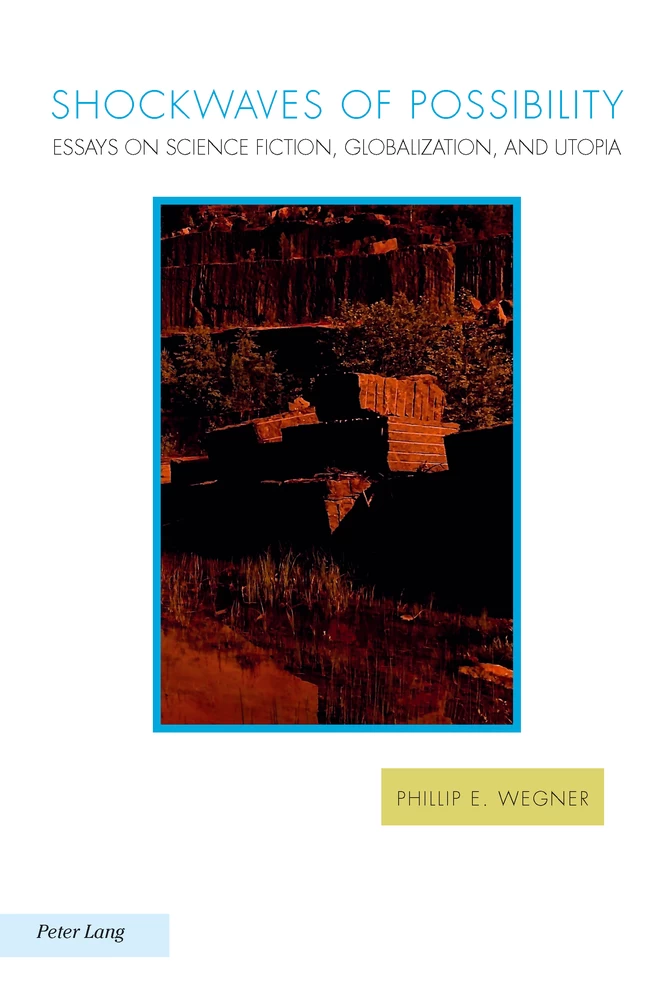
Shockwaves of Possibility
Essays on Science Fiction, Globalization, and Utopia
Summary
Excerpt
Table Of Contents
- Cover
- Title
- Copyright
- About the author(s)/editor(s)
- About the book
- This eBook can be cited
- Contents
- Acknowledgments
- Preface
- Notes
- Chapter One: The Modernisms of Science Fiction: Toward a Periodizing History
- I.
- II.
- III.
- IV.
- Notes
- Part One: Evental Genres
- Chapter Two: If Everything Means Something Else: Technology, Allegory, and Events in Roadside Picnic and Stalker
- Notes
- Chapter Three: After the End of the World: Pseudo-Apocalypse and Universal History in Paradise and The Windup Girl
- Notes
- Chapter Four: Recognizing the Patterns
- I.
- II.
- III.
- IV.
- V.
- Notes
- Part Two: Possible Worlds
- Chapter Five: The Beat Cops of History: Or, The Paranoid Style in American Intellectual Politics
- Notes
- Chapter Six: Popular Dystopias in an Era of Global War
- I. WALL-E’s world
- II. Into the heart of an immense darkness
- III. Adapting Watchmen
- IV. Time loops and other political paradoxes in Terminator Salvation
- Notes
- Chapter Seven: Alan Moore, “Secondary Literacy,” and the Modernism of the Graphic Novel
- Notes
- Chapter Eight: Ken MacLeod’s Permanent Revolution: Utopian Possible Worlds, History, and the Augenblick in the “Fall Revolution”
- Notes
- Part Three: Alternate Histories
- Chapter Nine: Alternate Histories, Periodization, and the Geopolitical Aesthetics of Ken MacLeod and Iain M. Banks
- I.
- II.
- III.
- Notes
- Chapter Ten: Learning to Live in History: Alternate Historicities and the 1990s in The Years of Rice and Salt
- I.
- II.
- III.
- Notes
- Chapter Eleven: “An Unfinished Project that was Also a Missed Opportunity”: Utopia and Alternate History in Hayao Miyazaki’s My Neighbor Totoro
- Notes
- Bibliography
- Works Cited
- Videography
- Index
- Series Index
| 1 →
The Modernisms of Science Fiction: Toward a Periodizing History
And yet, if the transcendent teleology that capitalist modernity constructed is coming to an end, how can the multitude define instead a materialist telos?
We will be able to respond to this question only after conducting a phenomenological and historical analysis of the relationship between virtuality and possibility, that is, after responding to the question if, how, and when the virtuality of the multitude passes through possibility and becomes reality. The ontology of the possible is in this sense the central terrain of analysis.
I.
I begin this book by doing two things. First, I describe what I see as the essential modernism of all science fiction practice and locate its origins in the cultural period of modernism itself. Secondly, I outline the contours of a new periodizing history of what remains one of the most productive and interesting narrative technologies developed in the last century. Central to my discussion here, as it is to all of my thinking, is the work of the most important contemporary theorist of periodization, Fredric Jameson.1 Jameson is also, as I am confident most readers of this book already know, the author of one of the most significant recent studies of science fiction, Archaeologies of the Future: The Desire Called Utopia and Other Science Fictions (2005). The convergence of investigations of periodization and ← 1 | 2 → science fiction in Jameson’s project is no coincidence. This is because all periodizations are themselves science fictions, forms of the subgenre of the alternate history that I discuss in detail in the third section of this book. Like the very best science fiction then, any effective periodizing narrative helps us look at the world we inhabit in new, and hopefully productive, ways.
In his 2002 book, A Singular Modernity: Essay on the Ontology of the Present—the opening section of the fourth volume of his great work-in-progress, The Poetics of Social Forms, the sixth and final volume of which is Archaeologies of the Future—Jameson acknowledges that periodization is, for the contemporary sensibilities of many at least, an act that is “intolerable and unacceptable in its very nature, for it attempts to take a point of view on individual events which is well beyond the observational capacities of any individual, and to unify, both horizontally and vertically, hosts of realities whose interrelationships must remain inaccessible and unverifiable” (28). Nevertheless, he maintains, “We cannot not periodize:” these forms are as “inevitable” as they are unacceptable, a quintessential part of our deeper modernity, and to reject them means to fall back into such pre-modern narrative forms as the chronicle or the ideological narrowness of empiricism or the sociology of culture. Moreover, periodization represents, in a moment fixated upon the static spatialized image, a “return of the repressed of narrative itself” and the politically contestatory stances narrative always already involves (A Singular Modernity29). Jameson concludes, “periodization is not some optional narrative consideration one adds or subtracts according to one’s tastes and inclinations, but rather an essential feature of the narrative process itself” (A Singular Modernity81).
On this basis, Jameson elaborates what he calls the “four maxims” for any discussion of modernity:
1. One cannot not periodize.
2. Modernity is not a concept but rather a narrative category.
3. The one way not to narrate it is via subjectivity (thesis: subjectivity is unrepresentable). Only situations can be narrated.
4. No “theory” of modernity makes sense today unless it comes to terms with the hypothesis of a postmodern break with the modern. (A Singular Modernity 94) ← 2 | 3 →
I want to argue that these are in fact the fundamental axioms of any periodizing narrative, with the term “modernity” being replaced in each case with that of the “period” (A period is not a concept but rather a narrative category; only situations can be narrated; no “theory” of a period makes sense unless it comes to terms with the hypothesis of a break).
Details
- Pages
- XX, 312
- Publication Year
- 2014
- ISBN (Softcover)
- 9783034307413
- ISBN (PDF)
- 9783035306422
- ISBN (MOBI)
- 9783035399196
- ISBN (ePUB)
- 9783035399202
- DOI
- 10.3726/978-3-0353-0642-2
- Language
- English
- Publication date
- 2014 (September)
- Keywords
- literature theory criticism animation television
- Published
- Oxford, Bern, Berlin, Bruxelles, Frankfurt am Main, New York, Wien, 2014. XX, 312 pp.
- Product Safety
- Peter Lang Group AG
