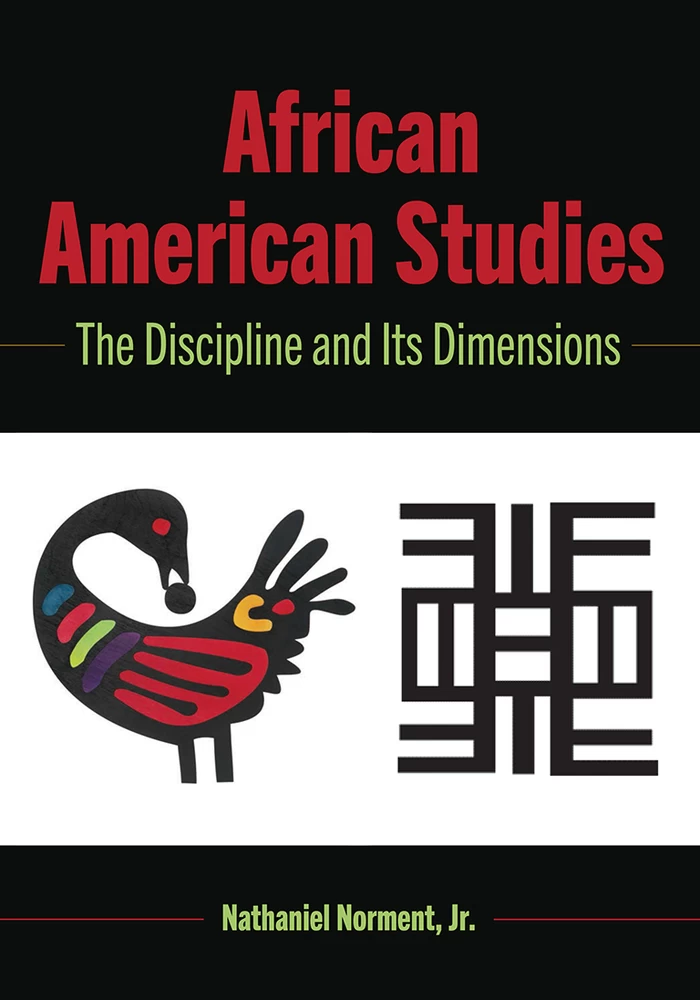
African American Studies
The Discipline and Its Dimensions
Summary
Excerpt
Table Of Contents
- Cover
- Title
- Copyright
- About the author(s)/editor(s)
- About the book
- Advance Praise for African American Studies The Discipline and Its Dimensions
- This eBook can be cited
- Table of Contents
- List of Tables
- List of Figures
- Preface
- A Note to the Reader
- Acknowledgments
- Part One: African American Studies: The Discipline
- 1. Introduction to African American Studies
- Introduction
- Forty-Five Years of African American Studies: 1969–2016
- What Is the Purpose of African American Studies?
- Mission of African American Studies
- Objectives of African American Studies
- African American Studies and Its Social-Community Responsibility
- Why Study African and African American Studies?
- What Can You Do with a Degree in African American Studies?
- The Concept of the Discipline of African American Studies
- The Development of African American Studies Core Curricula
- Basic Competencies for African American Studies
- Theoretical and Methodological Approaches to Research in African American Studies
- Theory and Theory Building in the Discipline
- Methods and Methodologies in African American Studies
- Research Methods in African American Studies
- African American Studies: New Challenges and Future Directions
- Traditional Disciplines and the Foundation of Black Studies
- African American Studies and Other Academic Disciplines
- African American Studies Concepts and Disciplinary Terminologies
- Questions/Assignments, Activities, and Research Projects
- Early Pioneers and Contributors of African American Studies
- Founding Scholars of African American Studies
- African American Studies Scholars with Ph.D. in the Discipline
- Part Two: African American Studies: Its Dimensions
- 2. African American History
- The African Antecedent
- Introduction
- What Is African American History?
- Goals of African American History
- Major Fields of African American History
- Periods of African American History
- Summary and Current Trends
- African American History: Concepts and Terms
- Prominent African American Historians
- Contemporary African American Historians
- Questions/Assignments, Activities and Research Projects
- 3. African American Literature
- The African Antecedents
- Introduction
- What Is African American Literature?
- Goals of African American Literature
- Major Genres of African American Literature
- Perspectives of African American Literature
- Summary and Current Trends
- African American Literature and Literary Terminologies
- African American Literary Figures
- Questions/Assignments, Activities and Research Projects
- 4. African American Anthropology
- The African Antecedent
- Introduction
- What Is African American Anthropology?
- The Goals of African American Anthropology
- Major Fields of African American Anthropology
- Perspectives of African American Anthropology
- Selected Theoretical Approaches in Anthropology
- Summary and Current Trends
- Key Concepts and African American Anthropological Terminologies
- African American Anthropologists
- Questions/Assignments, Activities and Research Projects
- 5. African American Sociology
- The African Antecedent
- Introduction
- What Is African American Sociology?
- The Goals of African American Sociology
- The Perspective of Black Sociology
- The Black Sociologists
- Conceptual Models in African American Sociology
- Brief History of African American Sociology
- Major Fields of African American Sociology
- Selected Topics and Content of African American Sociology
- Summary and Current Trends
- Key Concepts and African American Sociological Terminologies
- African American Sociologists
- Questions/Assignments, Activities and Research Projects
- 6. African American Psychology
- The African Antecedent
- Introduction
- What Is African American Psychology?
- Perspectives from Black Psychology
- The Goals of African American Psychology
- Conceptualizing African (Black) Psychology
- The Social/Cultural Context of Psychologically Healthy Black Adults
- Major Fields of African American Psychology
- Perspectives and Content of African American Psychology
- Theories of Black Personality and Identity
- Summary and Current Trends
- Key Concepts and Terms of African American Psychology
- African American Psychologists
- Questions/Assignments, Activities, and Research Projects
- 7. African American Religion
- The African Antecedent
- Introduction
- African American Religious Organizations
- What Is African American Religion?
- The Goals of African American Religion
- Functions and Purposes of African American Religions
- Major African American Religious Denominations
- Major Fields of African American Religion
- Perspectives of African American Religion
- Key Concepts and Religious Terminologies
- Historical Personalities in African American Religion
- African American Theologians
- Pioneers of African American Religion
- Mega Church Pastors
- The New Wave of Mega Churches
- African American Television Preachers
- Questions/Assignments, Activities and Research Projects
- 8. African American Philosophy
- The African Antecedent
- Introduction
- What Is African American Philosophy?
- Goals of African American Philosophy
- Major Fields of African American Philosophy
- Brief History of African American Philosophy
- Perspectives and Theories of African American Philosophy
- Summary and Current Trends
- Key Concepts and Philosophical Terminologies
- Biographies of Selected African American Philosophers
- Questions/Assignments, Activities, and Research Projects
- 9. African American Political Science
- The African Antecedent
- Introduction
- What Is African American Political Science?
- The Goals of African American Political Science
- Major Fields of African American Political Science
- Perspectives and Content of African American Political Science
- Summary and Current Trends
- Key Concepts and Political Science Terminologies
- African American Political Scientists
- African American Political Activists
- Questions/Assignments, Activities, and Research Projects
- 10. African American Economics
- The African Antecedent
- Introduction
- What Is African American Economics?
- The Goals of African American Economics
- Major Fields of African American Economics
- Contents and Perspectives of African American Economics
- Summary and Current Trends
- African American Economics Concepts and Terminologies
- African American Economists
- African American Entrepreneurs
- African American CEOs
- African American Women on Corporate Boards
- Questions/Assignments, Activities and Research Projects
- 11. African American Music
- The African Antecedent
- Introduction
- What Is African American Music?
- Major Genres of African American Music
- Perspectives of African American Music
- Summary and Current Trends
- African American Music Terminologies
- Contributors to African American Music
- Notable African American Gospel Artists
- Notable African American Blues and Soul Artists
- Notable African American Jazz Artists
- Notable African American Rhythm and Blues Artists
- Notable African American Hip-Hop Artists
- Notable African American Classical Musicians
- Notable African American Musical Producers
- African American Ethnomusicologists
- Questions/Assignments, Activities, and Research Projects
- 12. African American Dance
- The African Antecedent
- Introduction
- What Is African American Dance?
- The Goals of African American Dance
- Major Genres of African American Dance
- Popular African American Dances
- Perspectives and Content of African American Dance
- Summary and Current Trends
- Key Concepts and Dance Terminologies
- African American Dance Masters and Choreographers
- Questions/Assignments, Activities, and Research Projects
- 13. African American Art
- The African Antecedent
- Introduction
- What Is African American Art?
- The Goals of African American Art
- Major Forms of African American Art
- Perspectives Relevant to African American Art
- Selected African American Art Concepts and Terms
- Notable Works of African American Artists
- Recent African American Artists and Photographers
- Summary and Current Trends
- African American Painters
- African American Photographers
- African American Illustrators
- African American Cartoonists
- African American Sculptors
- African American Quilters
- African American Muralist and Other Artists
- Questions/Assignments, Activities and Research Projects
- 14. African American Film
- The African Antecedent
- Introduction
- What Is African American Film?
- The Goals of African American Film
- Major Genres of African American Film
- A Brief History of African American Film
- Contemporary African American Film
- Summary and Current Trends
- Selected African Americans Film Terms
- African American Actors
- African American Directors and Filmmakers
- Questions/Assignments, Activities, and Research Projects
- 15. African American Education
- The African Antecedent
- Introduction
- What Is African American Education?
- Goals of African American Education
- Major Fields of African American Education
- Perspectives of African American Education
- Summary and Current Trends
- Key Concepts and Terms of African American Education
- Contributors to African American Education
- Question/Assignments, Activities, and Research Project
- 16. African American Science and Technology
- The African Antecedent
- Introduction
- What Is African American Science and Technology?
- Goals of African American Science and Technology
- Major Fields of African American Science and Technology
- Summary and Current Trends
- Science and Technology Key Concepts and Terminologies
- African American Scientists
- Engineers, Mathematicians, Physicians, Scientists, and Inventors
- Questions/Assignments, Activities, and Research Projects
- 17. African American Sports
- The African Antecedents
- Introduction
- History of African American Sports
- Major Fields of African American Sports and African American Athletes
- Notable Black Tennis Players
- Notable Black Horse Racing Jockeys
- Notable Black Race Car Drivers
- Notable African American Swimmers
- Notable African American Martial Artist
- Notable Black Baseball Players
- Notable Black Basketball Players
- Notable Black Boxers
- Notable Black NFL Football Players
- Notable Black Track and Field Athletes
- Notable Black Golf Legends
- Notable Black Ice Hockey Players
- Notable Black Gymnasts
- Questions/Assignments, Activities, and Research Projects
- Index
- Series index
Library of Congress Cataloging-in-Publication Data
Names: Norment, Nathaniel, author.
Title: African American studies: the discipline and its dimensions / Nathaniel Norment, Jr.
Description: New York: Peter Lang, 2019.
Series: Black studies and critical thinking, vol. 110 | ISSN 1947-5985 Includes bibliographical references and index.
Identifiers: LCCN 2018038333 | ISBN 978-1-4331-6130-8 (hardback: alk. paper) ISBN 978-1-4331-6129-2 (paperback: alk. paper) | ISBN 978-1-4331-5937-4 (ebook pdf) ISBN 978-1-4331-5938-1 (epub) | ISBN 978-1-4331-5939-8 (mobi)
Subjects: LCSH: African Americans—Study and teaching.
African Americans—Study and teaching—History. | Blacks—Study and teaching. Blacks—Study and teaching—History. | Africa—Study and teaching.
Africa—Study and teaching—History. Classification: LCC E184.7 .N67 2019 | DDC 305.896/07307—dc23 LC record available at https://lccn.loc.gov/2018038333
DOI 10.3726/b14631
Bibliographic information published by Die Deutsche Nationalbibliothek.
Die Deutsche Nationalbibliothek lists this publication in the “Deutsche Nationalbibliografie”; detailed bibliographic data are available on the Internet at http://dnb.d-nb.de/.
© 2019 Peter Lang Publishing, Inc., New York
29 Broadway, 18th floor, New York, NY 10006
www.peterlang.com
All rights reserved.
Reprint or reproduction, even partially, in all forms such as microfilm, xerography, microfiche, microcard, and offset strictly prohibited.
About the author(s)/editor(s)
About the book
African American Studies: The Discipline and Its Dimensions is a comprehensive resource book that recounts the development of the discipline of African American Studies and provides a basic reference source for sixteen areas of knowledge of the discipline: anthropology, art, dance, economics, education, film, history, literature, music, philosophy, psychology, religion, sociology, political science, science and technology, sports and religion. African American Studies defines bodies of knowledge, methodologies, philosophies, disciplinary concepts, contents, scope, topics scholars have concerned themselves, as well as the growth, development, and present status of the discipline. African American Studies validates that African American Studies is a unique and significant discipline—one that intersects almost every academic discipline and cultural construct—and confirms that the discipline has a noteworthy history and a challenging future. The various bodies of knowledge, the philosophical framework, methodological procedures, and theoretical underpinnings of the discipline have never been clearly delineated from an African-centered perspective.
ADVANCE PRAISE FOR
African American Studies:
The Discipline and Its Dimensions
“African American Studies: The Discipline and Its Dimensions (by Nathaniel Norment, Jr., a professor with decades of experience) is a roadmap to the evolution of Black Studies, past and future. He rends his way through the history and development of a complex and comprehensive account, connecting African American Studies to other bodies of knowledge to reveal and display the elusive underbelly and underpinnings of the discipline, exposing its variety of parts of the discipline and what they mean, painting the contours of the difference between Black Studies and the study of blackness while incorporating and integrating the multidiscipline. After poring over the manuscript in recent months, I can testify that it is a monumental snapshot of a fountain of knowledge as well as a new pedagogy for the elevation and empowerment of those who lost their roots in the tangled horror and mean and rushing waters of the Middle Passage to a strange land and corrosive centuries of enslavement and inhumane destruction as segregated and marginalized chattel. This book will bolster the academic and public appreciation of the history of the field and is likely to become the number one bible of African American studies, a multifaceted blueprint, for years to come.”
—NATHAN HARE, professor, sociologist, psychologist; the first person to coordinate/chair a Black Studies program at a U.S. university (San Francisco State University); co-founder of The Black Think Tank with Julia Hare and co-founder of The Black Scholar: A Journal of Black Studies and Research with Robert Chrisman
“Nathaniel Norment, Jr has produced an impressively vital, thoroughly researched, and engagingly written overview of African American Studies. He illuminates the significant African American contributors to the development of Black culture, history, politics, and liberation movements with special focus on the twentieth and twenty-first centuries. African American Studies: The Discipline and Its Dimensions explores and provides insights into Black life, struggles, creativity, and the endless social movements for freedom and justice. The impressive bibliography, primary documents, and profiles of African American leaders and creative artists will encourage readers to delve even deeper into the Black past and to participate in the continuing quest for freedom and justice. This textbook places African American Studies on a solid foundation and insures its continuation as a dynamic field of intellectual inquiry.”
—DARLENE CLARK HINE, John A. Hannah Distinguished Professor of History, Michigan State University
“African American Studies: The Discipline and Its Dimensions is a rare text with as much depth as breadth. It stands alone as a comprehensive guide to the history, present and future of the fields of African American and Africana Studies and is a highly readable, engaging indispensable resource for teachers, students and the all others who want to better understand the breathtakingly interdisciplinary contributions of Black Studies to higher education and the world at large.”
—NOLIWE ROOKS, Professor, Africana Studies, and Director, American Studies, Cornell University
“Confronted with a volume this size the knee jerk reaction is to use terms such as ‘definitive,’ ‘comprehensive,’ and ‘indispensable’. With African American Studies: The Discipline and Its Dimensions these have been earned and are well deserved. Nathaniel Norment, Jr engages a subject that is broad in scope, evolving in complexity, steeped in scholarly debates, and now a half-century old in its current phase. After a learned and balanced discussion of the origins and development of African American Studies in the broadest sense, Professor Norment devotes seventeen chapters to areas and disciplines where it is both relevant and has had an impact. This book is such a treasure trove of persons, events, organizations, facts and analysis that it should be on the desk of every professor and teacher in the field from middle and high schools through undergraduate and graduate institutions. The bibliographies are reliable starting points for additional reading and research for teachers and students alike. Clear in its point of view, free from the factual errors, polemics and out right falsehoods that can appear on some. internet sites, African American Studies: The Discipline and Its Dimensions is a trustworthy resource. Well done, Professor Norment. Well done.”
—JOHN H. BRACEY, Professor and former Chair, W.E.B. Du Bois Department of Afro-American Studies, University of Massachusetts, Amherst
“Nathaniel Norment, Jr.’s African American Studies: The Discipline and Its Dimensions is the most comprehensive mapping of the field to date. Ambitious and learned, this text grounds Black thought in an African context before demonstrating how Black intellectuals have engaged, challenged and transformed Eurocentric bodies of knowledge housed in conventional Western disciplines. Ranging over sixteen areas including, but not limited to, philosophy, anthropology and history, this work is sure to shape our understanding of, and debates about, African American Studies for generations. It is a brilliant achievement, a singular contribution.”
—FARAH JASMINE GRIFFIN, William B. Ransford Professor English and Comparative Literature and African American Studies, Columbia University
“African American Studies: The Discipline and Its Dimensions</i> is an ambitious and successful project. Wonderfully balanced and nicely nuanced, the text examines a variety of conventional academic disciplines through the lenses of the Black experience, as well as Black scholars who study the black world. Nathaniel Norment, Jr. has brought together various elements of African American Studies as an intellectual enterprise that seeks a comprehensive exploration of that field of study grounded in an African-center perspective. In a single text, he contributes to our understanding of the limits of traditional Western conceptions of knowledge, as well as the unswerving commitment of black scholars and African American Studies to advance counterarguments, theories, and methodologies related to the ongoing struggle for Black freedom and liberation.”
—FLOYD W. HAYES, III, retired Senior Lecturer, Center for Africana Studies, Johns Hopkins University
“Nathaniel Norment, Jr.’s African American Studies: The Discipline and Its Dimensions is a comprehensive anthology on various streams in disciplinary and interdisciplinary African American Studies from an African-centered perspective. His approach is to address some of the gaps in African American Studies by illuminating some of the new trends, theories, and methods that have emerged. Professor Norment, a well-known, respected scholar in his own right, provides a view of African American experiences that looks more fully at the wholeness of African peoples from the perspective of those people. This book stands as an asset for students at all levels.”
—TARA GREEN, Linda Carlisle Excellence Professor of Women’s and Gender Studies, Professor and Former Director (2008–2016) of African American and African Diaspora Studies at the University of North Carolina in Greensboro
This eBook can be cited
This edition of the eBook can be cited. To enable this we have marked the start and end of a page. In cases where a word straddles a page break, the marker is placed inside the word at exactly the same position as in the physical book. This means that occasionally a word might be bifurcated by this marker.
Table 1.1 Theoretical Paradigms in African American Studies
Table 1.2 Disciplinary Research Methods Used in African American Studies
Table 1.3 Institutions Conferring Bachelor’s Degrees in 2002–200
Table 1.4 Institutions Conferring Ph.D. Degrees
Table 1.5 Institutions Conferring Master’s Degrees in 2002–200
Table 1.6 Bodies of Knowledge and Contents of African American Studies
Table 5.1 Black Prisoners by Offense
Table 5.2 State and Federal Prison Incarceration
Table 5.3 Population by Sex and Age for Black Alone and White Alone
Table 5.4 Top 20 Cities with Largest African American Population
Table 5.5 Marital Status of the Population Age 15 Years and Over by Sex, for Black Alone and White Alone, Not Hispanic
Table 5.6 Family and Nonfamily Household Type, for Black Alone and White Alone, Not Hispanic Households
Table 6.1 Dixon’s Comparison of Euro-American and African Philosophical Orientation
Table 7.1 Religion/Denomination
Table 10.1 Homeownership Rates by Race and Ethnicity of Householder
Table 10.2 Earnings of Full-Time, Year-Round Workers 15 Years and Over in 2003 by Sex, for Black Alone and White Alone, Not Hispanic
Table 10.3 Total Money Income in 2003 of Families by Type, for Black Alone and White Alone, Not Hispanic Families
Table 10.4 African Americans Net Worth
Table 10.5 The Wage Gap by Gender and Race
Table 10.6 Major Occupation Group of the Employed Civilian Population 16 Years and Over by Sex, for Black Alone and White Alone, Not Hispanic ← xvii | xviii →
Table 10.7 Poverty Status of Families in 2003 by Type, for Black Alone and White Alone, Not Hispanic Families
Table 10.8 Employment Status of the Population 16 Years and Over in the Civilian Labor Force by Sex, for Black Alone and White Alone, Not Hispanic
Table 10.9 Earnings of Full-Time Year-Round Workers 15 Years and Over in 2003 by Sex, for Black Alone and White Alone, Not Hispanic
Table 10.10 Total Money Income in 2003 of Families by Type, for Black Alone and White Alone, Not Hispanic Families
Table 10.11 Black-Owned Businesses
Table 11.1 Notable African American Gospel Artists
Table 11.2 Notable African American Jazz Musicians
Table 11.3 Notable African American DJs
Table 15.1 Educational Attainment of the Population 25 Years and Over by Sex, for Black Alone and White Alone, Not Hispanic
Table 16.1 First Science Doctorates Awarded to African Americans “The Faces of Science: African Americans in the Sciences”
Table 16.2 Black First: 2000 Years of Extraordinary Achievement in Science and Technology
Figure 1.1 Fields and Functions of African American Studies and Public Policy
Figure 11.1 The Evolution of African American Music
Figure 13.1 “Little Black Girl” by King-Steven Adebanji
Figure 13.2 “Mother and Daughter” by Michael Wilson
Figure 13.3 “North Star” by Assata Norment
Figure 13.4 “Attitude” by CMolly
Figure 13.5 “For Harriet” by Anthony Hale
Figure 13.6 “Brothers” by Rosemaire Mollison
Figure 13.7 “Mother and Sons” by Clarence Alexander
Figure 13.8 “Crest” by Maurice Evans
Figure 13.9 “Queen of Clubs” by Natasha Townsel
Figure 13.10 “Black Gem” by Paul Branton
Figure 13.11 “Untitled” by Trevor Lightsy
Figure 13.12 “Black Man” by Waymon Lindsay
Figure 13.13 “Laundry Day” by Ahmed Salam
Figure 13.14 “Growth Process” by Joseph Stewart
Figure 13.15 “Tara’s Smile” by Wycliffe Link Bennett
The discipline of African American Studies creates a space of intellectual agency that allows scholars to do academic work without being confined to the methodological paradigms of traditional disciplines. Hence, in African American Studies, all realms of knowledge become accessible to the scholar without concern for the embracing of traditional discipline-specific sanction. African American Studies as a discipline sought freedom from the enslavement of disciplinary boundaries and limitations. Therefore, this text gives honor to the invisible progenitors, that is, our founders who demanded our entry as equal and independent scholars.
African American Studies has taught the contributions of African people to the world. This textbook, African American Studies: The Discipline and Its Dimensions,1 includes the work of many scholars who have produced the knowledge content of this discipline. Contemporary scholars and students must be able to trace the evolution of the discipline in order to evaluate if the discipline has deviated from or stayed true to its original mission. It is absolutely necessary for students to know the original “blueprint/purpose”2 of Black Studies in order to understand arguments made for the discipline’s existence and to recognize its place in the academy and community.
This text presents the discipline’s subject matter about African Americans from an African-centered perspective.3 The various bodies of knowledge, the philosophical framework, methodological procedures, and theoretical underpinnings of the discipline have never been clearly delineated. This text attempts to do so. In order for any discipline to thrive, how the discipline emerged4 and the academic and historical legitimacy of its subject matter must be clear. Further, arguments and debates that scholars such as John Blassingame, John Henrik Clarke, St. Clair Drake, Nick Aaron Ford, Vivian Gordon, Ewart Guinier, Nathan Hare, Wilfred Cartey, Maulana Karenga, James Turner, Harold Cruse, Martin Kilson, Bertha Maxwell, and Sidney F. Walton initiated some forty-five years ago can now be discussed with the benefit of a comprehensive text which juxtaposes all aspects of the discipline of African American Studies. ← xxi | xxii →
Despite publications since 1968,5 today there is not a viable textbook that effectively incorporates the genealogy and worldview in which African American Studies scholars make meaning and produce knowledge. An introductory text for the discipline is crucial6 in providing an overview of the African antecedent, the history of African-centered thought in the Diaspora, the Africana worldview, and delineating the contributions of the exemplars of the interdisciplinary Africana Studies, highlighting their approaches, methods, and ways in which they applied their intellectual work to social uplift. This is a monumental task and scholars committed to the discipline must seek like-minded individuals dedicated to work on scholarly projects, much like the historical work completed by Dr. W. E. B DuBois in the Atlanta University’s studies and the Department of Labor in the early 20th century. Also, the work of the Institute of the Black World is a model that can be emulated, as well as the creation of a research committee within the National Council of Black Studies, the Association for the Study of African American Life and History, and the Association for the Study of Classical African Civilizations. This is absolutely essential to further the discipline in the 21st century and for eternity.
Within African American Studies, this volume7 takes its place alongside a number of volumes in print or in preparation, which together will give a comprehensive documentation of the discipline. These include: Mario Azevedo, ed. (2005), Africana Studies: A Survey of Africa and the African Diaspora; Beverly Guy-Sheftall, ed. (1995), Words of Fire: An Anthology of African American Feminist Thought; Nikongo BaNikongo, ed. (1997), Leading Issues in African-American Studies; Manning Marable, ed. (2000), Dispatches from the Ebony Tower: Intellectuals Confront the African American Experience; Talmadge Anderson (1990), Black Studies, Theory, Method and Cultural Perspectives; Floyd W. Hayes III (2001), A Turbulent Voyage: Readings in African American Studies; Maulana Karenga (2003), Introduction to Black Studies; James Turner, ed. (1984), The Next Decade: Theoretical and Research Issues in Africana Studies; Sidney F. Walton (1969), The Black Curriculum: Developing a Program in Afro-American Studies; Molefi Asante (1990), Kemet, Afrocentricity and Knowledge; Delores Aldridge and Carlene Young, eds. (2001), Out of the Revolution; James Conyers, Jr., ed. (1997), Africana Studies: A Disciplinary Quest for Both Theory and Method; Gloria Hull, Patricia Bell Scott and Barbara Smith, ed. (1982), All the Women Are White, All the Blacks Are Men, but Some of Us Are Brave; Armstead L. Robinson, Craig C. Foster, and Donald H. Ogilvie (1969), Black Studies in the University: A Symposium; Joyce A. Joyce (2005), Black Studies as Human Studies: Critical Essays and Interviews; Lewis Gordon and Jane Gordon (2006), A Companion to African American Studies; Marimba Ani (2000), Yurugu: An African-Centered Critique of European Cultural Thought and Behavior, 10th Edition; Molefi Asante and Maulana Karenga (2005), Handbook of Black Studies; Talmadge Anderson and James Stewart (2008), Introduction to African American Studies; and Nathaniel Norment Jr., editor, (2001/2007), The African American Studies Reader.
Notes
1. A discipline implies a set of formally interrelated facts, concepts, and generalizations. It also implies a set of standardized techniques and skills. The components are part and parcel of a body of theory, propositions, and a subject matter. The specific subject matter is normally what separates one discipline from another. Generally, disciplines have five basic components: (1) a rationale; (2) a body of literature; (3) a curriculum based on the major areas of the field; (4) an overall theoretical framework within which the various hypotheses can be constructed; and (5) methodologies by which the various hypotheses can be tested. For specific discussions relevant to African American/Black Studies as a discipline, see Phillip T. K. Daniel, “Black Studies: Discipline or Field of Studies?” The Western Journal of Black Studies 4, no. 3 (Fall 1980): 195–99; Preston Wilcox, “Black Studies as an Academic Discipline,” Negro Digest 19, no. 3 (1970): 75–87 and Black Studies as an Academic Discipline: Toward a Discipline (New York: Afam Associates, Inc., 1969).
For this textbook, Dimensions are the “traditional” academic disciplines and the bodies of knowledge that provide the foundations for the study of African American people. This author proposes sixteen fields of study: anthropology, art, dance, education, film, literature, psychology, sociology, philosophy, political science, economics, history, music, science and technology, sports, and religion that make up the bodies of knowledge in African American Studies. Within the general context of academia and education, African American Studies has not only contributed to existing bodies of knowledge, but has also generated new and challenging fields of study, epistemologies, perspectives, and approaches for examining the historical and contemporary experiences of people of African descent. ← xxii | xxiii →
Details
- Pages
- XXXIV, 684
- Publication Year
- 2019
- ISBN (PDF)
- 9781433159374
- ISBN (ePUB)
- 9781433159381
- ISBN (MOBI)
- 9781433159398
- ISBN (Hardcover)
- 9781433161308
- ISBN (Softcover)
- 9781433161292
- DOI
- 10.3726/b14631
- Language
- English
- Publication date
- 2019 (April)
- Published
- New York, Bern, Berlin, Bruxelles, Oxford, Wien, 2019. XXXIV, 684 pp., 17 b/w ill., 31 tables
- Product Safety
- Peter Lang Group AG
