Quantifier Scope as a Diagnostic for the Position of Arguments of Ditransitive Verbs

Summary
Excerpt
Table Of Contents
- Cover
- Title
- Copyright
- About the author
- About the book
- This eBook can be cited
- Acknowledgments
- Contents
- Introduction
- Chapter 1 Ditransitive structures in English
- 1.1 Introduction
- 1.2 Basic issue: canonical structure and the UTAH (Baker 1988)
- 1.2.1 Derivational approaches to English dative alternation
- 1.2.2 Non-derivational approaches
- 1.2.3 Lexicalist approaches
- 1.3 Quantifier scope as a diagnostic for the structure
- 1.4 Conclusion
- Chapter 2 Slavic ditransitives
- 2.1 Introduction
- 2.2 Object order in Slavic ditransitives and the nature of short scrambling
- 2.2.1 Derivational approaches
- 2.2.2 Scrambling as movement and binding facts
- 2.2.3 Scrambling without movement
- 2.2.4 Non-derivational and mixed approaches
- 2.3 Verb classes and different canonical object orders
- 2.4 Quantifier scope as a diagnostic
- 2.5 Conclusion
- Chapter 3 Scope changing mechanisms and scrambling
- 3.1 Introduction
- 3.2 Quantifier Raising (QR)
- 3.2.1 Setting the scene: Inverse Linking and QR landing site (May 1977, 1985, Larson 1985, May and Bale 2006)
- 3.2.2 Restrictions on QR: Economy
- 3.2.2.1 Scope Economy (Fox 1995)
- 3.2.2.2 Syntactic Economy (Bruening 2001)
- 3.2.2.3 Evidence for Shortest: Superiority effects
- 3.2.3 QR and Coordinate Structure Constraint (Ross 1967)
- 3.2.4 Against QR: scope as a result of Case-driven movement (Hornstein 1995)
- 3.3 Scope reconstruction
- 3.4 Scope interpretation in scrambling languages
- 3.4.1 Scope rigidity
- 3.4.2 Scope rigidity in DOCs
- 3.5 Conclusion
- Chapter 4 Quantifier scope and scrambling: off-line experiments
- 4.1 Introduction
- 4.2 Theoretical basis for object order and coordination variables
- 4.2.1 Scope rigidity (object order variable)
- 4.2.2 QR or scope reconstruction (coordination variable)
- 4.3 Experiment 1: the correlation between scope interpretation and object order – Polish verbs with Recipient vs. Bene-/Malefactive datives
- 4.3.1 Applicatives and QR
- 4.3.2 Aims and predictions
- 4.3.3 Participants, materials and procedure
- 4.3.4 Results and discussion
- 4.4 Experiment 2: the correlation between quantifier scope interpretation object order and coordination – verbs with Recipient and Benefactive datives
- 4.4.1 Aims and predictions
- 4.4.2 Participants, materials and procedure
- 4.4.3 Results and discussion
- 4.5 Experiment 3: the correlation between quantifier scope interpretation, quantifier order, object order and animacy
- 4.5.1 The scope of indefinites: specificity/referentiality in the choice-function approach
- 4.5.2 Aims and predictions
- 4.5.3 Participants, materials and procedure
- 4.5.4 Results and discussion
- 4.6 Conclusion
- Chapter 5 Quantifier scope processing: off-line and online visual disambiguation experiments
- 5.1 Introduction
- 5.2 Tested assumptions: syntactic structure and the processing of meaning
- 5.2.1 Two classes of ditransitive verbs: object order and coordination
- 5.2.2 Disambiguation methods and the processing of meaning
- 5.3 Experiment 4 (off-line): the correlation between quantifier scope interpretation, quantifier order, and coordination in two classes of ditransitive verbs
- 5.3.1 Aims and predictions
- 5.3.2 Participants, materials and procedure
- 5.3.3 Results and discussion
- 5.4 Experiment 5 (RTs): the correlation between quantifier scope interpretation, quantifier order, and coordination with two classes of ditransitive verbs
- 5.4.1 Aims and predictions: syntactic theory
- 5.4.2 Aims and predictions: processing of meaning
- 5.4.3 Experiment design
- 5.4.3.1 Participants and materials
- 5.4.3.2 Procedure
- 5.4.4 Results and discussion: syntactic theory
- 5.4.5 Results and discussion: processing theory
- 5.5 Conclusion
- Chapter 6 Toward an analysis
- 6.1 Introduction
- 6.2 Consequences for scope rigidity and scope reconstruction
- 6.2.1 Scope rigidity and scope freezing (class 1 verbs)
- 6.2.2 Quantifier scope and scope reconstruction (class 1 verbs)
- 6.3 Main findings and their consequences for the structure
- 6.3.1 Class 1 verbs
- 6.3.2 Class 2 verbs
- 6.3.3 Free IO datives
- 6.4 Conclusion
- Conclusion
- Summary
- Streszczenie
- Appendix A: Exp1 and Exp2 materials
- Appendix B: Exp3 materials
- Appendix C: Exp4 and Exp5 materials
- List of figures
- List of tables
- References
- Series Index
Introduction
This dissertation aims to establish the basic structural configuration between two objects of a ditransitive verb in Polish, basing on the accounts proposed for the English dative alternation, which were later adopted to other languages, including Slavic (or scrambling languages in general). Namely, just like English manifests two alternative structures for a ditransitive verb like ‘send’, i.e. double object construction (DOC) (1a) and prepositional dative structure in (1b), Polish sentences with ditransitive verbs allow for two object orders, as in (2).
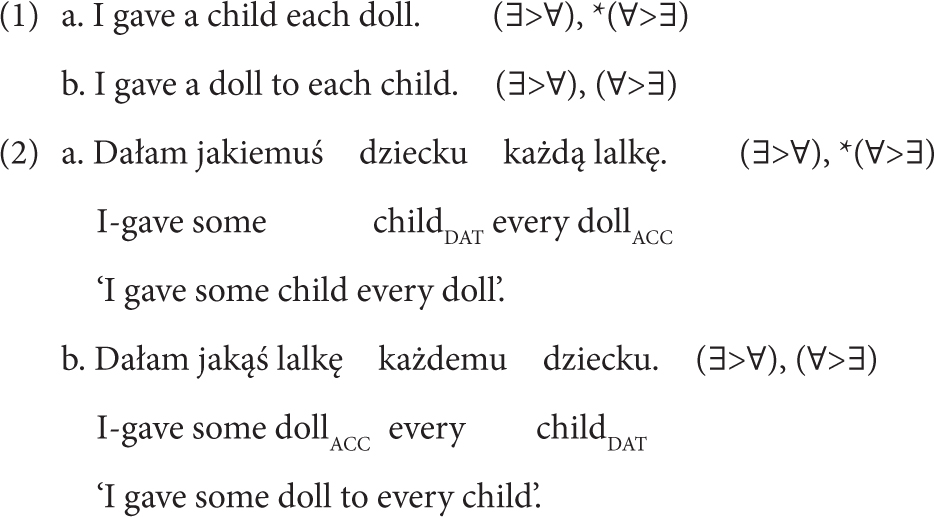
The main question regarding these alternations is whether they are derivationally related or not and if so, which of them is derived and which is canonical. Assuming that merger of arguments is licensed by a universal thematic hierarchy (a version of the Uniformity of Theta Assignment Hypothesis of Baker 1988), if the two dative variants in (1) and (2) involve the same thematic interpretation of objects, one must be derived from the other to comply with the universal thematic hierarchy. However, either can be basic or derived, depending on whether the hierarchy is Theme>Goal or Goal>Theme. If the arguments have different thematic interpretations depending on the dative alternation in (1) or object order in (2), the two variants can be claimed to involve separate basic structures.
One of the observations that has been used to claim for a particular ditransitive structure is scope pattern asymmetries. Namely, the double object construction in English (1a) is scope rigid, allowing only for surface scope interpretation, while the prepositional dative structure is scope ambiguous, allowing for the inverse scope reading. Likewise, the IODAT-DOACC order, as in Polish (2a), for ←13 | 14→many Slavic languages has been claimed to be scope rigid, while the DOACC-IODAT order in (2b) has been claimed to allow for scope ambiguity. However, the problem with using scope interpretation as a proof for the position of arguments is that such argumentation is usually beset with auxiliary assumptions as to the scope changing mechanism responsible for scope ambiguity/rigidity. That is, choosing one theory of quantifier scope or the other, the same scope patterns in (1)–(2) can be explained regardless of whether (1a)/(2a) or (1b)/(2b) is assumed to be canonical. For example, if scope reconstruction derives scope ambiguity in the (b) examples, these dative variants should be derived. On the other hand, if movement of one QP over another QP freezes scope while ambiguity is derived by free Quantifier Raising (QR) in the basic structure, the (b) examples should be basic and the (a) examples derived. Therefore, one needs to be cautious in using quantifier scope patterns to advocate for one structure or the other.
In the present study, quantifier scope was used as a diagnostic tool for the position of object arguments in a way which avoids the above-mentioned confound. More specifically, no assumptions were made as to the structure of ditransitive verbs or the scope changing mechanism responsible for deriving scope patterns. To achieve that, I implemented a well-established idea that quantifier movement obeys similar locality restrictions as overt movements, and thus, it is impossible out of syntactic islands such as e.g. complex DP or coordination. In particular, in my experiments, I used contexts with the universal quantifier embedded in one conjunct, which should prevent it from taking scope over any other QP (due to the Coordinate Structure Constraint, CSC, Ross 1967). This way, the emerging scope patterns could not be claimed to be derived by QR which is constrained under coordination island. Consequently, scope ambiguity could be explained by scope reconstruction, thus indicating which of the object orders is derived, since scope reconstruction applies only in the presence of traces of movement.
In my experiments, 3 classes of Polish verbs were tested. Class 1 involved canonical ditransitive verbs like ‘send’ (wysłać) or ‘show’ (pokazać), class 2 was based on the categorization proposed for Czech in Dvořák (2010) who claims that this class involves a canonical DO-IO order, with verbs like ‘subordinate’ (podporządkować) and ‘entrust’ (powierzyć), while class 3 involved transitive verbs which can occur with free datives, like ‘open’ (otworzyć) or ‘fix’ (naprawić).
The results showed two basic scope patterns. For class 1 verbs, the IODAT-DOACC order was scope rigid while the reverse DO-IO order was scope ambiguous and coordination did not diminish scope ambiguity but it had an effect in decreasing accessibility of ambiguous scope. For class 2 and class 3 verbs, again, the IODAT-DOACC order was scope rigid while the reverse DO-IO order was scope ambiguous but in this case, scope ambiguity was unaffected by coordination. ←14 | 15→This result supports the categorization of verbs into (at least) these 3 classes, with different merge positions of the IODAT.
I propose that in class 1 verbs, the IODAT is first merged in spec,vAppl, above the DOACC and the reverse object order is derived by scrambling of the DOACC which can result in reconstruction, leading to scope ambiguity. The IODAT in class 2 and class 3 verbs, on the other hand, is first merged as a complement to a null P head, with the DOACC being in spec,PP. The P head assigns dative case and appropriate θ role (Path in class 2 verbs and Target Person in class 3 verbs) to its complement. If the IODAT stays in this position, the DO-IO object order emerges and scope ambiguity results from ambiguous structure in which the two quantified objects c-command each other. However, the IODAT can in principle move to a higher dative position in spec,vAppl (the first merge position of the class 1 IODAT). This movement occurs when the P head is either deleted or caseless, and, this movement being case-driven, does not reconstruct for scope. As a result, the IO-DO order emerges and scope is rigid due to the asymmetric c-command between the objects.
This categorization and two merge positions for IODATs are further supported by the thematic interpretation of this argument depending on the verb class. Succinctly put, while class 1 verbs put stricter requirements on the animacy of IODATs, allowing only the NPs which can denote Recipients, the IODAT in class 2 and class 3 verbs do not have to abide by the same requirements, bearing a much broader thematic interpretation than class 1 IODATs (and also allowing for inanimate IODATs). This difference can be explained if the IODATs in classes 2 and 3 are introduced by a P head, the semantics of which is compatible with the semantics of the verb.
Details
- Pages
- 362
- Publication Year
- 2020
- ISBN (Hardcover)
- 9783631802861
- ISBN (PDF)
- 9783631811184
- ISBN (ePUB)
- 9783631811191
- ISBN (MOBI)
- 9783631811207
- DOI
- 10.3726/b16515
- Language
- English
- Publication date
- 2020 (March)
- Keywords
- Quantifier Raising scope reconstruction coordination syntax-semantics interface double-object verbs prepositional datives
- Published
- Berlin, Bern, Bruxelles, New York, Oxford, Warszawa, Wien, 2020. 362 pp., 112 fig. b/w, 6 tables.
- Product Safety
- Peter Lang Group AG
Biographical notes
Paulina Łęska (Author)
Paulina Łęska is a PhD candidate at the Faculty of English of Adam Mickiewicz University, Poznań. She was involved in two research projects funded by the Polish National Science Centre, one investigating Polish nominal phrases (2014-2017) and the other examining the properties of dative arguments (2015-). She was awarded Adam Mickiewicz University Vice-Chancellor's scholarship in years 2015/2016, 2016/2017, 2017/2018, 2018/2019, and Adam Mickiewicz University Foundation Scholarship for best PhD students in 2018/2019.
