results
-
Hermeneutic Commentaries
ISSN: 1043-5735
"The question of interpretation of the text is at the center of this collection of monographs and commentaries on classical literatures. Interpretation starts with the realisation that at the outset, the sense of a text is an hypothesis to be gradually and constantly revised and ascertained. Grammar, syntax, and rhetoric are certainly the necessary part for this critical operation, but they fall short of giving full sense to the signification of the text. A philological commentary establishes the texts as close as possible to the authors text, and provides the information necessary for modern readers to understand what the text meant to its contemporary users. But besides the impossibility of achieving this task fully, this sort of information does not provide the sense of the text as it opens itself to the questions of its individuality and universality, its historicity and its transhistorical iterability, as it hides the rules and game of its composition, its difference in order to show its identity. These opposite poles are constantly united and create a tension, a continuous oscillation that are the very domaine of the interpretative analysis, and the conditions of the texts ever emerging sense . The hermeneutic circle, through which the critical hypothesis is constantly revised and made more precise, can be viewed also as a sort of deconstructive operation, a decomposing of the text in order to recompose it around its now discovered rules and games, of which the author is not necessarily always fully aware. Because of these conditions the sense of a text is more open to the critics than to its author; this point makes the critics conscious that as they are reading, they are in some way writing the text." "The question of interpretation of the text is at the center of this collection of monographs and commentaries on classical literatures. Interpretation starts with the realisation that at the outset, the sense of a text is an hypothesis to be gradually and constantly revised and ascertained. Grammar, syntax, and rhetoric are certainly the necessary part for this critical operation, but they fall short of giving full sense to the signification of the text. A philological commentary establishes the texts as close as possible to the authors text, and provides the information necessary for modern readers to understand what the text meant to its contemporary users. But besides the impossibility of achieving this task fully, this sort of information does not provide the sense of the text as it opens itself to the questions of its individuality and universality, its historicity and its transhistorical iterability, as it hides the rules and game of its composition, its difference in order to show its identity. These opposite poles are constantly united and create a tension, a continuous oscillation that are the very domaine of the interpretative analysis, and the conditions of the texts ever emerging sense . The hermeneutic circle, through which the critical hypothesis is constantly revised and made more precise, can be viewed also as a sort of deconstructive operation, a decomposing of the text in order to recompose it around its now discovered rules and games, of which the author is not necessarily always fully aware. Because of these conditions the sense of a text is more open to the critics than to its author; this point makes the critics conscious that as they are reading, they are in some way writing the text." "The question of interpretation of the text is at the center of this collection of monographs and commentaries on classical literatures. Interpretation starts with the realisation that at the outset, the sense of a text is an hypothesis to be gradually and constantly revised and ascertained. Grammar, syntax, and rhetoric are certainly the necessary part for this critical operation, but they fall short of giving full sense to the signification of the text. A philological commentary establishes the texts as close as possible to the authors text, and provides the information necessary for modern readers to understand what the text meant to its contemporary users. But besides the impossibility of achieving this task fully, this sort of information does not provide the sense of the text as it opens itself to the questions of its individuality and universality, its historicity and its transhistorical iterability, as it hides the rules and game of its composition, its difference in order to show its identity. These opposite poles are constantly united and create a tension, a continuous oscillation that are the very domaine of the interpretative analysis, and the conditions of the texts ever emerging sense . The hermeneutic circle, through which the critical hypothesis is constantly revised and made more precise, can be viewed also as a sort of deconstructive operation, a decomposing of the text in order to recompose it around its now discovered rules and games, of which the author is not necessarily always fully aware. Because of these conditions the sense of a text is more open to the critics than to its author; this point makes the critics conscious that as they are reading, they are in some way writing the text."
1 publications
-

Old Jewish Commentaries on the Song of Songs I
The Commentary of Yefet ben Eli- Edited and translated from Judeo-Arabic by Joseph Alobaidi©2010 Others -
Old Jewish Commentaries on «The Song of Songs» II
The Two Commentaries of Tanchum Yerushalmi- Text and translation©2014 Others -
-
COMMENTARII IN PROPERTIVM - PRIMVS COMMENTARIVS
Der Kommentar zum Ersten Buch der Elegien des Properz©2015 Thesis -
Kommentare zum Buch Rut von Josef Kara
Editionen, Übersetzungen, Interpretationen – Kontextualisierung mittelalterlicher Auslegungsliteratur©2017 Thesis -
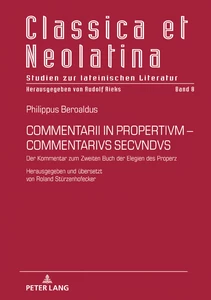
COMMENTARII IN PROPERTIVM-COMMENTARIVS SECVNDVS
Der Kommentar zum Zweiten Buch der Elegien des Properz. Herausgegeben und übersetzt von Roland Stürzenhofecker©2019 Thesis -
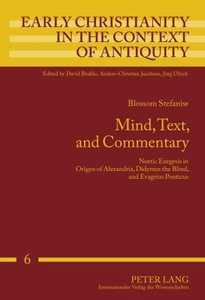
Mind, Text, and Commentary
Noetic Exegesis in Origen of Alexandria, Didymus the Blind, and Evagrius Ponticus©2010 Thesis -
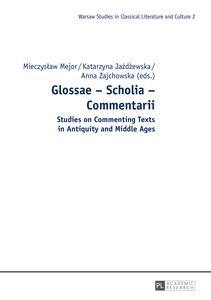
Glossae – Scholia – Commentarii
Studies on Commenting Texts in Antiquity and Middle Ages©2015 Edited Collection -
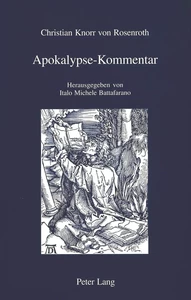
-
Glossar und Kommentare zu V. Astafjews "Der traurige Detektiv"
©1989 Monographs -

Kommentar zu Deuteronomium 1
©2024 Monographs -
-
-
13 Acts of Academic Journalism and Historical Commentary on Human Rights
Opinions, Interventions and the Torsions of Politics©2017 Monographs -
-
-

-
Philologischer Kommentar zu Augustinus «De civitate Dei», Buch I
Mit Hinweisen zu Sprache und Stil©2004 Thesis -
A Translation of Plato’s «Sophist» with an Introductory Commentary
Translated by James Duerlinger©2009 Monographs -
Der Deuteronomiumkommentar des Theodoret von Kyros
©2002 Thesis -
Der Hoheliedkommentar und die «Expositio de muliere forte» Brunos von Segni
Einführung, kritische Edition mit synoptischer Übersetzung und Kommentar©2015 Thesis -
Benedict Nta Tanka's Commentary and Dramatized Ideas on «Disease and Witchcraft in our Society»
A Schreber Case from Cameroon- Annotated Autobiographical Notes by an African on his Mental Illness©1980 Others