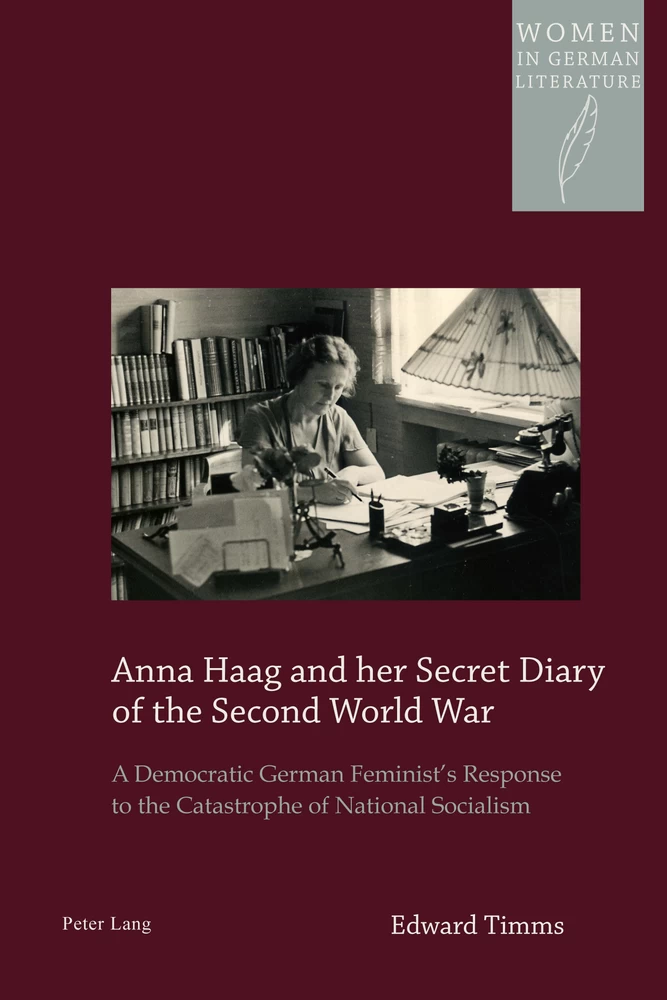
Anna Haag and her Secret Diary of the Second World War
A Democratic German Feminist’s Response to the Catastrophe of National Socialism
Summary
Excerpt
Table Of Contents
- Cover
- Title
- Copyright
- About the author(s)/editor(s)
- About the book
- This eBook can be cited
- Contents
- List of Illustrations
- Acknowledgements
- Introduction: Fragments of History in the Raw
- Chapter 1: Paradigms of Creativity and Marriage with an Educational Mission
- Chapter 2: Fighting for the Fatherland: Sacrifice, Resilience and Loyalty Betrayed
- Chapter 3: Republican Values, Female Agency and the International Peace Campaign
- Chapter 4: Responses to Hitler’s Seizure of Power: A Purely Masculine Affair?
- Chapter 5: The People’s War: Diarists, Demagogues, Spin-Doctors, Popular Broadcasters and Secret Listeners
- Chapter 6: False Ideals: Master Race, Religious Mission, Faith in the Führer, Tainted Healthcare and Perverted Justice
- Chapter 7: Avalanche: Super-Criminals, Yellow Stars, Deportations, Plunder, Slaughter – and the Spectre of Poison Gas
- Chapter 8: Echoes of Stalingrad and Un-German Attitudes: Women’s Responses to Total War
- Chapter 9: Cities Razed to the Ground and Calls for Resistance: Can You Kill Hitler with a Cooking Spoon?
- Chapter 10: Matrix of Democracy: The Diarist’s Political Vision
- Epilogue: The Legacy of a Swabian Internationalist
- Chronology
- Bibliography
- Index
- Series index
Matrix of Democracy: The Diarist’s Political Vision
Spring 1945: ‘How the world is transformed!’ Anna exclaimed on 27 March. ‘The Americans have crossed the Rhine near Karlsruhe’. The changes observed nearer home were equally dramatic: ‘The end is approaching, that is proved by the quick-change artists! This is really fabulous! They claim they never approved of the persecution of the Jews. Never trusted Hitler, that house-painter from Braunau! They were consistently opposed to his despicable lust for conquest! They were always outraged by his way of provoking a war! They never celebrated his victories!’1 The panic was understandable. Hitler’s scorched earth order of 19 March had decreed the destruction of German infrastructure, including industrial and food production, to prevent it from falling into enemy hands.2 Although this order was only implemented in part, Anna was apprehensive: ‘Away with the civilian population! Destruction of everything that might have escaped damage from military operations! All food supplies, all books, all machines right down to typewriters: everything is to be destroyed!’3 ← 207 | 208 →
By the first week of April the approaching artillery fire could be heard in Sillenbuch, prompting the Haags to take refuge in the cellar. A detachment of troops from the Tyrol, stationed on the wooded hillside near their home, took to their heels, leaving behind a welcome tub of Sauerkraut. ‘Poor chaps,’ she remarked, ‘they are so fed up with everything! They have only one idea in their heads: To escape alive from the final struggle!’4 Could this be the moment to raise the white flag? This was a question of life and death: ‘The first person to raise the white flag was the Gauleiter’s secretary!’ Anna wrote on 20 April 1945. ‘What despicable characters! That’s probably the same man who threatened the families of anyone who did this with “the death penalty and the destruction of all property and other draconian punishments”. One moment we were told: everyone should raise the white flag, and then: anyone who shows it will be killed by the “Werwolf” guerrilla gangs! The “Werwolf” are extremely strongly organized here and very active!’5
Anna was right about the Württemberg Gauleiter, Wilhelm Murr. On 13 April he had ordered that anyone who raised the white flag would be executed (press cutting pasted into diary, HA 19, 21). But Murr’s reign of terror was almost over, for six days later he and his wife went into hiding, hoping to escape detection by using false identity papers.6 Anna had not exaggerated the dangers of showing the white flag, for she also pasted into her diary a press cutting headed ‘Death to the Traitors’ (‘Tod den Verrätern’), dated Stuttgart 16 April, reporting that in Heilbronn fourteen ← 208 | 209 → people had been tried by court martial and shot for raising the white flag, including a town councillor named Kübler, the acting mayor (HA 19, 23).7
The ‘Werwolf’, recruited by Himmler as hit-squads to punish defeatists, proved to be less active around Stuttgart than Anna feared – but the danger was by no means over. A week later, in the Upper Bavarian mining town of Penzberg, the former Social Democratic mayor Hans Rummer seized the initiative in an effort to save the mines from destruction, believing Bavaria to have been liberated. He and fifteen supporters, including two women, paid for their actions with their lives when SS and ‘Werwolf’ fanatics briefly regained control and instituted an orgy of executions. The following morning, Sunday 29 April, worshippers on their way to church found the corpses of their neighbours swinging from the trees.8
A similar episode was noted by Ursula von Kardorff, the Berlin journalist who had found refuge from the death-throes of the Third Reich in Jettingen near Ulm. ‘What extraordinary people the Germans are’, she wrote in her diary on 23 April, ‘to go on killing one another up to the very last minute and to destroy their country with their own hands’.9 Loyalists were still following the Führer. According to an Order of the Day (‘Tagesbefehl des Führers’) published on 24 April, officers who authorized a retreat should be arrested or shot.10 Even the fragmentary diary of 18-year-old Ingeborg ← 209 | 210 → Bachmann, a trainee teacher ordered to dig trenches near Klagenfurt, mentions the ‘fear of being shot dead for desertion’.11
Details
- Pages
- XVI, 268
- Publication Year
- 2016
- ISBN (Softcover)
- 9783034318181
- ISBN (PDF)
- 9783035307993
- ISBN (MOBI)
- 9783035397604
- ISBN (ePUB)
- 9783035397611
- DOI
- 10.3726/978-3-0353-0799-3
- Language
- English
- Publication date
- 2016 (January)
- Keywords
- anti-Nazi diaries analysis of propaganda Democratic German feminism everyday life in the Third Reich Hitler's seizure of power
- Published
- Oxford, Bern, Berlin, Bruxelles, Frankfurt am Main, New York, Wien, 2016. XVI, 268 pp., 2 coloured ill., 18 b/w ill.
- Product Safety
- Peter Lang Group AG
