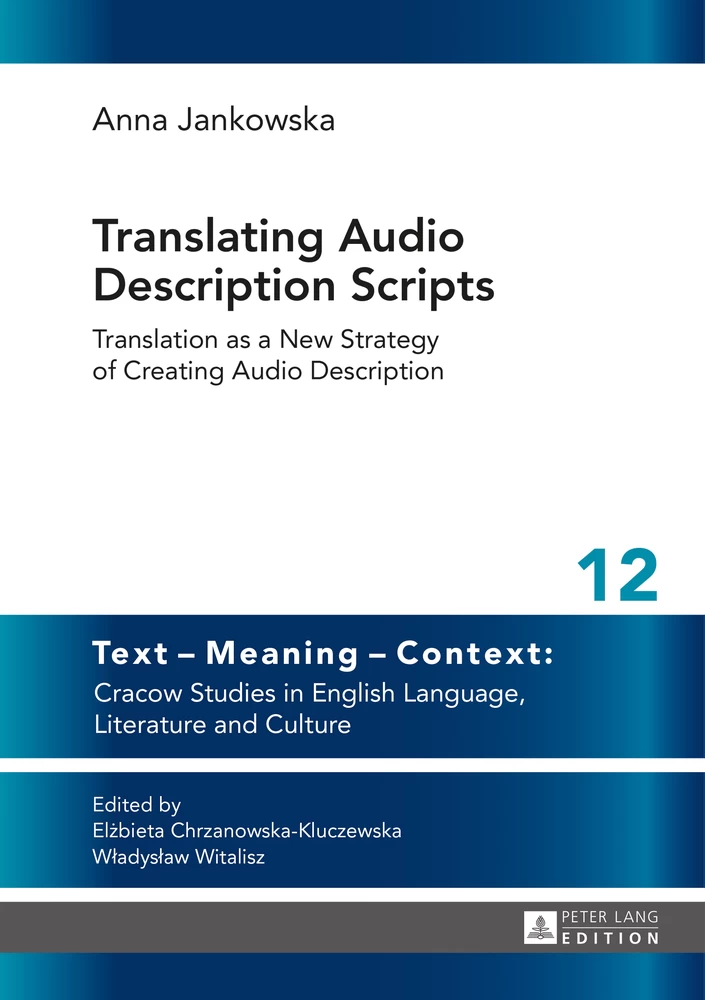
Translating Audio Description Scripts
Translation as a New Strategy of Creating Audio Description

Summary
Excerpt
Table Of Contents
- Cover
- Title
- Copyright
- About the author
- About the book
- This eBook can be cited
- Table of Contents
- Introduction
- I. Part One
- 1. Audio description in theory
- 1.1 An attempt to define audio description
- 1.2 Audio description’s place in translation studies
- 1.3 The history and the current state of audio description
- 2. Audio description in practice
- 2.1 Audio description creation
- 2.2 Audio description beneficiaries
- 2.3 The importance of audio description
- II. Part Two
- 3. State of the art
- 4. Research methodology
- 5. Time-consumption analysis
- 5.1 Research procedure
- 5.2 Results of the time-consumption analysis
- 5.3 Time-consumption analysis: summary and conclusions
- 6. Pilot study
- 6.1 Research procedure
- 6.2 The results of the experimental group research
- 6.3 Control group survey results
- 6.4 Summary of the results and conclusions
- 7. Comparative analysis of the scripts
- 7.1 Selection of the research tool
- 7.2 Research procedure
- 7.3 Detailed analysis
- 7.4 Comprehensive analysis
- 7.5 Comparative analysis of the scripts – conclusions
- III. Final Conclusions
- References
- Appendix 1
- Questionnaire for visually impaired people
- Appendix 2
- Questionnaire for people without sight malfunction
Audio description (AD) is an additional verbal description of the most important elements of a picture, i.e. a technique that provides visually impaired people with information that other viewers perceive only visually. This way, audio description gives the visually impaired access to visual and audiovisual products, in a broad sense of this word. The technique of audio description is used in television, cinema, during stage and sports shows, as well as in museums and galleries. Also DVD and Blu-ray recordings are made available through audio description. It is commonly said that it is a young, practically fledgling field. In fact, audio description has existed for almost thirty years, even for over fifty, according to some, and it was invented as a practical service that provides visually impaired people with an access to visual and audiovisual culture. Initially, it was mostly of interest to its beneficiaries: visually impaired people and non-governmental organisations that act in their interest and spend the funds they gather on, e.g. audio describing films and theatre shows. In the course of time, however, audio description was found interesting by scientists – universities conduct research, organise scientific conferences and teach the difficult craft of audio describing. Recently, many national and international initiatives were undertaken, aiming at the development of audio description and integrating theory with practice. With such a dynamic development of audio description in mind, in March 2013 the participants of Advanced Research Seminar on Audio Description (ARSAD), which takes place in Barcelona every two years since 2007, decided unanimously that it cannot be called a field in its beginning phase any more. Apparently, the initiatives of the groups of theoreticians and practitioners are followed by legislators as well. Already in 2007, European Parliament issued the Audiovisual Directive, whose main assumption is to provide elderly and disabled people with an opportunity to participate in social and cultural life through, e.g., the implementation of audio description (European Parliament and Council 2007).
Audio description has been present in Poland since at least 2006. It has been promoted by non-governmental organisations that undertake many initiatives whose aim is to provide the visually impaired with an access to visual and audiovisual culture. Collaboration with cinemas, film festivals, public television, theatres, museums and football clubs was a part of these initiatives. Audio description also became a subject of interest for Polish researchers from a number of academic centres – the scope of this interest is best proved by the fact that ← 9 | 10 → the group of Polish scientists was the largest national representation during the above mentioned ARSAD conference.
In one of the first articles on audio description in Poland, three basic problems concerning the implementation of audio description in this country were named: the lack of legal regulations and financing mechanisms, the need of audio description standards, and the absence of experienced, or trained audio describers (Jankowska 2008: 244). When taking into consideration the fact that the first Polish cinema screening with audio description took place over eight years ago, and the article quoted in this book was published only six years ago, it is hard not to appreciate how much Poland has achieved in the field of audio description implementation until today. In this short period the attempts to develop certain legal solutions that would regulate the question of implementing audio description in Polish media ended up successfully. Since the 1st of July 2011, in accordance with the Amendment to the Broadcasting Act, Polish broadcasters are obliged to introduce improvements for visually and hearing impaired people, and they should constitute at least 10 per cent of the programming, excluding commercials. The new law somehow solved the problem of financing audio description, and its presence – at least in television – is no longer the effect of the good will of broadcasters and the effort of a group of enthusiasts, but became a regular service, which is paid by the broadcasters just like any other audiovisual translation. A change in the field of standards also occurred – at the moment of writing this book as many as two documents on the rules of audio description creation were available, and a book which presents the rules of audiovisual translation, including audio description, and a textbook on writing audio description was soon to be printed. One can also find courses, which usually take one day and are organised by audio description foundations, as well as courses which are a part of MA or postgraduate studies.
Although we appreciate all those initiatives, it is hard not to notice that the steps taken to solve the above mentioned problems are insufficient and the situation connected with the availability of cultural properties for the visually impaired in Poland is still unsatisfying.
The groups lobbying for the availability of visual and audiovisual culture for visually impaired people had high hopes for the legal regulation of audio description. They expected that a legislative regulation would solve the problem of the profitability of audio description, whose presence should not depend on the number of people who use it (Szymańska in Jankowska 2008: 244). The above mentioned amendment met the expectations to a certain degree. However, one should notice that only television broadcasters are obliged to implement audio ← 10 | 11 → description, and there is still no obligation to audio describe films screened in the cinemas or those distributed in a digital formats. As an effect, cinema screenings, or even the issues of DVD and Blu-ray formats are still financed mostly by non-governmental organisations for visually impaired people. The question of audio description in television also leaves a lot to be desired. From the perspective of broadcasters, the implementation of the new law is connected with high costs. Audio description cannot be considered a profitable product – its relatively small group of recipients is not a target group for advertisers. When trying to save money, the broadcasters apply various practices. The first of them is such an interpretation of the Act’s regulations that is beneficial for the broadcasters. According to their interpretation, the features for both visually and hearing impaired people must constitute at least 10 per cent of the quarterly time of the programming broadcast, and the proportions between them depend on the broadcaster. As an effect, broadcasters use the facilities for hearing impaired people1 more often, since they are cheaper than audio description. Another practice of this kind is the qualification of sports broadcasts with commentaries as audio described programmes. At this point it is worth mentioning that a classic sports commentary does not fulfil the requirements of the visually impaired and differs significantly from the audio description of sports events. Yet another practice of this kind is adding audio description to programmes, when the cost of its creation is not big when compared to the length of the programme. A perfect example of such practice is audio description prepared for talk-shows. As the name suggests, productions of this type mostly consist of conversation, which, in accordance with the programme’s convention, is held in unchanging place and time. Only guests change, and their entrance is announced by the host and acclamation of the audience, and their physical appearance, although it is quite often characteristic, is not necessary to understand the content and the sense of the conversation. Therefore the sense of adding audio description to such a kind of programme is questionable. However, from the purely financial perspective such a procedure is beneficial – the creation of audio description which consists of several one-sentence lines that inform about the physical appearance of a next guest does not require hiring a professional audio describer. Usually this job is done by television crew members.
From the perspective of time, the question of a real usefulness of the rules and standards of audio description creation, at least in its present form, is another aspect that raises doubts. The rules and standards of audio description that ← 11 | 12 → function on the Polish market are partially based on foreign standards, which are considered to be tested, and on their authors’ experience. However, it is being asked more and more frequently: what are the bases of the British and American standards, which are used in other countries that considered them as tested? Has anybody ever asked visually impaired people about their opinion on the solutions suggested by those standards? Are they something more than a collection of anecdotic commandments and a description of the already applied practices (Udo & Fels 2011 and Fryer 2009)?
The question of the training and experience of audio describers is also not satisfactory. The courses and trainings which are offered currently are short and cover no more than 12–16 teaching hours. In such a short period one can gain some basic skills, but there is practically no way of developing them, since the market of commissions for audio describers is too small and dominated by a several professional audio describers, who mostly learned the rules of audio description themselves.
Details
- Pages
- 134
- Publication Year
- 2015
- ISBN (Hardcover)
- 9783631653449
- ISBN (PDF)
- 9783653045345
- ISBN (MOBI)
- 9783653983159
- ISBN (ePUB)
- 9783653983166
- DOI
- 10.3726/978-3-653-04534-5
- Language
- English
- Publication date
- 2015 (February)
- Keywords
- source language translation strategy foreign language
- Published
- Frankfurt am Main, Berlin, Bern, Bruxelles, New York, Oxford, Wien, 2015. 134 pp., 15 tables, 20 graphs
- Product Safety
- Peter Lang Group AG
Biographical notes
Anna Jankowska (Author)
Anna Jankowska is an Assistant Lecturer in the UNESCO Chair for Translation Studies and Intercultural Communication at the Jagiellonian University in Krakow. Her recent research projects include studies on the viability of translating audio description scripts from foreign languages, multiculturalism in audio description, audio description for foreign films and the history of audiovisual translation. She is the founder and president of the Seventh Sense Foundation which campaigns for media accessibility in Poland.
