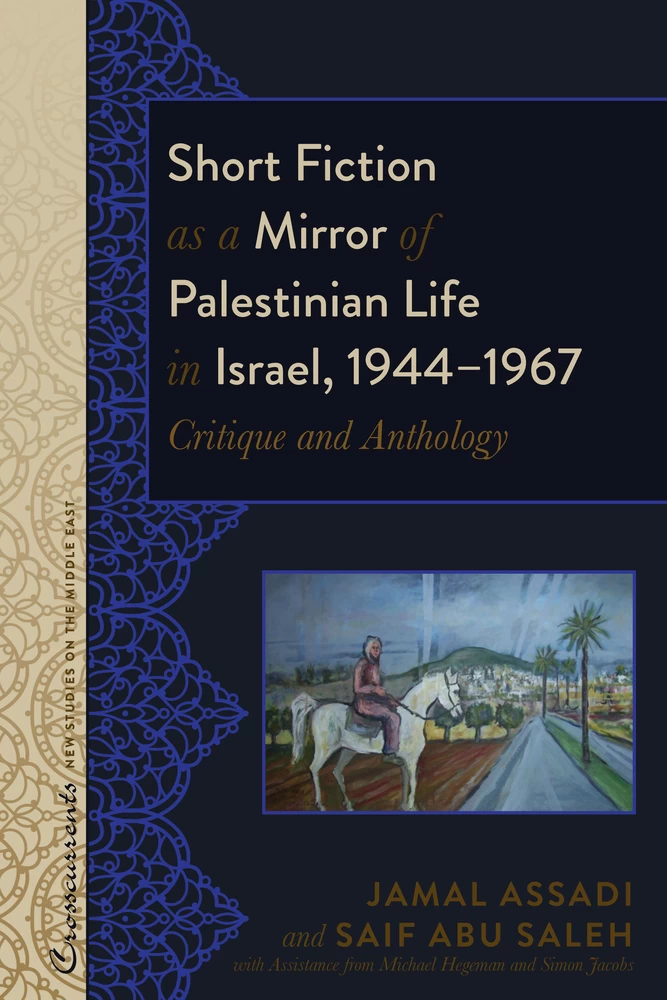
Short Fiction as a Mirror of Palestinian Life in Israel, 1944–1967
Critique and Anthology
Summary
Within the fold of this volume, the reader will find two parts: the first is a general account of the development of the genre of short fiction and the different approaches that characterized it along with a discussion of the language and an examination of the content. The second is an anthology of twenty-five stories published between 1944 and 1967 by Al-Ittiḥād, an Israeli Arabic-language daily newspaper.
Excerpt
Table Of Contents
- Cover
- Title
- Copyright
- About the author(s)/editor(s)
- About the book
- This eBook can be cited
- Advance Praise for Short Fiction as a Mirror of Palestinian Life in Israel, 1944–1967
- Contents
- Acknowledgments
- Introduction
- Notes
- Bibliography
- I. A Critique
- 1. The Palestinian Short Story: Beginning, Growth and Approaches
- Beginning
- The Development of Palestinian Short Story
- Currents and Trends in the Palestinian Short Story
- The Romantic Approach
- The Realistic Approach, Social Realism and the Literature of Ideological Commitment
- The Symbolic Approach
- Notes
- Bibliography
- 2. Language and Style
- Bibliography
- 3. Content: Themes and Motifs
- The Nakba and Family Reunion
- Land Confiscation and Judaization
- Military Rule
- Military Courts
- The Role of the Arab Countries
- The Role of the Communist Party
- Work, Poverty, Marriage and Other Social Topics
- Notes
- Bibliography
- II. Anthology
- 4. “A Scene from Life,” Abu Deeb [pseud.]
- Notes
- Bibliography
- 5. “Um Khalil,” Rashid [pseud.]
- Notes
- Bibliography
- 6. “Dalia: A Story from the Very Bottom of Reality,” Emile Habibie
- Notes
- Bibliography
- 7. “The Victim: Every Day’s Story,” ‘Aref Al-‘Azzounie
- Notes
- Bibliography
- 8. “Crime or Penalty?” Anonymous
- Note
- Bibliography
- 9. “My Friend, Abu Hassan,” Michael Awad
- Note
- Bibliography
- 10. “In the Poor Neighborhoods,” Michael Awad
- Notes
- Bibliography
- 11. “Two Hundred Humans Work the Earth, Eat with Flies and Breathe in Disgusting Smells,” Mohammad Khass
- Notes
- Bibliography
- 12. “Long Live Qirqash,” Mohammad Khass
- Notes
- Bibliography
- 13. “We Are from the Dear Land,” Mohammad Khass
- Notes
- Bibliography
- 14. “A Strange Story, Indeed! An Israeli Story,” Ali ‘Ashour
- Notes
- Bibliography
- 15. “A Military Court,” Tawfiq Mo’ammar
- Notes
- Bibliography
- 16. “October 29th,” Belal [pseud.]
- Notes
- Bibliography
- 17. “And the Bullets Mowed Down the Sons of My Village,” Abu Esam [pseud.]
- Note
- Bibliography
- 18. “I Am Not Alone,” Zaki Darwish
- Note
- Bibliography
- 19. “Dignity,” Zaki Darwish
- Note
- Bibliography
- 20. “Bewilderment,” Najeeb Susan
- Notes
- Bibliography
- 21. “Um Shaker,” Deeb Aabdie
- Note
- Bibliography
- 22. “Nur’s Red Placard,” Mohammad Naffa’
- Notes
- Bibliography
- 23. “The Grandchildren,” Mohammad Naffa’
- Notes
- Bibliography
- 24. “By God, I Have Never Betrayed You Except Once,” George Gharieb
- Notes
- Bibliography
- 25. “The Mortgaged Ring,” Riyadh Husain Mahmoud
- Notes
- Bibliography
- 26. “Such Are the Dreams of Our Children!,” Anonymous
- Note
- Bibliography
- 27. “The Dust of the Alleys,” Salem Haddad
- Note
- Bibliography
- 28. “Mahmoud Does Not Retreat,” Tawfiq Zayyad
- 1
- 2
- 3
- 4
- 5
- 6
- Note
- Bibliography
- Series index
For permission to use copyright material, we would like to thank Al-Ittiḥād.
For permission to use cover image, we would like to thank Mr Ibrahim Hejazi.
We would like to express our thanks and gratitude for Dr. Michael Hegeman for his notes, comments, questions and suggestions. We highly appreciate Mr. Simon Jacobs’ remarks and ideas.
We are greatly indebted to Dr. Lyn Barzilai for her notes.
We would like to heartily express gratitude to our families, friends and students for their support and help.
And grateful acknowledgment is made to Hasan Khateeb: Advocate’s Office and Al Qalam Foundation for their generous financial contribution to this publication.
The list of publications about Palestinian fiction is relatively long. Some publications are translations of individual works by individual writers. Sayed Kashua’s Dancing Arabs (2004), for example, tells the story of a young boy from a poor Arab village who receives a scholarship to a Jewish boarding school where he has to cope with the sense of displacement and estrangement that emerges in the wake of his attempt to compromise between two polar worlds. Similarly, Elias Khoury’s celebrated Gate of the Sun (2006) is a famous book in which the protagonist’s tale brings to life the story of an entire people driven out of their villages in their homeland. Gate of the Sun chronicles their love and ruin, survival and defeat, recollection and fantasy, thus humanizing the multifaceted Palestinian battle.
Jo Glanville’s Qissat: Short Stories by Palestinian Women (2007) is regarded an uncommon stage of Palestinian women writers. It records the Palestinian struggle through various phases, including the First Intifada,1 the Palestinian uprising against the Israeli occupation, and the outbreak of the Lebanese civil war. These varied and enthralling stories propose a compassionate, often precarious perception of the ← 1 | 2 → society, focusing on the warmth of human relations and future hopes. More important, the wide array of voices qualifies this book to enter the realm of a wider world literature than the restrictive collective identity or the traditional victim status.
Jamal Assadi’s translations of various works by individual writers are noteworthy. See for example his Mohammad Ali Taha’s “A Rose to Hafeeza’s Eyes” and Other Stories (2008), Mustafa Murrar: “The Internal Pages” and Other Stories (2010), Ibrahim Malik: The Man and his Works (2011) and Ibrahim Malik: the Culture of Peace and Co-existence (2015). Assadi has also translated and edited the works of a group of writers, like Father and Son: Selected Short Stories by Hanna Ibrahim Elias and Mohammad Ali Saeid (2009), and Three Voices from the Galilee: Selected Short Stories by Zaki Darwish, Mohammad Naffaa and Naji Daher (2009). His Loud Voices from the Holly Land: Short Fiction by Palestinian Women (2011) covers the works of ten women writers who manage to unite the contradictions of being Israeli citizens and daughters of the Palestinian people. What truly grants these Israeli-Palestinian women their unique flavor is their ability to defy rules, combat persecution, break open closed doors, and show their authentic countenances. And in Assadi’s Torn Body, One Soul: A Collection of Palestinian Short Fiction (2012) four Palestinian writers, from different regions in Palestine and abroad, tell their own tales of predicament, estrangement, marginalization, and expectations and visions in a new, magnified voice, first to their people, then to their nation, and finally to a wider English-speaking public.
Details
- Pages
- XII, 184
- Publication Year
- 2017
- ISBN (Hardcover)
- 9781433135361
- ISBN (ePUB)
- 9781433148279
- ISBN (MOBI)
- 9781433148286
- ISBN (PDF)
- 9781453919095
- DOI
- 10.3726/978-1-4539-1909-5
- Language
- English
- Publication date
- 2017 (November)
- Published
- New York, Bern, Berlin, Bruxelles, Frankfurt am Main, Oxford, Wien, 2017. XII, 184 pp.
- Product Safety
- Peter Lang Group AG
