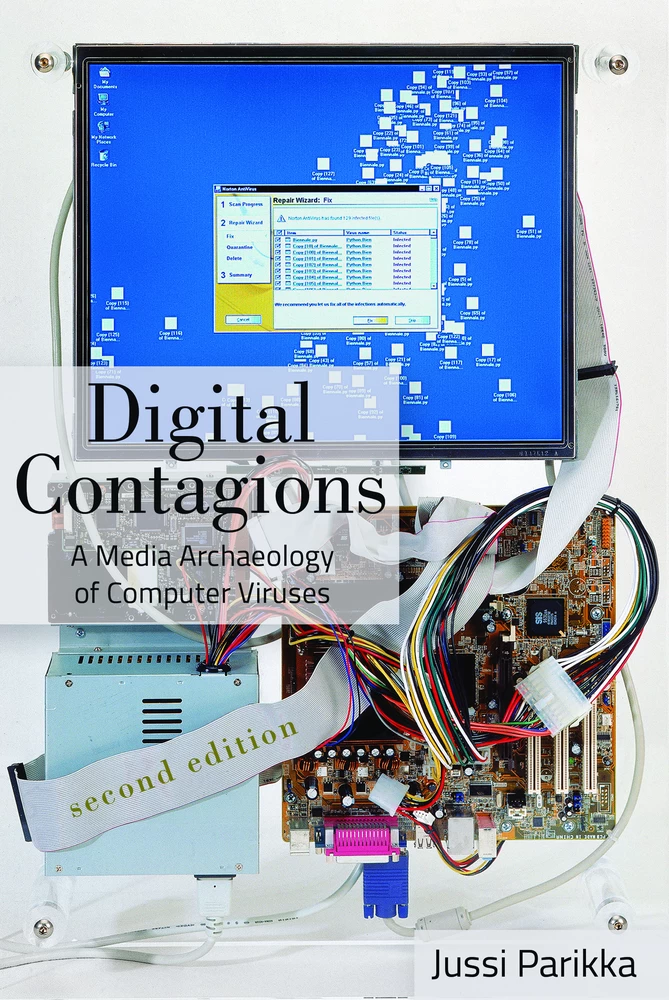
Digital Contagions
A Media Archaeology of Computer Viruses, Second Edition
Summary
At a time when our networks arguably feel more insecure than ever, the book provides an overview of how our fears about networks are part of a more complex story of the development of digital culture. It writes a media archaeology of computer and network accidents that are endemic to the computational media ecology. Viruses, worms, and other software objects are not seen merely from the perspective of anti-virus research or practical security concerns, but as cultural and historical expressions that traverse a non-linear field from fiction to technical media, from net art to politics of software.
Mapping the anomalies of network culture from the angles of security concerns, the biopolitics of computer systems, and the aspirations for artificial life in software, this second edition also pays attention to the emergence of recent issues of cybersecurity and new forms of digital insecurity. A new preface by Sean Cubitt is also provided.
Excerpt
Table Of Contents
- Cover
- Title
- Copyright
- About the author(s)/editor(s)
- About the book
- This eBook can be cited
- Contents
- Acknowledgments
- Preface
- Introduction: The General Accident of Digital Network Culture
- Disease and Technology
- Media Theory Meets Computer Technology: Definitions, Concepts, and Sources
- Eventualization
- Section I: Fear Secured: From Bugs to Worms
- Prologue: On Order and Cleanliness
- Security in the Mainframe Era: From Creepers to Core Wars
- The Shift in Safety: The 1980s
- Fred Cohen and the Computer Virus Risk
- The Morris Worm: A Media Virus
- Viruses and The Antidotes: Coming to the 1990s
- Viral Capitalism and the Security Services
- Section II: Body: Biopolitics of Digital Systems
- Prologue: How Are Bodies Formed?
- Diagrams of Contagion
- The Order-Word of AIDS
- Excursus: Faciality
- Digital Immunology
- The Care of the Self: Responsible Computing
- The Psyche of the Virus Writer: Irresponsible Vandalism?
- Intermezzo: Viral Philosophy
- Section III: Life: Viral Ecologies
- Prologue: The Life of Information
- The Benevolent Viral Machine
- Cellular Automata and Simulated Ecologies
- Organisms of Distributed Networks
- Ecologies of Complexity and Networking
- Coupling and Media Ecology
- Afterword: An Accident Hard, Soft, Institutionalized
- Appendix: A Timeline of Computer Viruses and the Viral Assemblage
- Bibliography
- Index
- Series index
To make a book happen, a lot of things need to be in place: these range from institutions to funding and, importantly, to intellectual networks and friendships. This is a second revised edition of the book that came out in 2007, but I will extend many of the thanks across these 10 years. The book itself has changed in many ways; I have added text, and taken out some; I have edited and revised, fine-tuned, tweaked, and added some new sections, including the Afterword.
As for thank yous, I am grateful to the Finnish Cultural Foundation, Emil Aaltonen Foundation, Jenny & Antti Wihuri Foundation, and also to the TIESU-project, funded by the Research Program for Advanced Technology Policy (Proact), the Ministry of Trade and Industry, and the National Technology Agency (Tekes) for providing support for the initial research in 2003–2007. Institutionally, I want to thank my alma mater, Cultural History and also Digital Culture at the University of Turku (Finland). A major part of this work was written “in-transit,” and I want to extend a thank you for their hospitality to the departments of Media Studies at the University of Amsterdam (Thomas Elsaesser) and the Berlin Humboldt University (Wolfgang Ernst). For granting the time and the possibility to do the editing, revisions, and additions, I thank my current institution, the University of Southampton (Winchester School of Art), for the support. ← vii | viii →
There are many individuals to thank. Hannu Salmi, Matthew Fuller, and Jukka Sihvonen gave continuously invaluable advice. Charlie Gere and Tiziana Terranova are to be commended for their input at a late stage of the work. Others who should not be forgotten include, in no particular order, Raine Koskimaa, Tony D. Sampson, Sakari Ollitervo, Pasi Väliaho, Matleena Kalajoki, Katve-Kaisa Kontturi, Ilona Hongisto, Milla Tiainen, Joss Hands, Teemu Taira, Henri Terho, Geert Lovink, Olli Pyyhtinen, Floris Paalman, Ryan Bishop, Ed D’Souza, Seb Franklin, Michael Goddard, Grant Bollmer, Yigit Soncul, Ebru Yetiskin, Olcay Öztürk, Burak Arikan, Joseph Nechvatal, Stefan Höltgen, Tero Karppi, Petri Paju, Petri Saarikoski, Tanja Sihvonen, Jaakko Suominen, Silja Laine, Maija Mäkikalli, Mikko Hyppönen, and the various people I interviewed for the book.
I am grateful to Sean Cubitt for his advice and friendship over the years and for writing the preface for this new edition. And a special thanks to Dr Jane Birkin for the help with the index and our conversations about media archaeology.
The people at Peter Lang were always very helpful. Mary Savigar planted the idea in my head about a new edition, and she deserves special thanks, as does Steve Jones, editor of the Digital Formations series.
***
Parts of this work have already been discussed in earlier texts, especially in the following:
“Denials of Service” in No Software, Just Services, edited by Irina Kaldrack and Martina Leeker. Lüneburg: meson press, 2015, 103–111.
“Digital Monsters, Binary Aliens—Computer Viruses, Capitalism and the Flow of Information.” Fibreculture, issue 4, <http://journal.fibreculture.org/issue4/issue4_parikka.html>.
“The Universal Viral Machine—Bits, Parasites and the Media Ecology of Network Culture.” CTheory—An International Journal of Theory, Technology and Culture, December 15, 2005, <http://www.ctheory.net/articles.aspx?id=500>.
“Viral Noise and the (Dis)Order of the Digital Culture.” M/C Journal of Media/Culture, <http://journal.media-culture.org.au/0501/05-parikka.php>.
“Contagion and Repetition—On the Viral Logic of Network Culture.” Ephemera: Theory & Politics in Organization, <http://www.ephemeraweb.org/>.
There is a disturbing etymological puzzle underlying the title. “Contagion” appears to be a late fourteenth-century coinage, appearing in the wake of the Black Death in mediaeval French and Middle English, from the Latin roots “con,” meaning “with,” and “tangere,” the active verb “to touch.” The puzzle comes from another word we associate at least equally closely with electronic media, “contact.” Here the root words are the same, with the only exception that “contact” comes from the passive form “tactum,” “to be touched.” Oddly, most people probably feel positive connotations about “contact,” but negative connotations from “contagion.” We have had six hundred years to develop these connotations, and yet there remains a nub of their origins: the contagious principle of something coming to touch us or to touch us together is more subjective than the principle of contact, where any two things could be brought together. The usefulness of the electrical contact as a major metaphor, dating back through early electrical experiments and familiar from the literature of the pioneering days of motoring and aviation, gives it both a certain objectivity and a sense of familiarity that we bring into the realm of communicative contact. Not so contagion, even though it is very close, at least etymologically.
The spark that leaps across the spark plug or the telegraphist’s key has given us a metaphor of life since Mary Shelley’s Frankenstein, and in that ← ix | x → same moment opened up the contact to contagion, a reversal of perspective that reveals, as Parikka emphasizes, the contagion in every contact, the toxic active in every passive. “Something there is that doesn’t love a wall,” as Robert Frost observed. Something sees the structural forms on which communication depends as a barrier too many, a taxonomic frontier between orchard and pine, in Frost’s poem, that might as well divide on any arbitrary or lethal imaginary line, or indeed sender from receiver, signal from channel, signal from noise. To put in touch is to infect, and so we put in place immunological barriers, which are not merely hygienic but apotropaic. The very structures we create to enable communication are themselves barriers to communication. Yet if we want to touch the world, we must be touched by it; and when we touch, the world presses back; and that mutual pressure, that mutual permeation, is communication, and involves us opening up, and therefore taking risks.
Where there is an etymological “touch,” there are etymological fingers. The “digital” of digital technology derives from counting on our fingers, an action in which touching finger to finger enumerates the external world while also affirming reflexively the counting self and the counting body in an act that both unites and divides the counter as it unites and divides the counter and the counted, which now occur as tactile sensations as much as numbers abstracted from the welter of the world. To say such etymologies “derive” is to admit that it is une dérive, an errant word that has meandered away from its origin and taken on the connotations of its erring. As much as this wandering includes the fingerprints it has left and, as Parikka argues, implies the prints it might multiply into the future, the double touching of Digital Contagions implies a phenomenology, a bodily interaction with artefacts of the past that, as it multiplies sensations, multiplies the subjectivities they conjure into being. The more swiftly the digital operates, the closer it comes to prestidigitation.
Parikka invites us into an adventure in history and ideas about history through an archaeological method that has two major principles. On the one hand, it asserts the right of evidence to exist, whatever the tidal movements of societies, polities, economies, and cultures bearing on around it. It is not only that, since Hegel, the idea of history has implied its movement toward some goal, but that our most persuasive historians of left and right, from Giovanni Arrighi to Niall Ferguson, seek out from the storm of events some sense of coherence. The media archaeologist is bound to insist that even if the world is moved towards mechanisation or electrification, atomisation or flow, the individual instance of mediation has its own right to exist, whether it fits or not with the grander orchestrations of the times. In the fury and the mire of ← x | xi → human and nonhuman life, history is an afterthought: a post hoc rationalisation. In the midst of things, in medias res, in the daily operations of media and mediation, there is no such teleology, only the battering of the need to communicate and the barriers that the very act of communication throws in its way.
Rather than the grand march of history, there is then only the ongoing cataclysm of events, that storm of wreckage Benjamin’s angel witnesses piling up at its feet as it is blown backwards out of paradise. Digital Contagions traces that ongoing cataclysm as the very condition in and through which we construct as best we may the connections from which we might discover some mode of becoming human, and not only human. Parikka suggests a tactical, minor politics of life, not as it is, but, as he cites AI maven Chris Langton, “life-as-it-could-be,” a life profoundly interconnected with technologies of mediation. Language, William Burroughs opined, is a virus: like a virus it has no aim but to replicate itself and needs to infect a host in order to do so, even if in the process, like a virus, it makes the host organism sicken. Our technologies of communication operate in much the same way, despite us, beyond us, with a life that includes and traverses but equally happily abandons us. At the same time, these contagions have radically enlightening side-effects, as it were, rational hallucinations we would otherwise never have been capable of, while they are not in themselves ultra-efficient, but mutated by their contacts, becoming internally noisy and changed, otherwise then themselves, so that their purity is always endangered. If media contaminate us, we contaminate them, and in that noisy mutuality we encounter each other in ever unpredictable communicative events, mutually implicated in a zigzag nomadism through time that constructs time itself in its conjoint wanderings.
Though there is in this book a fine history and archaeology of the computer virus, there is also a profound contamination of efficient models of communication in favour of codependent mediations between human and nonhuman agents that questions the very boundaries we have established between ourselves and our technological and natural others. Parikka offers us the alien as integral to any sense of self, the strange in every familiarity, the resistance of that which makes us social to the forms of the social that we have erected to control it. You will not read this book without being infected.
The General Accident of Digital Network Culture
As usual, everything negative remains untold, yet it is, interestingly enough, always there, in an embryonic form. How is it possible to state that technologies are being developed, without any attempt being made at learning about the very specific accidents that go with them?1
—Paul Virilio (1999)
Any information system of sufficient complexity will inevitably become infected with viruses: viruses generated from within itself.2
—Neal Stephenson, Snow Crash (1992)
The history of media and technology is a history of accidents. Things break down almost as often as they actually do what they are supposed to do. We fantasize about machines of ultimate communication and functionality, but the reality is different and goes back to a variety of technologies of movement, communications, and transmission. The train introduced the train accident, with the boat came the boating accident, and inherent in several techniques of data storage, such as papyrus, paper, and film, is the always present possibility of the erasure of information.3 Media are always embodied, and this ← xiii | xiv → embodiment is always related to the rather simple physics; things decay and rot; any communication medium is vulnerable to passing of time as much as the speed that might bring about a crash. One could, indeed, write a whole shadow history of technology through how it does not work; how it breaks down; how it frustrates and messes things up; how it disappoints and does not meet up with the expectations that are always rather sublime compared to the mundane everyday. Already the telegraph, the early network technology of the nineteenth century, was vulnerable to such problems as perceived in 1846 by Dr. Barbay, a semaphore enthusiast:
No, the electric telegraph is not a sound invention. It will always be at the mercy of the slightest disruption, wild youths, drunkards, bums, etc. (…) The electric telegraph meets those destructive elements with only a few meters of wire over which supervision is impossible. A single man could, without being seen, cut the telegraph wires leading to Paris, and in twenty-four hours cut in ten different places the wires of the same line, without being arrested.4
As technological accidents have a history, so do diseases. Causes of diseases, which since the nineteenth century have been mainly recognized as harmful minuscule actors, infectious bacteria and viruses, affect the very basics of human societies. They accompany the so-called human world as the animals we choose to live with. And diseases are themselves conditioned by a variety of social mechanisms; the spatio-temporal occurrence of a disease, an outbreak, is always set in a field of definitions of causes, of sanitation measures, of security and other ways to control the territory. Diseases tell a story of society. Diseases are symptomatic of the ways cultures interact. They reveal paths of communication and commerce, of interaction and cultural hierarchies, which form the networks of a society: what affects what, who frequents whom and where, and so forth. Diseases expose.
The improvement of road networks from late antiquity exposed populations to a growing number of infectors. The Silk Road was such a network of goods as well as germs, from China to Europe and back. However, a major change occurred with urbanization, industrialization, and the new transmission channels of steam ships, railroads, and airplanes, which connected people and germs more efficiently than ever. The Black Death that infected Europe in the mid-fourteenth century was to a large extent an expression of the new paths of communication and transmission paved by the Mongol empire, as well as the new ship routes connecting the Mediterranean to the northern parts of Europe. In the nineteenth century, steam in the form of locomotives ← xiv | xv → and transoceanic ships helped microorganisms to create a single, near-global disease pool.5 Transmission and communication have always defined and transformed geopolitical boundaries, and any consideration of the global should be aware of the role germs play; geopolitics can be read through diseases and their paths. Ships are still in modern times the clandestine transport vehicles of diseases—whether the plague of psychoanalysis, as Freud quipped to Jung entering New York harbor, or the mythical figure of Count Dracula in Bram Stoker’s novel of 1897.6
Transmission and communication come with a cost—an anxiety of established borders becoming all mixed up and trespassed. At the end of the twentieth century, another form of technological accident caused an immense amount of public anxiety. It seemed to combine these lineages of technological accidents and disease patterns and produce a truly novel situation. Computer viruses and worms, as the latest occurrences in the history of diseases, caused something that was referred to even as “hysteria”—the key sexed disease of the previous fin de siècle. Viruses have become a sign of the fin de millennium, indications of the uncontrolled threats of late modern technological mass society alongside a range of other threats, such as Chernobyl, AIDS, and Ebola. Digital viruses threaten to turn digital memory banks into “terminal gibberish.”7 As Wolfgang Schivelbusch notes, before industrialization, accidents seemed to refer to “coincidences” that attacked from the outside, usually in the form of natural catastrophes, such as storms and floods. With industrial machines, the accident became an internal problem as technologies seemed to potentially turn on themselves as a result of their own power.8 The recent decades of global technological infrastructures have seen a range of technological accidents, perceived as risks to be minimized and managed, signified, and valorized in the (mass) media system (in the traditional definition of print media, television, and, for example, cinema). The utopia of the global village9 and the vast number of accounts celebrating networks and cyberspaces as the key utopian (non)places of recent decades showed their flipsides to be a dystopia of global risks and accidents.
Details
- Pages
- XL, 298
- Publication Year
- 2016
- ISBN (Softcover)
- 9781433132322
- ISBN (ePUB)
- 9781433135774
- ISBN (MOBI)
- 9781433135781
- ISBN (PDF)
- 9781453918685
- DOI
- 10.3726/978-1-4539-1868-5
- Language
- English
- Publication date
- 2016 (August)
- Keywords
- Computer viruses Computer worms Accident Technology Networks Internet Spam Malicious software Virus Security Media archaeology
- Published
- New York, Bern, Berlin, Bruxelles, Frankfurt am Main, Oxford, Wien, 2016. XL, 297 pp.
- Product Safety
- Peter Lang Group AG
