


 de
de  fr
fr Disclaimer: The views and opinions below are the authors own, based on their own academic research and study, and are not representative of the Peter Lang Group
When we began compiling Confronting Toxic Rhetoric in early 2023, we imagined it as a way to support writing teachers who were teaching argument, evidence, and rhetorical ethos in a time when many were still reeling from four years of Trump-era post-truth and fake news. Perhaps naively, we did not consider that the book would hit the shelves the very month that Trump would be re-elected back into the oval office, and that we would be marketing it as we witness, arguably, some of the most inflammatory rhetoric and behavior our country has ever known: Elon Musk performing the nazi salute on television, Trump’s executive orders against trans and non-binary people (referring to “transgender insanity,” nbc news), immigrants being taken from their homes by ICE (referring to murderers, rapists, burglars, and criminals, abc news), and measures toward diversity, equity, and inclusion eliminated. The ways that people are being hurt by his words and actions are practically endless. The toxic rhetoric used by the new presidential administration seems to have only one purpose: to incite chaos, anger, fear, division, and violence not only in America, but abroad, as Trump attempts to make claims on land and instigate feuds in Canada, Greenland, Ukraine, Mexico, the Middle East, and elsewhere.
This continual onslaught of “toxic rhetoric,” described by John Duffy as “a discourse of denial—denial of science, of diversity, of democracy, of change, of the commitment to equality and individual freedom” (p. xii), is what makes Confronting Toxic Rhetoric timelier than we even realized as we began assembling the book only two years ago. Toxic rhetoric is gaining strength and permission not only to exist, but also to be spread widely and even exalted. Is toxic rhetoric accepted as a norm? Back, say, in 2017, we were horrified and shocked by the permissiveness granted to the vocal and visual instigators of the Charlottesville Unite the Right riot. Was our nation perhaps less shocked when a shooter entered a synagogue a year later and murdered 11 innocent people praying there? Had we already completely embraced toxic rhetoric in 2022 when 10 Black men and women were shot to death in a Buffalo grocery store?
These incidents all have one thing in common: they were incited or supported by toxic rhetoric used specifically by Donald Trump. In the case of Charlottesville, it was written many times in many places that “President Trump … gave the white supremacists cover to come out of the shadows” (Time, see also ABC News, AP for more examples). The shooter of the victims at Tree of Life Synagogue was an active member of Gab, a social media site where “users could freely traffic in the basest kinds of hate speech” and find a “a rebranding of traditional white nationalism by a new generation of believers that emerged online around 2014 and came to prominence by attaching itself to Donald Trump’s 2016 presidential campaign” (SPLC). The Buffalo grocery store attacker had written a manifesto outlining his belief in the Great Replacement Theory, which “asserts that there is a plan to bring nonwhite people to Western countries to replace whites” (Economist). Trump used this same toxic rhetoric of replacement theory when claiming that migrants were brought into the U.S. to vote for Biden in the 2020 election, thus illegally handing Biden the presidency (NPR).
All of these attacks, and many more like them, were motivated by racism, antisemitism, and white supremacy; we are seeing and hearing the toxic rhetoric of the great replacement theory and white nationalist conspiracy theories everywhere. And so are our students. On college campuses across the U.S., we see students engaging in protest, oftentimes themselves using toxic rhetoric even if they don’t always understand the meaning behind what they’re saying (see, for example, a survey of UC Berkeley students, which showed that 46% of student protestors who chanted “From the River to the Sea” did not know the names or locations of neither “the river” nor “the sea,” nor what lies between, Newsweek). But on many campuses, students are silent: silent about the presidential election, about recent executive orders that might even harm them or their families, about atrocities across the world.
What can we, educators, do about this constant exposure to toxic words and behaviors? Many people are taking news or social media “fasts,” that is, trying to avoid that which might harm them. Or they’re focusing their energies on activism: making calls to government officials and volunteering to support those whose rights are being challenged. But we don’t always know what our students are doing, or how they’re reacting to, or worse, absorbing and then replicating the toxic rhetoric onslaught. As Jamie says so eloquently in Chapter 1 of Confronting Toxic Rhetoric, as teachers, we can help students “to entertain multiple sides of arguments, discuss difficult topics, and disagree with each other respectfully […to] help solve some of our nation’s complex problems. Over time and with iteration, our work could engender a groundswell that could lead to meaningful and lasting change in American discourse, politics, and culture” (pg). Teaching students to engage in respectful discourse is no longer something we can do; it is something we must do.
Thus, we highlight two strategies from our collection for use in writing classrooms to support and encourage students as they navigate, disrupt, and confront toxic rhetoric. We learned these from teacher contributors to Confronting Toxic Rhetoric, where you can read more deeply about these strategies and several others.
One: Intervention through Public Memory
Whitney Jordan Adams teaches at Berry College, two hours from Atlanta, GA, and only a few miles from Stone Mountain, a current day campground that is also “the site of a Confederate memorial to Stonewall Jackson, Robert E. Lee, and Jefferson Davis. It is the site of the establishment of the Ku Klux Klan’s (KKK) Second Empire in 1915” (p. 24). For Berry, teaching students to examine the toxic rhetoric around Stone Mountain is an imperative that “provides college students a framework to consider how public memory, and specifically monuments, can be exclusionary or inclusionary” (p. 24). Students in Adams’ class learn about “heritage,” “tourism reset,” and how one “rendition” of public memory “might take precedence and wipe out others (p. 33). Students read public documents and learn about how larger national stories are crafted as related to monuments such as Stone Mountain. Many students in Adams’ class come to see Stone Mountain from a new angle, which can be challenging for those students who knew it as “an innocuous place for hiking and family fun” (p. 33) or those whose family values have taught them to align with confederate world views (p. 32). Adams cites Wheatley, who would refer to this challenge as a “positive disturbance” (p. 34), and she explains that this is the purpose of the course – for students’ views to be ruptured so that nuance can be allowed in. At the end of her chapter, Adams asks educators to “continue to provide opportunities for students to consider the historical sites around them and explore the situated and complex nature and histories of those sites, their origin stories, whom they include and exclude, and how those who take advantage of their beauty and location participate or resist in cultural oppression, structural perversion, or white supremacy” (p. 34). Because these sites are everywhere, and because they are challenged and contested on a national stage and in classrooms (see, for instance, Utah public schools, where nazi and confederate flags are allowed to be displayed “in accordance with curriculum,” Salt Lake Tribune), students are learning a valuable skill in Adams’ class that they can take with them anywhere: how to participate in conversations about history and its often toxic artifacts.
Two: Unveiling Media Motivation
When Sarah Lonelodge was a PhD student at Oklahoma State University in spring of 2020, she had the opportunity to develop an advanced composition course “focused on politically charged communication” that helped students “participate meaningfully and thoughtfully in public discourses in ways that might resist and counteract the damage done by toxic rhetoric” (p. 102). Early that spring, several events occurred right on top of each other – the Australian brush fires, the beginning of the Covid-19 pandemic, the death of Kobe Bryant and his young daughter, and the Trump impeachment trial and subsequent acquittal. As Lonelodge describes it, “my students and I could feel a shift – there was a dread hovering over us. I could see it as they scrolled through their phones before class began” (p. 103). The moment could not have been more kairotic for a course on public discourse, but Lonelodge wanted her course to be more than writing about social change. She wanted her students to engage as citizens (p. 104). For example, as the Covid-19 pandemic unfolded (before it was officially a pandemic), students learned about propaganda and how it works. They created multimodal projects – podcasts, presentations, narrated slides – where they learned to provide evidence to demonstrate types of propaganda and persuasion related to topics of their choosing. Lonelodge explains, “the multimodal nature of the project offered a significant amount of creativity and creative thinking from students as they explored the use of screenshots, embedded video, and other composing options,” (p. 109). Learning to compose multimodally is surely a productive outcome, yet we believe the most useful strategy Lonelodge employed in helping students counter toxic rhetoric was teaching them to analyze current events as found on the daily in the media and to understand how that media works to persuade, sometimes in toxic ways; the students developed and used a heuristic for determining if a text was persuasion or propaganda. Now they are now practiced in “identifying, analyzing, and responding to demagoguery, propaganda, and misinformation through various media,” (pg. 108) and as Lonelodge says, they have learned to respond “in real time.”
Finally,in the conclusion to Confronting Toxic Rhetoric, Rachel Ketai writes a letter to John Duffy in which she says, “I came to the field of rhetoric and composition to promote equity and access in education. I should have expected that this path would confront me with disagreements and controversy. Change in any direction requires conflict, and in 2023, that can look like an unfollow on social media or a piñata beating on campus” (p 218). In terms of disagreements and controversy, things have not gotten much better in 2025; in fact, they may be worse. But Ketai pushes forward, and we hope you will, too. She continues, “What my students and I need is not to avoid or scrub out the lines of difference that separate us from those we disagree with. We need to practice reading and writing and listening and speaking across those lines of difference in ways that will build better conversations and communities” (page 218). We hope you also find those practices that help you and your students toward better conversations and communities among the pages of Confronting Toxic Rhetoric.
Find the book here: https://www.peterlang.com/document/1446367
Why I decided to write this book?
As a new lecturer in both FE (further education) and HE (higher education), I found research terminology quite difficult to grasp when doing my own action research project for my Level 7 Postgraduate Diploma in Education and Training. There was almost a decade-long gap between completing my dissertation at undergraduate level, and then doing my postgraduate action research project. It took a while for me to re-acquaint myself with the differences and overlap between terms such as systematic reviews and meta-analysis. There weren’t any books or resources available which made research principles relatable to practice, so I decided to write one.
Potentially many researchers who are conducting action research/ research are in the same position as I was, so the ambition was to help others with my book, ‘A 101 Action Research Guide for Beginners’. It was always daunting not knowing where to begin, and there are probably many action researchers out there who feel the same way, so a book like this, written with the frankness of a Yorkshire person, could be a huge asset to others.
What it offers to readers?
The main premise of the book is to demystify research terminology for those teaching, and completing action research projects. Research terms such as systematic reviews, meta-analysis, primary research, and literature reviews are explained simply, with solid links to practice included (with a STEM and healthcare field focus). A book like this offers a much-needed bridge between research concepts and doing research in the real world.
With those new to research it may be difficult to know where to start. Managing a research project is difficult at times. Having a book to refer to that explores the practical side of research, and explains how to format research proposals and conduct research projects, will be an advantage to both up and coming and experienced researchers. Linking practice and research concepts together in a joined-up manner, rather than considering them as separate entities facilitates readers in gaining a deeper comprehension of research terminology. The book conveys how the researcher tackled issues they faced in their action research project by working with others to overcome obstacles. An action research project conducted in a FE college in West Yorkshire is shared in its entirety. This encompasses the research proposal, ethical considerations for the research project, literature review, methodology, results, results discussion and conclusion/ recommendations; right through to it being published in TES (a UK national magazine for teachers) to provide a bonafide practical research example.
Themes such as ethics and maintaining an unbiased approach in research are explained meaningfully. The book depicts how to structure a research proposal and research project report using a contemporary action research project as a template. The book chronicles the rationale behind the choices in methodology selected, and unscrambles research principles, so it connects with researchers at all levels.
Other areas covered in the book include reflection (with reflective account exemplars), artificial intelligence, and quality assurance. It has a free website with more examples of action research in STEM teaching, to provide supplementary resources to further support the readers.
The book is available here: A 101 Action Research Guide for Beginners – Peter Lang Verlag, and at other online retailers, and may be a welcome gift to researchers at all levels doing research projects at undergraduate or postgraduate level.
Readers can benefit from a 10% discount when using code ARG10, valid until 31 March 2025. Please note that discount codes are not valid in regions with fixed book pricing.
Find it here: https://www.peterlang.com/document/1466014
Good luck to all of you doing research projects!
Locating Intersections Between Middle-Grades
Science and Social Studies Curricula Through
Provocative Storytelling
Editors: Margery Gardner, Randa Elbih, and Anita Bright
As part of Shirley Steinberg’s edited series, Counterpoints, published by Peter Lang, we invite chapter proposals for inclusion in a forthcoming text, with an anticipated publication date of December, 2025.
Science and social studies curricula possess inextricable interconnections, with aspects of each informing the other. Since the onset of formalized public schooling, disciplinary structures have offered little opportunity to explore intersections in content areas. This siloing effect contributes to a loss of texture and contextual situatedness for both subjects. This book focuses on reintegrating the two intersectional content areas, focused on the middle grades. The middle-grade band is an area with an urgent need to present compelling and meaningful content in order to spark and maintain ongoing student engagement. We engage the construct of provocative storytelling to center the controversial nature of this integration and to further foster the critical thinking of young adolescent learners—our world makers of tomorrow. Provocative storytelling aims to emotionally connect learners to the content and context, and to promote conversations about socially contested topics such as climate change, disease/medicine, and global conflict, as well as countless other ethical dilemmas. For example, Henrietta Lacks’ cancer cells extracted without her consent have led to major advances in science. It was only until 2023 that her family received a legal settlement for their commercialization and the public exposure of her genetic information. Another example is the impact of climate change on Tangier Island, Virginia, which is currently impacted by the effects of climate change. Although the island is on track to disappear in the next 50 years due to rising sea levels, many local residents remain skeptical of the extant science related to this issue, which will continue to have a profound impact on their social lives.
We invite a cross-section of voices to share stories to expand educational possibilities. Through provocative stories, this critical work addresses a gap in the interlocking contextualization of science and social studies in the existing literature focused on adolescent education. This text offers commentary that can be generative to middle grades science and social studies teachers, and the education community writ large, pushing the fields of science and social studies education to new horizons.
Submissions will demonstrate an explicit connection between middle grade science and social studies disciplines. Provocative storytelling must also be an integral part of the chapter.
Chapter Proposal Guidelines:
Each chapter will begin with a provocative story, followed by ethical questions, leading to a dissection of the different facets of the dilemma. Finally, the chapters offer implications and/or steps to ground educators and students in the middle grades science and social studies classrooms. Authors should acknowledge the tensions around meeting disciplinary standards while fully addressing the curiosities and needs of the students in the classroom.
Please send a proposal of about 1000 words (excluding references) by November 30, 2024, along with a short biography (approx. 200 words).
Acceptance decisions will be made by December 31, 2024.
The final chapters should be approximately 7,000-9,000 words.
The first complete chapter drafts are due on March 31, 2025.
Final chapter submissions are due on August 31, 2025.
Please submit proposals to: locatingintersections@gmail.com
If you have an idea that you’re not sure about submitting for review, we invite you to contact us (the editorial team) to have a conversation about your ideas before you create your proposal. We seek to include a broad range of voices and topics, and invite you to share and still-developing or emergent ideas for chapters. We are happy to think with you!
Around the world today, there is a challenge to the most common organizing structure for society today. Never easily rested upon, democracy has required constant invention, reinvention and transformation since the earliest peoples practiced it, whether among the Greeks 2,700 years ago, the Indians 3,100 years ago, or Native American nations in the last 2,000 years. Right now, there is a lot being done to damage, harm, and wreck democracy worldwide, even after decades of active attempts to encourage, proselytize and even force democracy worldwide.
Why a “disorder”?
The World Health Organization defines a disorder as “a clinically significant disturbance in an individual’s cognition, emotional regulation, or behaviour.” The democracy deficit disorder is a significant disturbance in individual’s, communities’, and nations’ cognition, feelings about, and behaviors related to democracy.
Our cognition is the way we think about things. The ways our society has thought about democracy have expanded greatly since the American experiment began in 1776. Obviously government is the greatest function of democracy — which is majority rule — in our society. Today though, we apply democracy to many institutions, elements, factors and components like education, neighborhoods, and even families.
Feelings about democracy require balance with thinking things through. There are many sentimental ideas about democracy, including the feelings of passion, empathy and solidarity that lead to inclusivity, equity and empowerment. However, there are also other feelings about democracy, including cynicism, intransigence and even antipathy. Feelings are used to capture attention, divert resources, undermine paradigms and transform cultures.
Finally, there are our democratic behaviors. This can look like many things, including active listening, deliberate teamwork, obvious flexibility, and intellectual humility. These are particularly democratic because they focus on reciprocity, inclusion and belonging, and by using them as actions we see them as outcomes because each behavior is what democracy looks like in process.
The democracy deficit disorder exists because each of these elements is being actively and passively, overtly and subversively challenged by dominant powers in society. These powers are motivated by power and driven by violence, whether they are economic, cultural, social, political or otherwise.
There is hope!
There is hope though, and it is young people. Throughout the history of the American experiment, children and youth have continuously kept the flame of potential shining brightly for democracy. Working with adults as partners, young people have been addressing countless issues at the core of democracy, taking direct actions to keep democracy alive, and driven structural, elemental and powerful strategies to keep the democracy alive.
By dedicating, concentrating and sustaining action by young people focused on saving democracy, we can ensure leadership by the people, for the people continues. Political misdirection, environmental calamities, wars, social unrest, economic upheaval and more challenges have rocked the foundations of the United States since its foundation, and other democracies worldwide have faced these realities, too. Their innate belief in freedom and dedication to justice have ensured children and youth the standard bearers of a better society worldwide. They are the hope we need right now.
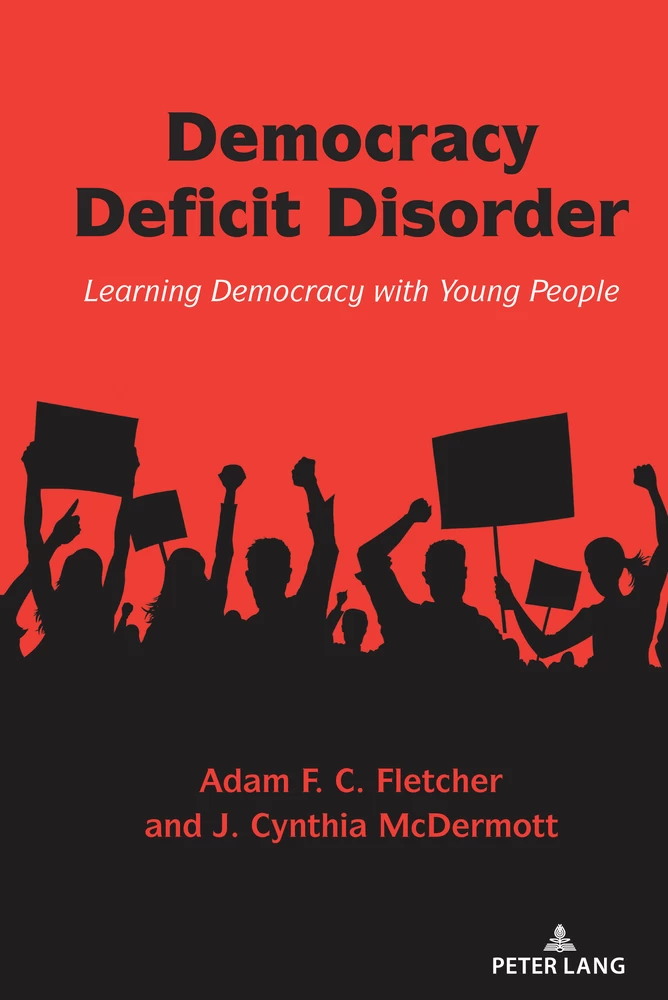
In May 2023, Peter Lang Group published a new book by Adam F.C. Fletcher and J. Cynthia McDermott called Democracy Deficit Disorder: Learning Democracy with Young People. Exploring everything in this blog post and much more, the book is going to become an essential read for youth workers, community organizers, government workers, educators, and others.
“A Black Woman’s Journey from Cotton Picking to College Professor. Lessons about Race, Class, and Gender in America” by Menah Pratt-Clarke and “Critical Multicultural Perspectives on Whiteness. Views from the Past and Present“, edited by Virginia Lea, Darren E. Lund and Paul R. Carrhave have been awarded the 2018 American Educational Studies Association Critics’ Choice Award. The monograph and textbook, published by Peter Lang in 2018, are two of twelve titles that were selected by AESA members as recent scholarship deemed to be outstanding in its field.
Celebrate National Teachers Day by viewing Peter Lang Publishing’s collection of ebooks in Teaching and Education!
View this collection on the iBook Store.
Read the new review of Dr. Virginia Stead’s book RIP Jim Crow: Fighting Racism through Higher Education Policy, Curriculum, and Cultural Interventions! This 2016 Peter Lang publication was included in Teachers College Record.
Congratulations to Dr. Patricia Mitchell, author of African American Males in Higher Education Leadership: Challenges and Opportunities. This 2017 Peter Lang publication was included in the The Journal of Blacks in Higher Education’s Recent Books of Interest to African American Scholars.
Congratulations to Professor Peter McLaren, for winning two lifetime achievement awards this year!
Dr. McLaren was awarded the Lifetime Achievement in Critical Media Literacy, presented by the Critical Media Literacy Conference at Georgia Southern University in Savannah, GA. In April, Peter McLaren will also be awarded the American Educational Research Association (AERA) Division B Lifetime Achievement Award at the annual conference in San Antonio.
Peter McLaren is the author of an impressive body of significant scholarly work, including Pedagogy of Insurrection: From Resurrection to Revolution.
Congratulations to Peter Lang authors in the Critical Qualitative Research series for winning the following National Association for Multicultural Education Award!
Whiteness Is the New South Africa: Qualitative Research on Post-Apartheid Racism by Christopher B. Knaus and M. Christopher Brown II has won the 2016 National Association for Multicultural Education’s 2016 Philip A. Chinn Multicultural Book Award
To learn more about the National Association for Multicultural Education and their work in social justice, view their website.